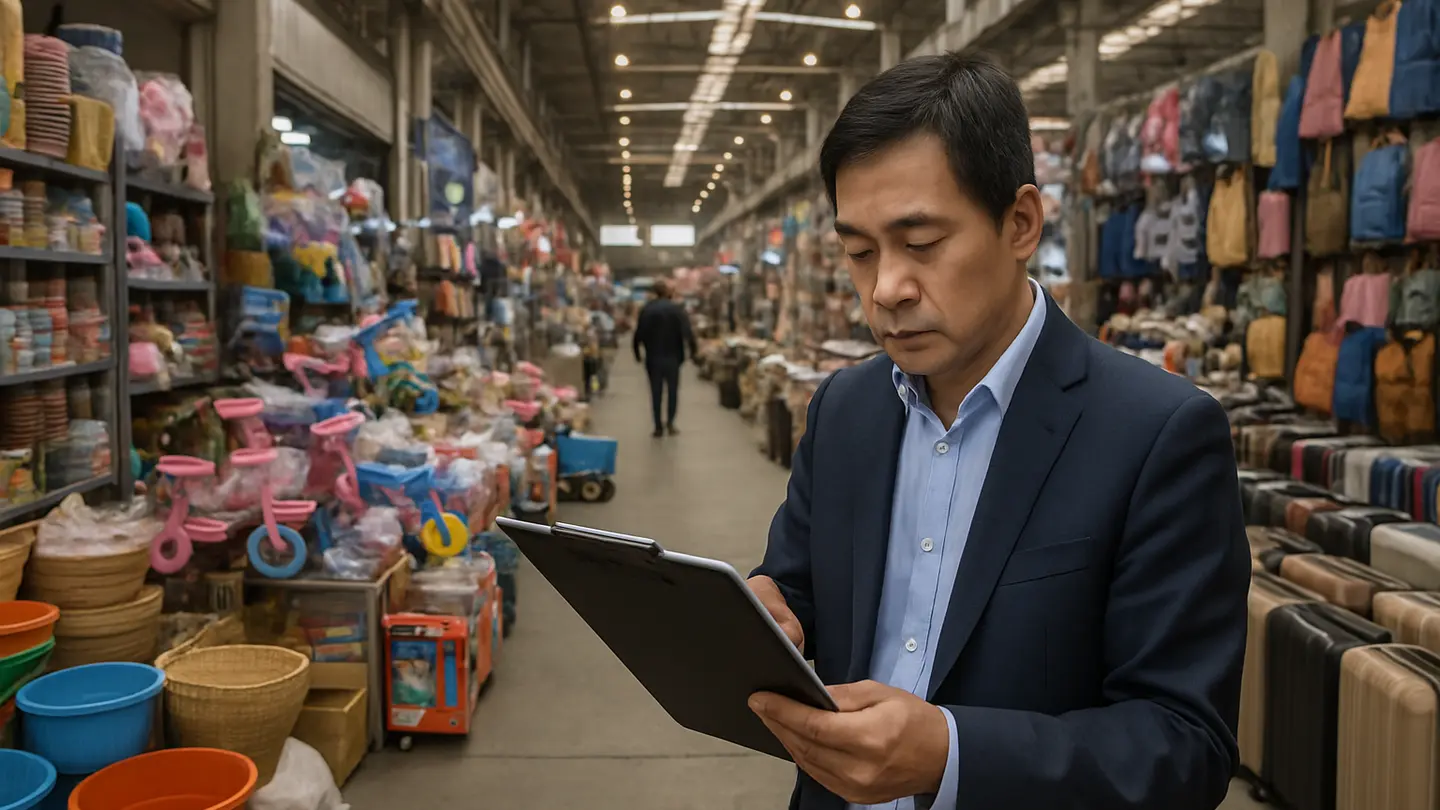
1688 is a China-focused domestic wholesale marketplace used by factories, trading companies, and local distributors. It can reveal a wide range of products at domestic-market prices, from bathroom accessories and packaging to hardware, home goods, and promotional items.
For overseas buyers, however, browsing 1688 is not the same as placing an export-ready order. Most listings, supplier conversations, payment methods, and delivery arrangements are designed for buyers located in China. A 1688 purchasing agent acts as the local operational link between the overseas buyer and domestic suppliers.
Depending on the agreed scope, an agent may search Chinese-language listings, confirm specifications, pay suppliers in RMB, receive goods at a China warehouse, consolidate multiple orders, inspect visible product details, and arrange international freight. That does not automatically mean the agent has verified the factory, tested the product, or guaranteed compliance. Product and supplier verification depend on the services the buyer specifically commissions.
For B2B buyers, the opportunity is not simply to access a lower listed price. It is to build a sourcing process that converts domestic listings into a controlled, exportable purchase.
Why 1688 Prices Can Be Lower Than Alibaba.com
A 1688 price can look substantially lower than a comparable Alibaba.com listing because the two platforms often serve different commercial needs.
1688 suppliers generally quote for China’s domestic market. Their prices may assume RMB payment, shipment to a Chinese address, and limited pre-sales support for overseas documentation, export packaging, international freight, or foreign-language communication. A listing may also display a tiered unit price based on quantity, color, stock availability, or a specific variant rather than the exact configuration an overseas buyer needs.
Alibaba.com suppliers, by contrast, often structure listings for export buyers. Their pricing may reflect the cost of international inquiries, English-language communication, payment handling, export documentation, and support for overseas shipping terms. That does not mean every Alibaba.com quote is higher, nor that every 1688 supplier is a factory. It means the commercial context differs.
The same supplier may sell on both platforms with different prices and minimum order quantities. For example, a supplier may accept a small domestic order on 1688 but require a higher MOQ for export packaging, custom branding, or compliance documents. Conversely, an export-focused listing may include services that would need to be purchased separately when sourcing from 1688.
Buyers should compare landed cost, not listing price. A useful comparison includes:
| Cost component | 1688 purchase through an agent | Export-oriented marketplace purchase |
|---|---|---|
| Product unit price | Often quoted at domestic-market level | May include export-oriented margin or service cost |
| Payment | Usually RMB payment handled locally | Often supports international payment methods |
| China domestic freight | Usually separate | May be included or quoted separately |
| Agent or sourcing fee | Usually separate | May not apply, depending on transaction model |
| Inspection and consolidation | Usually separate or scope-based | May require third-party support |
| Export and international freight | Must be arranged | May be offered by supplier or forwarder |
| Documentation and compliance support | Varies by supplier and agent | More commonly discussed upfront |
A lower ex-works or domestic-delivery price is meaningful only if the savings remain after all handling, inspection, export, and freight costs are included.
Five Barriers to Buying Directly From 1688
Buying directly from 1688 is possible for some experienced importers, but overseas buyers commonly encounter five practical barriers.
1. Chinese-language listings and communication. Product titles, supplier messages, specification tables, and customer reviews are primarily in Chinese. Search terms also matter: the wording used by domestic suppliers may differ from the English terms used in international trade. A buyer looking for “shower caddy,” for example, may need several Chinese search terms to distinguish wall-mounted racks, adhesive storage baskets, aluminum organizers, and stainless-steel bathroom shelves.
2. Machine translation is imperfect. Translation tools are useful for initial screening, but they can miss important distinctions in materials, dimensions, finishes, and production methods. Terms such as “stainless steel,” “iron,” “alloy,” “plated,” “powder coated,” or “304-grade” should not be accepted solely on a translated listing. The same applies to technical product details such as thread size, water-pressure rating, electrical voltage, packaging configuration, and mounting hardware.
3. RMB-based domestic payment expectations. Many 1688 sellers expect payment through domestic channels connected to a Chinese business or personal account. Overseas cards, bank transfers, or familiar international escrow arrangements may not be available. A purchasing agent can place orders locally, but the buyer should still understand how the agent calculates exchange rates, payment fees, and supplier charges.
4. China-only delivery. Most sellers ship to a domestic Chinese address rather than directly to an overseas warehouse or customer. A buyer therefore needs a receiving warehouse, clear parcel identification, counting procedures, and a freight solution for export. Without consolidation, separate domestic shipments can become difficult to track and costly to move internationally.
5. Limited remote verification. A polished store page does not prove that a seller owns a factory, holds stock, or will deliver the exact listed product. Listings can change, suppliers can substitute materials, and photos may show an older model or a premium variant. Remote buyers need a documented way to verify the supplier, confirm samples where appropriate, and inspect goods before export.
What a 1688 Purchasing Agent Can Handle
A 1688 purchasing agent can manage the local tasks that overseas buyers cannot easily perform from abroad. The exact service package varies, so buyers should distinguish between basic order administration and deeper sourcing or quality-control work.
At the basic level, an agent may:
- Search 1688 using Chinese-language product terms and filters.
- Contact suppliers to confirm stock, unit price, MOQ, colors, specifications, and domestic shipping charges.
- Purchase goods in RMB on the buyer’s behalf.
- Receive parcels at a warehouse and match them to the order.
- Consolidate orders from several suppliers into one export shipment.
- Arrange freight forwarding and provide shipping documents where applicable.
A more involved service can include supplier verification. This may involve reviewing business registration information, store activity, product-range consistency, transaction history, or communication responsiveness. These checks can help screen suppliers, but they are not equivalent to a factory audit.
For higher-value, customized, safety-sensitive, or repeat orders, buyers may need additional steps: sample collection, supplier video calls, third-party factory audits, production monitoring, laboratory testing, or a physical factory visit. A warehouse-based agent can inspect what arrives, but cannot confirm production conditions or hidden construction features without a more specific verification process.
Inspection scope should be written into the service agreement. At minimum, buyers should state:
- The exact SKU, color, size, material, and quantity ordered.
- Whether the agent must count every unit, every carton, or a sample of cartons.
- Which photos are required, such as labels, barcodes, dimensions, packaging, and close-ups of finishes.
- Whether the agent should check visible damage, incorrect models, missing accessories, or mixed colors.
- Whether functionality testing is required and how it will be performed.
- Who approves a discrepancy before goods are released for export.
For shower-related accessories, for example, a visual inspection may identify scratches, missing screws, mismatched finishes, or incorrect packaging. It may not confirm corrosion resistance, load capacity, adhesive performance, or the actual composition of plated metal. Those requirements need product-specific testing or supplier documentation.
When Sourcing Through 1688 Makes Sense—and When It Does Not
1688 is often useful when a buyer wants broad product discovery, low-volume market testing, or access to small consumer-goods orders that may not justify direct factory engagement. Common categories include home goods, kitchenware, fashion accessories, gift items, packaging, organizers, storage products, and basic household hardware.
It can be particularly useful for buyers who need to compare many existing designs quickly. A retailer testing several styles of bathroom hooks, soap dispensers, storage baskets, or travel containers may find 1688 efficient for identifying available products and purchasing trial quantities.
The model is less suitable when the product is bulky, highly regulated, technically complex, or heavily customized. Large shower enclosures, bathroom furniture, plumbing components, electrical items, and products requiring market-specific certifications can generate significant freight, inspection, and compliance risks. In these cases, a direct relationship with a qualified factory may offer better control over engineering specifications, production planning, packaging, documentation, and after-sales accountability.
Highly customized orders can also be difficult through a simple purchasing-agent workflow. If the buyer needs proprietary tooling, a custom mold, branded retail packaging, color matching, performance testing, or detailed quality standards, the transaction should be managed as a structured factory-sourcing project rather than a domestic-market purchase.
Before choosing the 1688 route, calculate the full landed cost:
- Supplier product price.
- Domestic China freight to the agent’s warehouse.
- Agent service fee.
- Currency conversion or payment-handling fee.
- Inspection, photography, testing, or repacking charges.
- Storage and consolidation fees, if applicable.
- International freight, insurance, customs brokerage, duties, and taxes.
- Destination-country compliance, labeling, and import costs.
Taobao presents many of the same issues. It is also mainly designed for China’s domestic market, though it is generally more retail-oriented than 1688. An overseas buyer may still require a local payment method, domestic receiving address, parcel consolidation, and export support.
How to Evaluate a 1688 Purchasing Agent
A suitable agent is not necessarily the one quoting the lowest percentage fee. Buyers should assess how the agent documents transactions, handles discrepancies, and explains service limits.
Start with verification practices. Ask what information the agent checks before ordering and what evidence they can share. A basic supplier screen may be enough for low-value standard goods, while larger orders may justify samples, factory verification, or independent audits.
Fee transparency is equally important. Common models include a percentage of product value, a flat fee per order, a fee per supplier, or charges tied to consolidation and shipping. Some agents use a combination of these methods. Request a quotation that separates:
- Supplier product value.
- China domestic shipping.
- Agent purchasing or sourcing fee.
- Exchange rate used and any payment-processing charge.
- Inspection, photography, counting, or repacking fees.
- Storage charges and free-storage period, if any.
- International freight and insurance.
- Export, customs, or documentation charges where relevant.
Do not assume that “quality inspection” has a standard meaning. Ask whether the service covers only carton counts and visible condition, or whether it includes SKU verification, dimensions, functional tests, packaging checks, and defect sampling. The inspection report should match the risk of the order.
Response speed is another practical indicator. An agent should be able to clarify whether a question has been answered by the supplier, verified from the listing, or inferred from experience. Fast but vague responses can create more risk than a slower, documented confirmation.
Warehouse arrangements also matter. Ask whether the agent operates its own warehouse, uses a partner facility, or relies entirely on a third party. There is no single correct model, but buyers should know who receives goods, how parcels are labeled, how inventory is tracked, and who is responsible if cartons are lost or damaged before export.
Finally, review the agent’s terms for supplier substitutions, damaged goods, returns, and order cancellations. Domestic returns can be time-sensitive and may require the agent to act quickly. The agreement should explain who approves replacements, who pays return freight, and what happens if the supplier disputes a quality issue.
FAQ
Q1: Can an individual buyer use a 1688 agent without a company?
Some agents work with individual buyers as well as small businesses. The agent may purchase from the 1688 supplier through its own Chinese business entity and receive the goods at its warehouse.
That arrangement does not remove the buyer’s responsibilities in the destination country. Import clearance, duties, taxes, restricted-product rules, product safety obligations, and local labeling requirements remain the buyer’s responsibility. Individuals should also confirm whether the shipment value, product category, and intended use create any additional import requirements.
Q2: Is my money protected when I buy through a 1688 agent?
Payment protection depends on the agreement with the agent, the payment method, and the quality of transaction records. Buyers should retain the agent quotation, supplier link, SKU list, approved specifications, payment receipt, inspection report, and shipping documentation.
Agent-mediated purchases may not provide the same protections available through Alibaba Trade Assurance. If a dispute occurs, recovery options can depend on the supplier’s domestic return policy, whether the goods have already been exported, and whether a pre-shipment inspection identified the problem in time.
For larger orders, reduce risk by approving a sample, using staged payments where feasible, and requiring inspection before international shipment.
Q3: Are 1688 listing photos reliable?
Listing photos are useful for product discovery, but they should not be treated as proof of the exact goods that will be supplied. Images may show a previous production run, a higher-grade version, optional accessories, or a color that is no longer in stock.
Ask the agent to obtain current supplier photos or videos where practical, then take warehouse photos after receipt. These should be compared against the agreed SKU, material, dimensions, color, packaging, and accessories.
A pre-shipment check can identify visible substitutions, incorrect models, missing components, damaged finishes, or labeling errors before goods leave China. It cannot confirm every hidden quality attribute unless the inspection plan includes relevant testing.
Q4: Will a good agent tell me which supplier the goods came from?
Supplier-disclosure practices vary. Some agents share 1688 links, supplier names, and communication records openly. Others treat supplier information as part of their commercial service and may disclose less.
Transparency can help buyers build direct relationships over time, especially for repeat products or custom development. However, a buyer should not assume disclosure is automatic. Agree on the expected level of supplier visibility before engaging the agent, including whether the buyer will receive supplier links, invoices, contact details, and factory information.
Conclusion: Use 1688 Pricing With a Clear Sourcing Process
1688 can be a cost-effective sourcing channel for small and midsized China purchasing orders, particularly when buyers are evaluating existing consumer goods, testing product ranges, or consolidating orders from multiple domestic suppliers.
Its domestic pricing does not eliminate the work involved in international procurement. Language interpretation, RMB payment, supplier confirmation, receiving, inspection, export handling, freight, and destination-country compliance still need to be managed.
A properly scoped 1688 purchasing agent can make those tasks more manageable. The key is to define what the agent is responsible for, document the product requirements, compare full landed costs, and use verification measures that match the value and risk of the order.
About the Author
Shower Manufacturer is an independent B2B editorial publication covering sourcing, manufacturing, procurement, and supply-chain considerations for bathroom and home-product buyers. Its editorial content is intended to help professional purchasers evaluate suppliers, platforms, product requirements, and cross-border sourcing processes.