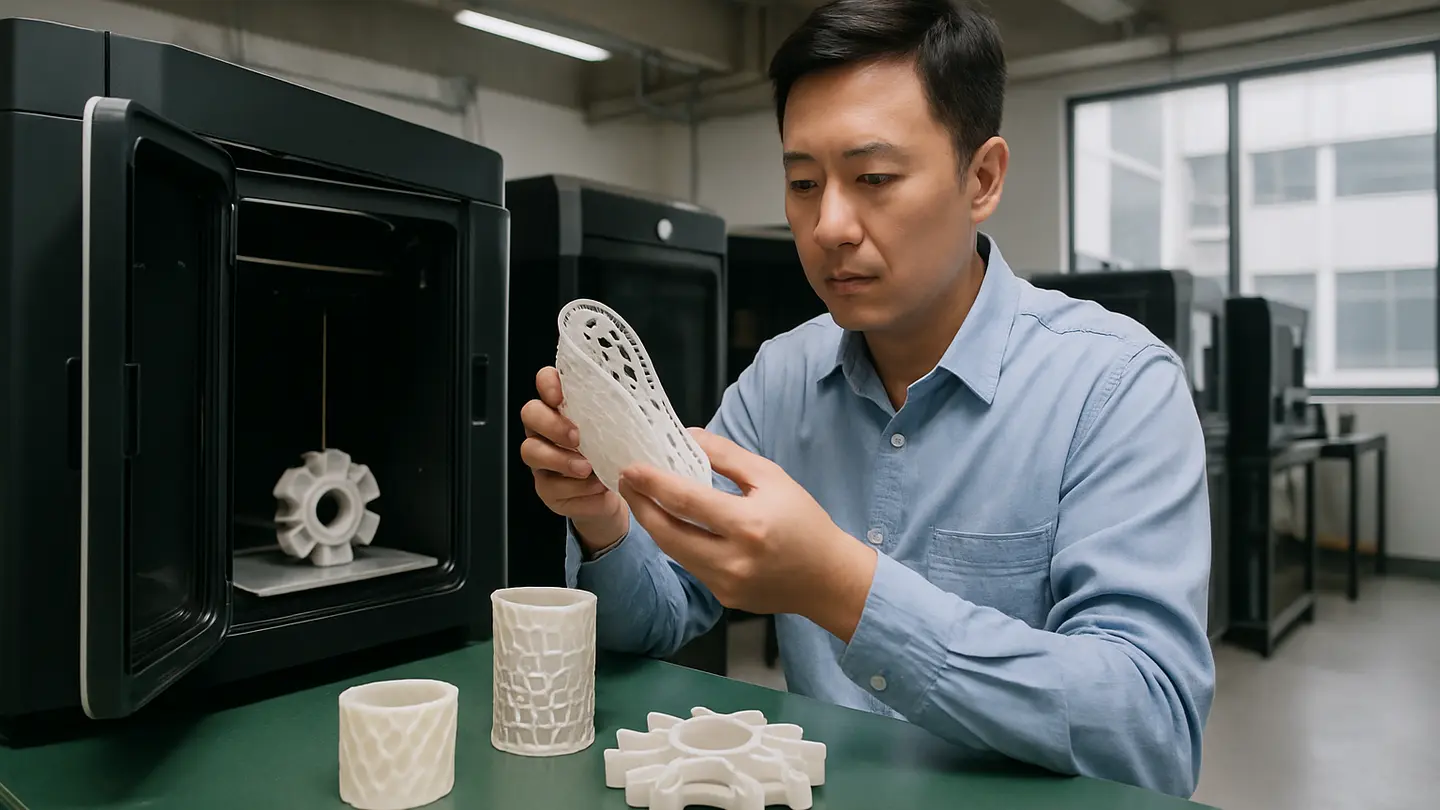
3D printing in China is often used when a buyer needs fast design feedback, customized parts, or low-volume production without paying for molds or dedicated tooling. For product teams developing housings, brackets, display components, sanitary hardware accessories, test fixtures, or consumer product assemblies, it can shorten the path from CAD model to physical sample.
The main advantage is flexibility. If a handle radius, clip position, wall thickness, or mounting feature changes, the update is usually made in the CAD file rather than through a mold modification. That makes 3D printing especially useful when the design is still moving.
It is not the best answer for every part. Injection molding is usually more economical for stable plastic parts at high volume. Sheet metal fabrication is better for many flat cut-and-bent parts such as panels, simple brackets, and covers. CNC machining is often preferred when the part requires tight tolerances, accurate threads, precise mating surfaces, or final-fit validation in production-like material.
The practical sourcing decision comes down to five questions:
- Is the design still changing?
- How many parts are needed now and later?
- What performance must the part achieve?
- What surface finish and dimensional quality are required?
- How quickly must each design loop be completed?
Used well, 3D printing is not just a “prototype service.” It is a sourcing tool for reducing early-stage risk before committing to more expensive manufacturing decisions.
When 3D Printing Makes More Sense Than Tooling
3D printing makes the most sense when design uncertainty is high and part quantity is low. Typical uses include concept checks, fit tests, assembly trials, trade show samples, ergonomic samples, and limited runs for internal testing.
For example, a buyer developing a new shower accessory housing may need to confirm whether a cover snaps securely onto a base, whether screw bosses align with the mating part, or whether the visible profile looks acceptable when installed. Printing a few versions is usually faster and cheaper than opening a mold before those details are settled.
Design changes are also less painful. A tooling change may require new machining, mold spotting, testing, and approval. A printed prototype may only require a file revision and a new build. That difference matters during early development, when small adjustments are common.
China-based printing can offer several sourcing advantages: a broad supplier base, access to multiple printing processes, competitive pricing, and the ability to combine printed prototypes with other manufacturing services in the same supply chain. However, international sourcing also changes the iteration rhythm. If every design change requires overseas shipping, the calendar savings from fast printing can be reduced by transit time, customs clearance, and internal review delays.
For that reason, buyers should avoid sending one minor revision at a time unless the schedule demands it. A better approach is often to batch several design changes into one print round. For example, print three wall-thickness options, two clip geometries, and two surface textures in the same shipment. This makes each iteration more informative and reduces the number of shipping cycles.
The point at which printing becomes less attractive is usually when geometry stabilizes and repeat demand grows. If the same part will be ordered in hundreds, thousands, or more, buyers should compare printing with injection molding, CNC machining, sheet metal, vacuum casting, or other production methods. The right decision may change as the product moves from concept to pilot run to full production.
Choosing the Right 3D Printing Process
Not all 3D printing processes produce the same type of part. A quote that simply says “3D printed” is not specific enough for a B2B sourcing decision. The process affects strength, surface appearance, dimensional behavior, cost, and finishing requirements.
| Process family | Best-fit uses | Strengths | Common limitations |
|---|---|---|---|
| FDM / FFF filament printing | Early prototypes, simple fixtures, basic shape checks | Low cost, fast, many material choices | Visible layer lines, lower cosmetic quality, weaker between layers |
| Resin printing, including SLA/DLP/LCD | Detailed visual parts, small features, presentation samples | Smooth surface, fine detail, good appearance after finishing | Some resins can be brittle; performance depends heavily on resin type |
| Nylon powder printing, often SLS or MJF | Functional prototypes, clips, housings, assembly-test parts | Tougher parts, no support marks in many geometries, better functional use | Grainy surface, color and finish options may be limited without post-processing |
| Metal additive manufacturing | Specialist metal parts, complex internal channels, lightweight structures | Can make geometries difficult or impossible by machining | High cost, technical qualification needed, post-machining often required |
FDM is commonly used for simple prototypes because it is accessible and cost-effective. It is suitable for checking size, general shape, and basic assembly concepts. However, the layer lines are usually visible, and the part may not be suitable for cosmetic review or precision fit checks without secondary work.
Resin printing is often chosen when appearance and detail matter. It can produce smooth surfaces and sharp features, making it useful for presentation samples, small components, and parts where visual evaluation is important. The limitation is that some standard resins are brittle or sensitive to stress, so buyers should not assume a resin part will behave like molded ABS, PP, or nylon. Engineering resins may improve performance, but they need to be specified.
Nylon powder printing is often a stronger choice for functional plastic prototypes. It is commonly used for clips, housings, covers, brackets, and assembly-test components because the parts can be tougher and less dependent on support structures. It is not always the best cosmetic choice without dyeing, smoothing, coating, or painting, but it can be very useful for mechanical testing.
Metal 3D printing is a specialist option. It may be justified for complex metal parts, internal channels, lightweight structures, or low-volume components where conventional machining would be difficult. For ordinary blocks, plates, shafts, and simple metal brackets, CNC machining or sheet metal fabrication is often more economical and predictable.
Selecting Materials for Prototype and Functional Tests
Material selection determines how useful the printed part will be. A prototype made from the wrong material may confirm the shape but mislead the team about heat resistance, bending behavior, impact strength, snap-fit performance, or long-term durability.
PLA is widely used for basic concept models and display pieces. It prints easily and can be inexpensive. However, it has limited heat resistance and is not ideal for demanding mechanical or functional testing. A PLA sample may be enough to judge shape, but it should not be treated as proof of production performance.
ABS is a common choice when buyers want a more engineering-oriented plastic prototype. It can be useful for housings and functional checks, though print quality and warping control depend on the process and supplier capability. PETG can offer a useful balance of toughness, chemical resistance, and printability for functional samples where high precision or high heat resistance is not the main requirement.
Nylon is often chosen for stronger functional prototypes. It can be suitable for clips, hinges, snap features, covers, and parts that need better impact resistance or fatigue behavior than basic display materials. For components that must flex repeatedly or survive assembly pressure, nylon powder printing may be more relevant than a brittle visual resin.
TPU is used when flexibility is required. It can support testing of soft grips, seals, bumpers, protective covers, and flexible interface parts. However, printed TPU may not exactly match the compression set, surface feel, or long-term performance of molded rubber or elastomeric production materials.
Resins vary widely. Standard resins may be suitable for detailed models and cosmetic prototypes. Tough, flexible, high-temperature, or engineering resins may be available for more demanding tests. Buyers should avoid assuming that “resin” means one fixed material category.
The prototype material does not always need to match the final production material. If the goal is only to review external appearance, a resin print may be suitable even if the final part will be molded ABS. If the goal is to test a snap-fit, hinge, threaded insert, or loaded bracket, the material choice must be closer to the intended function.
A clear material discussion with the supplier should include:
- The purpose of the prototype or printed part
- Expected loads, bending, impact, temperature, and exposure
- Whether the part is for visual review, assembly testing, or end use
- Available material data sheets
- Available colors and finishes
- Any restrictions related to painting, coating, dyeing, or bonding
Good suppliers will usually recommend a process and material together, not separately.
What Drives the Cost of 3D-Printed Parts
The cost of 3D-printed parts is shaped by more than material weight. Two parts of similar size can have very different prices depending on geometry, process, finishing, and inspection expectations.
The main cost drivers include:
- Part size and build volume
- Material consumption
- Printing process
- Machine time
- Quantity
- Support structures and support removal
- Surface finishing
- Tolerance requirements
- Inspection and reporting
- Packaging and shipping
Large parts cost more not only because they use more material, but because they occupy more machine space and may take longer to build. Tall parts, thin walls, enclosed cavities, and complex overhangs may increase the need for supports or affect print orientation. Orientation can influence strength, surface quality, and dimensional accuracy, so it should not be treated as a minor production detail when the part has functional requirements.
Finishing is often where quotes become difficult to compare. A raw FDM print with visible layer lines is not the same as a sanded, primed, and painted sample. A raw nylon powder print is not the same as a dyed, smoothed, or coated part. Resin parts may still require support removal, UV curing, sanding, and painting depending on the appearance standard.
Post-processing steps can include:
- Support removal
- Sanding
- Filling and priming
- Painting
- Dyeing or coloring
- Polishing
- Vapor smoothing for selected materials
- Thread insert installation
- Drilling or tapping
- Bonding of multiple printed sections
- Secondary machining of critical surfaces
An unusually low quote may be low because it excludes work required to make the part usable. For example, it may cover only raw printing and not sanding, painting, tolerance inspection, threaded inserts, or careful packaging. Buyers should compare quotes on the same scope.
It is also easy to overpay during early development. If a part is still changing, there is usually little value in specifying a premium cosmetic finish or tight tolerance on every surface. Early rounds can be rougher and cheaper. Later rounds can focus on appearance, accuracy, and production-like function.
A clear RFQ for 3D printing in China should specify:
- 3D model file format and drawing revision
- Preferred process, if known
- Material or target performance
- Quantity
- Build orientation, if critical
- Surface finish requirement
- Color requirement
- Critical dimensions and tolerances
- Inspection method and reporting expectations
- Any inserts, threads, bonding, or assembly work
- Packaging requirements
- Incoterms or shipping terms
- Required delivery date
If the buyer is unsure about the best process, the RFQ should state the test objective rather than forcing a process decision too early. For example: “Part must survive repeated clip assembly into a mating housing” is more useful than “print in any black plastic.”
FAQ
Q1: Should I print the part myself or send it to China?
Desktop printers are useful for inexpensive shape validation and early design checks. If the team only needs to see whether a concept fits in the available space or whether a general profile looks right, in-house printing can be fast and low cost.
Outsourcing becomes more relevant when the part needs production-grade materials, better repeatability, stronger mechanical performance, tighter dimensional control, or a higher-quality surface finish. It is also useful when the required process is not available internally, such as nylon powder printing, advanced resin printing, or metal additive manufacturing.
A practical approach is to use desktop printing for early concept loops and outsource the more serious validation builds.
Q2: Can a printed part be finished to look like the final product?
Yes, many printed parts can be improved visually through sanding, priming, painting, coating, polishing, dyeing, or other finishing steps. Resin prints often begin with smoother surfaces than FDM parts, which can reduce the finishing effort for small detailed components.
However, the final appearance depends heavily on the process, material, geometry, and post-processing workmanship. Buyers should define the finish standard clearly. A “painted sample” could mean anything from a quick color coat to a carefully prepared presentation model. If appearance matters, provide color references, gloss level expectations, texture requirements, and photos of the target finish.
Q3: How accurate are 3D-printed parts?
Accuracy varies by printing process, material, geometry, orientation, and part size. Small resin parts may hold fine detail well, while larger parts can experience shrinkage, warping, or dimensional variation. FDM parts may show more variation due to layer height, extrusion behavior, and orientation. Nylon powder parts can be useful for functional prototypes, but critical fits still need realistic tolerance planning.
Buyers should not rely only on the 3D model when dimensions matter. Mark critical dimensions clearly on a 2D drawing and ask the supplier what tolerance range can realistically be held for the selected process and material.
If a surface, hole, slot, or mating feature requires tighter control than printing can provide, secondary machining may be needed. In some cases, CNC machining is the better validation method from the start.
Q4: How strong are printed parts compared with molded ones?
Printed part strength depends on the process, material, wall thickness, geometry, and print direction. FDM parts may be weaker between printed layers, especially if the load pulls layers apart. Resin parts can be strong in some applications but brittle in others. Nylon powder prints often provide more consistent strength across directions and may be better for functional clips, covers, and assembly-test parts.
Molded parts usually have different material behavior because the manufacturing process creates a more continuous structure. A printed prototype can be very useful, but it may not perfectly predict molded performance.
To get a useful recommendation, buyers should share expected loads, assembly forces, use temperature, impact risks, and whether the part will be used once, tested repeatedly, or placed into limited service.
Key Takeaways for China 3D Printing Projects
3D printing is strongest when speed, flexibility, customization, or low-volume production matter more than the lowest possible unit price. It helps buyers test ideas, confirm fit, review appearance, and reduce design risk before investing in tooling or production processes.
The process should be reassessed as the project matures. Once repeat demand grows or geometry becomes stable, injection molding, CNC machining, sheet metal fabrication, or other processes may become more suitable.
The best sourcing decision balances cost, material performance, dimensional needs, finishing requirements, and quality expectations. For China-based projects, international shipping should be planned into the development schedule. Batching several revisions into each print round can reduce delays and make each shipment more valuable.