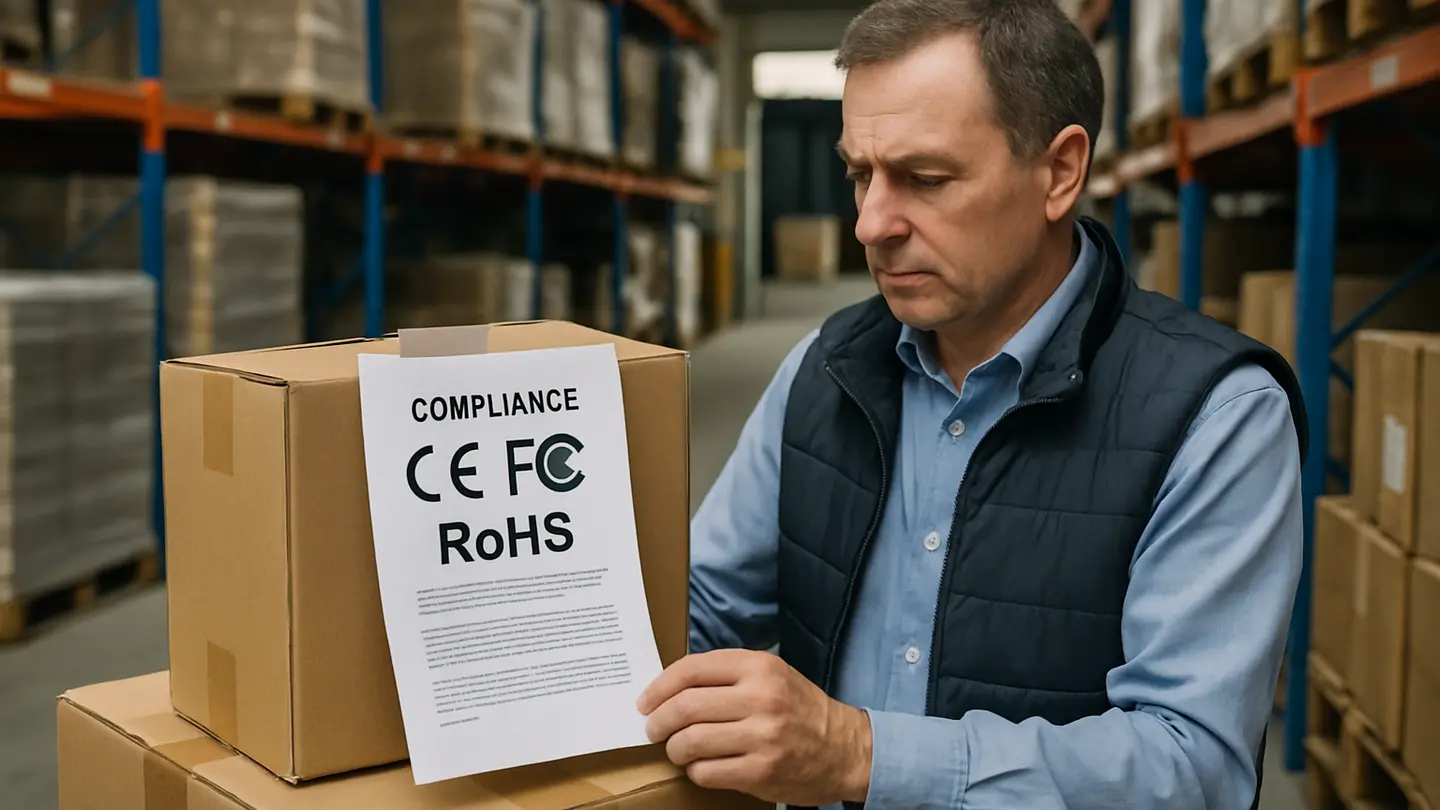
Amazon compliance gaps are cheapest to fix before the supplier deposit leaves your account. At that point, the buyer still has leverage, packaging artwork can still be changed, and samples can still be retested without derailing the shipment.
The same missing document becomes more expensive later. After production, it may require rework, repacking, relabeling, or scrapping. After shipment, it can become dead stock, delayed customs clearance, FBA storage fees, listing suppression, or inventory that cannot legally be sold in the target marketplace.
Amazon compliance should be treated as sourcing due diligence, not an administrative task after goods are ready. A factory may produce a shower accessory, bathroom organizer, valve component, or packaged consumer product at an acceptable price and quality level, but that does not mean the exact Amazon-bound SKU has the correct paperwork, labels, warnings, test reports, and marketplace documentation.
A useful rule for sourcing products for Amazon is to treat compliance as a matching exercise. Amazon and regulators do not simply ask whether a supplier has “some certificates.” They compare documents against the exact product, brand, model, label, packaging, and listing being sold.
Why Factory Paperwork May Not Satisfy Amazon Review
Supplier document folders are often prepared for sales conversations, not Amazon compliance review. A factory may send certificates quickly to reassure the buyer and secure the order. Those documents may be real, but still not apply to the specific product being purchased.
Common problems include:
- a report for a similar model rather than the model on the purchase order;
- testing completed under an older standard;
- a certificate issued to a different production site;
- documents prepared for another customer’s branded version;
- missing accessories or packaging components from the tested configuration;
- a report that covers raw material rather than the finished product;
- labeling that matches the supplier’s domestic market, not the Amazon marketplace.
For example, a supplier selling bathroom products may provide a chemical test report for stainless steel, while the Amazon-bound SKU also includes plastic hooks, rubber pads, adhesive strips, printed packaging, and a children’s-use claim. The steel report may be relevant, but it is not a complete compliance file.
The buyer must verify the exact product, brand, model, and factory behind the order. If a subcontractor will produce it, the report must be checked against that site. If the product is private-labeled, brand and model references may need to align with the seller’s listing and packaging.
An Alibaba supplier badge, trade assurance history, or general platform profile may help with supplier screening, but Amazon compliance depends on product-level evidence.
Check Each Report Against Your Actual Purchase Order
A test report only applies to the item that was tested. Many sourcing disputes begin when buyers assume a supplier’s report covers the commercial version being ordered. Review each report line by line against the purchase order and product specification before approving the deposit.
At minimum, compare the report with:
| Checkpoint | What to verify |
|---|---|
| Product name | Does the report describe the same product type being ordered? |
| SKU or model number | Does it match the supplier quotation, PO, packaging, and Amazon listing? |
| Materials | Are all major materials covered, including coatings, plastics, metals, adhesives, and surface finishes? |
| Colors and finishes | Are the tested version and ordered version the same where colorants or coatings may matter? |
| Accessories | Are batteries, chargers, screws, adhesives, spare parts, tools, or inserts included? |
| Packaging | Does the report or file reflect the final retail package where relevant? |
| Brand and applicant | Does the applicant or manufacturer information create any mismatch with the seller’s compliance submission? |
| Production site | Is the manufacturing address the same as the factory producing the order? |
| Standard used | Is the report based on the current applicable standard for the marketplace and product category? |
| Report date | Is the test recent enough for the platform, regulator, or buyer policy? |
If third-party testing is required, confirm that the testing body is a legitimate external laboratory and that the report can be verified. A professional-looking PDF is not enough. Check the lab name, report number, issue date, sample description, accreditation references where relevant, and whether the report can be authenticated through the issuing body.
The applicable standard also matters. A valid report under an outdated standard may fail review if Amazon or the relevant authority expects the current version. Product categories with child safety, food contact, electrical, chemical, medical, or flammability implications are especially sensitive.
Testing samples before mass production reduces the risk of buying noncompliant inventory. The tested sample should represent the commercial product, including materials, finish, accessories, and packaging. If the factory later changes a coating, resin, adhesive, battery, manual, or label, the original report may no longer support the shipment.
How Packaging Claims Can Create Compliance Problems
Packaging and marketing claims can trigger Amazon compliance review even when the physical product has passed testing. The box, label, insert, manual, and listing copy all form part of the seller’s product representation. If those claims suggest a regulated benefit or special use case, Amazon may ask for evidence.
Claims that commonly require support include:
- chemical-free, BPA-free, lead-free, phthalate-free, or non-toxic claims;
- antibacterial, antimicrobial, mold-resistant, or germ-killing claims;
- organic, natural, eco-friendly, biodegradable, or compostable claims;
- child-safe, baby-safe, toddler-friendly, or toy-related claims;
- medical, therapeutic, pain-relief, skin-health, or hygiene-treatment claims;
- waterproof or electrical safety claims where electrical components are included;
- food-contact or drinking-water claims.
The risk belongs to the seller approving the packaging, not only to the factory printing it. A supplier may print “antibacterial,” “non-toxic,” or “safe for children” because the buyer requested it. That does not mean the supplier has evidence that will satisfy Amazon.
For shower and bathroom products, this issue appears in claims around anti-mold materials, antibacterial coatings, baby bath use, skin-safe finishes, or chemical safety. A plain shower caddy may have a simple compliance profile. The same item described as “antibacterial,” “child safe,” and “non-toxic” may invite a different review.
Before approving artwork, check every claim against the available reports and certificates. If the report only shows corrosion resistance, it does not support an antibacterial claim. If a material report covers one component, it does not support a broad “chemical-free” claim across the entire product. Unsupported claims may lead to listing suspension, removal, or documentation requests the seller cannot satisfy after inventory arrives.
Why One Added Accessory Can Change the Compliance File
Amazon evaluates the complete shipped package, not only the main product. A small bundle change can alter the compliance file because accessories may introduce new rules, documentation, and shipping restrictions.
Examples include:
- adding a lithium battery or rechargeable component to a shower speaker, LED accessory, dispenser, or sensor product;
- including adhesive pads that require chemical or performance review;
- adding small parts that may affect child safety warnings;
- bundling a cleaning chemical, gel, fragrance, or desiccant;
- including a blade, sharp tool, or metal fitting;
- adding an electronic timer, USB cable, charger, or power adapter;
- changing the manual to include medical, hygiene, or safety claims.
Accessories can trigger battery rules, dangerous goods review, child safety requirements, carrier restrictions, or additional labeling. They can also create inconsistencies between the listing, carton marks, safety data sheets, product specification, and test reports.
Late bundle changes are especially risky. A buyer may approve testing for the main unit, then ask the factory to add a promotional accessory before shipment. If that accessory was not included in the tested sample or compliance review, the earlier file may no longer describe the actual product.
Consistency is critical. Safety data sheets, carton markings, product specifications, manuals, labels, and Amazon listing details should describe the same item. If one document says the product contains a lithium battery and another omits it, review may stall. If the carton mark references one model number and the test report references another, the seller may be asked to explain the mismatch.
Purchase Order Clauses That Protect the Compliance Check
Compliance responsibilities should be written into the purchase order before payment. Verbal assurances are difficult to enforce once production starts, and they are rarely specific enough to protect the buyer.
Two PO points are especially important.
First, the purchase order should state who books testing. If the buyer books the test directly, the buyer may have better control over the lab, sample selection, report language, and submission format. If the supplier books the test, the PO should specify the required lab type, standards, report recipient, sample description, and deadline.
Second, the PO should state which exact unit is tested. The tested sample should match the final production specification, including materials, color, coating, accessories, packaging, labels, warnings, and manual. If a pre-production sample is tested, the supplier should be required to produce mass goods to the same approved specification.
The PO should also prohibit unapproved changes. A useful clause states that the supplier must not change materials, coatings, components, adhesives, batteries, packaging, labels, manuals, markings, production site, or subcontractors without written approval from the buyer.
This matters because supplier changes can make earlier test reports unreliable. A factory may switch to a cheaper coating, alternate plastic resin, different adhesive, or subcontracted packaging supplier to protect margin or meet a deadline. The finished goods may look similar, but the compliance basis may have changed.
Buyers should connect payment milestones to document review. The deposit may be conditional on acceptable pre-production samples and a preliminary document check. The balance may be conditional on passed inspection, final packaging approval, and delivery of matching compliance documents. The goal is to ensure the seller does not lose leverage before the compliance file is usable.
Treat UK and EU Compliance as Separate Workstreams
Some test results may be reusable across markets, but UK and EU compliance should still be reviewed separately. A similar product may require different labels, importer information, warnings, language, declarations, or responsible-party details.
Common label gaps include:
- missing local language requirements;
- incomplete importer or responsible person details;
- incorrect age markings;
- missing warnings;
- wrong conformity marks;
- packaging symbols that do not apply in the target market;
- instructions that are acceptable in one market but incomplete in another.
Confirm target marketplaces before packaging artwork and labels are approved. If the seller plans to launch in the UK first and the EU later, the packaging strategy should account for both. If the same inventory will be used across multiple markets, the label must be checked carefully to avoid overprinting, relabeling, or splitting inventory after production.
Selling into multiple markets may require separate compliance files. Even where the underlying test data is useful in more than one jurisdiction, declarations, importer details, translations, warnings, and platform submissions should be reviewed market by market.
FBA preparation rules do not replace product-platform eligibility or legal compliance requirements. Barcode placement, carton labels, polybag warnings, and shipment preparation are operational requirements. Sellers need both proper FBA preparation and a defensible product compliance file.
FAQ
Q1: Does buying from a trading company instead of the factory change the paperwork?
It can. A trading company may collect and forward compliance documents, but it may not control the factory that produces the order. The buyer should confirm the manufacturing site, not only the company issuing the quotation.
If the trading company switches factories between shipments, previous reports may no longer apply. The same model number is not enough if production moves, materials change, or a subcontractor is added. Ask for the factory name, address, production role, and confirmation that the documents apply to that site and shipment.
Q2: The factory says it has sold this to Amazon sellers for years. Good enough?
No. Past sales to Amazon sellers do not prove current compliance. Amazon reviews the seller’s submitted file, the current listing, and the product being sold now. A factory’s sales history may be encouraging, but it does not replace document verification.
Ask which marketplace was involved, what product version was reviewed, which documents were submitted, and whether the packaging, brand, factory, and model number were the same. Also check whether the standards and report dates are still acceptable.
Q3: Can I start the listing while the documents are still being sorted out?
In many cases, a listing can be built before every document is finalized. Sellers often prepare titles, images, copy, variation structure, and backend information while testing or document review is underway.
However, goods should not ship before the compliance file is ready. Shipping early creates pressure to accept weak documents because inventory is already moving. If Amazon requests documents and the seller cannot provide them, the inventory may sit in storage while fees accumulate. In the worst case, the stock cannot be sold through the intended listing.
Q4: My test report is in Chinese. Is that a problem?
It may be. If Amazon, a regulator, an importer, or an internal compliance reviewer requires English documentation, a Chinese-only report may not be accepted. Request an official English report from the issuing lab when needed.
A buyer-made translation may help with internal understanding, but it may not count as part of the laboratory’s official report. Before submitting documents, check the report-language requirements for the marketplace and product category. It is easier to request the correct report format before payment than after shipment.
Conclusion: Verify the Product File Before the Deposit Leaves Your Account
Amazon compliance problems are easier and cheaper to fix before supplier payment. Before the deposit is paid, the buyer can still require corrected reports, retesting, revised packaging artwork, confirmed factory details, or a different supplier. After production starts, each correction becomes more expensive. After inventory reaches Amazon, a listing removal can leave the seller holding unsellable stock and paying storage fees.
The key checks are practical: match model numbers, factory details, product scope, materials, accessories, packaging claims, issuing lab, report age, applicable standards, and marketplace labels. Do not rely on a general certificate folder, a supplier badge, or a statement that other Amazon sellers have bought the item before.
Supplier verification should focus on the exact product and paperwork required for the Amazon-bound shipment. If the compliance file does not match the order, the seller is buying risk along with inventory.