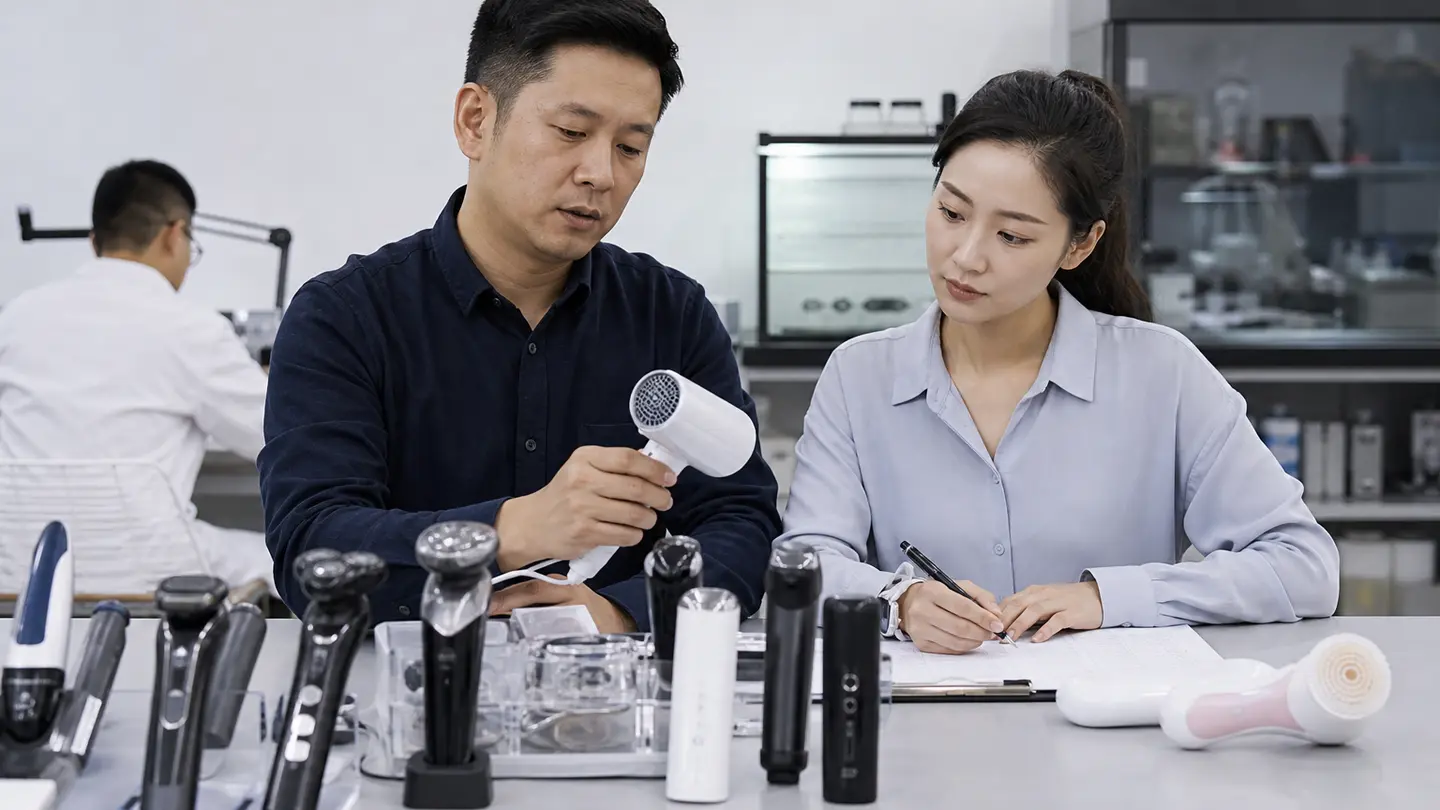
Beauty Tools from China: Where Quality Failures Start
Sourcing beauty tools from China can offer broad material choices, flexible customization, and competitive production options. However, the defects that create returns or damage a brand’s reputation are often not visible in catalog images, video calls, or even a quick sample review.
A brush can look full but shed after washing. Tweezers may appear polished but fail to grip. A sponge may feel soft when dry but split after repeated wet use. A mirror may arrive intact at the factory but break during freight. These are functional and durability issues, not simply cosmetic ones.
For this reason, buyers should test samples for the way customers will actually use them before focusing on price negotiations. Product-specific testing helps reveal whether a lower quote reflects a genuine production efficiency or a reduction in material grade, assembly quality, packaging protection, or quality control.
The main risk areas differ by product category:
- Brushes: ferrule attachment, adhesive performance, bristle grade, and handle durability
- Metal implements: steel composition, plating, alignment, corrosion resistance, and tip closure
- Sponges and applicators: wet expansion, rebound, density, splitting, and material declarations
- Mirrors: glass safety treatment, magnification consistency, weight, and freight protection
- Cases: zipper operation, stitch density, lining seams, and structural durability
- Sets: consistency across every individual item, not just the overall presentation
A product photo can confirm color, shape, logo placement, and general styling. It cannot reliably confirm wash durability, corrosion resistance, gripping performance, adhesive strength, or the consistency of a full production batch.
Brush Quality Often Fails at the Ferrule and Handle Join
For makeup brushes and similar applicators, visible bristle appearance is only one part of quality. Shedding often begins at the connection between the bristle bundle, ferrule, and handle.
Common causes include weak ferrule crimping, insufficient or poor-quality adhesive, inadequate curing time, loose bristle bundles, and low-grade fibers. A brush may pass a quick initial pull test but fail after exposure to water, cleanser, drying cycles, and repeated handling.
Buyers should request samples before agreeing final price and perform repeated functional checks. A practical evaluation process can include:
- Gently pulling the bristles several times to identify immediate shedding.
- Washing the brush under normal intended-use conditions.
- Allowing it to dry fully.
- Repeating the pull test and checking whether the ferrule loosens or rotates.
- Repeating the wash-and-dry cycle to assess longer-term durability.
The test should inspect more than bristle loss. Buyers should also look for cracking paint, swelling wooden handles, loose ferrules, adhesive odor, bristle deformation, and changes in softness or shape after drying.
Synthetic and animal hair should be selected before the supplier shortlist is finalized. Neither option is automatically superior. Synthetic fibers can offer good wash durability, consistent production, and fewer concerns related to animal-derived material documentation. Animal hair may be selected for particular applications or customer preferences, but it can create additional import, labeling, or destination-market documentation considerations.
Claims also need to be separated clearly. “Cruelty-free” generally relates to animal testing claims, while “vegan” indicates that the product does not contain animal-derived materials. A brush using animal hair may be marketed as cruelty-free in some circumstances, but it would not normally qualify as vegan. Buyers should not assume the terms are interchangeable.
The product specification should identify the fiber type, bristle length, bundle density, ferrule material, handle material, adhesive expectations, and acceptable shedding level. Without this detail, the approved sample may be difficult to reproduce consistently.
Metal Beauty Tools Depend on Material Specifications and Alignment
Metal beauty tools, including tweezers, eyelash curlers, scissors, nail tools, comedone extractors, and manicure implements, depend heavily on material selection and precision assembly.
Two products may look nearly identical but perform very differently because of steel composition, thickness, heat treatment, sharpening quality, plating, surface finish, or tip alignment. A low-cost metal tool may initially feel acceptable but corrode, discolor, bend, lose tension, or fail to close accurately after limited use.
Buyers should request written specifications covering the steel grade and surface finish. Terms such as “stainless steel” alone may be too broad to compare quotations accurately. The specification should also state whether the tool is polished, brushed, coated, plated, painted, or otherwise surface treated.
For gripping tools such as tweezers, tip alignment is critical. Close the tips against a light source and inspect for gaps. If light remains visible between the gripping surfaces, the tool may not grasp fine hairs effectively. The tips should meet evenly without excessive pressure or lateral movement.
Useful sample checks include:
- Closing-tip light-gap tests for tweezers and precision tools
- Repeated opening and closing to assess spring tension
- Damp-storage checks to identify visible corrosion or staining risks
- Surface inspections for rough edges, burrs, plating defects, and sharp unfinished seams
- Repeated use tests for hinge stability and tool alignment
Where products are intended for prolonged skin contact, buyers should also consider destination-market requirements concerning nickel and other restricted substances. Requirements can vary according to the market and the nature of contact. Suppliers should not make compliance claims unless they can provide relevant supporting documentation.
Test Sponges and Applicators in Wet Use, Not Only When Dry
A dry sponge can appear smooth, symmetrical, and soft while still performing poorly during makeup application. Many of the most important properties of a sponge or applicator only become visible after wetting.
Buyers should assess wet expansion, rebound speed, density, water absorption, edge splitting, and shape retention. A sponge that expands unevenly, becomes overly soft, tears at pointed edges, or remains compressed after squeezing may create a poor customer experience even if it looks acceptable in packaging.
A basic evaluation should include wetting the sponge, squeezing out excess water, and observing how it behaves during repeated compression. Buyers can compare samples for:
- Size increase after wetting
- Speed of shape recovery after squeezing
- Uniformity of texture and density
- Splitting around edges, seams, or pointed tips
- Durability after repeated wet-and-squeeze cycles
- Odor changes after exposure to water
Physical samples are particularly important when comparing density. Product descriptions may use terms such as “soft,” “premium,” or “high-density,” but these are not sufficient technical specifications by themselves. Side-by-side handling provides a clearer indication of user-perceived quality.
Material composition should be confirmed before labels, packaging claims, or product descriptions are finalized. Buyers should understand whether the applicator contains latex and whether a latex-free claim is appropriate. Latex declarations and buyer expectations can differ by market, so the label should reflect confirmed material information rather than assumptions based on appearance.
If a product is sold as antibacterial, antimicrobial, or otherwise treated for hygiene performance, that claim should be supported by appropriate documentation. Such performance claims should not be added merely because the material or product category appears suitable for them.
Mirrors and Cases Create Freight and Durability Risks
Mirrors and cases can create disproportionately high logistics and post-sale risk. Both categories may appear straightforward in photos, yet hidden functional failures are common.
Glass mirrors add weight and can increase freight breakage risk. Buyers should confirm the type of mirror glass used, the safety treatment applied, and the protection method used for packing. The packaging must be evaluated as part of the product, especially for compact mirrors, vanity mirrors, and mirror-containing travel kits.
Magnification also requires attention. If a mirror is sold with magnification, the magnification level should remain consistent across production batches. A sample may be acceptable while later units differ in clarity, distortion, or magnification effect. Buyers should inspect multiple units where possible, rather than relying on a single sample.
For cases, the visible exterior is rarely enough to judge durability. Important checks include:
- Zipper movement and pull-tab attachment
- Stitch density and seam consistency
- Alignment of panels and closures
- Lining seam strength
- Interior compartment functionality
- Odor from adhesives, coatings, or lining materials
- Handle, strap, snap, or clasp durability where applicable
A case that photographs well may still have a zipper that catches, a lining that separates, or stitching that loosens at stress points. These failures can be particularly damaging for gift sets and travel-oriented products, where customers expect the case to protect the tools inside.
Beauty Tool Sets Are Only as Reliable as Their Weakest Item
Beauty tool sets combine multiple components, materials, and production processes. This creates a higher risk of inconsistent quality because customers often judge the entire set by its weakest item.
A premium-looking kit may include strong brushes but poor tweezers, a durable case but fragile sponges, or attractive packaging with low-performing tools. If one item fails quickly, customers may regard the complete set as low quality.
Every component should have its own approved sample and written quality standard. For example, a set containing brushes, a sponge, tweezers, a mirror, and a travel pouch should not be approved based only on the assembled kit presentation. Each item needs its own criteria for material, dimensions, color, finish, function, and durability.
Inspection scopes should list every item inside the kit. A sealed-kit inspection can confirm outer packaging, barcode placement, and general presentation, but it cannot verify whether each internal tool is correctly assembled, aligned, clean, undamaged, and functional.
For larger or more complex sets, buyers may also define the required assortment clearly: item count, item placement, protective sleeves, inner trays, instruction sheets, and replacement parts where relevant. This reduces the risk of missing items or substitutions during packing.
Identify Who Controls Each Part of Production
Not every supplier manufactures every component in-house. Some suppliers coordinate assembly, packaging, and export while sourcing critical components such as bristles, ferrules, metal tools, mirrors, cases, or printed packaging from other producers.
This model is not automatically a problem. It can be effective when the supplier has strong control over incoming materials and final assembly. However, buyers should understand who is responsible for each key component before placing an order.
Request a component list that identifies the main parts of the product and the supplier responsible for each one. For a brush set, this may include fibers, ferrules, handles, adhesive, packaging, and case components. For metal tools, it may include steel blanks, plating or coating, sharpening, assembly, and packaging.
Supplier evaluation should consider:
- Incoming-material checks for bristles, steel, glass, foam, and other components
- Controls for incorrect material substitution
- Assembly procedures and in-process inspection
- Handling of rejected materials and defective units
- Traceability between components and finished products
- Responsibility for resolving defects found before shipment
A low quotation may reflect reduced material cost, less inspection, outsourced components, or simplified packaging. Price should therefore be compared alongside production control, not in isolation.
MOQ Requirements Usually Increase by Variant
Minimum order quantity is often more complex than a single total-unit number. For beauty tools, MOQ may increase by color, finish, handle style, bristle type, mirror shape, case material, size, print treatment, or packaging variation.
For example, an order of 3,000 brushes may be commercially possible as one color and one logo treatment, but not as six colors in equal quantities. Similarly, a supplier may accept a total order quantity for a standard product while requiring separate minimums for custom plating, custom molded parts, logo printing, or special packaging.
Buyers should request a variant-level MOQ breakdown before confirming product development. The quotation should clarify:
- MOQ per product design
- MOQ per color or finish
- MOQ per print or logo version
- Setup charges for printing, tooling, plating, or packaging
- Whether sample charges can be credited against a future order
- Any quantity threshold required for custom materials or components
For a first order, limiting the assortment to one finish or a smaller number of variants can reduce complexity. This approach can make it easier to inspect quality, manage packaging, compare customer response, and identify which variations justify future expansion.
Inspect Production Batches Rather Than Relying on Approved Samples
An approved sample establishes a target, but it does not prove that every unit in production will match it. This is especially important for hand-assembled or semi-manual beauty tools.
Variation can occur across a production run in brush shedding, ferrule attachment, bristle trimming, tweezer-tip alignment, plating color, surface finish, logo placement, sponge density, zipper operation, and packaging assembly. A supplier may provide an excellent development sample while production units differ because of material substitutions, different workers, rushed assembly, or inconsistent quality checks.
Pre-shipment inspections should focus on known functional risks, not visual appearance alone. A suitable inspection scope may include:
| Product type | Functional inspection focus |
|---|---|
| Brushes | Shedding, ferrule stability, handle finish, bristle trimming, wash durability |
| Tweezers and metal tools | Tip closure, alignment, sharp edges, corrosion signs, plating consistency |
| Sponges | Shape, density, wet expansion, edge splitting, odor, packaging cleanliness |
| Mirrors | Glass condition, magnification consistency, frame assembly, protective packing |
| Cases | Zipper function, seam strength, lining condition, closure operation |
| Tool sets | Item count, individual tool condition, correct assortment, internal packing |
The inspection plan should define what is checked, how it is checked, and which defects are unacceptable. A visual review alone may not identify a brush that sheds after washing or a tweezer that leaves a gap when closed.
FAQ
Q1: Are synthetic bristles seen as lower quality?
No. Synthetic bristles are not inherently lower quality than animal hair. Performance depends on fiber grade, shape, density, softness, intended application, and how the fibers are secured in the ferrule.
High-quality synthetic fibers can provide good wash durability and consistency between batches. They may also simplify sourcing for buyers who prefer to avoid animal-derived materials or the related documentation considerations. Animal hair may still be selected for particular product positioning or application preferences, but the choice should be based on intended use and verified performance rather than assumptions about quality.
Q2: How do I compare two quotes that look identical on paper?
Ask each supplier to explain the material and construction specifications behind the quote. Similar-looking products may use different bristle grades, adhesives, ferrule crimping methods, handle materials, steel grades, plating processes, or packaging protection.
If one quotation is lower, request a clear explanation of what changes at that price. The supplier should be able to identify the affected specification rather than simply stating that the product is “the same quality.” If the specification cannot be explained clearly, the buyer may have limited control over what will be delivered.
Q3: How do I know a sample came from the supplier’s own production?
Request samples drawn from a current production run rather than display inventory. Ask which order, production run, or customer project produced the sample, and whether the same materials and processes will be used for your order.
Very rapid sample delivery may be convenient, but it can also justify further questions about whether the supplier produced the sample or sourced it from existing inventory. Sample provenance should be investigated rather than assumed, particularly for highly customized or technically complex products.
Q4: Can a factory match a competitor’s tool if I send one as a reference?
A factory may be able to replicate the visible design, but visual similarity does not ensure equivalent function or durability. Important details can be hidden, including fiber blend, adhesive type, crimping method, steel composition, handle weight, spring tension, sharpening, or coating quality.
Provide the physical reference product together with written targets. These can include hair length, bristle density, shedding expectations, handle weight, ferrule finish, tip alignment, steel specification, closure performance, and any required durability checks. A reference sample is most useful when it is supported by measurable requirements.
Conclusion: Catch Functional Defects Before Goods Leave Production
Many expensive beauty-tool quality problems can be identified through low-cost checks before goods leave production. Repeated brush washing and pull testing can reveal weak ferrule joins. Tweezer-tip closure checks can identify gripping gaps. Damp-storage tests can expose corrosion concerns. Wet-use sponge testing can reveal splitting and poor rebound. Documentation review can prevent unsupported material, vegan, latex-free, or antibacterial claims.
The most effective approach is to convert product expectations into written specifications, approve samples against those specifications, and inspect production batches for the functional risks most relevant to each item.
When buyers focus only on appearance and unit price, defects may remain hidden until customers start using the products. When they evaluate materials, assembly methods, durability, labeling requirements, and batch consistency before shipment, they are better positioned to reduce returns, complaints, and avoidable rework.
About the Author
The author is a B2B sourcing and product-quality writer covering supplier evaluation, product specifications, inspection planning, and procurement risk management for consumer goods. The focus is on practical buying guidance that helps importers assess product performance beyond catalog images and initial quotations.