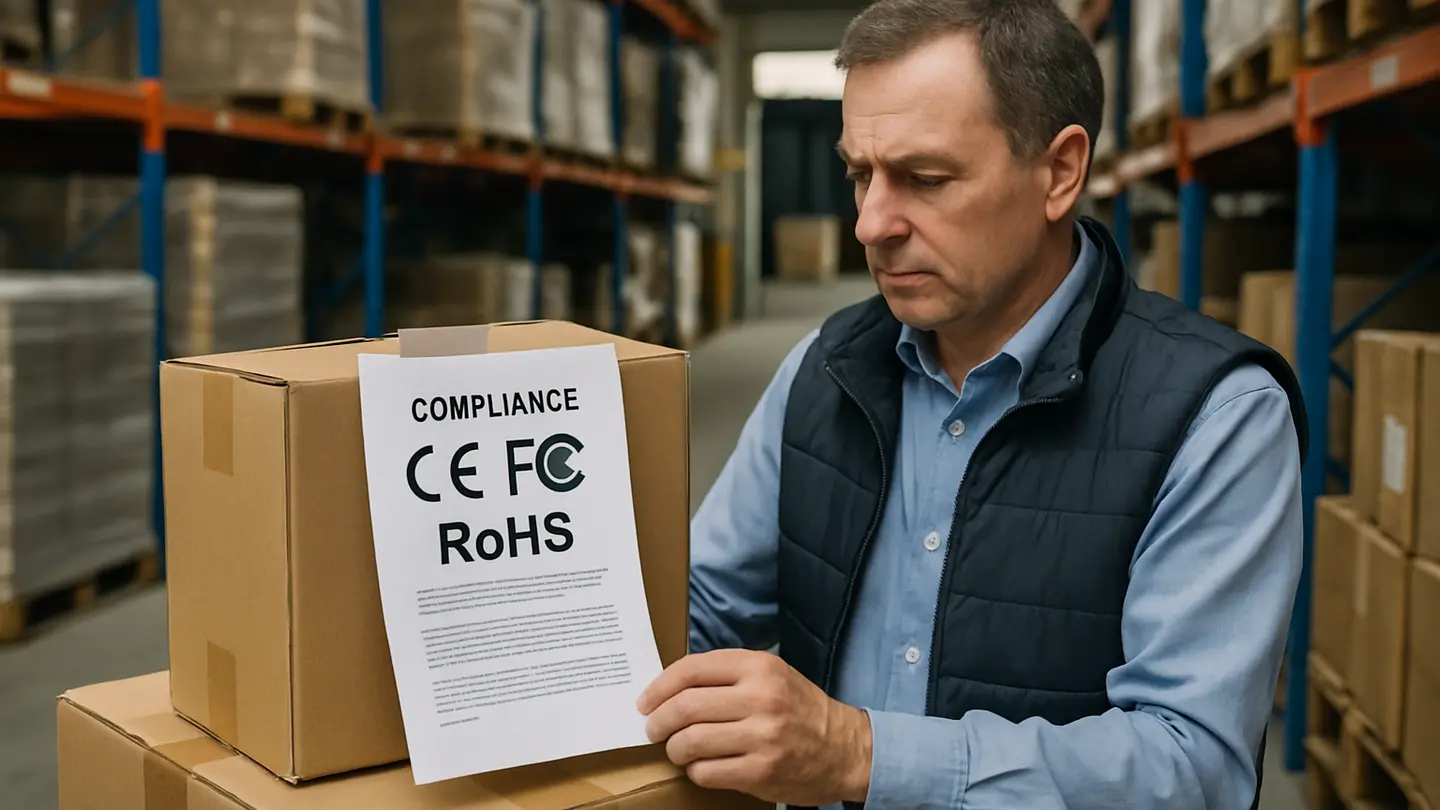
Carton shipping marks are the identification details printed, stamped, sprayed, or labeled on outer cartons before export. They help forwarders, consolidators, customs brokers, warehouse staff, retailers, and receivers identify what is inside each carton and where it belongs.
For importers, correct data is not enough. Many receiving locations require a specific sequence, wording, label position, barcode format, or carton-numbering style. A carton with the right SKU but the wrong purchase order reference may still trigger manual receiving, delays, relabeling costs, rejected appointments, or retailer chargebacks.
Typical carton shipping marks include:
- Consignee or buyer name
- Destination or warehouse reference
- Purchase order number
- SKU, item number, or style number
- Product description
- Quantity per carton
- Carton number and total carton count
- Gross weight and net weight
- Carton dimensions
- Country of origin
- Handling symbols or warnings where required
The safest approach is to specify the marks before production, approve the format before cartons are made, and verify final cartons before sealing and loading.
What Carton Marks Cannot Replace
Carton shipping marks identify the outer shipping carton. They do not replace every other mark or label required in the supply chain.
A product may still need its own permanent country-of-origin mark, compliance label, serial number label, energy label, warning label, or retail packaging information. Printing “Made in China” or another origin statement on the master carton may not satisfy product-level marking rules in the destination market.
Carrier labels are separate. Parcel, air freight, and truck carriers may require routing labels, tracking barcodes, service labels, or pallet labels generated through the carrier, freight forwarder, warehouse management system, or fulfillment program.
Regulated goods may need dangerous goods labels or handling marks that follow transport rules. These cannot be replaced by a general “fragile” mark or a buyer’s internal SKU label.
Fulfillment programs and retailers may add shipment-specific carton labels or barcodes. These usually sit alongside standard carton marks rather than replacing them.
Importers should check two levels during production:
- Product-level markings: origin, compliance, warnings, retail packaging, serial or batch information.
- Carton-level markings: shipping marks, logistics data, handling symbols, carrier labels, and customer-specific labels.
Waiting until goods are packed can make corrections slow and expensive. If product labels are missing after cartons are sealed, the factory may need to reopen cartons, relabel units, repack, and repeat inspection.
Give the Factory a Finished Marking Template
A general instruction such as “print PO, SKU, quantity, and made in China on cartons” leaves too much room for interpretation. Factories may use their usual layout, abbreviate fields, place marks on only one face, use an internal reference number, or reuse old artwork.
Importers should provide a finished carton-marking template for each purchase order. The template should show exactly what appears and where it appears.
At minimum, the template should control:
- Wording of each field
- Field order
- Punctuation and abbreviations
- Line breaks
- Font size or minimum character height
- Bold text where required
- Barcode or QR code placement, if applicable
- Handling symbol placement
- Carton face placement
- Required blank spaces for carton number, weight, or dimensions
- Whether information appears on one, two, or more carton faces
A practical template may look like this:
| Carton face | Required content | Notes |
|---|---|---|
| Long side | Buyer name, PO number, SKU, item description, carton number, country of origin | Main identification mark |
| Short side | SKU, quantity, gross weight, net weight, dimensions | Useful for warehouse and freight handling |
| Top or side, if required | Handling symbols, warning marks, carrier or fulfillment labels | Keep clear of seams and tape |
Each purchase order should have a fresh template. Reusing old templates can lead to last season’s PO number, an old warehouse address, a previous destination port, or a carton total that does not match the new production run.
For repeat orders, keep the layout if it still works, but reissue the template with updated order-specific data. The factory should confirm that obsolete artwork, label files, and carton printing plates are not used.
Three Fields That Commonly Disrupt Receiving
Many carton-marking errors are minor. Others disrupt receiving because they affect how the warehouse matches physical cartons to purchase orders and inbound appointments. Three fields deserve particular attention: carton count, PO number, and country of origin.
Carton count should match the buyer’s or warehouse’s required format. Some receivers want “CTN NO.: 1/50,” while others prefer “Carton 1 of 50” or a scannable serialized carton label. Mixed-SKU shipments may require carton counts by SKU, by purchase order, or by total shipment. If cartons are numbered 1–50 but the packing list shows 48 cartons, the receiver may hold the shipment for reconciliation.
For multi-item orders, specify whether numbering restarts for each SKU or continues across the full shipment. Either method can work, but confusion can lead to missing-carton investigations even when the goods are present.
PO number should be the buyer-facing purchase order reference, not the factory’s internal job number or sales contract number. If the receiving team cannot match the carton to an open PO, the shipment may be delayed or received manually.
If multiple POs ship together, cartons should clearly indicate the correct PO for each item. Do not assume the packing list alone will solve the problem after arrival.
Country of origin should align with destination-market rules and shipment documents. The wording on the carton should match the commercial invoice, packing list, product labels, and customs documentation. Inconsistent origin wording can trigger questions during import clearance or receiving checks.
Origin marking is also a compliance topic. Correct wording, permanence, language, and product-level requirements depend on destination country and product type. Review carton-level and product-level origin marks before mass production.
Use Handling Symbols as Real Instructions
Handling symbols should communicate real handling needs. If every carton is covered with “fragile,” “this side up,” “keep dry,” and “do not stack,” workers may stop treating them as meaningful instructions.
Use handling symbols when the product or packaging genuinely requires them. Orientation arrows matter for liquids, pumps, kits that can shift, trays, fragile assemblies, glass parts, or products damaged if stored upside down. “Keep dry” matters when moisture can weaken cartons, damage finishes, affect labels, or compromise performance.
Overusing fragile marks can reduce their value. If the master carton is designed for export handling and the product is robust, a fragile symbol may add little. If the carton contains glass, ceramic, electronics, precision parts, plated finishes, or assembled components that can crack or scratch, the symbol should be clear and justified.
Placement is as important as selection. Symbols should be:
- Large enough to see from normal handling distance
- Printed in a high-contrast color
- Placed away from carton seams and tape lines
- Kept off corners likely to crush during transit
- Repeated on more than one face where practical
- Not distorted by uneven carton surfaces or straps
Handling symbols do not guarantee careful treatment, but they align expectations among the factory, forwarder, consolidator, carrier, and receiving warehouse. They may also support damage discussions by showing that handling requirements were specified.
Regulated Products May Require Different Marks
Some marks are not optional buyer preferences. Batteries, aerosols, chemicals, adhesives, paints, solvents, pressurized containers, and certain cleaning or treatment products may require legally mandated labels, warning marks, documentation, and packaging controls.
Required marks can change by transport mode. A carton accepted for sea freight may need different marks or documentation for air freight. Courier and parcel networks may have their own acceptance rules. Small components such as lithium batteries, magnetized parts, liquids, or chemical accessories can change the marking requirements.
Lithium battery marking is a common example. Requirements can differ depending on whether batteries are:
- Shipped alone
- Packed with equipment
- Contained inside equipment
Each case may require different packaging, documentation, watt-hour information, handling labels, or dangerous goods procedures. The importer should not rely on a generic battery icon or a factory’s casual assurance that “we ship this often.”
Regulated-goods marking should be confirmed before cartons are printed or sealed. If mandatory warning labels are missing after packing, the shipment may be refused by the forwarder, delayed at the warehouse, or held before loading. In some cases, cartons may need to be reopened or repacked.
Importers should coordinate among the supplier, freight forwarder, customs broker, and destination compliance team. The final carton should satisfy both commercial receiving requirements and transport regulations.
Amazon and Retailer Programs Add Stricter Label Rules
Fulfillment networks and major retailers usually add labels rather than replacing standard carton shipping marks. A carton may need the buyer’s PO and SKU marks, factory outer carton data, a carrier label, a warning label, and a retailer-specific inbound label at the same time.
Amazon is a common example. Carton labels should be generated from the current shipment plan, not copied from an old shipment. Reusing labels from a prior plan can send cartons into exception processing because the barcode, shipment ID, fulfillment center, or carton quantity no longer matches the inbound record.
Retailer programs may have strict rules for:
- Label size
- Barcode type and print quality
- Placement on the carton
- Human-readable text
- PO and department references
- Carton sequence numbers
- Mixed-carton or master-carton identification
- Pallet labels
- Advance shipping notice alignment
The correct format may vary by customer program and shipment type. A direct-to-retail distribution center shipment may not use the same labels as an e-commerce fulfillment shipment, drop-ship program, or cross-dock shipment.
The challenge is label coexistence. Specify where each label goes so that one label does not cover another. Barcodes should not be placed over seams, under straps, on crushed corners, or where stretch wrap will distort scanning.
Before production, confirm which labels are factory-applied and which are applied later by the forwarder, warehouse, or carrier. If the factory applies retailer labels, provide current files and clear placement instructions.
Approve Marks Before Cartons Are Sealed
Carton-marking mistakes are cheaper to correct before cartons are sealed, palletized, or loaded. Once goods are packed, a simple correction can become a repacking project.
Request clear photos of finished cartons before loading begins. Photos should show the main marked faces, close-ups of text and barcodes, handling symbols, and any retailer or carrier labels applied by the factory. For mixed orders, ask for photos from each SKU and purchase order, not only one sample carton.
A carton-marking check should also be included in the inspection checklist. The inspector should verify:
- PO number
- SKU or item number
- Product description
- Quantity per carton
- Carton number and total carton count
- Gross and net weight
- Carton dimensions
- Country of origin
- Required handling symbols
- Required warning labels
- Barcode readability, if applicable
- Label placement and orientation
- Consistency with packing list and buyer template
Approval should happen at production completion, not during container loading. At loading, cartons may already be sealed, stacked, strapped, palletized, or staged for immediate departure. The factory may have limited labor available, and the forwarder may not wait while labels are corrected.
If errors are found early, the factory can often reprint labels, apply correction stickers, remark cartons, or replace affected cartons without disrupting the shipping schedule.
FAQ
Q1: Do the marks change if I ship in a shared container rather than a full one?
Usually, the importer’s main carton fields remain the same. Cartons still need to identify the buyer, PO, SKU, quantity, carton count, origin, and physical carton data.
However, less-than-container-load or shared-container shipments may require extra references from the consolidator, such as booking numbers, warehouse receiving numbers, consolidation marks, destination CFS references, or forwarder-specific labels.
Readable marks are especially important in shared-container moves because cartons may be sorted, restacked, and mixed with cargo from other shippers. If outer marks are unclear, damaged, or incomplete, the risk of misrouting or manual identification increases.
Q2: Should the marks be in English only?
English is commonly used on export cartons because it is widely understood in international freight and warehouse operations. For many shipments, English carton marks are sufficient.
Some destination markets, retailers, government agencies, or receiving warehouses may require or prefer local-language markings. Bilingual marks may also help local warehouse staff identify products quickly.
Decide the language before carton printing or label production. Adding a second language later can crowd the layout, reduce readability, or require relabeling. If bilingual marks are used, confirm which fields must be translated and which references, such as PO numbers and SKUs, should remain unchanged.
Q3: Where on the carton should the marks go?
Where practical, place marks on at least two adjacent carton faces. This helps keep cartons identifiable after palletizing, stacking, shrink wrapping, or partial obstruction.
Long-side placement often improves visibility because carton ends may be blocked when goods are stacked tightly. For larger cartons, one main identification mark on the long side and supporting logistics data on the short side can work well.
Avoid placing critical information over seams, tape lines, straps, labels likely to be covered, or corners that may be crushed. If cartons are palletized, consider how marks will appear once the pallet is built and wrapped.
Q4: Printed on the box, sprayed on, or a stuck-on label?
Printed marks, sprayed marks, and adhesive labels can all work if they remain durable and legible through transport and receiving.
Adhesive labels are flexible and easier to revise late in production. They are useful when PO numbers, carton totals, fulfillment labels, or destination details change frequently. The label material and adhesive should suit the carton surface and expected handling conditions.
Direct carton printing can be economical for high-volume or repeat orders with stable artwork. It reduces the risk of labels peeling off, but it is less forgiving if order details change after cartons are produced.
Sprayed or stenciled marks may suit some export environments, especially where cartons face moisture, scuffing, or rough handling. The trade-off is lower precision for small text or barcodes. For detailed receiving data, a printed label is often clearer.
Final Checks Before the Shipment Leaves
Importers should control carton mark wording, format, and placement. The factory should not be left to guess which PO number, carton sequence, origin wording, or label format the receiving warehouse expects.
Most problems can be prevented with three controls: a finished carton-marking template, photos of completed cartons, and inspection instructions that include marking checks. These are inexpensive compared with relabeling at destination or disputing retailer chargebacks.
Wrong PO numbers, unclear carton counts, missing origin marks, or labels placed over seams can make otherwise acceptable goods difficult to receive. The risk is highest when shipments include multiple SKUs, multiple POs, retailer-specific labels, or regulated products.
The best time to check carton shipping marks is while corrections are still inexpensive: before cartons are sealed, palletized, loaded, and handed over to the forwarder.