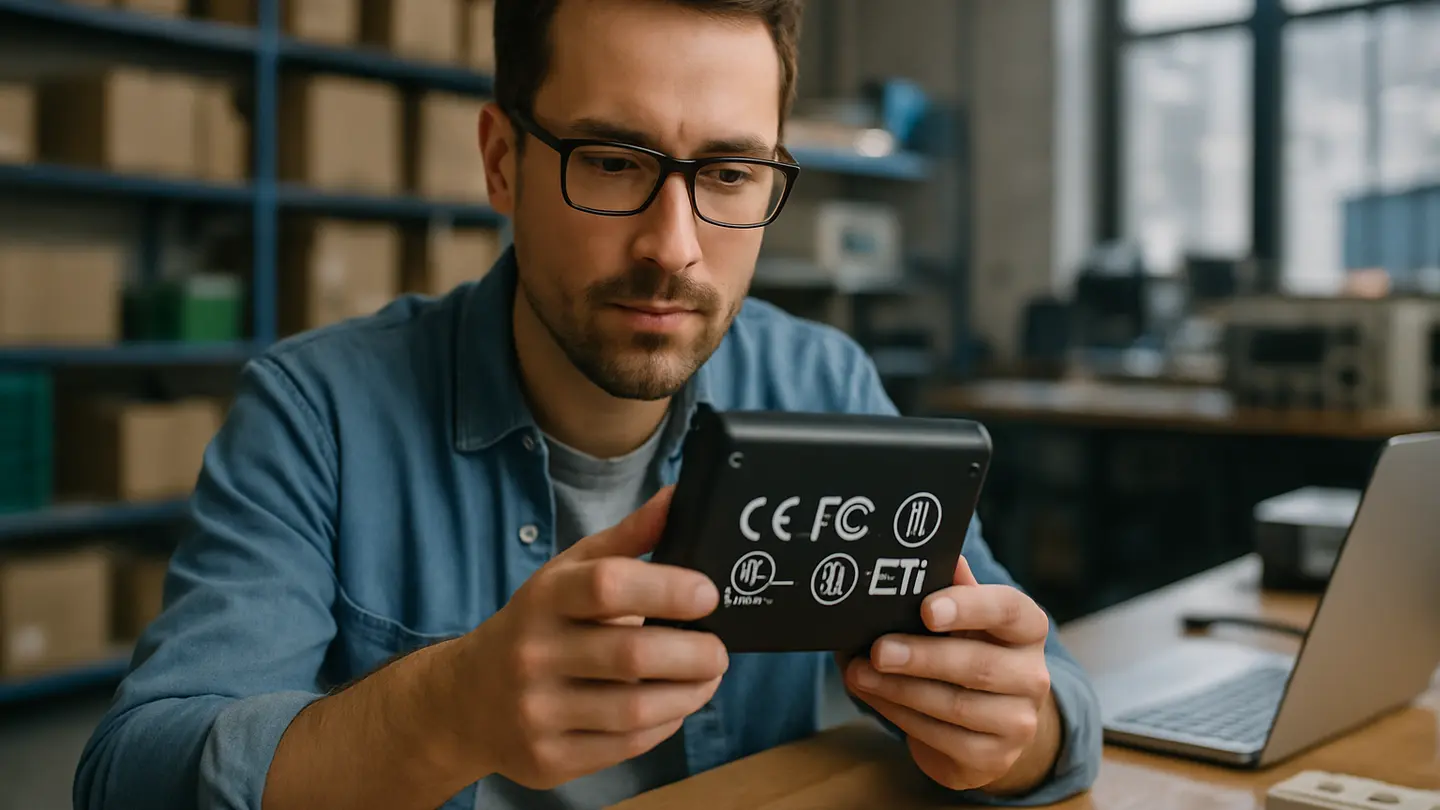
CE, FCC, UL, and ETL are often discussed as if they are interchangeable “certifications.” For importers, that is a costly misunderstanding. These marks serve different purposes: EU legal conformity, U.S. electromagnetic compliance, electrical safety testing, and market-access expectations from customers or sales channels.
A product may need several of them, only one of them, or none of them. The right answer depends on three practical factors: where the product will be sold, what the product does, and who will accept or reject it before it reaches the end user.
For B2B buyers sourcing wall-powered products, wireless controls, digital displays, bathroom electronics, shower accessories, or simple non-electronic goods, the safest approach is not to ask, “Does this product have CE FCC UL ETL certification?” The better question is: “Which rules and channel requirements apply to this exact product in this exact market?”
What CE, FCC, UL, and ETL Mean in Practical Terms
The four marks answer different compliance questions.
| Mark | Main purpose | Typical market relevance | What importers should understand |
|---|---|---|---|
| CE | Indicates conformity with applicable EU legislation | European Union and some related markets | Usually based on a manufacturer’s declaration, but some product categories require third-party involvement |
| FCC | Addresses electromagnetic emissions and radio-frequency compliance | United States | Can apply to electronics even when the product is not wireless |
| UL | Electrical and product safety testing by a recognized safety organization | Often requested in North America | Commonly linked to fire, shock, overheating, and electrical safety risks |
| ETL | Electrical and product safety testing by Intertek to applicable standards | Often requested in North America | Frequently treated as an alternative recognized safety mark where accepted by customers or channels |
CE is commonly misunderstood as a universal quality mark. It is not. In most cases, CE marking means the manufacturer declares that the product meets the EU legislation that applies to that product category. For some higher-risk or specially regulated categories, a notified body or other third-party process may be required. For others, the manufacturer’s declaration and technical file are central.
FCC compliance is also narrower than many buyers think, but it is not limited to Bluetooth, Wi-Fi, or cellular products. In the U.S., FCC rules can apply to electronic devices that generate electromagnetic interference, including unintentional radiators such as products with digital controls, circuit boards, displays, motors, or switching power supplies.
UL and ETL are different from CE and FCC in practical use. They indicate testing by a recognized safety laboratory to applicable safety standards. For importers of plug-in appliances, powered bathroom products, illuminated mirrors, smart shower controls, pumps, heaters, or other electrical goods, UL or ETL may be essential even when not directly mandated by a federal product-specific law. Major customers, retailers, distributors, insurers, and marketplaces may require one of these marks before they will handle the product.
This distinction matters. CE and FCC are legal compliance matters where applicable. UL and ETL are often market-access requirements in practice, especially for electrical products sold through structured retail or commercial channels.
The Common FCC Mistake: Ignoring Non-Wireless Electronics
Many importers only ask about FCC when a product has Wi-Fi, Bluetooth, Zigbee, cellular, or another wireless function. That is too narrow.
FCC rules also address devices that can unintentionally emit electromagnetic interference. A product does not need to transmit data wirelessly to create interference. Circuit boards, touch controls, digital timers, LED drivers, motors, relays, power supplies, sensors, and display modules can all generate emissions that may need evaluation.
For example, a simple mechanical shower accessory with no power source will not raise the same FCC question as a digital shower controller, an LED bathroom mirror, an automatic soap dispenser with a circuit board, or a pump system with electronic speed control. The difference is not whether the product is “smart” in a marketing sense. The question is whether the product contains electronics that fall within FCC equipment authorization or testing rules.
Wireless capability adds a separate layer. A Bluetooth-enabled product may need radio-related FCC review in addition to assessment for other electronic emissions. The radio module, antenna design, enclosure, firmware, labeling, and integration method may all affect the compliance position. Using a pre-certified module can help, but it does not automatically clear the finished product in every configuration.
Importers should ask a qualified test laboratory or compliance adviser a product-specific question: “Do the electronics in this finished product trigger FCC testing, authorization, labeling, or documentation requirements?” That question should be asked before production, not after a marketplace listing is suspended or a shipment is questioned.
The Common CE Mistake: Assuming Every EU-Bound Product Needs the Mark
CE marking is not required for every product sold in the European Union. It is required only when applicable EU legislation calls for CE marking for that product category.
This is an important point because applying CE to a product outside CE-marking rules can itself be improper. A CE logo should not be treated as a decorative trust symbol or a general claim that a supplier is “certified.” It must be connected to specific legislation and supported by appropriate documentation.
The first step for EU-bound goods is therefore classification. What is the product? Is it electrical equipment? A radio product? Machinery? A construction-related product? A toy? A medical device? A pressure product? A simple accessory with no electronics? Different answers lead to different EU rules, standards, documentation, labeling, and importer obligations.
For B2B buyers, this classification step should be done on the exact product version that will be shipped. A CE declaration for a supplier’s similar model may not cover your private-label version, modified enclosure, changed power supply, different radio module, new battery, added display, or alternative component set.
Documentation should identify the product, model number, manufacturer, applicable legislation, standards used, and responsible party. A vague declaration that does not match the product description, label, manual, or invoice should not be accepted at face value.
Four Questions for Building the Right Certification Checklist
A practical compliance checklist starts with four questions.
1. Will the product be sold in the EU, the U.S., or both?
Destination market comes first. A CE file does not satisfy U.S. FCC obligations. A U.S. safety mark does not replace EU conformity documentation. If the product will be sold in multiple markets, the compliance checklist must be built market by market.
2. Does each destination market have rules covering this product category?
Do not start with the mark. Start with the product category. A wall-powered LED mirror, a thermostatic shower control, a battery-powered dispenser, a simple plastic shower caddy, and a wireless leak detector are not the same compliance problem.
Rules may relate to electrical safety, radio equipment, electromagnetic compatibility, restricted substances, labeling, batteries, packaging, energy efficiency, plumbing approvals, or other sector-specific obligations. CE, FCC, UL, and ETL are only part of the larger compliance picture.
3. Does the product contain electronics, radio functions, or both?
Electronics and radio functions change the analysis. A base product may be mechanically simple, but adding a digital display, sensor, motor, LED light, rechargeable battery, app control, or wall adapter can create new testing and documentation requirements.
A buyer sourcing two versions of the same product should not assume the compliance list is identical. A non-powered model, a USB-powered model, a wall-powered model, and a Bluetooth-enabled model may each require a different review.
4. Do customers, retailers, marketplaces, or insurers require a safety certification such as UL or ETL?
Legal compliance is not always enough for commercial acceptance. A distributor may require UL or ETL before adding the product to its catalog. A retailer may have its own vendor manual. A marketplace may request safety documentation during listing review. An insurer may expect recognized safety certification for products connected to mains power.
For importers, these channel requirements should be collected before supplier quotation. If the sales channel expects UL or ETL and the factory quote does not include the testing, labeling, ongoing certification fees, or approved component controls, the quoted price is incomplete.
How to Check Supplier Claims Before You Rely on Them
Supplier compliance claims are useful starting points, not final proof. Importers should verify them independently before relying on them in purchase orders, customs files, customer submissions, or marketplace listings.
Start by asking what each mark is meant to satisfy. Is it required by destination-market law? By a retailer? By a distributor? By an online marketplace? By an insurer? If no one can connect the requested mark to a specific requirement, it may be unnecessary—or it may be the wrong mark entirely.
Next, confirm scope. A certificate or test report for one model may not cover another. Common gaps include:
- Different model numbers from the one being purchased
- Reports issued for an older design
- Certificates covering only the power adapter, not the full product
- A radio report for a module, but no review of the finished product
- A CE declaration for a supplier’s standard version, not the buyer’s private-label version
- UL or ETL certification covering one factory location, not the actual production site
- Labels that display marks not supported by the file
Compliance files should clearly identify the covered goods and the company holding the certification or declaration. For safety marks such as UL and ETL, buyers should check whether the mark is listed for the product category, model, factory, and standard claimed. For CE files, the declaration and technical documentation should match the applicable EU legislation and exact shipped version. For FCC, model numbers, grantee details, test reports, labeling, and user manual statements should be reviewed against the finished product.
Private-label buyers should be especially careful. A supplier may show legitimate documents for its own branded model, but that does not always authorize a different brand, label, enclosure, adapter, or configuration. If the customer-facing model number changes, the compliance file must still provide a traceable connection to the product being sold.
When to Decide on Marks, Labels, Testing, and Cost
Compliance decisions belong at the design and quotation stage. Waiting until mass production has started can create avoidable cost, delay, relabeling, rework, or failed listing review.
The product brief sent to suppliers should state the destination markets, required marks, target standards where known, labeling requirements, manual requirements, and documentation expected before shipment. If the buyer is not sure which marks apply, the quote request should ask the supplier to separate standard product cost from testing, certification, labeling, and documentation cost.
Late feature changes are one of the most common causes of compliance problems. Adding wireless control, a wall-powered adapter, a rechargeable battery, LED lighting, a motor, or a digital control board may alter the testing plan. Even a component substitution after sample approval can affect safety, EMC, radio, or CE documentation.
Approved production samples should match the version sent for testing. If the lab tested one adapter, one PCB layout, one antenna location, one motor, or one enclosure, production should not quietly change those items unless the compliance impact has been reviewed.
Before final payment or marketplace submission, importers should check:
- Product labels and required compliance marks
- Model numbers on the product, packaging, manual, invoice, and reports
- User manual warnings and regulatory statements
- Power adapter documents, if sold as a bundle
- Test report dates and applicable standards
- Certificate holder and factory information
- Whether private-label branding is covered
- Photos of production units showing required labels
This review is much easier before shipment than after the goods arrive in the destination market.
FAQ
Q1: Which marks apply to a plain USB cable?
A plain passive USB cable may not need CE, FCC, UL, or ETL in the U.S., depending on its construction and how it is sold. It has no radio function, no active electronics, and no wall-power circuitry by itself.
For the EU, the answer depends on whether an applicable rule covers that specific type of cable and use case. If the cable contains a chip, indicator light, active circuitry, charging control, or other electronics, the analysis can change. The review should be based on the exact cable design, not the generic term “USB cable.”
Q2: How do I handle a product sold with a separate power adapter?
Assess the main product and the power adapter separately. A power adapter connected to mains electricity usually raises electrical safety questions and may need recognized safety certification or other market-specific documentation.
The main unit has its own compliance profile. It may involve electronics, radio functions, batteries, EMC requirements, product-category rules, or none of those. Bundled products often require multiple documents: one set for the adapter, another for the main product, and sometimes additional documentation for the complete package and labeling.
Q3: What about the UK, Canada, and Australia?
An EU and U.S. checklist does not automatically cover the UK, Canada, Australia, or other markets. Each country or region may have its own conformity mark, radio rules, electrical safety system, importer obligations, and labeling requirements.
Use the same decision process for every target market: identify the product category, determine whether electronics or radio functions are present, check legal requirements, and confirm channel expectations. Create a written mark list before asking suppliers for quotes so that pricing and lead times reflect the real launch plan.
Q4: Should I choose UL or ETL for the US?
There is no universal answer. UL and ETL acceptance can vary by product type, customer, retailer, marketplace, distributor, local authority, and insurer.
Before choosing, ask major customers and sales channels which safety marks they accept for the specific product category. Then request quotes and timelines from the relevant labs based on the actual product design. In many cases, ETL may be accepted where a recognized safety mark is required, but buyers should confirm acceptance before committing to tooling, labeling, or production.
Conclusion: Put the Required Compliance List in Writing
Importers should not treat CE, FCC, UL, and ETL as a single bundle to request from every supplier. Each mark should be tied to a specific legal requirement, customer requirement, retailer rule, insurer expectation, or marketplace need.
The required compliance list should be written into the purchase order before sample approval. It should identify the destination markets, covered model numbers, required labels, documents due before shipment, and consequences if the supplier changes components or factory location without approval.
Reject extra marks that cannot be linked to a real requirement. At the same time, do not accept vague supplier assurances when a required mark is missing or does not cover the exact product being purchased.
Before final payment, confirm the files, model coverage, labels, and certification claims against the production version. In compliance, “similar” is not enough. The certificate, declaration, or report must match the product you will actually import and sell.