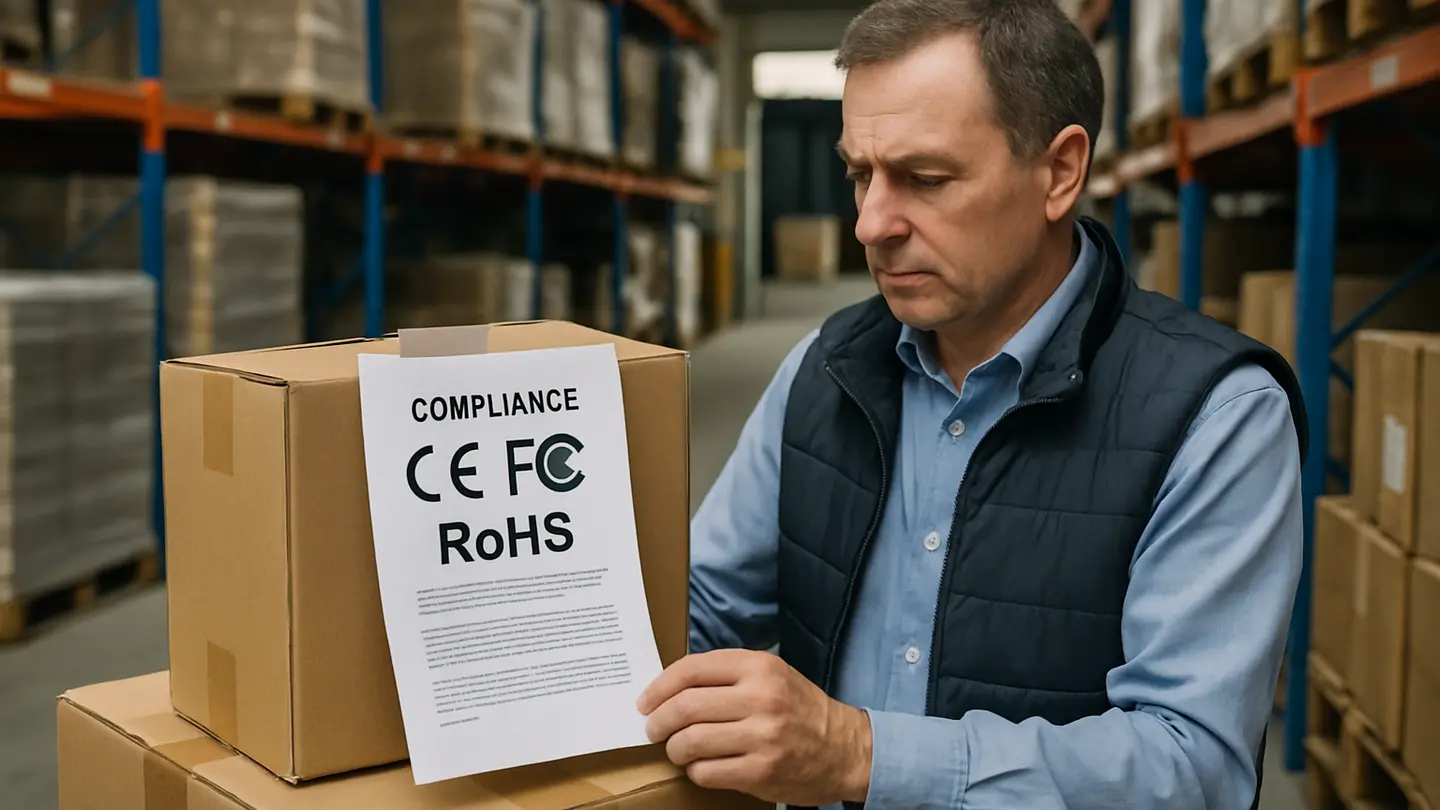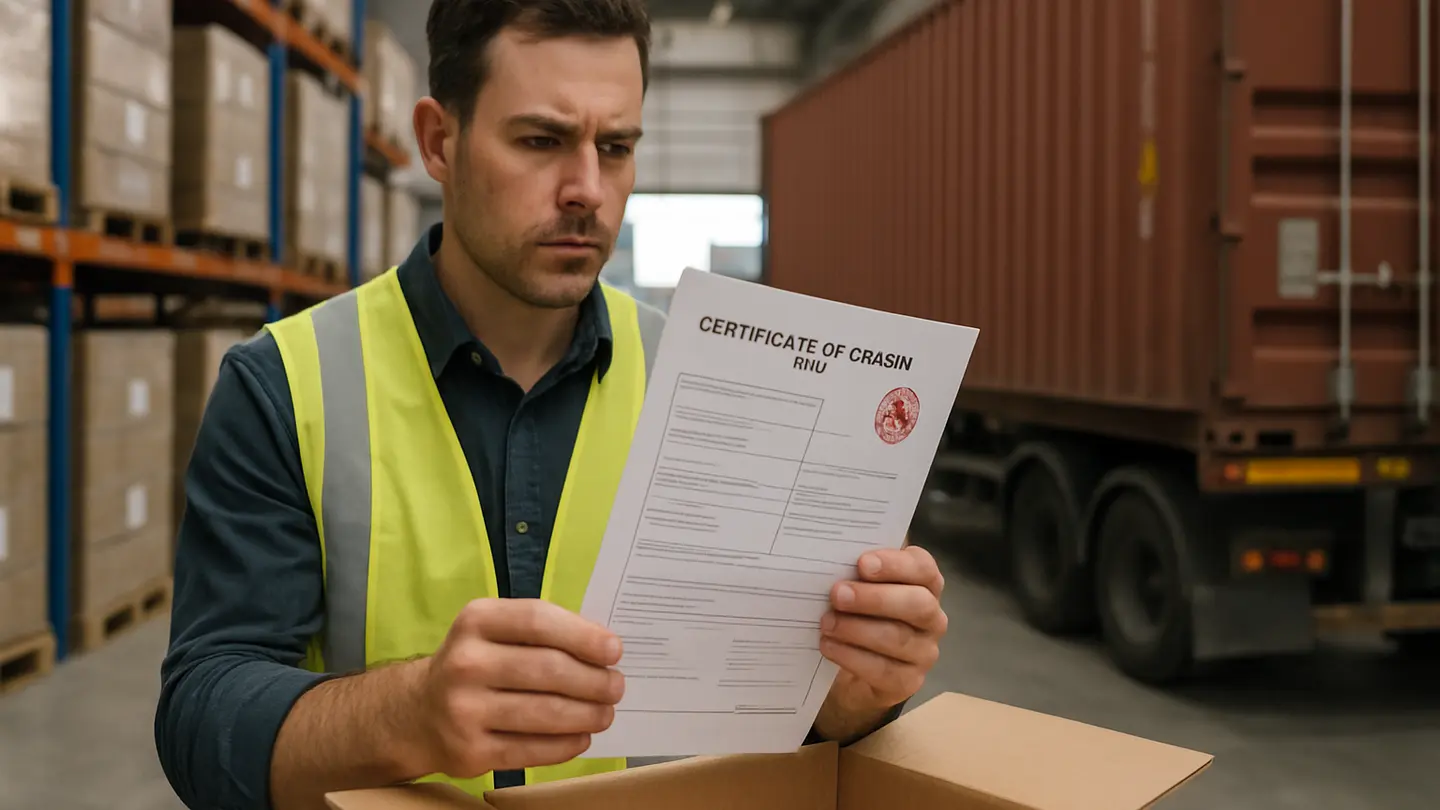
A certificate of origin from China is not automatically required for every shipment. Many routine imports clear with a commercial invoice, packing list, transport document, and product-specific compliance records, without a separate origin certificate.
The document matters when formal proof of legal origin is needed by customs, a buyer claiming preferential duty treatment, or a bank checking documents under a letter of credit or documentary collection.
Origin is determined by rules of origin, not simply by the supplier’s address or port of loading. Final assembly in China may be enough in some cases, but not in others. If imported components are used, processing is minor, or goods only pass through China, customs may assess origin differently from the commercial paperwork.
Importers should also avoid assuming that a general Chinese certificate reduces duty. For most US, EU, and UK importers, it confirms origin but does not create preferential tariff treatment. Before requesting one, check the destination customs requirement, any relevant trade agreement, and the wording required in payment documents.
The Main Situations That Make a Certificate Necessary
A certificate of origin is most likely to be needed for customs control, preferential tariff claims, or documentary payment requirements.
Customs may request origin proof when goods are regulated, the declaration appears inconsistent, or a shipment is selected for review. If origin affects duty, restrictions, labeling, or trade remedies, customs may ask for evidence beyond the commercial invoice.
Origin proof is especially important in anti-dumping, countervailing duty, safeguard, or other trade-remedy cases. These measures are often country-specific. If duties apply to goods of Chinese origin, customs may want assurance that the goods are not being transshipped through another jurisdiction to avoid the measure. If a buyer claims goods shipped from China are actually of another origin, that claim must be supported by production facts and credible documents.
Preferential duty claims are another common reason. Some countries have trade agreements with China or participate in regional frameworks that may allow reduced or zero duties for qualifying goods. Customs will not usually accept a generic certificate if the agreement requires a specific certificate, declaration, or approved format. The importer must provide the exact proof accepted under that agreement and ensure the product satisfies the applicable origin rule.
Bank payment terms can also make the certificate mandatory even when customs does not. Under a letter of credit, the bank examines documents against the credit terms. If the credit requires a certificate of origin with particular wording, consignee details, invoice references, or signatures, the exporter must present matching documents. A small mismatch can delay payment or trigger a discrepancy fee.
Many problems arise because the requirement is identified too late. Once goods are loaded, sailed, or presented to the bank, correcting names, quantities, invoice numbers, or origin wording may be slow and costly.
| Situation | Why the certificate matters | Practical risk if ignored |
|---|---|---|
| Customs asks for origin proof | Confirms declared origin for tariff, compliance, or risk review | Clearance delay, inspection, request for additional documents |
| Trade-remedy exposure | Supports true origin where anti-dumping or similar duties apply | Additional duties, penalties, or rejected origin claim |
| Preferential duty claim | Required evidence under a trade agreement | Loss of reduced-duty treatment |
| Letter of credit or documentary collection | Bank requires exact document presentation | Payment delay or document discrepancy |
General and Preferential Certificates Are Not the Same
Importers often use “certificate of origin” as if it refers to one document, but purpose matters.
A general certificate of origin confirms the origin of goods for ordinary trade, compliance, or documentary purposes. It may support a customs declaration, satisfy a buyer’s internal process, or meet a bank or customer contract requirement. It does not, by itself, grant lower duties.
A preferential certificate of origin is tied to a specific free trade agreement, regional trade agreement, or preferential tariff program. It must normally identify the relevant agreement and meet its format, data, and eligibility requirements. Preferential treatment applies only if the goods meet that agreement’s rules of origin.
Those rules may be based on:
- a change in tariff classification;
- a required percentage of regional or domestic value content;
- specific manufacturing or processing operations;
- wholly obtained criteria for agricultural or natural products; or
- combinations of the above.
Goods shipped from China are not always Chinese-origin for every legal purpose. A product may be exported from a Chinese port, invoiced by a Chinese supplier, and packed in China, yet fail a particular origin rule if the work performed in China is insufficient. Conversely, a product using imported materials may qualify if Chinese processing meets the relevant rule.
If the goal is to support a normal declaration or bank checklist, a general certificate may be enough. If the goal is reduced duty, identify the applicable trade agreement first and obtain the accepted origin proof for that agreement.
How the Requirement Varies in the US, EU, UK, Australia, and New Zealand
Requirements vary by destination, product, tariff treatment, and customs risk profile. Importers should confirm current rules with a broker or customs adviser, but several broad patterns are useful.
United States. Routine US entries usually do not require a Chinese certificate of origin. The importer must still declare the correct country of origin, which can affect normal duty, Section 301 tariffs, anti-dumping or countervailing duties, marking rules, and other measures. A general Chinese certificate may help support the declaration if questioned, but it is not normally a duty-reduction tool for Chinese-origin goods.
European Union. EU importers usually declare non-preferential origin as part of the customs entry. For ordinary imports from China, a general Chinese certificate is not normally a standard requirement. Customs may ask for evidence where origin affects anti-dumping duties, quotas, product controls, or risk review.
United Kingdom. For UK importers, a general Chinese certificate may evidence origin when requested, but it normally does not reduce duty on its own. If a preferential claim is available under a specific arrangement, the importer needs the origin proof required by that arrangement.
Australia. Australian importers claiming benefits under the China-Australia Free Trade Agreement generally need accepted origin proof under that agreement. Depending on the goods and circumstances, this may involve a certificate or another approved form of origin documentation. Without correct proof, the shipment may clear at the normal duty rate even if the goods would otherwise qualify.
New Zealand. New Zealand may accept different forms of origin evidence depending on the claim and circumstances, including certificates, exporter declarations, or other adequate evidence. The acceptable proof depends on the relevant trade arrangement, the importer’s records, and any customs request.
The better question is not simply “Do I need a certificate?” but: What origin proof will the destination authority or bank accept for this shipment and this claim?
Issuers in China, Application Process, and Possible Costs
In China, certificates of origin are commonly issued through bodies such as the China Council for the Promotion of International Trade (CCPIT) and China Customs. The appropriate issuer may depend on the certificate type, destination country, trade agreement, product, and exporter’s registration status.
The exporter in China normally applies. The importer provides instructions, confirms the destination requirement, and checks draft details. The exporter submits shipment and product information to the issuing body, often based on the invoice, packing list, contract, HS code, and manufacturing or origin details.
Costs may include:
- official issuance cost, which may be low or sometimes not charged separately depending on the system and document type;
- supplier handling fee, if the supplier charges for preparation and submission;
- agent or freight forwarder fee, if a third party manages the process;
- courier cost, if originals must be sent internationally; and
- expedited processing fee, if requested urgently.
The larger cost may be delay: corrected documents, reissued certificates, missed clearance timing, or a bank presentation deadline.
Post-shipment issuance is possible for some certificates, but rules and time windows vary. Some preferential certificates have stricter timing requirements than general certificates. If the certificate may be needed at destination clearance, confirm before shipment whether a post-shipment certificate will be accepted.
Verification also matters. Importers should verify the certificate through the issuing authority’s own verification channel or database where available, especially when documents come through a trading company, agent, or unfamiliar exporter. A certificate that looks formal but cannot be verified may not satisfy customs or a bank.
Document Checks to Complete Before the Shipment Leaves China
The best time to review a certificate of origin is before the exporter submits the final application. At draft stage, changes are usually simple. After issuance, errors may require amendment, cancellation, or reissue.
The certificate should be consistent with the commercial invoice, packing list, bill of lading or air waybill, sales contract, and bank documents. Exact matching is especially important under letters of credit.
Key fields to check include:
- exporter or consignor name;
- buyer, consignee, or notify party name;
- invoice number and invoice date;
- product description;
- HS code, if shown;
- quantity, gross weight, net weight, and package count;
- marks and numbers;
- transport details if required;
- country of origin;
- origin criterion or origin basis, especially for preferential documents;
- certificate type and issuing authority;
- signatures, stamps, and issue date.
Product descriptions should not conflict with the invoice or customs declaration. If the invoice states “tempered glass shower door set” and the certificate states only “glass products,” customs or a bank may ask questions. If the invoice includes several items under different HS codes, the certificate should not collapse them into a vague description that undermines classification or origin review.
Trading-company exports add complexity. A buyer may order from a Shenzhen or Hong Kong trading company while goods are manufactured by a factory in another mainland province. For a general certificate, the trading company may coordinate the document through the mainland exporter. For a preferential certificate, the issuer may require manufacturing details or origin data that only the factory can provide. For bank documents, the exporter name may need to match the letter of credit exactly.
Importers should give suppliers written document instructions before production is complete. State the certificate type, destination requirement, issuer if specified, consignee wording, invoice reference, and any bank wording required.
Samples and Small Trial Orders: Is a Certificate Worth Requesting?
For samples and small trial orders, a certificate is usually unnecessary unless customs requests one, the importer is making a duty claim, or payment documents require it.
Many samples move by courier and clear with simplified documentation. A general certificate may add no practical benefit, especially for trial orders shipped to the US or Europe where it does not reduce duty. If the shipment is low value and non-regulated, the cost and time may outweigh the advantage.
Exceptions include regulated products, goods exposed to trade-remedy measures, or items imported for certification testing. If the trial order may become evidence for future tariff treatment or compliance review, proper origin documentation can be useful.
The practical test is whether the certificate changes clearance, duty, compliance, or payment. If not, it may be better to save the cost and lead time.
Express Courier Shipments and Simplified Clearance
Small express courier parcels often clear under simplified customs procedures. The courier may submit basic data electronically, and a formal certificate of origin may not be requested.
Simplified clearance is not guaranteed. Rules depend on the destination country, declared value, product type, importer status, and whether the goods are restricted or regulated. A courier shipment that exceeds the low-value threshold or contains goods subject to special controls may require a full customs declaration.
Once a full declaration is required, normal origin-document rules may apply. Customs can question origin, ask for evidence, or deny a preferential claim if accepted proof is missing. Shipping by courier changes the clearance process for eligible parcels; it does not remove origin obligations.
When Mainland China Goods Are Invoiced by a Hong Kong Company
Goods manufactured in mainland China are often sold through a Hong Kong company. This invoicing structure does not normally change origin. If the goods are manufactured in mainland China and meet the relevant origin rule as Chinese-origin goods, they generally remain Chinese-origin even when the invoice is issued by a Hong Kong entity.
The certificate should normally be arranged through the mainland exporter or relevant mainland issuing authority. The importer should check whether the certificate must show the manufacturer, exporter, seller, or consignee in a particular way.
Problems can arise when the invoice shows one company, the bill of lading another, and the certificate a third. Such structures may be legitimate, but they should be documented consistently. If a letter of credit is involved, confirm that the permitted wording allows the structure before shipment.
Whether to Hold a Shipment While Waiting for the Certificate
If the supplier needs more time to obtain the certificate, the importer should check the consequence before releasing or holding the shipment.
First, confirm whether the certificate can be issued after shipment. Some certificates allow post-shipment issuance within a defined period, while others have stricter timing rules. Verify the deadline and whether destination customs will accept a certificate issued after departure.
Second, check whether customs needs the original certificate at clearance. A scanned copy may be enough for preliminary review in some cases, with the original to follow. In others, the claim may not be accepted without the original or a verifiable electronic certificate.
Third, consider bank-document deadlines. Under letters of credit and documentary collections, documents usually must be presented within a specified number of days after shipment and before credit expiry. Waiting for a certificate may create a discrepancy if timing is missed.
Sometimes holding the shipment is safer than shipping without the certificate, paying full duty, and trying to recover the difference later. In other cases, if the certificate can be issued after shipment and the importer can clear without it, holding the goods may only add storage and delay. The right decision depends on the destination rule, duty amount, urgency, and payment terms.
Key Takeaways for Importers
A certificate of origin from China is not automatically required for every import, and a general certificate is not the same as preferential origin proof. Identify the real reason for the document before requesting it.
Before goods leave China or bank documents are submitted, confirm:
- whether customs, a trade agreement, or payment terms require origin proof;
- the exact certificate type or declaration accepted;
- the required issuer, format, wording, and timing;
- whether post-shipment issuance is allowed;
- whether originals are needed for clearance or banking; and
- whether the certificate details match the final invoice and shipping documents.
Give suppliers clear document instructions early, especially when a trading company, Hong Kong invoicing entity, or letter of credit is involved. Reviewing a draft certificate before issuance can prevent avoidable customs delays, lost duty benefits, and payment disputes.