Can China Bag Manufacturers Produce Your Custom Design?
Many buyers begin with a simple question: can China bag manufacturers make an original product from a sketch, mood board, or technical drawing, rather than simply reproduce an existing bag?
The answer depends far more on the supplier’s development process than on the number of catalog products it displays. A factory may be effective at producing established styles but lack the pattern-making, sampling, material-sourcing, or engineering capability needed for a new design. Conversely, a supplier with fewer online listings may have an experienced sample room and be better equipped to translate a concept into repeatable production.
The strongest early capability signals are practical. A qualified supplier should ask questions about construction, materials, dimensions, use cases, load requirements, hardware, lining, branding, and expected order volume before issuing a final quotation. It should also be able to show comparable custom projects, not only generic product photos.
For a custom bag program, evaluate whether the supplier can develop the product, not merely sew a version of it.
A Bag Is a Multi-Component Product, Not a Simple Sewing Project
A bag combines many materials and operations into one finished product. Depending on the design, these may include:
- Shell materials such as leather, PU, nylon, canvas, polyester, or coated fabrics
- Lining fabrics and internal pocket materials
- Foam, board, nonwoven backing, or other reinforcement materials
- Zippers, sliders, pulls, snaps, buckles, D-rings, feet, rivets, and other hardware
- Webbing, shoulder straps, handles, piping, binding, and edge treatments
- Printed, embossed, embroidered, woven, or metal branding elements
- Cutting, skiving, stitching, edge painting, assembly, finishing, and packing operations
These elements are interconnected. A thicker shell material may require different needle sizes, sewing settings, reinforcement methods, or edge-finishing processes. A heavier bag may need wider webbing, stronger strap attachments, and added reinforcement around handles. A waterproof outdoor bag may require seam sealing or welding rather than conventional stitched construction.
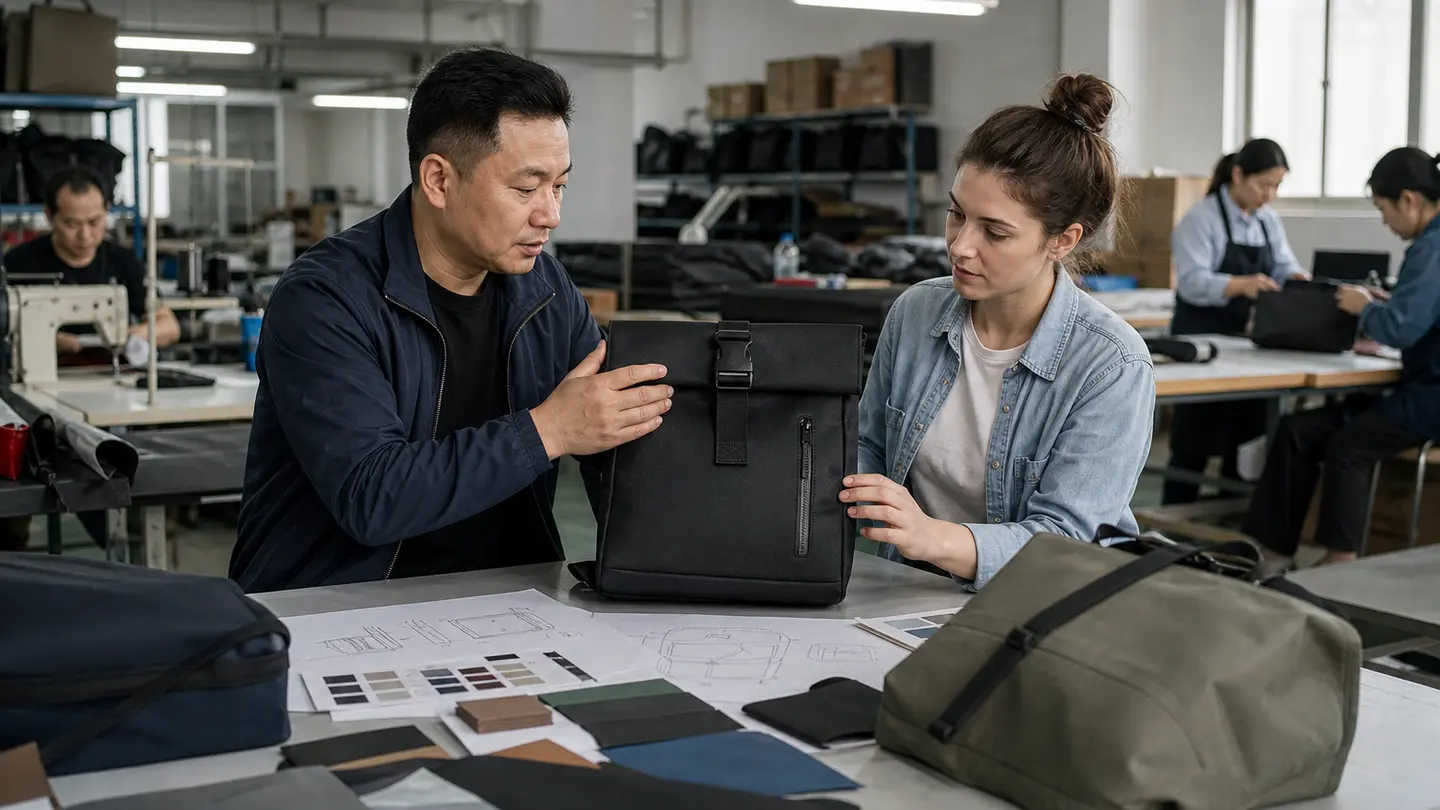
This is why genuine product development differs from copying a sample. Development usually involves creating or modifying patterns, selecting compatible materials, producing samples, testing construction logic, and coordinating components from several suppliers.
Even a seemingly minor feature can affect the entire production process. Adding an exterior pocket may require new pattern pieces, extra lining, additional stitching operations, and reinforcement. Changing a zipper compartment into a magnetic flap can alter the material structure, hardware requirements, and assembly sequence.
When assessing China bag manufacturers, ask how the factory manages these dependencies. A supplier that can explain pattern development, material sourcing, and sample revisions is generally better positioned to handle original work than one that only asks for a reference image.
Understand China’s Major Bag Manufacturing Clusters
China’s bag industry is spread across several manufacturing regions, and each area may have stronger supply chains for particular product categories. Location alone does not prove capability, but it can help buyers identify where relevant materials, labor skills, and component suppliers are commonly available.
| Manufacturing area | Common product focus | Buyer consideration |
|---|---|---|
| Guangzhou and the Pearl River Delta | Fashion handbags, wallets, accessories, and leather-look products | Often relevant for style-driven products with decorative hardware, structured silhouettes, and detailed finishing |
| Quanzhou and Hui’an, Fujian | Backpacks, school bags, sports bags, outdoor bags, and functional sewn products | Often relevant for performance fabrics, webbing, padding, and utility-focused construction |
| Baigou, Hebei | Luggage, travel bags, and broader bag supply chains | Can be relevant for travel-oriented products and suppliers handling luggage-related components |
These regional associations should be treated as starting points for supplier discovery, not as a substitute for factory evaluation. A handbag supplier in one region may be capable of producing a backpack, while a factory in an outdoor-bag cluster may also handle fashion accessories. The relevant question is whether it has proven experience with your required construction.
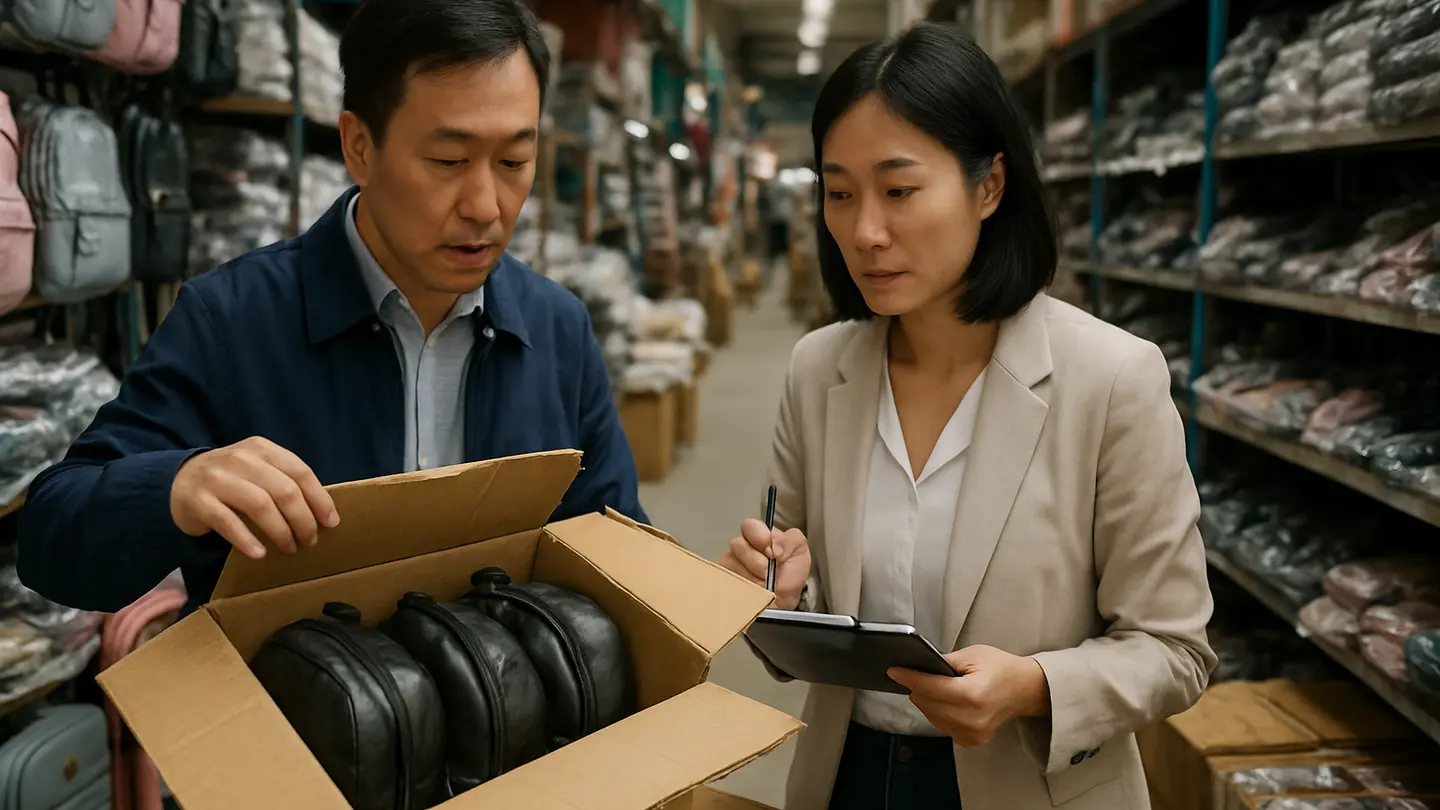
Buyers should also distinguish between wholesale-market locations and actual production locations. A showroom, trading company, or wholesale market may display many bag styles, while the workshop producing those products may be elsewhere. Clarify whether the company owns the production facility, manages contracted workshops, or acts as an intermediary.
Match Your Bag Construction to the Factory’s Actual Equipment
A factory’s machinery and workforce skills must match the construction of the intended bag. General sewing capability is not enough for every design.
For example:
- Edge-painted handbags may require edge-skiving, folding, sanding, painting, drying, and polishing processes.
- Thick leather or reinforced canvas bags may require machines and operators capable of consistent stitching through multiple material layers.
- Quilted bags require accurate panel alignment, controlled padding placement, and repeatable quilting operations.
- Water-resistant or waterproof designs may require compatible coated fabrics, seam sealing, or seam welding equipment.
- Structured bags may require experience with board reinforcement, molding, shaping, and controlled assembly sequences.
Ask suppliers which processes are completed in-house and which are subcontracted. Subcontracting is not automatically a problem, but it can increase lead-time uncertainty, reduce direct quality control, or complicate accountability if a specialist process fails.
Unapproved design simplification is another warning sign. If a supplier changes a zipper type, removes reinforcement, replaces edge paint with binding, or alters a pocket construction without discussing it, the issue may be capability, cost pressure, or weak communication. The supplier may have a valid manufacturing concern, but it should be raised and resolved before sampling or production.
A factory visit can be useful when the project is high value or technically demanding. If an in-person visit is not practical, request a live production walkthrough showing the sample room, cutting area, sewing lines, material storage, hardware handling, and quality-control process. The objective is not to inspect every machine remotely; it is to verify that the supplier’s claimed processes are part of its routine operation.
Validate Development Capability Before Comparing Prices
A low quotation has little meaning if suppliers are pricing different products. Before comparing prices, ensure that each factory is working from the same assumptions.
A meaningful quotation should identify, at minimum:
- Shell material type, grade, thickness, weight, or coating requirement
- Lining material and approximate quality level
- Hardware type, finish, and branding requirements
- Zipper brand or performance specification where relevant
- Stitching expectations and construction complexity
- Packaging requirements
- Expected order quantity and colorway breakdown
- Sampling, tooling, or development charges where applicable
A price difference may result from a different lining weight, lower-grade zipper, thinner reinforcement, simpler hardware plating, fewer stitches, or an omitted construction operation. These differences may not be obvious in a basic spreadsheet quotation.
Review comparable physical samples whenever possible. Samples can reveal whether the supplier’s pattern work is accurate, whether corners and curves are well finished, whether hardware is installed cleanly, and whether seams are consistent. A supplier’s catalog photo does not provide the same evidence.
Basic company identity verification is still useful, but it is not the same as confirming development and production capacity. A legitimate operating company may still rely heavily on subcontractors, lack an internal sample team, or be unable to control complex production. Evaluate the actual product-development process, not only the company profile.
Send a Complete Tech Pack Instead of Only Product Photos
A product photo is useful for communicating style direction, but it rarely contains enough information for accurate bag development. A detailed tech pack reduces interpretation gaps and gives suppliers a clearer basis for sampling and pricing.
A practical bag tech pack should include:
- Multi-angle drawings or photographs showing front, back, sides, bottom, interior, and key details
- Exact external and internal dimensions
- Material specifications for shell, lining, reinforcement, webbing, and trims
- Color references for each component
- Hardware type, size, finish, and placement
- Zipper type, length, puller style, and color
- Stitching, piping, edge-painting, binding, or quilting instructions
- Branding artwork, logo dimensions, and placement details
- Label, hangtag, packaging, and carton instructions
- Required use case or load expectations where applicable
If a detail is not specified, the supplier may choose its standard method or make a decision based on cost assumptions. That can produce a sample that appears close to the intended design but differs in important functional or aesthetic details.
The first sample should not be treated only as a pass-or-fail event. It is also an opportunity to identify unresolved specification gaps. Review it against the tech pack and document all changes, including those affecting hidden construction, dimensions, hardware, and materials.
Approve Internal Construction, Not Only the Finished Appearance
A bag can look correct on a table and still fail during use. Durability often depends on concealed construction details that are not visible in product photography.
Quality-critical areas commonly include:
- Shoulder strap attachments
- Handle connections
- Internal reinforcement panels
- Back-panel and bottom reinforcement
- Zipper-end construction
- Seam allowances and stitch density
- Rivet placement and backing
- Internal pocket attachment points
For example, a shoulder strap may be sewn through the shell material but lack sufficient reinforcement inside the bag body. A handle may look neat externally but pull loose if the attachment point is not properly supported. These issues can be difficult to detect after the bag is fully assembled.
Document concealed construction requirements in the product specification. Where the product will carry meaningful weight, define load-test criteria clearly: the intended load, the duration of the test, and the pass condition. Avoid vague requests such as “make it strong.” A measurable requirement is easier for both buyer and supplier to interpret.
For complex designs, a cutaway sample or partially assembled sample can help verify reinforcement, foam placement, seam structure, and internal material layers before full production begins.
Plan for Sampling Rounds, Minimums, and Production Timing
Custom bag development commonly requires more than one sample round. The first sample may confirm overall size and structure. Later rounds may address material changes, hardware selection, logo treatment, fit of internal components, or finishing improvements.
Buyers should retain an approved physical sample as the production reference. This sample can be compared with bulk goods if questions arise about construction, color, hardware, or workmanship.
Minimum order requirements may also come from components rather than the finished bag itself. Separate minimums may apply to:
- Custom-dyed shell materials
- Special lining colors
- Branded hardware
- Custom zipper pulls
- Printed or embossed logos
- Woven labels
- Hangtags and packaging
As a result, a small finished-product order may still require purchasing more material or components than immediately needed. Buyers should ask suppliers to identify these minimums early rather than discovering them after sample approval.
Consolidating colorways can sometimes reduce minimum-order pressure more effectively than simply reducing unit volume. Producing one or two colors in a meaningful quantity may be easier to manage than producing many colors in very small runs.
Identify the Design and Material Factors That Drive Bag Costs
Material price is important, but it does not fully determine the cost of a bag. Construction complexity, labor time, yield loss, component quality, and finishing requirements can all materially affect the quotation.
Common cost drivers include:
| Cost factor | Why it affects the quote |
|---|---|
| Leather or premium material | May have natural variation, defects, lower usable yield, and more demanding handling |
| High panel count | Adds cutting, alignment, stitching, and assembly time |
| Curved seams and shaped panels | Require more careful sewing and can increase material waste |
| Heavy lining or reinforcement | Adds material cost and may slow assembly |
| Zipper specification | Brand, size, coil type, puller, and finish can affect both cost and reliability |
| Hardware finish | Plating, custom shapes, engraving, and color matching may add cost |
| Edge painting or detailed finishing | Requires multiple operations and more controlled workmanship |
| Custom packaging | Can create separate material minimums and handling requirements |
When comparing supplier quotations, request pricing against equivalent specifications. If one supplier is much lower, ask it to confirm the material, lining, zipper, hardware finish, reinforcement, and packaging assumptions.
It can also be useful to request defined upgrade prices. For example, ask for the difference between a standard zipper and a specified zipper model, or between a basic metal finish and a higher-detail finish. This can reveal whether the price gap comes from a genuine operational advantage or from lower construction specifications.
Protect Your Design and Inspect the Full Production Batch
Design protection and supplier evaluation should be managed together. During initial screening, buyers can share enough information to confirm whether a supplier has relevant experience. Once a supplier is shortlisted, it needs complete specifications to produce an accurate quotation and meaningful sample.
A clear development agreement should address practical issues such as pattern ownership, sample ownership, use of buyer-provided artwork, and responsibility for approved revisions. The appropriate arrangement depends on the project, but ambiguity should be resolved before bulk production.
Approved samples are essential because they establish a physical reference for production. However, do not assume that a successful sample automatically guarantees consistent bulk output. Production drift can occur through changes in materials, hardware, stitch quality, dimensions, color matching, or internal reinforcement.
Quality checks should assess the batch, not only selected presentation samples. A pre-shipment inspection can help identify deviations before goods leave the factory, including:
- Incorrect shell, lining, zipper, or hardware components
- Inconsistent logo placement
- Stitching defects or skipped stitches
- Color variation
- Poor edge finishing
- Incorrect dimensions
- Missing reinforcement
- Packaging errors
Inspection criteria should be linked to the approved sample and documented specifications. If an issue is critical to durability or brand presentation, define it before production rather than relying on a general request for “good quality.”
FAQ
Q1: How different are leather and PU factories?
Leather and PU can require substantially different handling. Natural leather hides vary in grain, thickness, usable area, and visible defects, so cutting decisions often require more judgment. PU is commonly supplied in rolls and may offer more consistent surface appearance, but it can behave differently during cutting, folding, stitching, and edge finishing.
A supplier’s claim that it works with both materials is not enough. Review comparable products made from the relevant material and inspect whether the finishing, panel alignment, edge treatment, and structure meet your expectations.
Q2: Should I specify a zipper brand or let the factory choose?
Where zipper performance matters, specify the required zipper brand and model rather than leaving the decision entirely to the factory. Zippers are durability-critical components, particularly on travel bags, backpacks, work bags, and frequently opened compartments.
The approved zipper should be stated in the specification and checked during inspection. Buyers should also pay close attention to strap joins, handles, seam quality, and hardware installation, since these areas can affect product life as much as the zipper itself.
Q3: Can I reuse the same pattern in a different material?
Not always. Changing the main material can affect thickness, stretch, stiffness, cutting behavior, edge treatment, and sewing performance. A pattern that works in a flexible PU may require changes when produced in thicker leather or a structured coated fabric.
A new sample round is generally advisable whenever the primary shell material changes. This helps confirm dimensions, shape retention, seam appearance, and assembly feasibility before bulk production.
Q4: Who pays for samples and development work?
Buyers commonly pay development and sample fees for custom bag projects. These fees may cover pattern making, material sourcing, labor, sample construction, and revisions, depending on the supplier’s policy and the complexity of the design.
A waived sample fee may mean the supplier is adapting an existing product, limiting development work, or applying its own commercial policy. Before development begins, agree on what the fee covers, whether revision samples are charged separately, and whether any portion may be credited against a future production order.
Conclusion: Choose a Factory That Can Engineer the Design
China bag manufacturers can produce custom designs, but not every supplier is equipped to turn an idea into a production-ready product. The key capability is the ability to convert a design into workable patterns, source compatible materials and components, construct reliable samples, and repeat the approved result at scale.
Before making price the primary decision factor, assess comparable products, sample quality, pattern-making capability, equipment, subcontracting arrangements, and responsibility for quality control. A complete tech pack, approved physical sample, and documented internal construction requirements give both parties a stronger basis for production.
Clarify pattern ownership, development responsibilities, component specifications, and inspection requirements before bulk production begins. These steps reduce avoidable misunderstandings and help ensure the finished bag reflects the intended design rather than a supplier’s assumptions.
About the Author
The author is a B2B sourcing and product-development writer focused on supplier evaluation, manufacturing communication, specification control, and quality-risk management. Their work helps buyers assess production capability before committing to custom manufacturing programs.