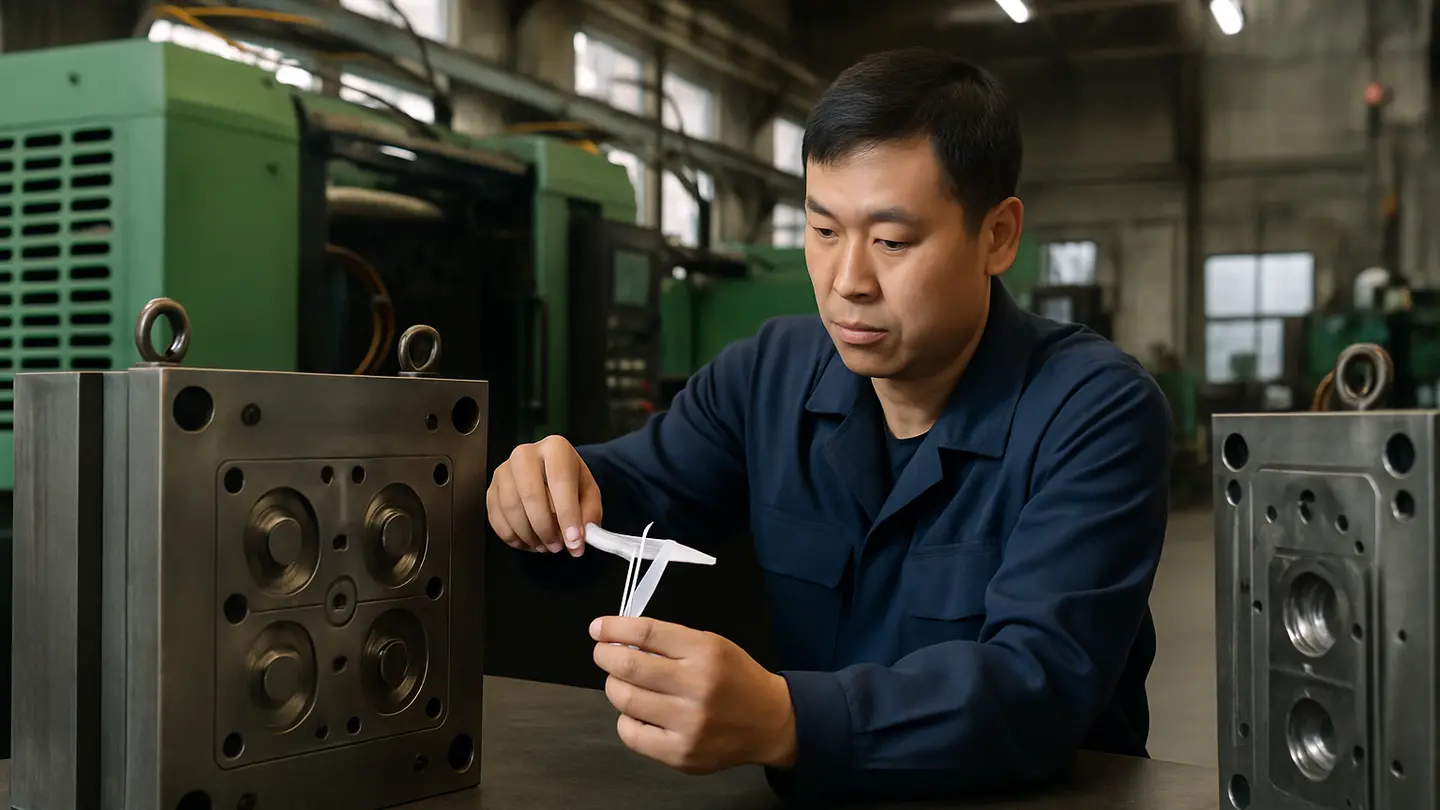
China injection molding costs are best understood as a tooling-and-volume decision, not simply a search for the lowest per-part price. The mold is the upfront investment that determines what can be produced, how consistently it can be produced, and how many parts must be sold before the economics make sense.
For B2B buyers, the key question is not “How cheap is the part?” but “Can the expected annual demand recover the tooling cost while maintaining the required quality?” A small plastic bracket, shower trim component, enclosure, valve-related housing, or packaging insert may look inexpensive at the unit-price level, but the total business case changes once tooling, sampling, inspection, finishing, packaging, freight, and duties are included.
Higher repeat volumes can justify stronger production molds, additional cavities, tighter process control, and lower unit pricing. Low volumes, uncertain forecasts, or unstable designs often cannot. Part size, geometry, resin grade, finish requirements, tolerances, and order frequency all affect where that threshold sits.
Before Tooling: Does the Part Need a Custom Mold?
A custom mold should not be opened until the buyer has two things: realistic demand and a stable design. Injection molding is efficient once production is repeatable, but it is unforgiving when a product is still changing.
For an unproven product, alternatives may be more sensible at the validation stage. Buyers can test the market with stock plastic parts, standard enclosures, machined samples, 3D-printed prototypes, urethane casting, or a soft validation tool before committing to production tooling. These options may carry a higher unit cost, but they reduce the risk of paying for a mold that becomes obsolete after the first design revision.
This matters because design changes after mold fabrication can be expensive. Minor adjustments may be possible through steel-safe modifications, inserts, polishing, or local rework. But changes to parting lines, undercuts, wall sections, ribs, bosses, gates, cooling channels, or cosmetic surfaces can require major mold modification. In some cases, the original tool cannot be economically salvaged and a new mold is needed.
Before approving tooling, buyers should confirm:
- The product demand is more than speculative.
- The 3D CAD model and 2D drawings are controlled and approved.
- Critical dimensions and tolerances are defined.
- Resin, color, finish, and surface texture are known.
- Assembly interfaces have been tested.
- Regulatory, safety, chemical, or temperature requirements are understood.
- Expected annual volume and order frequency are realistic.
For shower manufacturers and other component buyers, this is especially important when molded parts must fit with metal, rubber, ceramic, or electronic assemblies. A small dimensional change in a molded housing, button, cover, handle, bracket, or cartridge-related component can affect assembly yield and warranty risk.
Tooling Choices That Shape Cost, Risk, and Production Life
A mold quote should be more than a single price. It should clearly state what the buyer is actually purchasing. At minimum, the quote should identify the cavity count, mold steel or material, expected tool life, sampling scope, surface finish, runner system, lead time, and ownership terms.
Tooling cost is influenced by several engineering and commercial choices:
| Tooling factor | Cost impact | Buyer consideration |
|---|---|---|
| Mold material | High | Aluminum, P20, H13, S136, and other steels differ in cost, durability, polishability, and corrosion resistance. |
| Cavity count | Medium to high | More cavities increase tooling cost but reduce machine time per part. |
| Slides and lifters | High | Needed for undercuts or complex geometry, but add machining, maintenance, and failure risk. |
| Hot runner vs. cold runner | Medium to high | Hot runners reduce runner waste and can improve cycle efficiency, but add cost and maintenance complexity. |
| Surface finish | Medium | High-gloss, textured, or cosmetic surfaces require better machining, polishing, and process control. |
| Expected tool life | High | A pilot mold for thousands of shots is different from a production mold expected to run hundreds of thousands or more. |
| Maintenance responsibility | Commercial risk | The quote should say who pays for routine maintenance, repairs, and storage. |
Lower-cost tooling can be appropriate for pilot runs or controlled launch quantities if its lifespan matches the plan. It becomes risky when the buyer expects repeat production but the mold has been built only for limited output. A tool that looks cheap at the quoting stage can become costly if it wears quickly, flashes, sticks, warps parts, or cannot hold dimensions over time.
Ownership terms also need attention. Buyers should clarify whether they own the mold, whether it is dedicated exclusively to their parts, where it will be stored, and whether it can be transferred to another factory. Contracts should address mold custody, transfer rights, maintenance records, access to design files, and what happens if production is moved.
If the mold remains in the supplier’s facility, practical control still depends on written terms. “Buyer-owned tooling” is only meaningful if the buyer can inspect, transfer, or retire the mold according to agreed procedures.
How to Compare Injection Molding Quotes from China
Comparing injection molding quotes from China requires a consistent format. Two quotes may look similar at the total price level while making very different assumptions about tooling quality, resin grade, cycle time, finish, scrap, packaging, or inspection.
Ask each supplier to separate the following line items:
- Mold cost
- Mold design and DFM review
- Sampling charges
- Per-part price by quantity tier
- Resin grade and resin brand, if specified
- Color matching or masterbatch cost
- Secondary operations
- Printing, coating, plating, ultrasonic welding, or assembly
- Packaging
- Inspection and testing
- Export carton, pallet, and labeling requirements
- Domestic transport in China
- Trade terms, such as EXW, FOB, CIF, or DDP
The quote should also define mold complexity. Important variables include cavity count, slides, lifters, tolerances, surface finish, parting line requirements, gate location, wall thickness, and part geometry. Cosmetic parts require closer review because sink marks, flow lines, weld lines, gloss variation, or gate vestige may be unacceptable even when dimensions are correct.
Per-part pricing should be requested at different production levels. A useful RFQ may ask for pilot, launch, and repeat-volume pricing, such as 500 units, 2,000 units, 10,000 units, and annual volume. This makes it easier to see whether the supplier is pricing for small-batch flexibility or high-volume efficiency.
Minimum order quantity should also be clarified. MOQ may apply by color, version, material, individual part number, mold setup, or combined order. A supplier may accept a combined 10,000-piece order but still require 2,000 pieces per color or per SKU. For product lines with multiple finishes—chrome-look, matte black, white, grey, translucent, or custom brand colors—this distinction matters.
Typical Cost Ranges and Volume Effects
Current sourcing benchmarks should be treated as ranges, not guaranteed prices. The actual cost of injection molding in China depends on part design, resin, mold construction, quality requirements, and supplier capability.
As a broad market reference, simple single-cavity prototype molds may start in the low thousands of U.S. dollars. Mid-volume production molds often move into the several-thousand to tens-of-thousands range. Complex precision molds with multiple cavities, slides, lifters, hot runners, high-grade steel, or strict cosmetic requirements can cost far more, including six-figure tooling for demanding applications.
A practical way to understand China injection molding costs is to separate tooling amortization from the molded part price.
| Example quantity | Mold cost example | Tooling burden per unit | Estimated molded part cost | Approximate all-in unit cost before freight/duty |
|---|---|---|---|---|
| 100 units | $2,000 | $20.00 | $0.80 | $20.80 |
| 500 units | $2,000 | $4.00 | $0.65 | $4.65 |
| 2,000 units | $2,000 | $1.00 | $0.50 | $1.50 |
| 10,000 units | $2,000 | $0.20 | $0.35 | $0.55 |
This example is simplified, but it shows the central point: the same mold cost creates a heavy burden at 100 units and a much lighter burden at thousands or tens of thousands of units.
The molded part cost itself also changes with volume. Larger orders may improve resin purchasing, setup efficiency, machine utilization, and scrap absorption. Multi-cavity molds can further reduce press time per part, but only if the added mold cost is justified by repeat production.
Final pricing depends on resin, part weight, cycle time, cavity count, tolerances, scrap rate, inspection level, secondary operations, and packaging. A small commodity cap in PP is not priced like a glass-filled nylon structural component, a clear PC cosmetic cover, or an ABS part with tight appearance requirements.
What Actually Drives the Unit Price
The unit price is a combination of material, machine time, labor, overhead, quality control, and post-molding work. Buyers who focus only on resin cost may miss the more important drivers.
The main cost factors include:
- Resin grade: Engineering resins, flame-retardant grades, UV-stabilized materials, food-contact materials, glass-filled compounds, and branded resin specifications cost more than commodity PP or PE.
- Part weight: More material increases cost directly and may require larger presses.
- Cycle time: Longer cooling, thicker walls, difficult ejection, or complex geometry reduce output per hour.
- Machine tonnage: Larger parts or high clamping-force requirements occupy more expensive machines.
- Cavity count: More cavities can reduce unit cost but increase mold cost and tool-balancing requirements.
- Scrap rate: Cosmetic rejects, start-up waste, color changes, and dimensional failures raise the effective cost.
- Labor and handling: Inserts, manual trimming, assembly, sorting, and bagging add cost.
- Inspection: Critical dimensions, appearance standards, leak-related features, or functional interfaces require more control.
Secondary operations are often underestimated. Printing, pad printing, laser marking, painting, plating, vacuum metallization, ultrasonic welding, hot stamping, threaded inserts, gasket installation, and assembly can add meaningful cost. They also add defect opportunities.
Responsibility should be clear when several suppliers handle the same part. If one factory molds the component, another applies finishing, and a third performs assembly or packaging, defects can become difficult to assign. Scratches, contamination, poor adhesion, color mismatch, deformation, and assembly damage may appear after the molded part has already passed inspection.
For quote comparison, use total landed cost rather than factory unit price alone. Landed cost should include trade terms, export packaging, inland freight, ocean or air freight, insurance, duties, customs brokerage, destination port charges, warehousing, and local handling. A low EXW part price may be less attractive than a higher FOB or DDP offer once logistics and risk are included.
Timelines: From DFM Review to Approved Production
Injection molding timelines vary with tool complexity and supplier workload. Simple molds may take several weeks from design approval to first samples. More complex tools with slides, tight tolerances, polished cosmetic surfaces, difficult cooling, or multiple cavities can take longer.
A typical process follows this sequence:
- RFQ review and technical clarification
- DFM review
- Tool design
- Mold machining
- Mold assembly and fitting
- First sampling
- Dimensional and visual review
- Corrections or tuning
- Revised samples
- Buyer approval
- Mass production scheduling
- Pre-shipment inspection and release
The two control points buyers should watch most closely are DFM review and sample approval.
DFM review should identify risks before steel is cut. Important checks include wall thickness, draft angles, undercuts, ribs, bosses, gate location, parting lines, ejection marks, weld lines, sink marks, warping risk, shrinkage assumptions, cooling design, and tolerance feasibility. A supplier that skips DFM or treats it as a formality may discover problems only after the mold has been machined.
Sample approval is the second critical point. First shots are rarely the final production standard. Buyers should expect some level of tuning, such as gate adjustment, cooling changes, polish corrections, dimensional offsets, venting improvements, or processing changes.
For critical features, dimensional reports should accompany samples. Cosmetic standards should be documented with photos, boundary samples, color references, gloss targets, or texture requirements where appropriate. Written approvals matter because they establish what mass production must match.
Before shipment, inspection should confirm that production parts match the approved samples and drawings. Depending on the part, inspection may include visual checks, dimensional measurement, assembly tests, functional tests, color review, packaging verification, and quantity confirmation.
FAQ
Q1: Should I choose injection molding or die casting for my part?
Injection molding is generally used for plastic components. Die casting is generally used for metal components, especially aluminum, zinc, and magnesium alloys.
If either process is technically possible, compare strength, weight, heat resistance, corrosion behavior, surface finish, assembly requirements, and unit cost. Plastic injection molding may be better for lightweight, corrosion-resistant, or electrically insulating parts. Die casting may be better where metal strength, stiffness, or heat performance is required.
Q2: What files should I prepare before asking for a quote?
Prepare 3D CAD files and 2D drawings with tolerances. The RFQ should also specify resin, color, surface finish, texture, cosmetic standard, annual volume, and expected order quantities.
Include operating conditions such as temperature exposure, outdoor use, UV exposure, chemical contact, water contact, load requirements, assembly interfaces, and regulatory constraints. Complete technical information helps suppliers quote faster and reduces the risk of later price changes.
Q3: When does a second cavity pay for itself?
A second cavity increases mold cost but can reduce machine time per part by producing more parts in each cycle. It tends to pay for itself when repeat volume is high enough that press time becomes a major part of the unit cost.
For low or uncertain volumes, a single-cavity mold may be safer. For repeat production, multi-cavity tooling can improve output, reduce unit price, and shorten production lead time, provided the mold can be balanced and maintained properly.
Q4: How tight can tolerances on a molded plastic part be?
Achievable tolerances depend on resin, part geometry, mold quality, shrinkage behavior, wall thickness, process control, and measurement method. Tighter tolerances increase tooling cost, molding control requirements, and inspection time.
Plastic parts shrink as they cool, and shrinkage is not always uniform across the part. Buyers should confirm achievable tolerances with the factory before finalizing drawings, especially for snap fits, sealing surfaces, threaded features, mating parts, and assembly-critical dimensions.
Conclusion: Judge the Whole Offer, Not the Lowest Line Item
The lowest quote is not always the best injection molding offer. A low mold price may hide shorter tool life, fewer samples, weaker steel, unclear ownership, or missing maintenance terms. A low unit price may exclude finishing, inspection, packaging, scrap assumptions, or logistics.
Buyers should separate tooling, per-part cost, sampling, secondary operations, packaging, and logistics before comparing suppliers. Comparable quote formats expose hidden assumptions and make future extra charges easier to identify.
Approved samples and written specifications should define the production standard. Once those standards are clear, buyers can judge China injection molding costs by the full commercial and technical offer—not by a single line item.