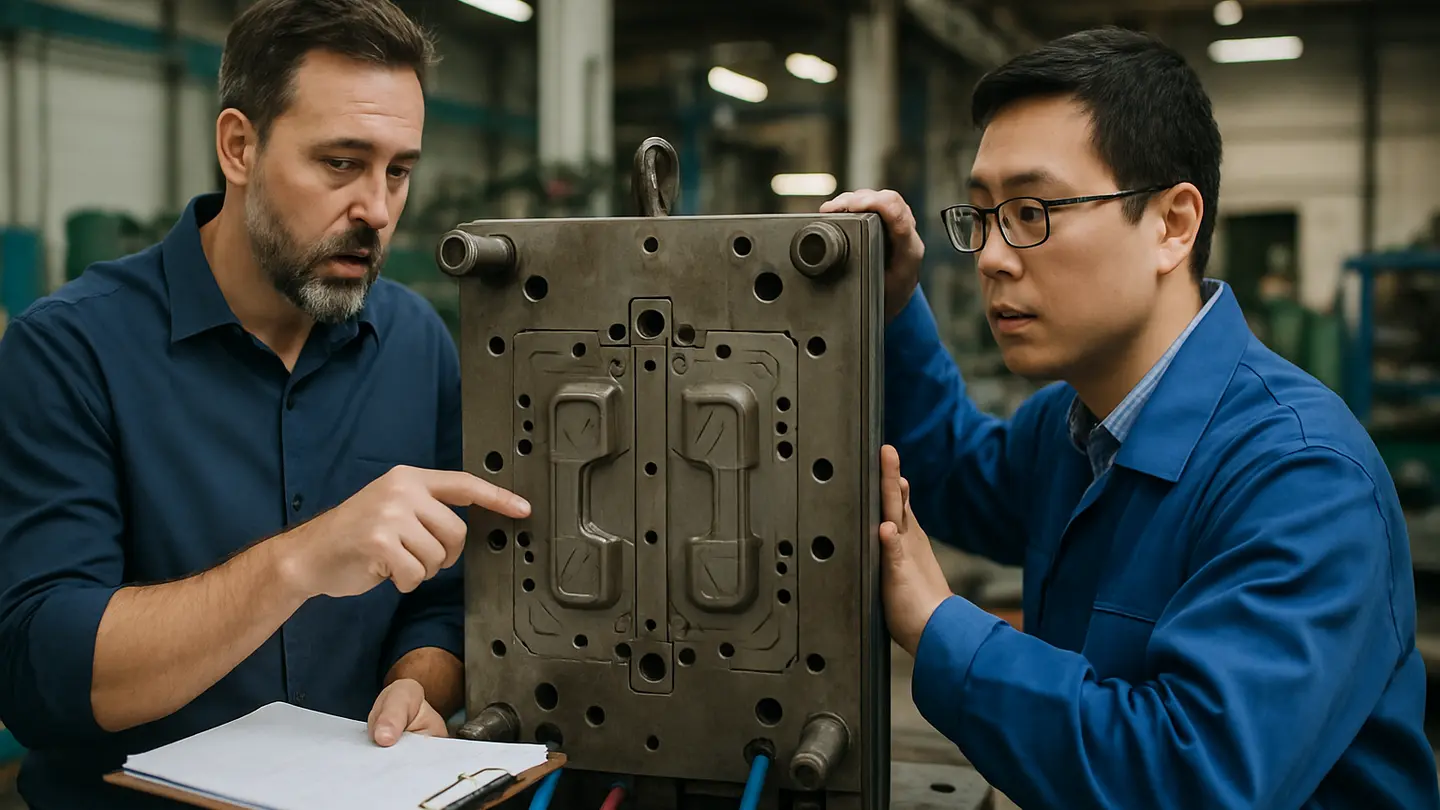
Paying a tooling invoice in China is not the same as having clear, enforceable control over the mold. For B2B buyers, that distinction matters. A mold may be stored at the factory, used on its machines, maintained by its technicians, and described only vaguely on an invoice. If the relationship breaks down, “we paid for it” may not be enough to get the tool released quickly—or at all.
China mold ownership usually depends on written contract language, payment records, tooling specifications, acceptance documents, and release terms. A receipt helps, but it rarely answers every key question: Who owns the physical tool? Who may use it? Who pays for maintenance? Can the supplier refuse release because of an unrelated dispute? What happens if the mold is damaged, modified, or worn out?
These issues are especially relevant for buyers sourcing shower components, plastic housings, die-cast parts, handles, brackets, cartridge bodies, trim pieces, packaging inserts, and other custom products. Once a mold is cut, the buyer’s flexibility depends on that asset. Before paying for tooling, treat mold ownership as a commercial control issue, not just a quotation line item.
Why Tooling Payment Alone Does Not Prove Mold Ownership
A tooling invoice generally proves that money changed hands. It does not automatically prove that legal title to the mold transferred to the buyer. The invoice might say “mold fee,” “tooling charge,” “development cost,” “setup cost,” or simply include a surcharge in the unit price. Each wording can imply a different arrangement.
If the invoice identifies a specific mold and states that the buyer is purchasing that physical asset, the buyer is in a stronger position. If the cost is bundled into product pricing, ownership becomes more ambiguous. The supplier may argue that the buyer paid for engineering, setup, or amortized development—not the tool itself.
Verbal assurances are weak protection. A sales manager may say, “Of course the mold is yours,” during quotation or sampling. But if management changes, a payment dispute arises, or the buyer moves production, the factory may point to the signed purchase order, invoice, or lack of a tooling agreement instead.
Buyers should put the key points in writing before tooling starts. At minimum, the documents should state:
- who owns the mold;
- when title transfers;
- whether the supplier may use the mold for anyone else;
- where the mold will be stored;
- how the buyer can inspect or move it;
- what happens if production ends or the supplier relationship changes.
These terms can be included in a tooling contract, manufacturing agreement, purchase order terms, or dedicated mold ownership agreement. The format matters less than clarity and consistency.
Four Common Ways Buyers Lose Control of a Mold
Most mold disputes grow from documentation gaps that become expensive when the buyer needs leverage.
First, bundled tooling charges obscure what was purchased. A supplier may quote a low or zero mold fee but raise unit prices to recover tooling costs. That may be acceptable if the buyer expects to stay with the supplier. But if the buyer later wants to move the tool, the supplier may argue that it invested in the mold and only recovered cost through production. Without written terms, both sides may believe they are right.
Second, factories may resist mold release during supplier changes. A buyer may want to move production because of quality problems, late deliveries, price increases, or capacity limits. At that point, the mold becomes leverage. The supplier may delay release, demand handling fees, claim unpaid balances, or say engineering costs remain outstanding.
Third, the mold may be reused for other customers. This is serious for custom shower products and branded components, where the mold may contain product geometry, design work, or market differentiation. A mold ownership clause should not only say who owns the tool; it should prohibit unauthorized use, copying, and production for third parties.
Fourth, unclear maintenance duties can create disputes over wear, damage, repairs, and replacement costs. Molds wear out. Cavities may need polishing, inserts may need replacement, cooling channels may need cleaning, and slides or lifters may require adjustment. The contract should distinguish normal production wear from supplier mishandling and state who pays for each category.
Contract Terms That Should Be Written Before the Tool Is Made
A strong mold ownership arrangement starts before steel is cut. Once the supplier has possession and production has begun, the buyer has less leverage to correct weak paperwork.
The contract should identify the mold owner and the timing of title transfer. In many buyer-funded arrangements, title transfers after full tooling payment, after mold acceptance, or after both. The trigger should be specific. “Buyer owns the mold” helps, but “legal title transfers to buyer upon full payment of the tooling invoice and written acceptance of first article samples” is clearer.
The agreement should separate physical possession from legal ownership. In many China manufacturing relationships, the factory stores and operates the mold even though the buyer owns it. That is normal. But supplier possession should be limited to producing buyer-authorized goods. Custody should not give the supplier the right to sell, pledge, copy, alter, scrap, or reuse the mold.
Use restrictions should be explicit. The supplier should be prohibited from:
- using the mold to produce goods for any party other than the buyer;
- copying or duplicating the mold;
- modifying the mold without written approval;
- transferring the mold to another facility without consent;
- using the mold as security for debts;
- scrapping or disposing of the mold without authorization.
Each mold should be clearly listed. For a simple plastic component, that may mean mold number, cavity count, part number, material, and drawing revision. For a shower assembly, the list may include multiple molds, inserts, die-casting tools, trimming fixtures, gauges, and dedicated jigs. If the buyer later needs to recover “the mold,” both sides should know which assets are included.
A bilingual or Chinese-language agreement can reduce friction. English terms may be acceptable for negotiation, but factory managers, local staff, and legal advisers often need Chinese text to act quickly. Buyers should ensure the Chinese version accurately reflects the intended ownership and release terms.
Storage, Maintenance, Repairs, and Inspection Rights
Legal ownership does not guarantee that a mold will be cleaned, protected, and maintained correctly. A buyer may own the tool on paper while the factory stores it poorly, runs it beyond agreed parameters, or fails to document repairs.
Storage terms should specify where the mold will be held and under what conditions. The agreement may require the supplier to store the tool in a designated tooling area, protect it against corrosion, maintain identification tags, and avoid moving it without notice. For bathroom and shower products, poor storage can cause rust, parting line damage, flash, warpage, or cosmetic defects.
Maintenance responsibilities should be divided into routine and non-routine work. Routine cleaning, lubrication, rust prevention, and minor upkeep may be assigned to the supplier as part of normal production. Major repairs, cavity refurbishment, insert replacement, or design changes may require buyer approval, especially above a defined cost threshold.
The contract should distinguish normal wear from mishandling. Normal wear occurs when a mold is used properly over its expected production life. Supplier damage may include improper clamping, incorrect machine setup, careless forklift or crane handling, unauthorized modification, or failure to maintain the tool.
Buyers should maintain a tooling file that includes:
- mold photos from multiple angles;
- mold number or serial number;
- cavity count and part numbers;
- drawings and revision history;
- sample approval or first article inspection records;
- payment records;
- current storage location;
- maintenance and repair history;
- latest condition report.
Inspection rights should also be written into the agreement. The buyer, or an appointed third-party inspector, should be able to verify the mold’s existence, condition, identification, and storage location with reasonable notice. For high-value tooling or sensitive designs, third-party storage may be worth considering, despite added cost and logistics.
How to Plan for Moving a Mold to Another Factory
A mold transfer should not be improvised during a dispute. The agreement should define the release procedure before the buyer needs it.
A practical transfer clause should cover notice period, release conditions, packing requirements, condition report, shipping responsibility, and any permitted administrative fee. The supplier should cooperate with reasonable transfer steps once the buyer has satisfied agreed payment obligations. If the supplier may charge for packing or crane loading, those fees should be defined or capped in advance.
Unpaid balances are a frequent source of leverage. If the buyer owes money for finished goods, engineering changes, or prior production, the supplier may refuse to release the tool until the dispute is resolved. Buyers should avoid mixing mold ownership rights with unrelated commercial claims where possible, and reconcile production invoices before announcing a supplier change when commercially feasible.
Even after release, the new factory must review the tool, confirm machine compatibility, check cooling and ejection systems, run trial production, and verify parts against drawings and approved samples. A mold that ran well in one factory may need adjustment in another because of different machines, resins, operators, process settings, or quality controls.
Buyers should budget time for trial shots, dimensional inspection, cosmetic review, and possible modification. For shower components, fit and finish may depend on tight tolerances across mating parts. Moving only one tool without related fixtures, gauges, assembly equipment, or secondary processing tools can create delays.
In some cases, rebuilding the mold is commercially smarter than fighting over it. For simple or low-cost tools, delay, legal support, management time, and lost sales may exceed the cost of making a new mold.
FAQ
Q1: How much does a mold cost, and what drives the number?
Mold cost depends on part size, material, cavity count, steel grade, surface finish, dimensional tolerance, expected production volume, and tool complexity. A simple single-cavity plastic part may be relatively inexpensive. A multi-cavity tool with sliders, lifters, texture requirements, tight cosmetic standards, or complex cooling will cost more.
Buyers should ask suppliers to quote both tooling price and expected mold life. A low tooling quote may reflect softer steel, fewer cavities, a lower tool specification, or a shorter intended production life.
For comparison, request tooling quotations that identify the mold, cavity count, material, expected life, included samples, modification terms, and ownership status. Without those details, the lowest tooling quote may not be the lowest total cost.
Q2: How many production runs should a mold last?
Mold life is usually better defined by expected part quantity before major rebuild or replacement, not by the number of production runs. A tool that runs 500,000 shots in short batches has a different duty cycle from one that runs continuously for the same total quantity.
The expected lifespan should be documented in the quotation or tooling agreement. It should also state who pays for major maintenance, insert replacement, refurbishment, or rebuilds after normal wear.
A documented lifespan helps both sides evaluate disputes. If problems appear early, the buyer can ask whether the tool was poorly made, poorly maintained, or incorrectly operated. If the mold has exceeded its agreed life, a rebuild request may be reasonable.
Q3: Can I have the mold made by an independent tool shop?
Yes. Using an independent tool shop can give the buyer more direct control over tooling title, technical documentation, acceptance records, and transfer rights. Separately contracted tooling may also be easier to relocate if the production supplier changes.
However, the buyer then must coordinate the toolmaker and production factory. The mold must fit the factory’s machines, process requirements, materials, and quality expectations. Mold base standard, injection machine tonnage, cooling connections, ejection method, runner design, and part handling should be agreed before the tool is built.
The production factory should review key mold design assumptions before manufacturing begins. Otherwise, the buyer may own a mold that is difficult or inefficient to run.
Q4: What if my supplier is a trading company rather than a factory?
If the supplier is a trading company, identify who physically holds the mold before paying tooling charges. A trading company may handle orders, communication, and export documents, while the actual mold sits at a subcontracted factory the buyer has never met.
The agreement should name the factory or custodian responsible for storing, maintaining, and releasing the mold. It should also state whether the trading company has authority to instruct the factory to release it. Without that clarity, the buyer may pay the trading company but later find that the factory claims a separate right to retain the mold.
For higher-value tooling, buyers should consider written confirmation from both the trading company and the actual factory. The confirmation should identify the mold, acknowledge the buyer’s ownership rights, and define the release process.
Key Takeaways for Protecting Buyer-Funded Tooling
China mold ownership should be settled when tooling is quoted, not after production problems appear. Once the mold is made and stored at the supplier’s facility, the buyer’s practical control depends heavily on the paperwork already in place.
A tooling invoice is useful evidence, but it should be supported by contract language stating who owns the mold, when title transfers, where the mold is stored, and how it can be moved.
Buyers should separate tooling costs from unit prices where possible, identify each mold and related asset, restrict unauthorized use, and document maintenance and inspection rights. Payment milestones should align with ownership rights.
The goal is not unnecessary legal complexity. It is to prevent a critical production asset from becoming a bargaining chip. Clear mold ownership terms protect supply continuity, reduce switching costs, and give buyers more control over custom products made in China.