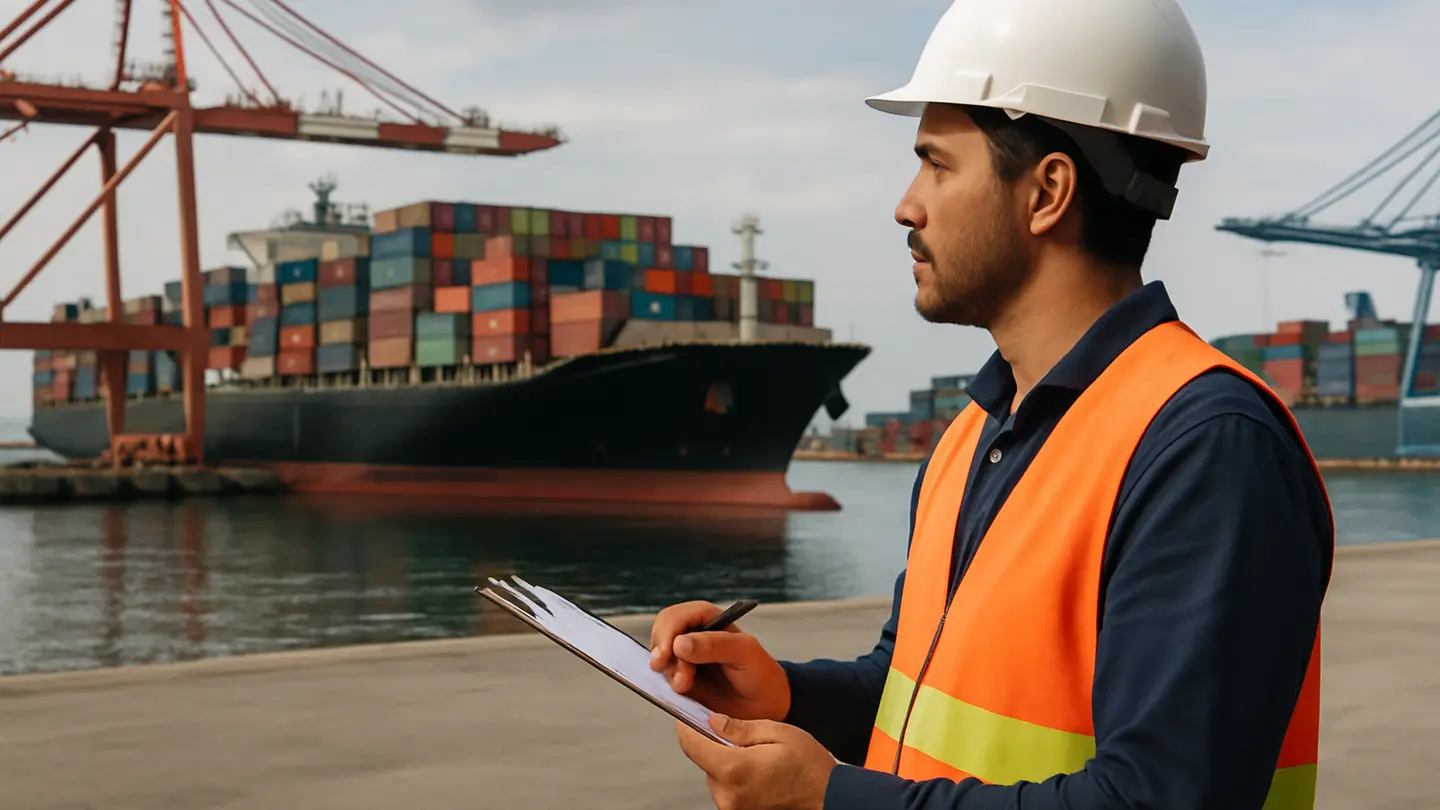
For importers, China to North America shipping ports are not just a logistics detail. The export and arrival ports can change freight spend, inland delivery cost, customs timing, and how quickly inventory is available for resale, installation, or distribution.
A shipment that looks inexpensive on a port-to-port quote may become costly once trucking, rail, storage, handling, and schedule risk are added. This matters especially for B2B goods such as shower doors, bathroom fixtures, tiles, hardware, vanities, and other bulky products where cube, weight, and packaging protection can strongly affect transportation economics.
Port choice should be considered during sourcing and purchase planning, not only after production is finished. The practical decision has two parts: ship from a China port that makes sense for the supplier’s factory location, and land the cargo at a North American port that supports the importer’s warehouse, customer geography, and replenishment schedule.
Major China export gateways such as Shanghai, Ningbo-Zhoushan, Shenzhen, and Guangzhou are common in international trade. However, the largest or most familiar port is not automatically the right port for every order. The best route is the one that delivers the goods reliably at the lowest realistic delivered cost.
Start With the China Export Port
The China export port is usually shaped by where the supplier is located. A factory in eastern China will often use a different practical gateway than a factory in the Pearl River Delta. The supplier’s freight forwarder, the buyer’s nominated forwarder, trade terms, container availability, and sailing schedules can also influence the final routing.
For many eastern China suppliers, Shanghai and Ningbo-Zhoushan are common export options. For many manufacturers in the Pearl River Delta, Shenzhen or Guangzhou may be more practical. These are not rigid rules, but they reflect the basic principle: cargo should generally move to a nearby efficient port rather than being hauled unnecessarily across China.
Moving goods a long distance inland before ocean shipment can create several problems:
- Higher domestic trucking or feeder transport cost
- More handling before the container is loaded
- Greater risk of packaging damage, especially for fragile or bulky goods
- Longer lead time before the cargo even reaches the port
- More coordination between factory, warehouse, forwarder, and carrier
This is why importers should confirm the supplier’s proposed export port before accepting quotations, production schedules, or freight estimates. A product quotation based on FOB Ningbo, for example, is not directly comparable with a quotation from a supplier located far from Ningbo unless the inland logistics are properly understood.
Trade terms also matter. Under FOB terms, the supplier typically delivers goods to the named China port, while the buyer controls the main ocean freight. Under EXW terms, the buyer may be responsible for pickup from the factory, export formalities, and all onward transport. Under CIF or CFR terms, the supplier arranges ocean freight to the destination port, but the buyer still needs to understand whether that routing supports the final delivery plan.
Factory location should therefore be part of supplier selection. A slightly cheaper unit price can be offset by inefficient logistics if the factory is far from suitable export infrastructure or if the shipment requires excessive inland movement before sailing.
Choose the North American Arrival Port by Delivered Cost
Importers often have more flexibility on the North American side than on the China side. While the supplier’s location strongly influences the export port, the buyer’s warehouse, distribution center, jobsite, or customer base should drive the arrival-port decision.
The key question is not “Which port has the lowest ocean rate?” It is “Which route gets the cargo to the final destination at the best combination of cost, speed, reliability, and risk?”
West Coast ports may be practical for importers serving the western United States or western Canada. For cargo destined for California, the Pacific Northwest, British Columbia, Nevada, Arizona, or nearby regional distribution centers, landing on the West Coast can reduce total transit time and inland distance. It may also help when inventory is urgently needed and the importer can clear and move the cargo quickly after arrival.
East Coast ports may make more sense for importers with warehouses or customers in the eastern United States or eastern Canada. Although ocean transit from China to the East Coast is generally longer than to the West Coast, the overall delivered cost can be more favorable when it avoids a long cross-country rail or trucking move. For importers serving markets in the Northeast, Mid-Atlantic, Southeast, or parts of central Canada, an East Coast or Gulf routing may reduce inland complexity.
The same logic applies to Canadian importers. Vancouver or Prince Rupert may be logical for western distribution, while eastern Canadian destinations may require comparison against routings through Montreal, Halifax, U.S. ports with inland transfer, or other available options depending on carrier service and customs planning.
A low ocean freight quote can become expensive if it creates a difficult inland move. Long-haul trucking, rail transfer, chassis availability, container storage, and final-mile delivery can erase apparent savings. For bulky goods, the risk is even greater because cargo may cube out before it weighs out, limiting how efficiently each container or truck can be used.
Compare the Full Door-to-Door Cost, Not Just the Ocean Rate
Ocean freight is only one line item in the transportation bill. Importers should compare routes on a door-to-door or warehouse-delivered basis whenever possible.
A realistic route comparison should include:
| Cost or timing factor | Why it matters |
|---|---|
| China inland transport | Determines cost and risk before export loading |
| Origin port charges | Can vary by port, forwarder, and service structure |
| Ocean freight | Important, but not the whole landed transportation cost |
| Destination port charges | Affects total cost after arrival |
| Customs-related timing | Delays can affect storage, delivery appointments, and inventory availability |
| Rail or truck movement | Often determines whether a route is truly economical |
| Demurrage and detention risk | Can become costly if containers are not cleared or returned on time |
| Storage and warehouse scheduling | Matters when receiving capacity is limited |
| Delay cost | Lost sales, production stoppages, or jobsite disruption may exceed freight savings |
The choice between FCL and LCL can also change the route decision.
FCL, or full container load, is usually more efficient when the order volume can fill a 20-foot, 40-foot, or 40-foot high-cube container economically. It gives the importer more control over loading, reduces cargo mixing, and may lower handling risk. This is especially relevant for large bathroom products, glass components, fixtures, or packaged hardware that must remain protected in transit.
LCL, or less than container load, can be practical for smaller trial orders, spare parts, mixed SKUs, or low-volume replenishment. However, LCL cargo is consolidated with other shipments, which can add handling, consolidation fees, deconsolidation time, and potential schedule uncertainty. The lowest LCL quote may not be the best choice if the shipment is fragile, time-sensitive, or difficult to handle.
Importers should compare realistic shipment scenarios rather than headline rates. For example, the right comparison may be:
- One 40-foot high-cube container via a West Coast port plus inland rail
- One 40-foot high-cube container via an East Coast port with shorter trucking
- Two LCL shipments timed around production completion
- A partial urgent air shipment plus later ocean replenishment
The best route is not always the cheapest on paper. It is the route that supports the commercial objective: keeping inventory available, protecting goods, avoiding unnecessary fees, and meeting customer commitments.
Plan Port Routing Before Placing the Purchase Order
Port routing should be discussed before the purchase order is issued, particularly for bulky, heavy, or damage-sensitive B2B goods. Waiting until cargo is ready can limit options, compress booking time, and force the importer into whatever sailing is available.
Several product and order details can narrow the realistic choices early:
- Factory city and province
- Named trade term and named port
- Production completion date
- Carton and pallet dimensions
- Gross weight and volume
- Container loading plan
- Packaging requirements
- Final warehouse or jobsite address
- Receiving hours and delivery constraints
- Required in-stock date
Estimating shipment volume early is especially important. A buyer may assume an order is suitable for LCL, only to find that the packed volume is close to a full container once protective packaging is included. Conversely, a buyer may plan for FCL but later reduce the order quantity, changing the economics of the route.
For bathroom and construction-related products, packaging can be a major variable. Glass panels, ceramic items, metal frames, shower bases, and assembled kits may require reinforced cartons, crates, pallets, edge protection, or non-stackable handling. These details influence container utilization and may affect whether transloading or extra handling is acceptable.
Before production completion, importers should ask a freight forwarder or logistics partner to compare routes based on:
- Carrier availability from the likely China export port
- Sailing frequency and cutoff dates
- Port fees and local charges
- FCL versus LCL cost structure
- Inland rail and trucking options
- Customs clearance timing
- Total transit time to the final destination
- Known congestion or equipment constraints
- Container return requirements
This planning also helps the purchasing team evaluate supplier quotations more accurately. If two suppliers offer similar product pricing but one is located near a more efficient export gateway, the logistics difference may be commercially meaningful.
Account for Peak Seasons, Holidays, and Port Congestion
Shipping cost, space availability, and transit reliability can change sharply during the year. A route that is smooth in an off-peak month may become expensive or unreliable during a cargo surge.
Pre-holiday shipping periods often bring higher freight rates, tighter container space, and more pressure on port operations. Importers shipping seasonal goods, retail inventory, or project materials should avoid planning around ideal transit times only. The more inventory-sensitive the business, the more important it is to build schedule buffers.
Chinese New Year is one of the most important planning risks for China-to-North-America shipping. Many factories close for an extended period, and production schedules can become compressed before the holiday. In the weeks leading up to the shutdown, many exporters try to move cargo at the same time. This can create pressure on trucking, warehouse loading, container availability, vessel space, and documentation.
The risk does not end on the holiday date. After factories reopen, labor return, production ramp-up, and backlog clearance can also affect timelines. Buyers should confirm factory holiday schedules early and avoid assuming that production and shipping capacity will return immediately to normal.
Off-peak months may offer more capacity, lower rates, and smoother scheduling, although conditions vary by trade lane and year. Importers should monitor freight market updates, port conditions, and carrier service changes, particularly when their replenishment plans depend on narrow arrival windows.
A practical approach is to build routing decisions into the inventory calendar:
- Identify required warehouse arrival dates
- Work backward through customs, port handling, ocean transit, and China inland movement
- Add buffer time for peak seasons and holidays
- Book earlier when space is likely to be tight
- Avoid using the last available sailing before a stockout
- Keep alternative ports or routings available when commercially reasonable
For importers that rely on continuous inventory, port selection is not just about one shipment. It is part of replenishment resilience.
FAQ
Q1: Do I get to choose which China port my goods ship from?
Usually, not independently. The supplier’s factory location often determines the nearest practical export gateway, and the supplier or forwarder may already have established trucking and booking arrangements through that port.
A buyer can request a different China port, but forcing cargo to move to a distant gateway may add inland cost, handling risk, and transit time. Before agreeing to a quotation or schedule, confirm the supplier’s planned export port, trade term, and routing assumptions.
Q2: Is the West Coast always cheaper than the East Coast?
No. West Coast ocean transit from China may be faster or may show a lower ocean freight rate in some cases, but that does not automatically make it cheaper on a delivered-cost basis.
If the final warehouse is in the eastern United States or eastern Canada, long inland rail or trucking from the West Coast can reduce or eliminate the ocean freight savings. Importers should compare the cost all the way to the warehouse, distribution center, or customer region.
Q3: How much longer does East Coast shipping take?
It depends on the carrier, routing, canal choice, port conditions, and season. Ocean transit to the East Coast is generally longer than to the West Coast, but ocean days alone do not show the full delivery timeline.
A fair comparison should include vessel transit, unloading, customs clearance, port availability, rail or trucking, delivery appointment scheduling, and warehouse receiving time. The route with a longer ocean leg may still be practical if it reduces inland movement and improves final delivery efficiency.
Q4: What’s the busiest port for goods leaving China?
Shanghai is commonly cited as one of China’s leading container export ports. Ningbo-Zhoushan is also a major container gateway, and Shenzhen is an important port area for many Pearl River Delta export suppliers.
However, port size alone should not determine routing. The best export port for a buyer should follow supplier location, available freight services, sailing schedules, and the overall practicality of moving goods from factory to final destination.
Conclusion: Treat Port Choice as Part of Sourcing Strategy
Port planning should be part of sourcing, purchasing, and replenishment decisions. The basic rule is straightforward: where practical, ship from a port near the factory and land the cargo near the warehouse, customers, or distribution region.
Importers should also match FCL or LCL to the actual shipment volume, packaging needs, handling sensitivity, and delivery timeline. A route that works well for a full container may not be ideal for a small consolidated shipment, and a route that looks inexpensive for standard cartons may be unsuitable for fragile or oversized goods.
Factory location can create hidden logistics costs if it is ignored during supplier selection. A lower product price may not be a better total deal if the route adds inland transport, handling risk, longer transit time, or unreliable replenishment.
The strongest routing decisions compare total delivered cost, schedule reliability, and inventory impact—not just the ocean freight rate. For B2B importers shipping from China to North America, that discipline can improve margins, reduce disruption, and make supplier choices easier to evaluate.