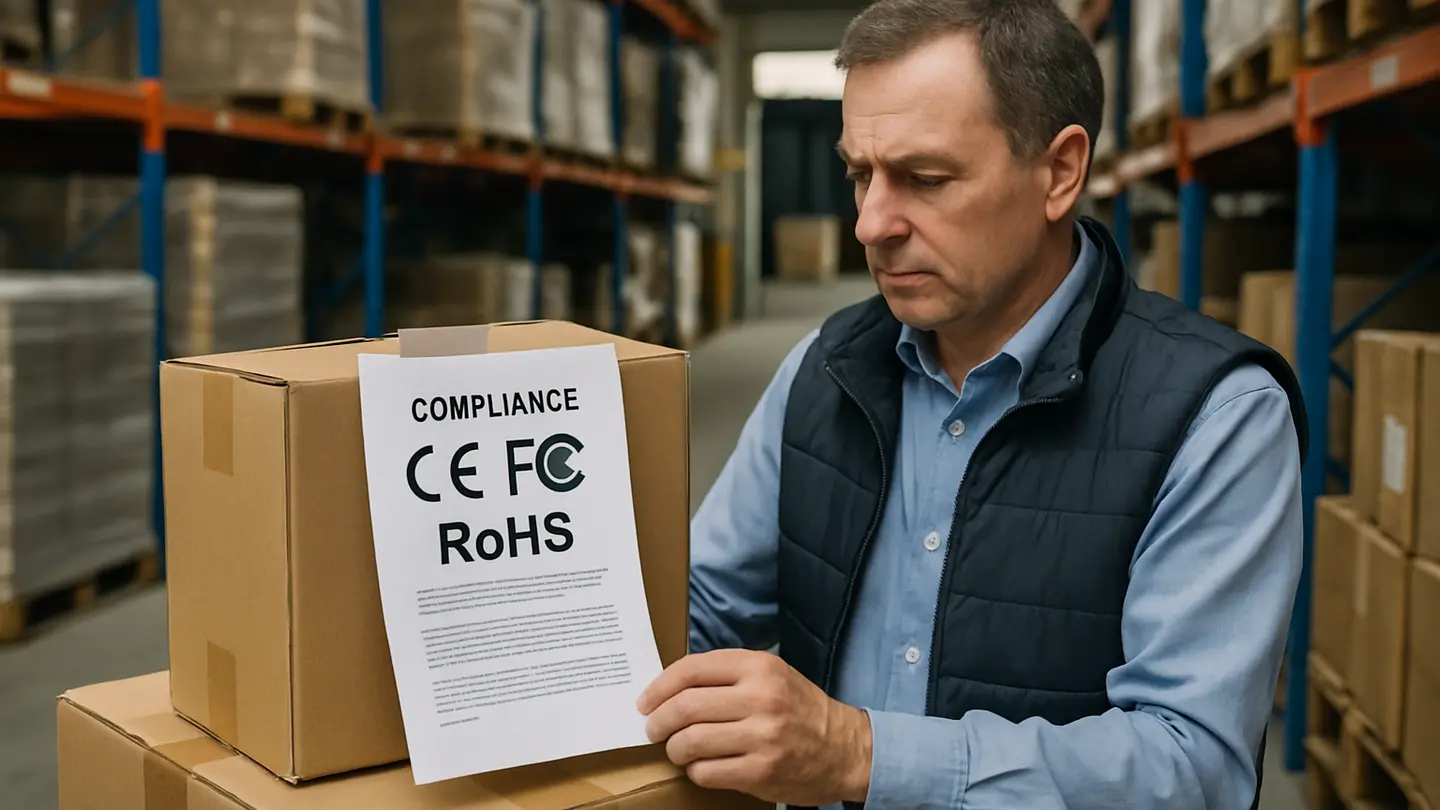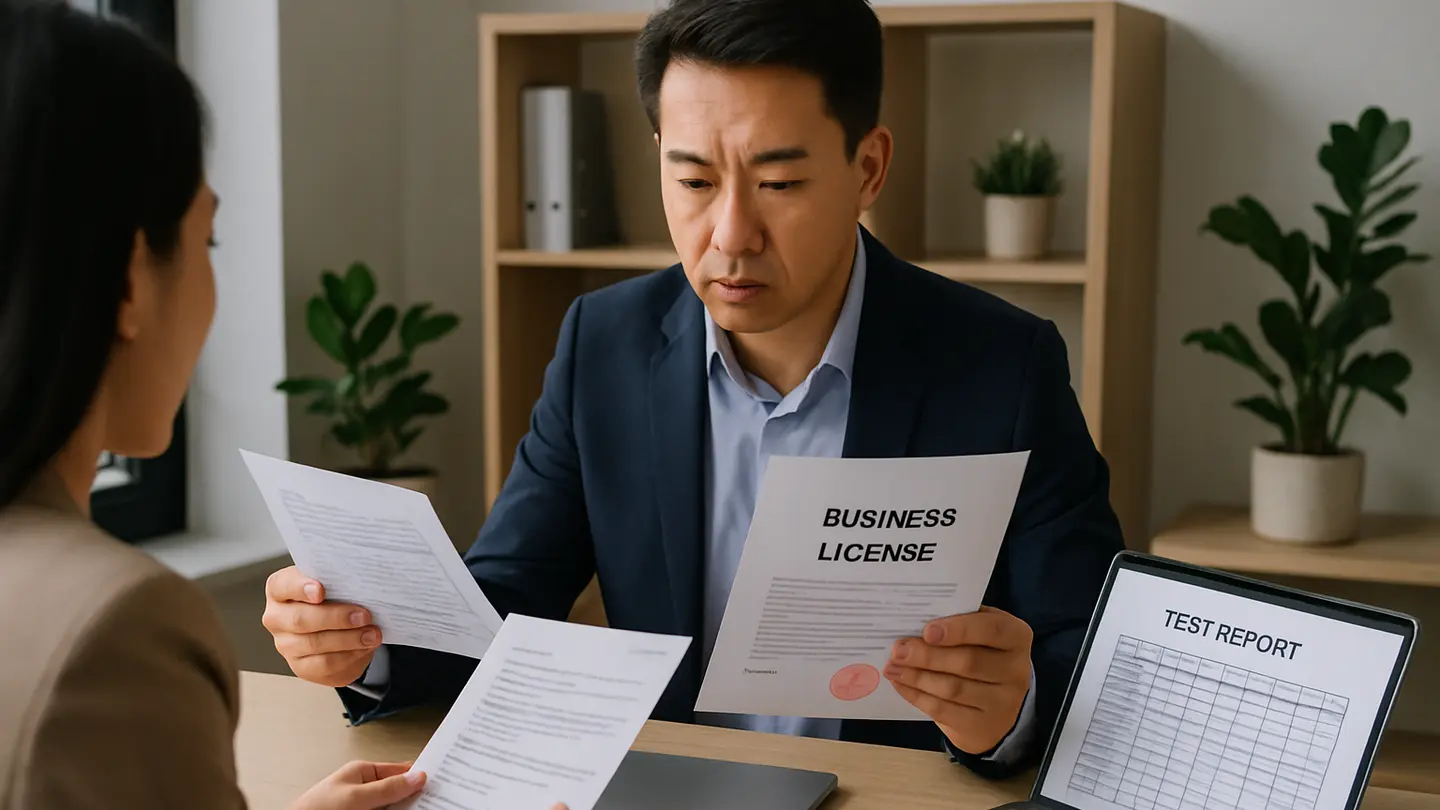
Before placing a first order with a Chinese supplier, buyers often ask for a “compliance file.” The phrase sounds reassuring, but different documents answer different questions. A business license may confirm that a company exists. Bank details help reduce payment diversion risk. Customs registration may show that an entity can prepare export documents. None of these proves that the goods can legally enter and be sold in your destination market.
A useful supplier file separates company legitimacy from product compliance and ties each request to a sourcing milestone: shortlist review, quotation comparison, deposit approval, production release, shipment booking and final payment. The goal is to know which risk each document reduces, which risk remains, and when an unanswered question should stop the order.
Why a Thick Supplier File Can Still Miss the Main Risk
A supplier can send a polished folder and still leave the buyer exposed because company-level paperwork and product-level compliance evidence answer different questions.
Company documents help answer:
- Is this a registered business?
- What is its legal name and address?
- Does its business scope fit the goods offered?
- Who will receive payment?
- Which entity may appear on export documents?
Product compliance documents answer:
- Has this exact product, material or component been tested?
- Which standard was used?
- Is the report valid for the ordered configuration?
- Does the evidence apply to the buyer’s target market?
- Are labeling, documentation and technical-file obligations covered?
A legitimate supplier may still lack evidence for the specific goods in your purchase order. This is common when suppliers sell broad ranges, traders source from several factories, or customization changes the product’s compliance status.
For example, a bathroom accessories supplier may have a valid business license and export history, but that does not prove a thermostatic shower valve meets applicable performance, safety or material-contact rules. A shower enclosure supplier may have an ISO certificate, while the glass, hardware, packaging warnings and installation instructions still need separate review.
Comparable documentation also helps buyers evaluate quotations. A lower price is less attractive if it excludes required testing, uses a different factory, or relies on certificates that do not apply to the quoted model.
How to Read a Chinese Business License Before You Shortlist
The Chinese business license is one of the first China supplier compliance documents to request. It is not complete due diligence, but it is a baseline identity check.
Start with the exact legal company name. Do not rely only on the English name in a brochure or email signature. English names are often translations, trade names or marketing names. The Chinese legal name is usually the key identifier for public records, contracts and bank-account matching.
Next, review the registered address. A registered address is not always the production site, but it should match the supplier’s explanation. If a company claims to own a factory in one city but the license shows an office in another, ask who owns or operates the production site and whether it can be audited or visited.
The business scope should be reasonably consistent with the goods offered. A broad trading scope may be acceptable for an exporter or sourcing company. A manufacturing scope may support a factory claim. Unexplained gaps should be resolved before the supplier reaches your shortlist.
Compare the license details against:
- The quotation header and footer
- The pro forma invoice
- The draft sales contract
- Email signatures and business cards
- Bank-account holder name
- Website and marketplace profile
- Audit reports or certificates
Traders can be legitimate and useful, especially when they coordinate components, consolidate shipments or handle export procedures. The problem is when a trader presents itself as a factory, refuses to identify the actual manufacturer, or uses different company names without explanation.
Marketplace sourcing adds another layer of risk when the storefront name, brand name and legal entity differ. Before comparing quotes, confirm which legal company is making the offer.
Confirm Which Entity Will Export the Goods
Not every capable Chinese manufacturer exports under its own name. Some factories use a related export company, trading partner or licensed exporter for customs paperwork. This can be normal, but it should never be vague.
Ask the supplier:
- Will the factory itself appear as the exporter?
- If not, which company will appear on the commercial invoice, packing list and customs declaration?
- What is the relationship between the factory, seller and exporter?
- Will the exporter be named in the purchase order or contract?
- Who is responsible if export documents are incorrect?
Customs registration or export-related registration can show that an entity can participate in export procedures. It does not prove the product will clear customs in your country. Destination-market clearance depends on the product, HS code, documentation, labeling, importer obligations and local regulations.
Exporter identity affects accountability. If the contracting party is one company, the factory is another, and the exporter is a third, document the structure before payment.
For first orders, the purchase order should identify all entities connected to the goods: seller, manufacturer, payment receiver and exporter. If they are not the same, the contract should explain why.
Match the Names on the Quote, Contract, Payment and Export Papers
The cleanest arrangement is one legal entity on all key documents: quotation, contract, pro forma invoice, bank account and export paperwork. Related-party structures and export agents can also work if the buyer can connect the names before money moves.
A basic name-matching review should cover:
| Document or record | What to check | Why it matters |
|---|---|---|
| Quotation | Legal company name and contact details | Confirms who made the commercial offer |
| Contract or purchase order | Seller name and obligations | Establishes legal accountability |
| Bank account | Account holder name | Reduces payment diversion risk |
| Business license | Chinese legal name and registration details | Verifies corporate identity |
| Export documents | Exporter name | Identifies customs-facing party |
| Certificates and reports | Holder, factory site and product model | Shows whether evidence applies |
Avoid paying personal bank accounts. A request to pay an individual, even if the person is a sales manager or owner, weakens corporate accountability and creates avoidable fraud and recovery risk.
If payment must go to a third party, name and explain the arrangement in the contract. The buyer should know whether the third party is an export agent, related company, finance company or unrelated collector. “Our boss’s account” or “our finance partner” is not enough.
Any bank-account change during an order is high risk. Confirm it through an independent channel, such as a known phone number or previously verified senior contact. Do not rely only on an email thread near deposit or final-balance payment.
What ISO Certificates and Social Audits Actually Prove
ISO certificates and social audit reports can be useful, but they are often misunderstood.
ISO 9001 relates to a quality management system. It does not mean every product made by the company is compliant in every market. It does not replace product testing, technical documentation, importer review or regulatory approval. A factory with ISO 9001 may still produce a non-compliant item if the design, material, labeling or test evidence is inadequate.
A capable factory may also lack ISO certification, especially in lower-risk product categories or smaller production environments. The absence of ISO should prompt questions about process control, inspection records and quality consistency, but it is not always a deal-breaker.
When reviewing an ISO certificate, check:
- The certificate holder’s legal name
- The certified address or production site
- The standard and certification scope
- Issue date and expiry date
- Certification body
- Whether the certificate can be verified
A group certificate may cover a head office or one facility but not the site where your order will be made. For multi-site suppliers, ask which site will produce your goods and whether it is within the certificate scope.
Social audits assess labor, workplace, health and safety, environmental or ethical conditions depending on the audit program. They can support responsible sourcing and brand-risk management, but they do not prove product safety or legal market access.
Documents That Speak Directly to Your Product
Product-level evidence is the part of the compliance file that supports legal sale in the target market. The required documents depend on product category, destination country and intended use.
Depending on the goods, buyers may need:
- Laboratory test reports
- Declarations of conformity
- Product certifications
- Technical files
- Material declarations
- Safety data sheets
- Installation and user instructions
- Labeling artwork
- Packaging compliance evidence
- Component certificates
- Factory production control records
For shower and bathroom-related products, evidence may vary widely. A stainless-steel accessory, glass enclosure, plastic hose, mixer valve and electronically controlled shower system may fall under different rules. Water-contact materials, pressure performance, mechanical safety, electrical components, chemical restrictions, packaging and installation warnings may all be relevant depending on the market.
Do not accept a certificate simply because it looks official. Check whether the model number, material, size range, component configuration and supplier name match your order. A report for another product family, previous customer’s private-label design or different configuration may not cover your version.
Some ordinary goods may not require formal compliance documents in a particular market. Confirm that in writing. Ask the supplier what it believes is required and what it can provide, then verify with your customs broker, compliance consultant, importer of record or internal regulatory team.
When Each Supplier Document Should Be Collected
Document requests work best when tied to decision points. If every file is requested only after production, the buyer has little leverage. If every possible file is demanded at the first email, good suppliers may disengage before they understand the opportunity.
A practical sequence looks like this:
Shortlist stage: Request the business license, exact legal name, registered address, basic company profile and bank-account holder name. You are checking identity and eliminating obvious mismatches.
Quotation stage: Ask which entity is quoting, which factory will produce the goods, and whether the supplier is a manufacturer, trader or exporter. Request existing product test reports or certificates relevant to the quoted item.
Before deposit: Require product compliance evidence or a written evidence plan. If new testing is needed, agree who pays, which standard applies, which lab will be used, which samples will be tested and how failure will be handled. Confirm exporter identity, payment account, contract name and audit documentation before releasing funds.
During production: Collect updated production records, approved samples, material confirmations and in-process inspection results if relevant. For customized products, confirm that the production version still matches the tested or approved version.
Before final balance: Use independent inspection results, shipping-document drafts and final compliance file checks to control payment release. Once the balance is paid and goods are shipped, correcting document gaps becomes harder and more expensive.
The principle is simple: no critical unanswered question should be carried past the milestone where the buyer loses leverage.
What to Do When Key Files Do Not Arrive
A missing document does not automatically prove fraud. Suppliers may need time to retrieve certificates, translate files, confirm factory details or check with an export partner. However, delays around basic, verifiable information should shift the burden back to the supplier.
Pause payment when a supplier provides only corporate or system paperwork but no relevant product evidence. A business license, ISO certificate and company profile do not answer whether your specific product can be imported and sold.
Unconnected names are another warning sign. If the quotation comes from one company, the license belongs to another, payment is requested to a third, and the exporter is unknown, stop and require a written explanation.
Be especially cautious when the supplier avoids:
- Certificate numbers
- Legal Chinese names
- Factory addresses
- Test-report pages showing model references
- Certification body or lab details
- Bank-account holder information
- Exporter identity
Walking away early can be cheaper than resolving undocumented compliance risk after a deposit, after production or at the port of destination. A serious supplier may not have every document immediately, but it should be able to explain what exists, what does not, and how the gap will be closed.
Should Buyers Request Chinese Originals or English Versions?
Request the original document plus any existing English version. For Chinese registration documents, the Chinese original is often the authoritative record. The English name may be a translation, sales name or brand name rather than the exact legal entity.
For contracts, bank details and public-record checks, match the Chinese legal name wherever possible. If the supplier uses an English name commercially, ask how that name relates to the Chinese registered entity.
Can a Chinese Business License Be Checked for Free?
China has a public enterprise-credit lookup system for basic company registration information. The unified social credit code shown on the business license is the key reference for retrieving registered company details.
A basic lookup may reveal mismatches in company name, registration status, business scope, address or other registration details. It will not replace full due diligence, but it is a useful first check before sending money or approving a supplier.
What If the License City Differs From the Claimed Factory Location?
A different city is not automatically a problem. The license may show a headquarters, sales office or registered address, while production takes place elsewhere. Many legitimate suppliers operate this way.
It can also indicate that the claimed factory is unverified or that the seller is actually a trader. Ask which exact site will manufacture the goods. Then make sure the plant address can be visited, audited or independently checked. If the supplier avoids naming the site, the factory claim should not be treated as verified.
How to Respond When a Supplier Calls Basic Documents Confidential
Some information can be commercially sensitive, including customer names, pricing, formulas, drawings or proprietary process details. Basic registration records and certificate numbers, however, are normally meant to be verifiable.
If the supplier has a legitimate confidentiality concern, propose a mutual confidentiality agreement. That can protect sensitive files while still allowing due diligence. A blanket refusal to share basic verifiable documents is a warning sign, particularly before deposit payment.
A Practical Platform for Building a China Supplier Shortlist
Early supplier discovery is easier when buyers can compare several candidates before detailed negotiations. Made-in-China.com is a B2B sourcing platform buyers can use to search for products and build an initial supplier shortlist.
For background review, its Audited Supplier feature can be useful because Audited Suppliers are subject to third-party verification and on-site audit, with Audit Reports available for buyer review. These reports can include structured information such as general supplier details, export trade, manufacturing capacity, quality control and R&D capability. They should not replace your own compliance checks, but they can support early screening.
Buyers who want to reduce manual outreach can also use Easy Sourcing. The buyer submits one sourcing request, receives quotations from matched suppliers, compares quotes and can request samples. From there, the same discipline still applies: verify the legal entity, confirm who manufactures and exports the goods, and request product compliance evidence before committing funds.