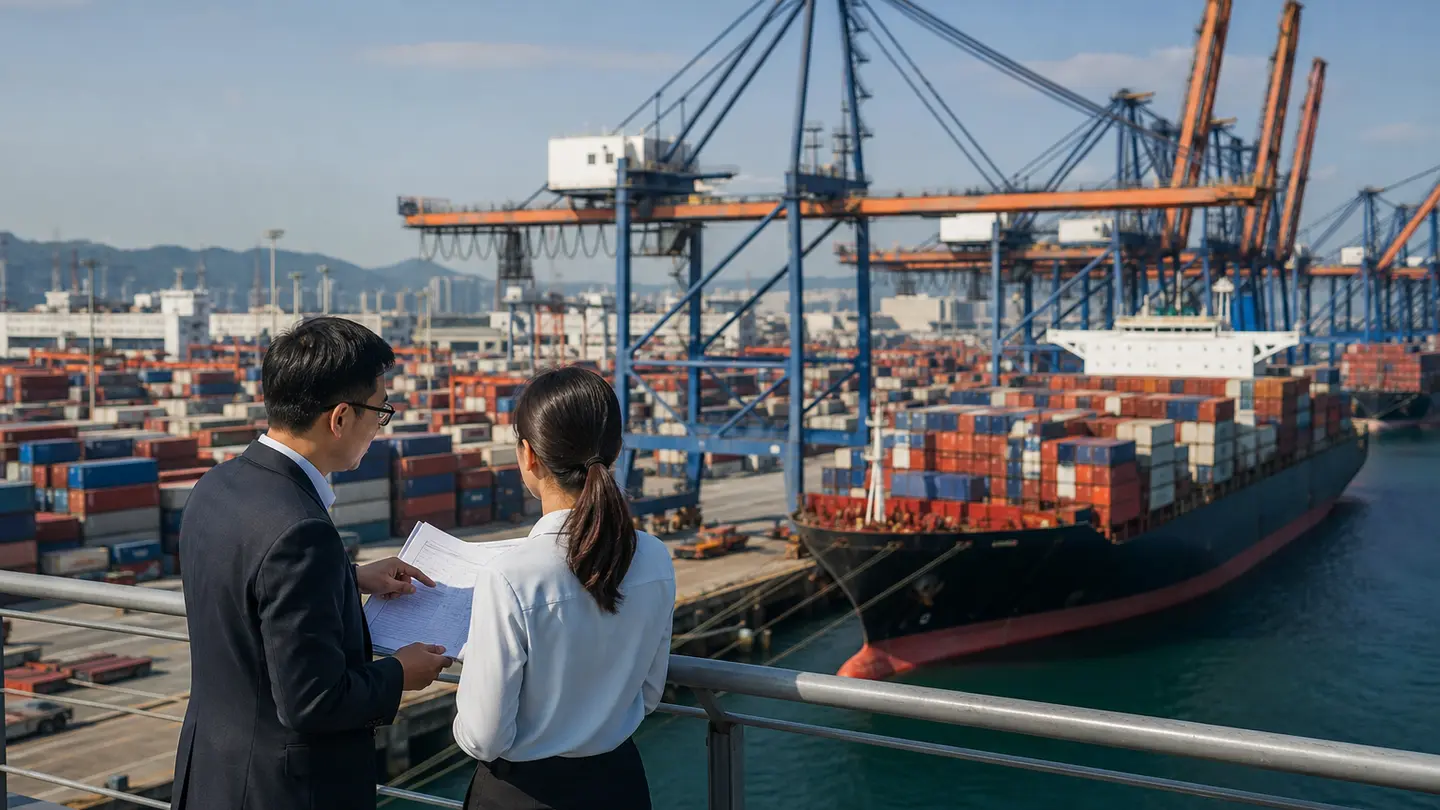
What a Door-to-Door Shipment to Europe Actually Includes
For a shower manufacturer importing finished products, components, packaging, or accessories from China, the China to Europe shipping cost is rarely limited to the ocean-freight figure shown on an initial quotation. A container’s journey typically includes several separate cost stages:
- Collection or delivery from the factory to the export port
- Export documentation, customs declaration, terminal handling, and loading in China
- Ocean freight and carrier surcharges
- Destination terminal handling and port charges in Europe
- Customs clearance, duty, and import VAT
- Inland transport from the port to the receiving warehouse or distribution centre
- Potential storage, demurrage, detention, waiting time, or delivery appointment charges
The responsibilities for these costs depend heavily on the agreed Incoterm. Under FOB terms, for example, the supplier generally handles export clearance and delivery to the named loading port, while the buyer arranges the main ocean freight and the destination-side process. Under CIF, the supplier may arrange ocean freight to the destination port, but the buyer will usually remain responsible for destination charges, customs formalities, duty, VAT, and inland delivery. DDP arrangements can appear simpler, but buyers should confirm exactly who acts as importer of record and how taxes and customs obligations are handled.
An “all-in” freight quote should therefore be reviewed line by line. It may include ocean transport and basic delivery while excluding customs brokerage, duties, VAT, port storage, delivery waiting time, or charges caused by an unsuccessful delivery attempt.
For procurement planning, compare landed cost rather than ocean freight alone. Ask freight forwarders to itemize origin charges, ocean freight, destination charges, customs processing, and inland delivery. This makes it easier to identify whether a lower headline rate simply shifts costs to another point in the shipment.
For shower products, this review is especially useful because cartons may be bulky and containers can include glass panels, trays, frames, valves, enclosures, and fittings with different packaging densities. The physical volume, loading plan, and risk of damage during handling can affect both freight efficiency and the final landed cost.
Why China-to-Europe Freight Has No Single Standard Rate
There is no single standard China to Europe shipping cost because routes, ports, carriers, equipment availability, and delivery locations vary widely.
Northern European gateways such as Rotterdam, Hamburg, Antwerp, and Bremerhaven may offer frequent services and extensive inland connections. Mediterranean gateways may provide a more practical route for southern European distribution or certain eastern European destinations. A lower ocean rate into one port does not necessarily result in the lowest total cost once customs handling and onward trucking or rail transport are added.
Freight indices can help buyers understand whether the container market is generally rising or falling. However, they do not replace a shipment-specific quote. An index cannot account for the actual Chinese port of loading, European destination, container type, cargo-ready date, delivery postcode, or the carrier’s current allocation for a particular sailing.
Carrier rates can change frequently. Seasonal demand, equipment shortages, blank sailings, port congestion, and capacity management may all affect available rates and booking conditions. A quotation should state its validity period, applicable surcharges, and any assumptions about cargo readiness and sailing dates.
Transit-time planning is equally important. Rotterdam may be a suitable gateway for many European warehouse networks, but the ocean transit is only one part of the schedule. Production completion, factory loading, export cut-off, vessel departure, potential transshipment, discharge, customs release, and final delivery all affect the practical lead time.
UK shipments need separate consideration. The UK is outside the EU customs territory, so importers should not treat UK delivery as equivalent to delivery into an EU member state. The customs process, importer details, duty treatment, VAT administration, and final-mile delivery arrangements should be planned separately.
Planning Shipments From Shenzhen and Yantian
Shenzhen and nearby Yantian are common export areas for many bathroom-product supply chains. When cargo is produced near these ports, direct services from Yantian can be operationally attractive because they may reduce the need for domestic repositioning or transshipment through another Chinese port.
A direct sailing does not guarantee a problem-free shipment, but it can reduce the number of handovers in the route. Fewer transfers may mean fewer opportunities for missed connections, delayed feeder movements, or cargo arriving after a connection cut-off.
Buyers should compare total door-to-door transit time rather than choosing solely by the lowest ocean rate. A cheaper service that involves an additional transshipment, longer port dwell time, or difficult inland delivery may create stock shortages that outweigh the freight saving. This is particularly relevant for shower enclosures and related products when retailers, installers, or project customers require reliable replenishment dates.
Consolidation can also reduce cost duplication. If several factories are located near the same origin port, consolidating compatible cargo may reduce repeated fixed charges for export handling, terminal processes, and documentation. For example, a buyer sourcing shower trays from one supplier, glass panels from another, and accessories from a third may benefit from a coordinated loading plan if the products can be shipped safely together.
However, consolidation should be assessed carefully. It can introduce extra warehouse handling and may delay a ready shipment while waiting for another supplier’s cargo. For fragile shower glass, separate packaging checks, pallet stability, carton marking, and loading supervision may be necessary before combining cargo.
Why Inland Delivery Can Determine the Best European Port
The cheapest European port is not always the best entry point. Inland delivery can outweigh an apparent ocean-freight saving, especially when the final warehouse is far from the discharge port or difficult for a container truck to access.
A useful comparison starts with the delivery postcode, not just a port-to-port quote. Ask forwarders to price complete alternatives, such as:
- China to a northern European gateway plus delivery to the warehouse
- China to a Mediterranean gateway plus delivery to the same warehouse
- Different carriers serving the same port
- Port delivery versus bonded or customs-cleared warehouse delivery where appropriate
Northern gateways may be suitable for warehouses in Benelux, Germany, northern France, Scandinavia, or nearby distribution networks. Mediterranean gateways may offer better inland economics for southern destinations and may also be worth evaluating for parts of central or eastern Europe. The best route depends on actual road, rail, barge, and terminal connections rather than a general assumption about geography.
Inland transport also has operational conditions that need to be included in the quote. These can include delivery appointments, limited unloading hours, urban access restrictions, tail-lift requirements, driver waiting time, and restricted warehouse access. A container delivery to a busy distribution site may incur extra charges if unloading is delayed or the appointment is missed.
Container-related waiting costs also require attention. Delays in collecting or returning equipment can lead to demurrage or detention exposure, depending on the circumstances and carrier terms. Buyers should confirm who monitors free time, who books delivery appointments, and who is responsible if customs clearance or warehouse readiness is delayed.
For shower products, the unloading method matters. Large shower trays, screens, and glass enclosures may require sufficient labour, appropriate unloading equipment, and a warehouse layout that can receive long or fragile cartons without avoidable damage.
Customs Duty and Import VAT Are Usually Separate From Freight
Customs duty and import VAT should not be assumed to be included in a freight quote unless this is expressly stated. Even when a forwarder offers customs clearance support, the importer remains responsible for ensuring that the customs information is accurate and that the correct party is named in the declaration.
Customs duty is generally calculated according to the customs classification of the imported goods and their customs value. Product classification is important because different shower products, fittings, glass components, metal frames, plastic accessories, and other items may be subject to different tariff treatment. Buyers should avoid relying on a generic product description when a more precise classification is required.
Import VAT is normally calculated using the customs value together with applicable duty and other required value elements. Its treatment depends on the importing country and the business’s tax position. For eligible VAT-registered businesses, import VAT may be recoverable under applicable rules, subject to proper registration and supporting documentation. Customs duty, by contrast, is normally a non-recoverable import cost.
Before shipment, confirm:
- The importer of record
- The importer’s EORI number where required
- The correct legal entity name and address
- Product descriptions and tariff classifications
- Customs value and commercial invoice information
- Country of origin details
- The party responsible for duty and VAT payment
- The records required for VAT accounting or recovery
Incorrect importer details or incomplete customs paperwork can delay release at the destination port. For buyers shipping shower products with multiple component types, a well-prepared commercial invoice and packing list can make customs review more straightforward than a broad description such as “bathroom goods.”
How to Compare Freight Quotes for European Delivery
Freight quotes can only be compared fairly when the underlying shipment details are equivalent. A lower price may reflect a different Incoterm, a different port, a shorter rate-validity period, excluded destination charges, or a delivery scope that ends at the terminal rather than the warehouse.
When requesting a quotation, provide the same information to each forwarder:
| Information to provide | Why it matters |
|---|---|
| Factory address | Determines collection, export routing, and origin charges |
| Port of loading preference, if any | Helps assess direct services and inland movement in China |
| Delivery postcode and warehouse conditions | Required for realistic inland delivery pricing |
| Cargo-ready date | Affects vessel availability, rate validity, and booking options |
| Container size | FCL pricing is generally quoted per container |
| Total cartons, gross weight, and dimensions | Needed for loading, LCL, and delivery planning |
| Incoterm | Defines where supplier responsibility ends |
| Product description | Supports customs and handling assessment |
| Delivery requirements | Covers appointments, unloading constraints, and access restrictions |
For full-container load shipments, pricing is normally structured per container rather than per unit. A 20-foot, 40-foot, or high-cube container may have different availability and pricing. Buyers should select container equipment based on safe loading, cargo volume, weight distribution, and packaging requirements rather than only the apparent cost per cubic metre.
For less-than-container-load shipments, charges are commonly based on chargeable volume or weight, using whichever produces the higher freight calculation. Accurate packing-list measurements are essential. Estimating carton dimensions too loosely can lead to revised charges after cargo is received at the consolidator’s warehouse.
Request rate validity in writing and ask whether quoted charges are fixed, estimated, or subject to carrier adjustment. It is also useful to confirm the quote’s assumptions on customs clearance, free time, delivery appointments, and destination handling.
FAQ
Q1: How far ahead should I book space to Europe?
Booking several weeks before cargo readiness can improve access to vessel space and provide time to resolve documentation, container availability, and factory-loading issues. Peak-season cargo often requires earlier booking because carrier allocations may be tighter.
Late booking can result in fewer sailing options, revised rates, or routing through an alternative service. Once cargo is nearly ready, reconfirm the factory completion date, packing list, container requirement, and export cut-off with the forwarder.
Q2: Does delivering into eastern Europe cost more than western Europe?
Not necessarily. The total cost depends on both the chosen European gateway and the inland transport route to the final warehouse. A northern European port is not automatically the lowest-cost option for an eastern European destination.
Compare complete door-to-door routes from alternative ports, including terminal charges, customs arrangements, road or rail delivery, and expected transit time. The route with the lowest ocean freight may not provide the lowest landed transport cost.
Q3: What happens if the carrier bumps my container to a later sailing?
When capacity is constrained, a carrier may move a booked container to a later vessel. This is commonly described as a rollover or bump. A named vessel on a booking confirmation does not always guarantee that the container will load on that departure.
Reconfirm booking status close to the cargo cut-off and maintain schedule contingency, particularly for launch dates, promotional stock, or project deliveries. If timing is critical, ask the forwarder about alternative sailings and the cost implications before cargo is delivered to the port.
Q4: Do I need an EORI number before my first EU shipment?
Businesses acting as importer generally need an EORI number before EU customs declarations are submitted. The EORI identifies the business in customs processes and is an important part of import documentation.
Apply for the required registration before the first shipment reaches the destination port. Missing or incorrect importer details can delay clearance, create storage exposure, and complicate duty and VAT processing.
Conclusion: Reassess Routes as Costs and Operations Change
The best China to Europe shipping route can change as shipment volume, destination markets, product mix, carrier capacity, and inland transport conditions change. A gateway that works well for regular deliveries to one warehouse may be less effective when distribution shifts to another country or when container utilisation changes.
Review routes periodically rather than relying on an old freight pattern. Port charges, carrier surcharges, destination handling fees, and trucking rates can move independently. Comparing several door-to-door options helps buyers identify whether the real cost driver is ocean freight, destination charges, customs administration, or inland delivery.
Cargo consolidation and origin-side checks can also improve planning. Coordinating supplier readiness, verifying packing-list data, and confirming container loading requirements before booking can reduce avoidable fixed charges and last-minute changes. For shower manufacturers and importers, careful routing should support both cost control and reliable delivery of bulky, fragile, or mixed-component shipments.
About the Author
The author writes about international sourcing, freight planning, import administration, and practical landed-cost management for B2B buyers. The focus is on helping procurement teams evaluate logistics decisions using complete route costs, shipment requirements, and operational risk rather than headline freight rates alone.