Before a deposit is wired, a production slot is booked, or a shipment deadline becomes fixed, buyers need a clear way to identify Chinese supplier red flags. The most expensive sourcing mistakes rarely come from one obvious failure. They often begin with small inconsistencies: a mismatched company name, an unexplained low quote, a sample that cannot be repeated, or a supplier that communicates well until technical questions begin.
The goal is not to distrust every supplier. Many Chinese manufacturers are capable and reliable. The goal is to separate evidence from claims early enough to protect margin, cash flow, and customer commitments.
How Chinese Supplier Warning Signs Turn Into Margin Losses
Supplier vetting is a margin-protection process, not just paperwork.
A low-cost order can become expensive if it creates rework, late shipment, replacement stock, refunds, chargebacks, poor reviews, or emergency air freight. Even when goods arrive, missed selling windows can reduce inventory value. Seasonal products, promotions, and marketplace product cycles leave little room for delay.
Common sourcing mistakes include accepting unrealistic delivery promises, relying on polished sales material, skipping independent verification, and assuming that a good sample proves bulk production capability. These shortcuts create exposure after the deposit has been paid, when the buyer has less leverage.
Strong due diligence helps buyers decide whether to proceed, pause, negotiate tighter controls, or walk away before exposure becomes expensive.
1. When the License, Invoice, and Bank Beneficiary Point to Different Entities
The first check is supplier identity. Before sending any deposit, compare the supplier’s Chinese business license with the proforma invoice and bank beneficiary details.
The business license should show the company’s Chinese name, Unified Social Credit Code, legal representative, registered address, and business scope. These details should align with the entity issuing the invoice and receiving payment. If the invoice comes from one company but the bank beneficiary is another, payment should pause until the reason is verified.
Some mismatches have legitimate explanations, such as a group structure or export company arrangement. However, those explanations should be documented and supported by official records. A vague statement such as “this is our finance company” is not enough.
Buyers should check:
- Chinese company name and English trading name
- 18-digit Unified Social Credit Code
- Legal representative
- Registered address
- Business scope
- Invoice issuer
- Bank account name and location
- Any related export or trading entity
Marketplace profiles can obscure the real operating entity. Alibaba, Made-in-China.com, and other B2B platforms may present a supplier as a manufacturer, but the legal and payment identity still need independent verification.
2. When a Claimed Factory Avoids Live Production Proof
A supplier that claims to be a factory should be able to show production evidence. If the supplier avoids live access, delays walkthroughs, or only sends edited videos, treat that as a serious warning sign.
A practical step is a live video walkthrough showing the office or reception area, active production areas, relevant machinery, material storage, quality-control points, and finished goods. The walkthrough should connect the stated location to real operations, not isolated clips that could belong to another site.
Ask for line-level proof that the supplier manufactures the relevant product category. A busy workshop is not enough if the production line does not match the order. Ask to see process steps, tooling, operators, inspection areas, and packaging lines related to the product.
The registered address also matters. Compare the business license address with map data and the physical plausibility of the location. Some companies use separate office and factory addresses, but both should be disclosed and verifiable.
A polished B2B storefront may show sales capability, but it does not confirm ownership, equipment, capacity, or process control.
3. When a Quote Is Far Below the Market Without a Clear Reason
A quote far below competing offers deserves investigation. Sometimes a supplier has a real cost advantage: efficient production, local material access, high machine utilization, or an existing mold. But if the savings cannot be explained, the risk often appears later.
Unusually low pricing may hide:
- Lower-grade materials
- Missing surface treatment, testing, labeling, or packaging
- Excluded tooling or setup costs
- Unrealistic lead times
- Later price increases after deposit
- Weak quality controls
- Different Incoterms than expected
- Reduced weight, thickness, tolerance, or performance
Request line-item pricing where possible. At minimum, the quote should clarify materials, tooling, labeling, packaging, inspection requirements, sample fees, MOQ, production lead time, Incoterms, and payment terms. A unit price is not meaningful unless assumptions are the same across suppliers.
If one supplier is 20% or 30% below the others, ask what is different. The lowest quoted price is not always the lowest landed cost if defects, delays, returns, or replacement shipments erase the savings.
4. When a Strong Sample Does Not Prove Production Capacity
A strong sample is useful, but it does not prove the supplier can repeat the result in mass production. Samples may be produced with better materials, special handling, slower processes, or senior technicians. Bulk production involves more operators, larger material batches, tighter schedules, and more variation.
Treat samples as part of a controlled approval process, not as a guarantee. The approved “golden sample” should be documented with detailed specifications, including dimensions, materials, finish, performance requirements, packaging, labeling, test standards, and acceptable defect limits.
The purchase order should align with those specifications. If the PO is vague, the supplier may interpret requirements differently during production.
A stronger process includes:
- Multiple samples from different production runs
- A pilot order before full-volume commitment
- Incoming material checks
- In-process quality control
- Pre-shipment inspection
- Defect classification by critical, major, and minor issues
- Written approval before shipment
Repeatability is the key issue. One excellent sample does not prove the supplier can make 5,000, 20,000, or 100,000 units to the same standard.
5. When Certificates Look Professional but Verification Is Weak
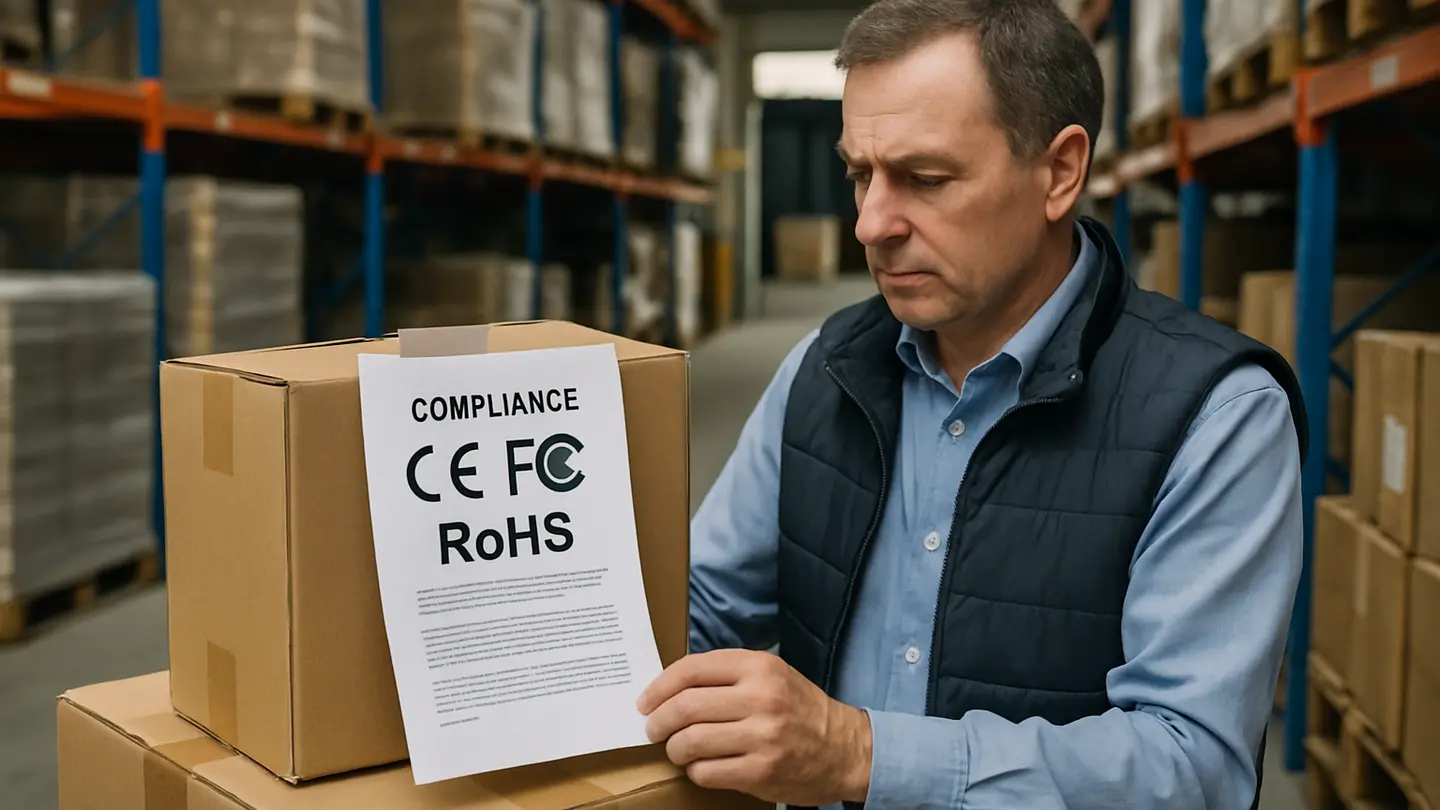
Certificates, audit reports, and lab-test PDFs should be verified rather than accepted at face value. Professional formatting does not prove validity. Names, dates, addresses, product descriptions, and production entities must match across compliance documents.
A due diligence file should include relevant records such as:
- Business license
- Bank account confirmation
- Export license or export-related documents where applicable
- Customs registration or shipping records where relevant
- Product test reports
- Quality management certificates
- Factory audit reports
- Inspection records
- Defect logs
- Corrective and preventive action records
Where possible, check certificate numbers with the issuing lab, certification body, or official database. If a test report names a different factory, covers a different product, or is several years old, it may not support the current order.
Raw operating records are often more useful than polished marketing documents. Inspection logs, nonconformance reports, defect trend data, and corrective-action records show how the supplier manages real production problems. A factory with no defect history may simply be failing to measure defects.
Compliance evidence is strongest when it connects directly to the legal entity, production site, and product being purchased.
6. When Confident Sales Replies Fail Under Technical Questions
Fast communication is useful, but it does not prove manufacturing competence. Some suppliers respond quickly to pricing and availability questions but become vague when the discussion turns technical.
Before onboarding, ask specific questions about engineering, materials, tolerances, packaging, testing, production constraints, and logistics. The answers do not need to be perfect immediately, but the supplier should be able to involve engineers, production managers, quality specialists, or logistics staff.
Warning signs include:
- Ignoring technical questions
- Repeating generic assurances
- Refusing to discuss tolerances or test methods
- Giving inconsistent material information
- Avoiding packaging drop-test or transport-risk discussions
- Providing vague root-cause explanations for defects
- Saying “no problem” to every requirement without review
A capable factory usually understands its process limits. It may push back on unrealistic tolerances, suggest alternative materials, or request drawings and test standards before confirming. That discipline is often a positive sign.
7. When a Busy Workshop Has Weak Management Controls
A busy production floor can create false confidence. Activity is not the same as control. A workshop may look full while still lacking stable processes, preventive maintenance, calibration, change control, or disciplined quality management.
Buyers should assess management maturity, not only production activity. Important records include:
- Equipment maintenance logs
- Calibration records for measuring tools and test equipment
- Incoming material inspection records
- In-process inspection records
- Final inspection records
- Change-control records
- Corrective and preventive action procedures
- Training records for operators and inspectors
- Subcontracting controls
Weak management systems can lead to recurring defects, missed deadlines, unauthorized material changes, and unapproved subcontracting. These problems may not appear during a quick visual tour, especially if the supplier prepares the site in advance.
Independent QA supervision can reduce this risk. Third-party audits, during-production inspections, and pre-shipment inspections provide evidence beyond supplier claims and help confirm whether the supplier is following agreed specifications at the stated location.
A factory with moderate equipment but strong process control may be safer than a larger workshop with poor documentation.
A Verification Scenario: Uncovering a Fake Factory Claim
Consider a typical sourcing situation. A supplier presents a convincing catalog, offers a competitive price, and promises a short lead time. The sales representative says the company owns a factory and can start production quickly after deposit.
The buyer asks for the Chinese business license and compares it with the proforma invoice. The company name matches, but the business scope focuses mainly on wholesale, trading, and sales rather than manufacturing. That does not automatically prove fraud, but it conflicts with the factory claim.
Next, the buyer checks the registered address. It appears to be in an office building rather than an industrial zone. The supplier says the factory is at a different location but does not provide official documentation for that site.
The buyer requests a live video walkthrough showing the office, production line, relevant machinery, material storage, and quality-control area. The supplier sends a prerecorded video instead. When asked for a live call, the supplier delays, then says the production floor is unavailable due to confidentiality.
At this point, the buyer has several warning signs: a business scope that does not support manufacturing, an office-style registered address, refusal to show live machinery, and reliance on sales material instead of verifiable evidence.
The right decision is not to accuse the supplier. It is to pause payment, request stronger evidence, consider third-party verification, or move to another supplier with clearer factory status.
Use a Diagnostic Scorecard to Choose the Right Supplier
A structured scorecard helps procurement teams compare supplier risk objectively. Without a repeatable process, decisions often depend too heavily on price, personal rapport, or deadline pressure.
Use the scorecard during supplier screening, sample approval, pre-production review, and order renewal. The purpose is to convert supplier claims into evidence-based decisions.
Step 1: Rate the Five Evidence Categories
Score each supplier across five categories: communication, documentation, quality assurance, factory access, and financial transparency.
Communication should measure more than speed. Low scores apply when the supplier ignores technical questions, gives vague answers, refuses to involve production specialists, or repeatedly says “no problem” without analysis. Strong communication includes clear escalation to engineers, QC staff, and logistics personnel.
Documentation should focus on consistency and verifiability. Strong documentation includes matching legal entities, valid business records, aligned invoice details, and certificates that can be checked. Weak documentation includes mismatched names, unclear addresses, outdated certificates, or unverifiable PDFs.
Quality assurance should be scored on operating evidence. Strong suppliers can provide inspection data, defect logs, corrective-action records, and sampling plans. Weak suppliers rely on claims such as “we check everything” without records.
Factory access should measure whether the supplier can show live, relevant production evidence. A strong score requires access to the production site, relevant machinery, and line-level operations. A low score applies when the supplier avoids live walkthroughs or cannot connect its factory claim to the product being sourced.
Financial transparency should include itemized invoices, clear cost breakdowns, reasonable payment terms, and commercial terms aligned with risk exposure. A supplier demanding high upfront payment while refusing verification should score poorly.
Step 2: Convert Scores Into Procurement Decisions
Scores should lead to action. High scores can support moving forward, provided normal controls remain in place: written specifications, approved samples, purchase orders, inspections, and shipment approval.
Mid-range scores should trigger a pause or deeper review. That may mean a limited pilot order, third-party factory audit, additional certificate verification, or tighter payment milestones.
Very low scores should lead buyers to reject the supplier before financial exposure increases. If the supplier cannot prove its identity, refuses live production access, provides inconsistent bank details, or avoids technical accountability, the safest decision is often to walk away.
Score thresholds are decision aids, not substitutes for due diligence. Even a strong supplier needs contract controls, inspection rights, and clear acceptance criteria.
FAQ
1. How do I spot fake Alibaba suppliers before I pay?
Use a live video call to verify production before sending funds. Ask the supplier to show the factory floor, relevant machinery, material storage, quality-control area, and packaging area in real time. Fake suppliers or intermediaries often stall when asked to show live production.
Also check the registered address on a map. If the company claims to operate heavy manufacturing equipment from an office building or residential location, ask for the actual factory address and supporting records.
Marketplace profiles on Alibaba, Made-in-China.com, or another B2B platform should be treated as starting points rather than proof. Verify the legal entity, production site, and payment beneficiary independently.
2. What is the fastest way to tell a trading company from a factory?
Review the supplier’s official Chinese business license and use the 18-digit Unified Social Credit Code to check registry information where available. The business scope is important. A scope that includes manufacturing supports factory status more than one limited to wholesale, trading, import/export, or sales.
This check is not perfect because some manufacturers also operate trading entities, and some groups use separate export companies. Still, government records are stronger than supplier-provided summaries or English-language sales profiles.
3. What documents belong in a Chinese factory due diligence file?
A practical due diligence file should include business records, banking details, export or customs documents where relevant, product certificates, lab-test reports, quality documents, inspection records, defect logs, and corrective-action records.
Certificates should be checked with the issuing lab, certification body, or relevant authority when possible. Unverified PDFs are not enough to prove compliance. A real factory should also be able to show how it handles defects, including root-cause analysis and corrective actions.
4. Is a factory audit worth it for e-commerce orders?
Often, yes—especially when the deposit, order value, or downside risk is significant. Factory audits and pre-shipment inspections can catch problems before goods leave China, when corrective action is still more practical.
For e-commerce sellers, defects can create chargebacks, replacement shipments, negative reviews, platform penalties, and higher customer-service costs. Compare the audit or inspection cost with the deposit, total order value, and potential loss from a failed shipment. Physical inspection gives buyers evidence that supplier assurances alone cannot provide.