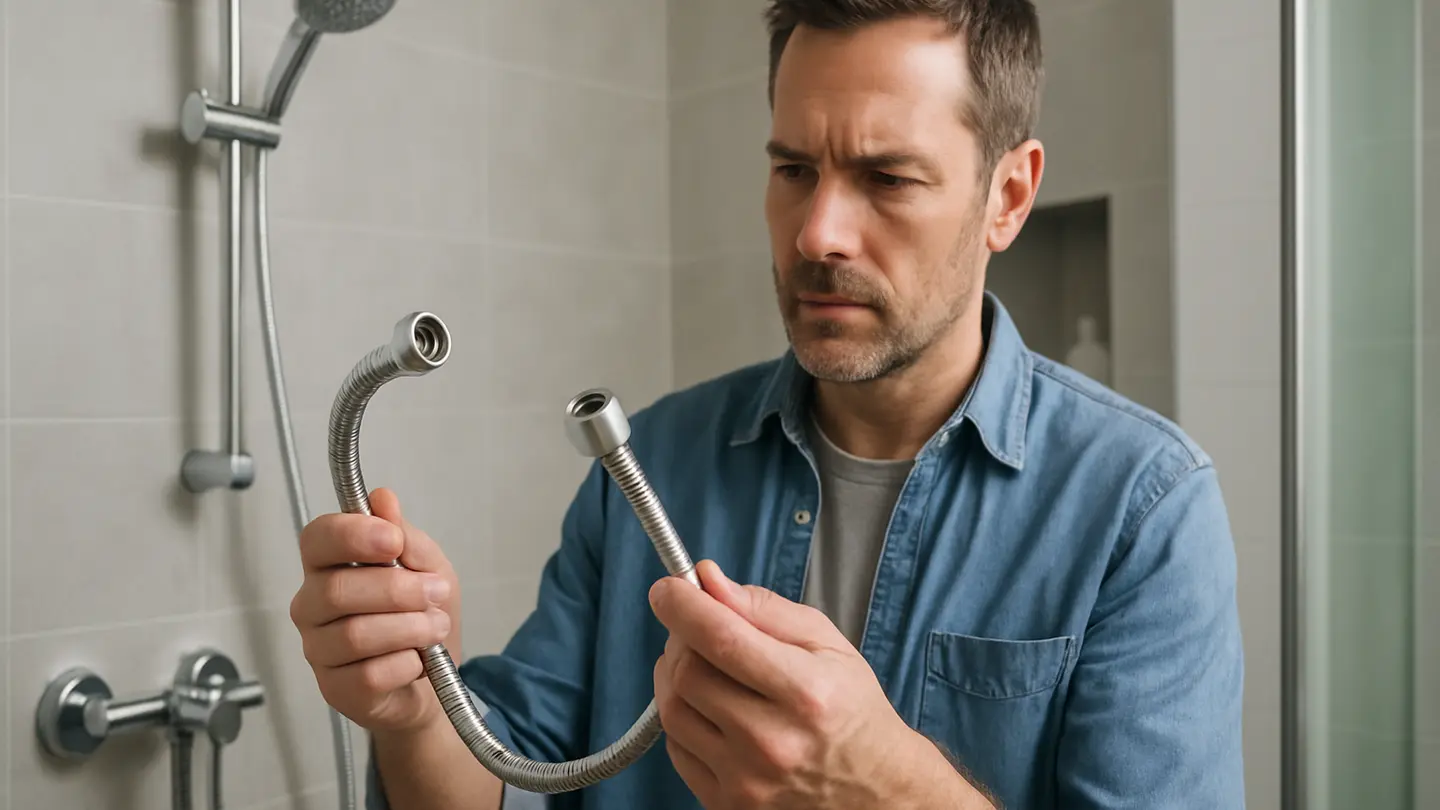
Choosing a shower hose affects shower reliability, user comfort, warranty exposure, and after-sales service. For B2B buyers sourcing replacement hoses, private-label bathroom ranges, hospitality parts, or OEM components, the right hose is not simply the one that looks compatible in a product photo.
The practical answer to how to choose a shower hose is to start with the connection, then match the length, material, bore, and features to the installation environment and product tier.
Start With Connector Compatibility
Connector compatibility should be confirmed before comparing finishes, hose lengths, or material upgrades. A hose that does not seal correctly at the outlet or showerhead can create leaks, returns, installation complaints, and service calls.
A shower hose normally connects at two points:
- The water outlet, shower valve, bath mixer, or wall elbow
- The handheld showerhead or handset
Both ends must match the required thread standard and sealing arrangement. In many standard installations, the two ends use the same fitting size, but designer fixtures, older plumbing, power shower systems, and imported bathroom products can introduce variation.
For B2B purchasing, connector details should appear in product data sheets, technical drawings, and packaging copy. If the hose is sold as a replacement item, compatibility guidance should be clear enough for installers, retailers, and end users.
G1/2, or 1/2-Inch BSP, as the Common Household Standard
G1/2, also described as 1/2-inch BSP, is the widely used fitting size for many household shower hoses. It is common across UK and European bathroom fittings and is typically the default specification for standard replacement hoses.
For mainstream retail and replacement ranges, G1/2 is usually the first specification to evaluate. It suits many handheld showerheads, mixer showers, shower outlets, and bath shower mixers, making it practical for distributors and retailers that need broad compatibility.
However, “common” does not mean “universal.” Buyers should still confirm thread type, washer arrangement, and connection depth, particularly when matching hoses to a specific shower kit or OEM showerhead. Small inconsistencies in thread engagement or washer seating can cause slow leaks even when the nominal thread size appears correct.
For packaged replacement hoses, state the fitting as “G1/2 / 1/2-inch BSP” and specify whether washers are included. In commercial procurement, requesting technical drawings of the end nuts and thread detail can prevent avoidable compatibility issues.
G3/4, or 3/4-Inch BSP, for Higher-Flow Systems
G3/4, or 3/4-inch BSP, is less common in typical domestic shower setups, but it may appear in higher-flow systems. The larger connection can support greater water flow where the rest of the system is designed for it.
Some high-pressure, power shower, or specialist installations may require this size. For buyers serving refurbishment projects, high-end bathroom installations, or non-standard shower systems, G3/4 should be checked during specification rather than discovered at installation.
Connection size should not be confused with performance. A larger connector alone does not guarantee a stronger shower. Flow depends on the full system: water supply, valve, hose bore, showerhead restriction, local plumbing, and any filters or flow regulators. If the system requires G3/4, substituting a standard G1/2 hose without the correct adapter or specification can create fitment and performance problems.
Checking Older, Designer, or Non-Standard Fittings
Older plumbing, designer fixtures, and imported bathroom products may not align with common replacement hose assumptions. This is especially relevant for maintenance buyers managing mixed property portfolios or replacement parts across multiple product generations.
The most reliable approach is to remove the existing hose and verify the replacement size before ordering. When the thread size is uncertain, calipers can be used to measure the thread diameter. Buyers should also check whether the existing hose seals with a flat washer, internal cone, or another arrangement.
Universal adjustable connectors can help in some replacement scenarios, but they are not a complete substitute for accurate specification. They may require sealing tape to help prevent leaks, and their appearance or installation method may not suit premium bathroom ranges.
For B2B orders, samples should be tested against the actual outlets and handsets they will be paired with, especially for OEM shower kits, hotel maintenance programs, rental refurbishments, or aftermarket replacement assortments.
Choose a Shower Hose Length That Matches the Bathroom Layout
After connector compatibility, length is the next practical decision. The best length gives comfortable reach without excess hose that drags, tangles, or obstructs the user.
Buyers should consider:
- Shower enclosure size
- Bath-over-shower installations
- Outlet or mixer position
- Height of the showerhead holder
- User mobility and height range
- Cleaning, rinsing, children, or pet-washing needs
A hose that is too short restricts handheld movement and can pull against the connection. A hose that is too long may lie on the shower tray or bath floor, increasing tangling, wear, and cleaning issues.
1.25 m Hoses for Compact Shower Spaces
A 1.25 m hose is suitable for compact shower spaces, small cubicles, and bathrooms where the handheld showerhead needs limited movement. In tight enclosures, a shorter hose can reduce excess hose lying on the floor or catching on fittings.
This length works best where the outlet and showerhead holder are close together and extended reach is not required. It may also suit minimalist shower sets where a neat appearance is more important than maximum flexibility.
For B2B buyers, 1.25 m hoses are worth considering for compact apartment bathrooms, budget shower cubicles, and replacement programs where space is limited. The limitation is reach. If the showerhead must move around a bath, be used for cleaning, or suit users of different heights, this length may feel restrictive.
1.5 m Hoses as the Most Versatile Standard Option
A 1.5 m hose is the most versatile standard option for many household bathrooms. It usually provides enough reach for showering over a bath while keeping the hose short enough to reduce dragging and tangling.
For retail assortments and general replacement ranges, 1.5 m is often the safest default because it suits many common installations. It gives users enough movement for normal handheld showering and rinsing without making the hose difficult to manage.
In B2B specification, 1.5 m hoses are a practical baseline for standard shower kits, family bathrooms, and mainstream replacement products. They can be offered across both metal and PVC constructions and in multiple finishes, depending on the target price point.
However, this length may not be ideal where the outlet is mounted unusually low, the shower area is large, or users require extended reach for accessibility or cleaning.
1.75 m to 2.0 m Hoses for Extra Reach
Longer hoses in the 1.75 m to 2.0 m range suit larger bathrooms, walk-in showers, bath rinsing, children, pets, and users who need more reach. A hose around 1.8 m can provide useful flexibility without becoming as unwieldy as the longest options.
Before choosing an extended hose, measure from the water outlet to the showerhead holder and allow roughly 20 cm extra for comfortable movement. This helps avoid specifying a hose that is too tight during use or unnecessarily long.
Longer hoses are particularly useful in:
- Walk-in shower areas
- Bath-over-shower setups
- Family bathrooms
- Accessible bathrooms
- Hospitality bathrooms
- Cleaning-intensive environments
The trade-off is management. Oversized hoses can drag across the bath or shower tray, collect soap residue, tangle around fixtures, and wear faster through abrasion. For product ranges, it may be useful to stock both 1.5 m and 1.75 m or 2.0 m options rather than treating one length as suitable for every installation.
Compare Shower Hose Materials by Durability, Flexibility, and Cost
Material affects service life, flexibility, appearance, cleaning, pressure resistance, and customer perception. Stainless steel and PVC are two common shower hose material categories, each with distinct advantages.
For B2B sourcing, the best material depends on the application:
| Material | Main strengths | Main limitations | Typical B2B fit |
|---|---|---|---|
| Stainless steel braided | Durable, pressure-resistant, heat-resistant, familiar chrome look | Higher cost, can feel less flexible | Mid-range to premium replacement hoses, high-use bathrooms, longer-life programs |
| PVC | Lightweight, flexible, affordable, easy to clean | May crack, kink, or degrade faster | Budget ranges, temporary installations, lightweight designs, smooth easy-clean hoses |
Buyers should also consider water conditions. Hard water, heat, frequent flexing, and cleaning chemicals can shorten hose life. The outer material is only part of the specification; the inner tube, washers, reinforcement, and end nuts also affect real-world performance.
Stainless Steel Braided Shower Hoses
Stainless steel braided shower hoses are valued for durability and resistance to heat and pressure. Their chrome-finish appearance coordinates with many bathroom fixtures, making them familiar to installers, retailers, and consumers.
This construction is often a strong option for high-use bathrooms and longer-term replacement needs, including rental properties, hotels, family bathrooms, and retail ranges positioned above entry level.
The main trade-offs are cost and flexibility. Stainless steel hoses may cost more than PVC and can feel less supple, depending on braid quality, inner tube, and connector design. Lower-quality metal hoses can also become noisy, stiff, or prone to surface wear.
When sourcing stainless steel braided hoses, B2B buyers should evaluate:
- Braid consistency and surface smoothness
- Inner tube quality
- End nut material and finish
- Washer quality
- Pressure and temperature ratings
- Resistance to corrosion and discoloration
- Bend performance after repeated use
- Packaging protection to avoid scratches in transit
Stainless steel is generally the stronger long-term investment where durability is the priority, but the hose still needs proper construction and quality control.
PVC Shower Hoses
PVC shower hoses are lightweight, flexible, affordable, and easy to clean. Many have a smooth outer surface, which can reduce grime build-up and make the hose easier to wipe down. Some PVC finishes imitate chrome or metal without exposed metal braiding.
PVC is a good fit for budget ranges, temporary installations, student accommodation, light-use bathrooms, or applications where low weight and flexibility matter more than maximum service life. Smooth PVC can also be useful where buyers want to reduce the risk of marking delicate bath or tile surfaces.
The limitation is long-term durability. PVC may crack, kink, discolor, or degrade faster than metal alternatives, particularly under frequent bending, heat, chemical cleaning, or poor storage conditions. The hose may also be more vulnerable to compression if it lacks reinforcement.
For B2B buyers, the key is whether the specific PVC hose matches the expected duty cycle. A value-oriented hose for occasional use has different requirements from a product intended for daily family or hospitality use.
Evaluate Upgrade Features That Solve Common Hose Problems
Beyond size, length, and material, functional features can reduce common user complaints. These upgrades are especially relevant for buyers managing product reviews, maintenance calls, or warranty returns.
Anti-kink and anti-tangle designs are among the most useful improvements. These may use swivel connectors, flexible hose structures, or designs that allow the hose to rotate during handheld use. A 360-degree swivel connector can help prevent twisting as the showerhead moves, improving comfort and reducing stress on the hose.
Burst-resistant reinforcement is valuable for higher-pressure systems or applications where safety margins are important. Reinforced inner tubes or layered construction can reduce the risk of sudden failure, provided the hose is correctly rated and installed within its pressure and temperature limits.
Internal bore also matters. A wider internal bore can support better flow where the system can supply it, which may help in some low-pressure installations or high-flow shower systems. However, bore size should be considered alongside the showerhead, valve, and local plumbing. A high-flow hose cannot overcome restrictions elsewhere in the system.
Buyers should match features to actual use conditions:
- Frequent handheld use: prioritize anti-twist and swivel ends
- High-pressure installations: consider burst-resistant reinforcement
- Low-flow complaints: review internal bore and filter washer restrictions
- Hard water areas: choose designs that are easier to clean and inspect
- Premium bathroom ranges: evaluate finish, flexibility, and handling feel
- Maintenance-heavy environments: prioritize durability and replaceable washers
Feature upgrades should be practical rather than decorative. A hose that prevents twisting, maintains flow, and withstands regular movement can reduce dissatisfaction more effectively than a purely cosmetic finish.
Installation and Maintenance Checks Before and After Purchase
Even a well-specified shower hose can perform poorly if installed incorrectly or neglected. B2B buyers should consider installation and maintenance requirements, especially where hoses are supplied to contractors, retailers, or property managers.
Before installation, check that the washer is seated correctly and that the connector threads engage smoothly. Cross-threading can damage the fitting and cause leaks. In some threaded connections, sealing tape can help create a watertight seal where appropriate, but it should not replace the correct washer or fitting.
After installation, run water through the hose and check both connection points for leaks. Likely causes include a missing washer, damaged washer, incorrect thread size, poor thread engagement, or overtightening.
Maintenance is simple but important. Connector filter washers should be cleaned periodically to maintain flow, particularly in hard water areas where mineral deposits can accumulate. A hose that seems to reduce pressure may simply be blocked by debris or scale at the washer or internal bore.
Regular inspection helps identify:
- Cracks or splits
- Bulging sections
- Rust, discoloration, or corrosion
- Loose end fittings
- Persistent kinks
- Leaks at the connectors
- Reduced flow caused by debris or mineral deposits
Replacement timing depends on material, water conditions, usage frequency, and visible condition. Any hose showing leakage, bulging, severe kinking, or structural damage should be replaced promptly.
The best specification combines the right connector, suitable length, appropriate material, and functional features that match the installation. For B2B buyers, that means fewer compatibility issues, better user experience, and more reliable shower performance.
FAQ
Are all shower hose fittings the same size?
No. Shower hose fittings are not all identical. G1/2, or 1/2-inch BSP, is the common household standard in many UK and European installations, but G3/4, older, or bespoke fittings may appear in some systems. Buyers should check the existing connection before ordering replacements.
Is a metal or plastic shower hose better?
Metal hoses generally prioritize durability, pressure resistance, and longer service life. PVC hoses prioritize flexibility, low weight, easy cleaning, and affordability. The better choice depends on budget, usage frequency, and durability requirements. Plastic hoses may need more frequent replacement than stainless steel in demanding applications.
Can a new shower hose affect water pressure?
Yes. A new hose may improve flow if the old hose was clogged, damaged, kinked, or restricted by mineral deposits. Wider internal bore designs can support higher flow where the system is suitable. However, replacing the hose alone may not solve pressure problems caused by the valve, plumbing, or showerhead.
How can buyers reduce shower hose tangling and kinking?
Choose anti-kink or anti-tangle hose designs, especially for frequent handheld-shower use. A 360-degree swivel connector lets the hose rotate more freely as the showerhead moves. Reducing twists improves comfort, lowers stress on the hose, and can extend its usable life.