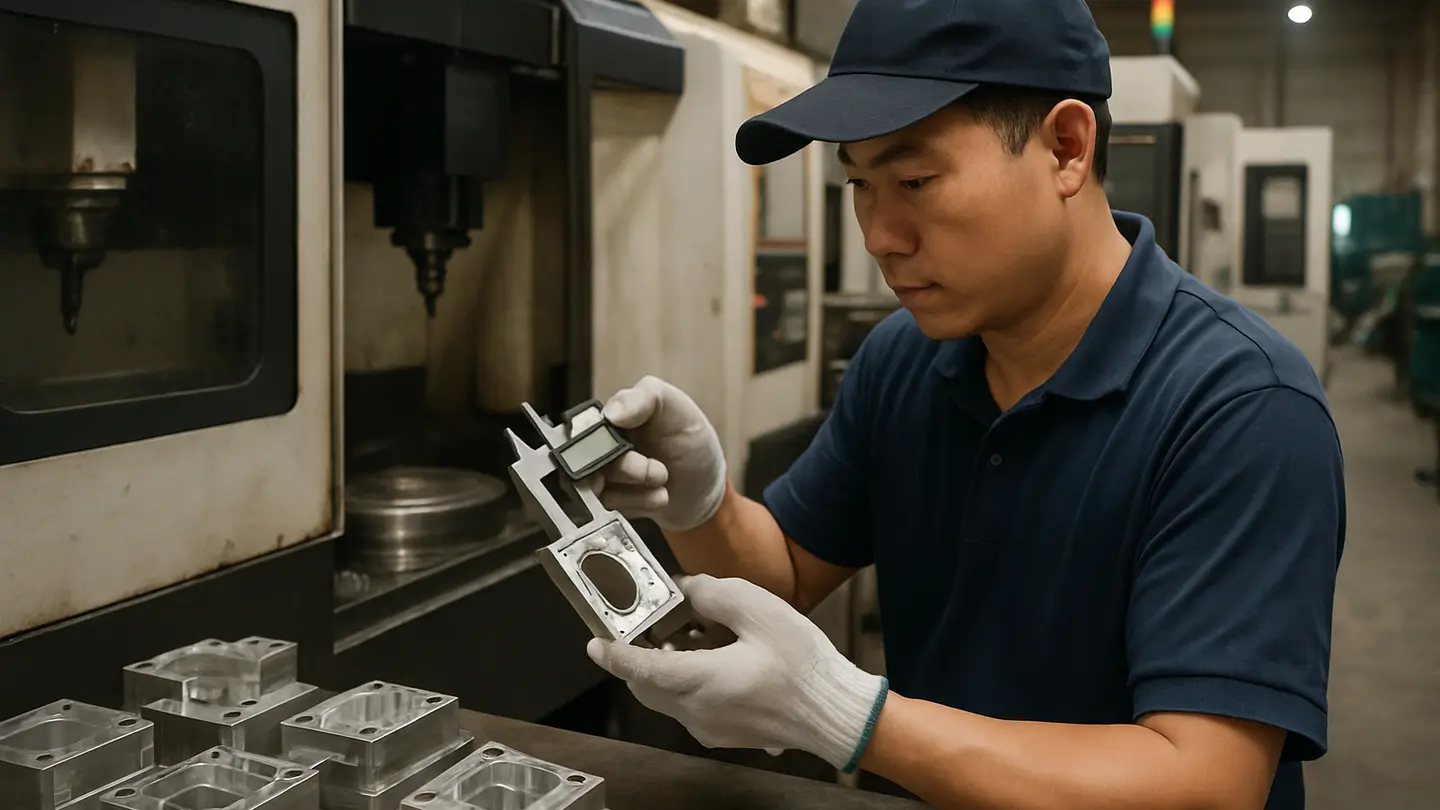
For B2B buyers, CNC machining in China can be a practical sourcing option when parts require precision, repeatability, and production-like materials without hard tooling. It is widely used for prototypes, pilot batches, replacement components, jigs, fixtures, and low-volume production parts in metals and engineering plastics.
The commercial appeal is straightforward, but CNC pricing depends on part geometry, required precision, material grade, surface finish, setup time, batch size, inspection requirements, and shipping assumptions. A small stainless steel insert with tight concentricity may cost more than a larger aluminum bracket with loose tolerances.
Unlike injection molding, die casting, or forging, CNC machining does not require a dedicated mold. The factory still needs to program toolpaths, prepare workholding, select tools, and prove the process, but revisions are usually handled by updating the digital file and drawing rather than modifying hard tooling.
For buyers sourcing machined parts from China, the main task is not finding the lowest unit price. It is defining the part well enough that suppliers quote the same requirement, then controlling quality before small misunderstandings become expensive production problems.
When CNC Machining Is the Best Fit
CNC machining is often the right process when the buyer needs functional parts in real metals or engineering plastics, but the volume does not yet justify hard tooling. It is also useful when a design may still change after testing.
3D printing is usually faster for early form checks, ergonomic reviews, and concept models. However, printed parts may not represent the final material’s strength, surface behavior, thread quality, sealing performance, or long-term wear.
CNC machining is better when the test must reflect production-like performance. A machined brass valve component, stainless steel fitting, aluminum housing, or POM sliding part can be evaluated for fit, load, sealing, corrosion exposure, assembly torque, and dimensional stability more realistically than many printed alternatives.
Other processes may be better for different part types:
| Process | Often best for | Main limitation compared with CNC |
|---|---|---|
| 3D printing | Form checks, visual models, early prototypes | Material and tolerance may not match production |
| Laser cutting | Flat sheet-metal profiles and simple brackets | Limited for complex 3D geometry and deep features |
| Casting | Complex metal shapes at higher volume | Tooling cost, longer development, more design lock-in |
| Injection molding | High-volume plastic parts | Mold cost and tooling changes can be significant |
| CNC machining | Functional prototypes, pilot runs, low-volume precision parts | Unit cost can be high at large volumes |
CNC is commonly used as the bridge between rapid prototyping and full tooling. A buyer may print the first concept, CNC machine functional samples, run a pilot batch for assembly testing, then move to casting, molding, or stamping once the design and demand are stable.
What Goes Into a CNC Quote
A CNC quote is more than machine time. It usually combines several cost elements, some visible and some hidden inside the unit price.
The main quote drivers include:
- Programming: creating toolpaths from the CAD model and drawing.
- Setup: preparing machines, tools, fixtures, and work instructions.
- Workholding: designing soft jaws, fixtures, or special clamping methods if needed.
- Material: bar, plate, casting blank, extrusion, or plastic stock, including waste.
- Cutting time: time required on mills, lathes, turning centers, or multi-axis machines.
- Tool wear: especially for harder metals, abrasive materials, or long runs.
- Secondary operations: deburring, tapping, polishing, anodizing, plating, passivation, coating, laser marking, or assembly.
- Inspection: basic checks, first-piece inspection, CMM reporting, material certificates, or full inspection records.
- Packaging and shipping: export packing, corrosion protection, labels, cartons, pallets, freight terms, and delivery method.
Buyers should request quotes at several quantities, such as 1, 10, 50, 200, and 1,000 pieces. This helps separate one-time setup and programming costs from repeatable unit costs. A one-piece quote may look expensive because setup is carried by a single part. At higher quantities, setup is spread across the batch, while material and cycle time become more important.
Machine time rises when the part is difficult to cut or inspect. Common cost-sensitive features include:
- Deep pockets that require long tools and slower cutting.
- Thin walls that may vibrate, distort, or require light passes.
- Small internal radii that require small cutters and longer cycle time.
- Tight flatness, concentricity, or perpendicularity requirements.
- Multiple setups because the part must be machined from several sides.
- Hard materials such as some stainless steels or hardened alloys.
- Cosmetic finishes that require careful handling and extra polishing.
- Blind holes, cross holes, internal threads, and difficult burr locations.
Two suppliers may quote very different prices because they made different assumptions. One may include anodizing, inspection reports, and export packaging; another may quote only machining ex-works. One may assume general tolerances; another may price every dimension as tightly controlled.
Before comparing quotes, ask each supplier to clarify what is included and excluded. The RFQ should specify material grade, tolerance standard, finish, inspection level, quantity, delivery term, packaging, and whether the quote is based on a 3D model, 2D drawing, or sample.
Control Costs by Tightening Only Critical Tolerances
Tolerances are one of the most important cost levers in CNC machining. Tighter tolerances increase machining time, inspection effort, setup sensitivity, tool wear, and rejection risk. They may also require better fixtures, more stable material, or slower production speeds.
The key sourcing principle is simple: tighten only the dimensions that matter.
Critical tolerances should be reserved for features that affect:
- Fit with mating parts.
- Sealing surfaces and O-ring grooves.
- Thread engagement and assembly torque.
- Bearing, shaft, or sliding movement.
- Alignment of holes, pins, or mounting points.
- Safety-related load paths.
- Water flow, pressure control, or valve function.
- Visible cosmetic alignment where appearance is part of the product value.
Noncritical dimensions can often use looser tolerances without reducing performance. The outside profile of a hidden spacer may not need the same precision as the bore that locates it. A mounting plate may need hole positions controlled tightly, while external edges can follow a general tolerance.
Vague wording causes problems. Requirements such as “high precision,” “best quality,” or “make it accurate” do not give the factory a measurable target. A proper drawing should include numeric tolerances, general tolerance standards where appropriate, and specific callouts for critical-to-quality dimensions.
Buyers should distinguish between prototype tolerance and production tolerance. A factory may be able to make one sample extremely close to nominal by spending extra time. That does not mean it can hold the same result across hundreds or thousands of parts at the quoted production price.
Before releasing the full batch, require a first-piece inspection. The first completed part should be checked against the drawing, including critical dimensions, material, finish, and any functional checks. Only after approval should the supplier continue. This is especially important for new suppliers, revised drawings, new materials, or parts with sealing and assembly requirements.
Specify the Exact Material Grade
Material descriptions must be precise. Saying “stainless steel,” “aluminum,” “brass,” “POM,” or “nylon” is not enough for a controlled CNC order. Grades within the same family can differ in cost, machinability, corrosion resistance, strength, hardness, color, surface finish behavior, and availability.
For example, stainless steel grades vary in corrosion resistance and machinability. Some aluminum grades are easier to machine and anodize, while others provide higher strength. Brass grades can differ in lead content, cutting behavior, and compliance considerations. Plastics such as POM, nylon, PTFE, and PEEK vary by formulation, filler, moisture absorption, and dimensional stability.
The RFQ should state the exact material grade and, when relevant, the applicable standard. It should also define whether certificates are required. For higher-risk applications, buyers may request material certificates, incoming material checks, or traceability by batch.
Any material substitution should require written buyer approval. A supplier may suggest an alternative grade for cost, availability, or machinability reasons, but the buyer should evaluate whether the substitution affects strength, wear, corrosion, sealing, food-contact requirements, regulatory compliance, or appearance.
Prototype material should match production material when the test is intended to evaluate functional performance. Testing a cheaper or easier-to-machine substitute may lead to misleading results if corrosion behavior, surface hardness, thread strength, or dimensional stability differ from production.
For cosmetic parts, written finish descriptions are often not enough. Terms such as “satin,” “brushed,” “mirror,” or “matte” are subjective unless controlled by a reference. Buyers should use approved physical finish samples, agreed color standards, surface roughness targets, or equivalent reference panels. This reduces disputes when machined parts are polished, anodized, plated, or coated.
Use the Quote to Judge Supplier Understanding
A CNC quote is not only a price document. It is also evidence of how carefully the supplier reviewed the part.
A capable supplier will often ask questions before quoting or before final production approval. These questions may concern thin walls, deep cavities, tight internal radii, difficult burr locations, tolerance conflicts, material availability, surface finish risks, or inspection methods. Such comments show the factory is thinking about how the part will actually be made.
A silent quote is not always a problem for simple parts. For complex geometry, tight tolerances, or cosmetic requirements, however, a quote with no technical questions can be risky. It may mean the supplier has not fully reviewed the drawing, has assumed looser requirements, or plans to resolve issues after the order is placed.
Buyers should look for practical signs of process understanding:
- The supplier identifies difficult features and suggests design-for-manufacturing changes.
- The supplier separates machining, finishing, inspection, and freight costs.
- The supplier confirms material grade and availability.
- The supplier asks which dimensions are critical.
- The supplier explains whether the part requires multiple setups.
- The supplier flags where burrs, deformation, or cosmetic defects may occur.
- The supplier clarifies whether finishing is in-house or subcontracted.
- The supplier can provide an inspection plan for critical dimensions.
Samples are useful, but they should not be overvalued. A good sample proves that one part can be made. It does not prove stable production control, trained operators on every shift, reliable inspection discipline, or robust export packaging.
For new parts or new suppliers, a pilot run is often the better test. A pilot batch can reveal problems that a single sample hides: tool wear, fixture repeatability, finish consistency, burr control, inspection speed, packaging damage, and communication gaps. It also gives the buyer a chance to confirm assembly performance before committing to a larger order.
FAQ
Q1: Is CNC machining in China cheaper than at home?
CNC machining in China can be cheaper for complex, multi-operation parts, especially when quantities rise and setup costs are spread across the batch. China’s supplier ecosystem can also be efficient when machining, finishing, materials, and packaging are coordinated well.
However, savings are not automatic. Freight, import duties, bank fees, communication time, time-zone delays, and quality follow-up can reduce or erase the advantage on single-piece or urgent orders. Local shops may be better for same-week engineering changes, emergency replacement parts, or one-off prototypes that require direct discussion with engineers.
A fair comparison should use total landed cost, not only the quoted unit price.
Q2: Can a factory quote from a sample if I have no drawing?
Many CNC factories can quote from a physical sample and reverse-engineer it into a working drawing or 3D model. This can be useful when replacing an old part, reproducing discontinued components, or developing a drawing from an existing prototype.
The risk is that measured dimensions reflect the sample, not necessarily the original design intent. The sample may be worn, bent, modified, or produced out of tolerance. If the factory copies every measured feature without understanding function, the new part may repeat old defects or miss critical requirements.
Before approving production, the buyer should confirm critical dimensions, tolerances, material grade, surface finish, and functional requirements. Reverse engineering is a starting point, not a substitute for design control.
Q3: Does the same factory do the finishing, or is it subcontracted?
Some CNC factories handle basic deburring, polishing, passivation, or simple marking in-house, but many secondary processes are subcontracted. Anodizing, electroplating, powder coating, heat treatment, black oxide, specialized polishing, and certain coatings are often performed by outside finishing suppliers.
Subcontracted finishing is common and not necessarily a problem. Specialist finishing vendors can produce better results than a machining shop working outside its core capability. The risk is reduced direct control, added lead time, more handling, and potential disagreement over responsibility if defects appear.
Before placing the order, clarify who is responsible for finishing quality, rework, inspection after finishing, color consistency, masking requirements, and damage during transport between suppliers.
Q4: Can I order a single piece?
Yes. Single-piece CNC orders are possible and common, especially for prototypes, engineering validation, replacement parts, and custom fixtures.
The buyer should expect a high unit price because programming, setup, tool selection, and inspection are carried by one part. CNC avoids mold tooling, so minimum order quantities can remain low, but it does not eliminate setup work.
For early design testing, ordering one or a few pieces may still be cost-effective because it allows the buyer to find design problems before committing to larger production or hard tooling.
Key Takeaways for Sourcing CNC Parts
The cost of CNC parts is largely determined before supplier negotiation begins. Geometry, tolerances, material grade, finish, and inspection requirements all shape the final price. A buyer who sends vague files and asks for the cheapest quote is likely to receive inconsistent offers and higher quality risk.
Choose the right process first. CNC machining is strong for functional prototypes, pilot runs, low-volume production, and precision components in production-like materials. It may not be the lowest-cost option once volumes justify casting, molding, stamping, or other tooled processes.
Limit tight tolerances to dimensions that affect function, fit, sealing, alignment, safety, or controlled movement. Use clear numeric tolerances and identify critical-to-quality features on the drawing. Require first-piece inspection before full batch production.
Specify exact material grades, not broad material families. Any substitution should require written approval. When surface appearance matters, use approved physical finish samples or clear reference standards instead of subjective descriptions.
Finally, judge suppliers by how they review the part, not only by price. Technical questions, design-for-manufacturing feedback, clear quote assumptions, inspection planning, and pilot-run discipline are strong indicators of production readiness. For B2B buyers sourcing CNC machining in China, these controls are often the difference between a low quoted price and a reliable delivered part.