Consumer Electronics Sourcing from China
Consumer electronics sourcing from China can give buyers access to a broad range of established products, component options and customization possibilities. However, electronics procurement requires more than comparing unit prices and appearance samples. Batteries, charging systems, wireless functions, firmware and destination-market rules can all affect whether a product is commercially viable.
A successful sourcing process begins by defining the product clearly. Buyers should document the intended market, core functions, target retail price, expected order volume, packaging requirements and any branding changes. For connected or battery-powered products, the specification should also state the expected charging method, battery type, supported devices, firmware version and app requirements.
Quality control should be planned before production starts, not added only after a problem is found. Approved samples, inspection criteria, production-stage checks and pre-shipment testing can help buyers identify issues before goods are dispatched. Compliance documentation also needs close review because certificates and markings may depend on the exact model, configuration and destination country.
Consumer Electronics Products Commonly Sourced from China
China supplies a wide variety of consumer electronics products, from relatively simple accessories to more complex connected devices. Common sourcing categories include:
- Phone chargers, cables, adapters, cases and power banks
- Bluetooth speakers, headphones and other audio products
- Smart-home devices, such as sensors, plugs, switches and cameras
- Wearables, including fitness trackers, pedometers and smart watches
- Action cameras, security cameras and related accessories
- Battery-powered personal devices, lights and portable gadgets
The approval and documentation requirements for these products vary by device type and destination market. A basic wired accessory may require a different review process from a wireless speaker, a Wi-Fi camera or a lithium-battery power bank. Buyers should therefore avoid treating a supplier’s general certificate file as evidence that every product variant is suitable for every market.
Lithium-battery products need particular attention. Depending on the transport arrangement, batteries or battery-containing products may require UN38.3 transport documentation. The documents should relate to the relevant battery configuration rather than a loosely similar product. Buyers should also confirm how batteries will be packed, labelled and declared for shipment.
Minimum order quantities for standard consumer-electronics models commonly fall in the range of roughly 100 to 500 units. The actual minimum can rise when a buyer requests special colors, revised components, customized firmware or branded packaging. Custom retail boxes, inserts and manuals often have their own printing minimums, which can make a small electronics order less economical even when the factory can produce a limited quantity of the device itself.
For first orders, an existing model with limited branding changes is often easier to manage than a fully new design. It can reduce development time and allow buyers to focus on product verification, market fit and packaging quality before committing to tooling or substantial engineering changes.
Tools for Building and Checking a China Supplier Shortlist
Early supplier research should compare more than quoted price. Buyers sourcing electronics may need to assess whether a supplier can support the required product category, quality controls, documentation, packaging work and sample process.
Made-in-China.com is a B2B sourcing platform that can support early supplier discovery and comparison. Its Audited Suppliers feature enables buyers to review suppliers that have undergone third-party verification and an on-site audit. This information can help buyers develop a more structured shortlist, although it does not remove the need to assess the specific product and order requirements.
Available Audit Reports can provide structured information on areas such as manufacturing capacity, quality control, export trade and research and development capability. These details can be useful when comparing suppliers that offer similar products but may have different production resources or quality-management practices.
Buyers can also use Easy Sourcing to submit one sourcing request, receive quotations from matched suppliers, compare quotes and request samples. For electronics products, the request should include detailed functional requirements, target market, battery specifications, branding needs and required documentation so supplier responses can be evaluated on a like-for-like basis.
What to Inspect on Consumer Electronics Orders
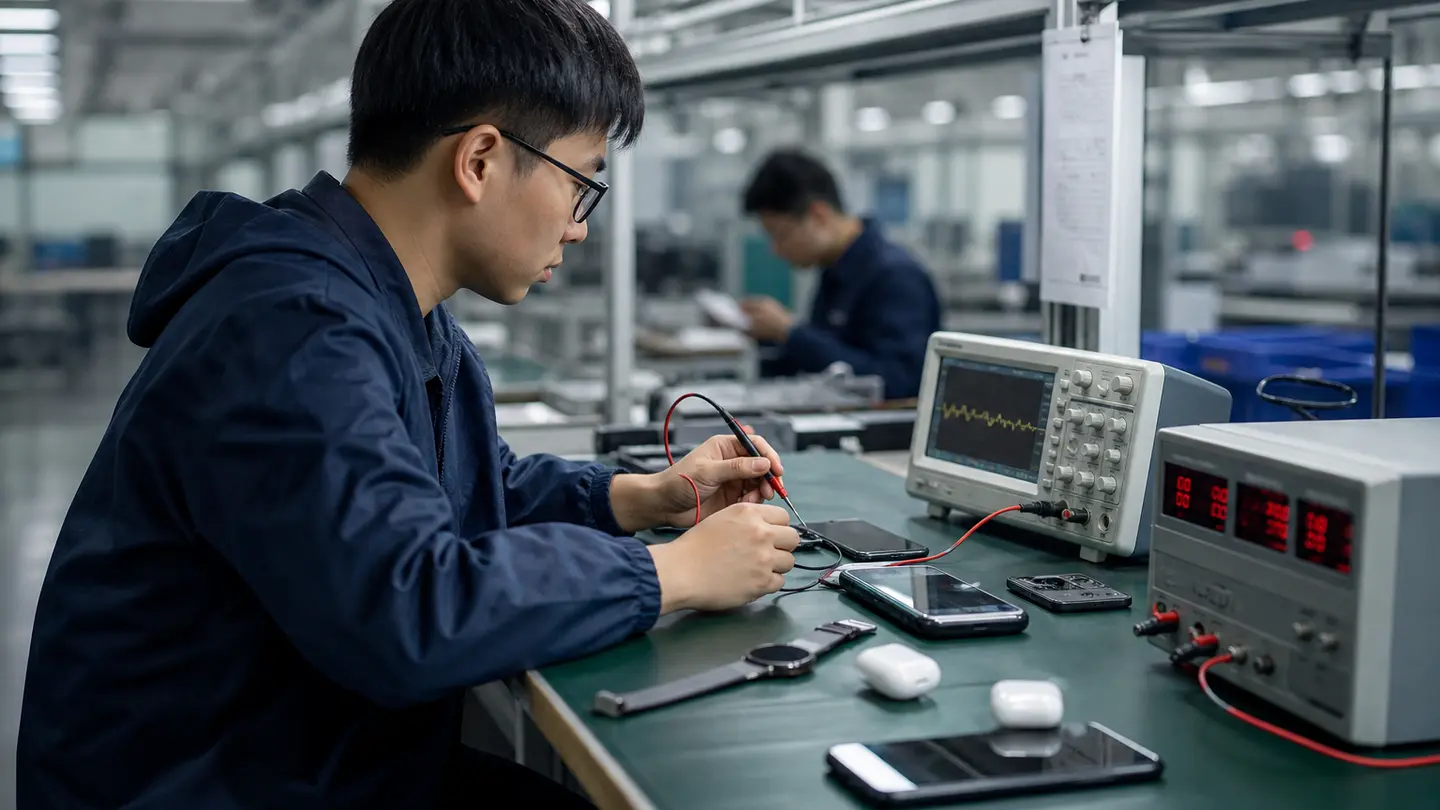
Electronics inspections should combine visual checks with functional and documentation review. A device can look well made while still having weak battery cells, unstable firmware or incompatible charging components. The inspection plan should reflect the product’s actual use conditions and the approved sample.
Battery checks are particularly important for portable products. Review may include the stated battery type, cell quality, actual capacity, charging temperature and shipping documentation. A battery that charges unusually hot, drains rapidly or performs below the agreed capacity can create customer complaints even if the outer casing appears acceptable. For products with removable batteries, buyers should also verify fit, connection stability and correct polarity markings.
Functional testing should cover normal operation over repeated use. Depending on the product, this can include charging cycles, charging-port fit, cable compatibility, button response, display behavior, sound output, camera performance or wireless connectivity. The finished goods should perform in line with the approved sample and agreed specifications.
Connected products require additional checks. Inspectors may test Bluetooth or Wi-Fi pairing, app installation, account connection, basic app functions and firmware version. If the product relies on a mobile application, the buyer should identify the supported operating systems and verify whether changes to the app or firmware could affect the device after shipment. A device that pairs correctly during a quick factory demonstration may still fail during repeated pairing attempts or after an update.
Build quality also matters. Relevant checks can include:
- Seal integrity for products exposed to moisture, dust or outdoor use
- Casing fit, gaps, loose parts and sharp edges
- Button, switch and control responsiveness
- Port alignment and insertion quality
- Screen, lens or indicator-light condition
- Surface finish, printing quality and cosmetic consistency
Finally, certificates, labels and packaging marks should correspond to the exact product model and destination market. Buyers should compare model numbers, battery details, rated input information and product images across the documents, labels, user manual and production sample. A document that refers to a different model, component set or product configuration may not provide the assurance the buyer expects.
Why Electronics Quality Checks Deliver Value
Visual inspection is necessary, but it is rarely sufficient for consumer electronics. Many of the most costly failures are not obvious from the outer appearance. A power bank may have a clean finish and correctly printed capacity label while containing cells that do not deliver the expected performance. A wearable may switch on during a basic check but record inaccurate data during normal use.
Battery and software-related problems can also appear after delivery. Long-stored lithium batteries may arrive significantly discharged, affecting first-use performance and customer perception. Firmware issues may only emerge after repeated use, device pairing, app updates or changes in a customer’s phone operating system. These defects are difficult to identify through carton checks or a brief visual inspection.
The commercial consequences can be significant. Defective electronics may lead to returns, warranty claims, negative reviews and marketplace penalties. For sellers of branded products, recurring quality failures can also affect confidence in future launches. Replacing units after delivery is often more expensive than identifying a preventable issue during production.
Production-stage controls and pre-shipment testing can reduce avoidable risks. During production, buyers may verify that the approved battery, key components, firmware version and packaging materials are being used. Before shipment, the inspection team can test a defined sample of finished units against agreed acceptance criteria. This approach does not guarantee that every unit will be defect-free, but it gives buyers more opportunity to detect deviations before goods leave the factory.
The highest-value testing is usually product-specific. A camera may require image and recording checks; a wireless earbud may require pairing, charging and audio tests; a smart-home device may require setup and app verification. Generic checklists are useful starting points, but the final inspection plan should focus on the functions most likely to affect customer satisfaction.
Case Study: Bodytronics’ 20,000-Pedometer Walking Test
A useful example of the importance of real-use testing involved Bodytronics’ order of 20,000 pedometers based on an existing factory model. The product appeared suitable during initial review, but further testing identified a step-counting issue: the devices were overly sensitive and could record steps too easily.
The problem was linked to the damping of the sensor spring. The factory’s swing-jig test showed that the pedometers responded to a controlled movement, but that test did not adequately represent the varied pace, direction and impact of normal walking. A device can pass a simple mechanical motion test while still producing inaccurate readings in real-world use.
To investigate the problem, walking trials compared manual step counts with readings from multiple pedometers. This provided a more practical view of how the devices behaved during actual movement. The comparison helped identify whether the recorded results remained within the agreed tolerance rather than simply confirming that the mechanism moved.
The case illustrates an important sourcing principle: test methods should reflect how customers will use the product. For fitness devices, this may mean walking, running or repeated-motion trials. For chargers, it may mean compatibility testing with intended cables and devices. For smart products, it may mean repeated app pairing and reconnection checks.
Following the testing and adjustment process, production samples reportedly met the agreed step-counting tolerance before shipment. The value of the exercise was not only finding a defect, but also ensuring that the final quality standard was based on a meaningful use condition rather than a limited factory demonstration.
FAQ
Q1. Can I put my own brand on an existing electronics product?
In many cases, buyers can add their own logo, colors and retail packaging to an existing electronics model. This is often a practical route for launching a product without paying for new tooling or developing a device from the ground up.
Using an established model may also reduce minimum-order requirements compared with a fully customized product. The factory may already have the product housing, internal components and production process in place, leaving branding, packaging and small cosmetic changes as the main variables.
This approach can help sellers test demand before investing in extensive product development. Buyers should still approve branded samples, confirm logo placement and verify that packaging, manuals and labels match the final model and target market.
Q2. Can I add a custom feature to an existing electronics product?
Some existing electronics products can be modified without a complete redesign. Possible changes may include firmware adjustments, added sensors, alternative battery options or revised accessories. The feasibility depends on the product’s existing hardware, software architecture and the factory’s engineering capability.
A requested change can affect more than one part of the product. For example, a larger battery may alter charging time, casing dimensions, transport documentation or packaging requirements. A firmware adjustment may require fresh functional testing, especially if it affects pairing, app functions or power management.
Buyers should provide clear specifications and complete sample rounds before approving production. The agreement should identify the requested feature, expected performance, test method and acceptable tolerance. A verbal request such as “improve battery life” or “make the app easier to use” is not sufficiently precise for production control.
Q3. Can I get a small trial order before committing to the full minimum?
Some factories may accept a paid pilot order below their normal minimum order quantity, particularly when the buyer selects an existing product model. A pilot order can be useful for checking market response, packaging performance and early customer feedback before placing a larger order.
Smaller runs typically have a higher per-unit cost because setup, component purchasing and packaging work are spread across fewer units. Custom colors, printed boxes and modified firmware may also be harder to arrange at a low quantity.
When requesting a trial order, buyers should clarify whether the pilot units will use the same components, firmware and packaging process planned for the larger production run. A small sample batch assembled differently from mass production may not provide a reliable basis for evaluating final quality.
Q4. What are the most common quality problems with electronics from China?
Common risks include overstated battery capacity, batteries that have lost charge during long storage, early charging-port failures and firmware defects. Connected products may also experience pairing problems, app-function errors or instability after software updates.
Documentation can create another risk. Certificates may not apply to the exact model, battery configuration or version being sold. Buyers should not assume that a certificate for a similar product automatically covers a customized version with different components or wireless functions.
Many issues can be identified before delivery through suitable product testing and documentation review. Battery checks, charging tests, port and cable compatibility checks, firmware verification, real-use trials and packaging-label review can all help reduce the chance that a problem reaches the customer.