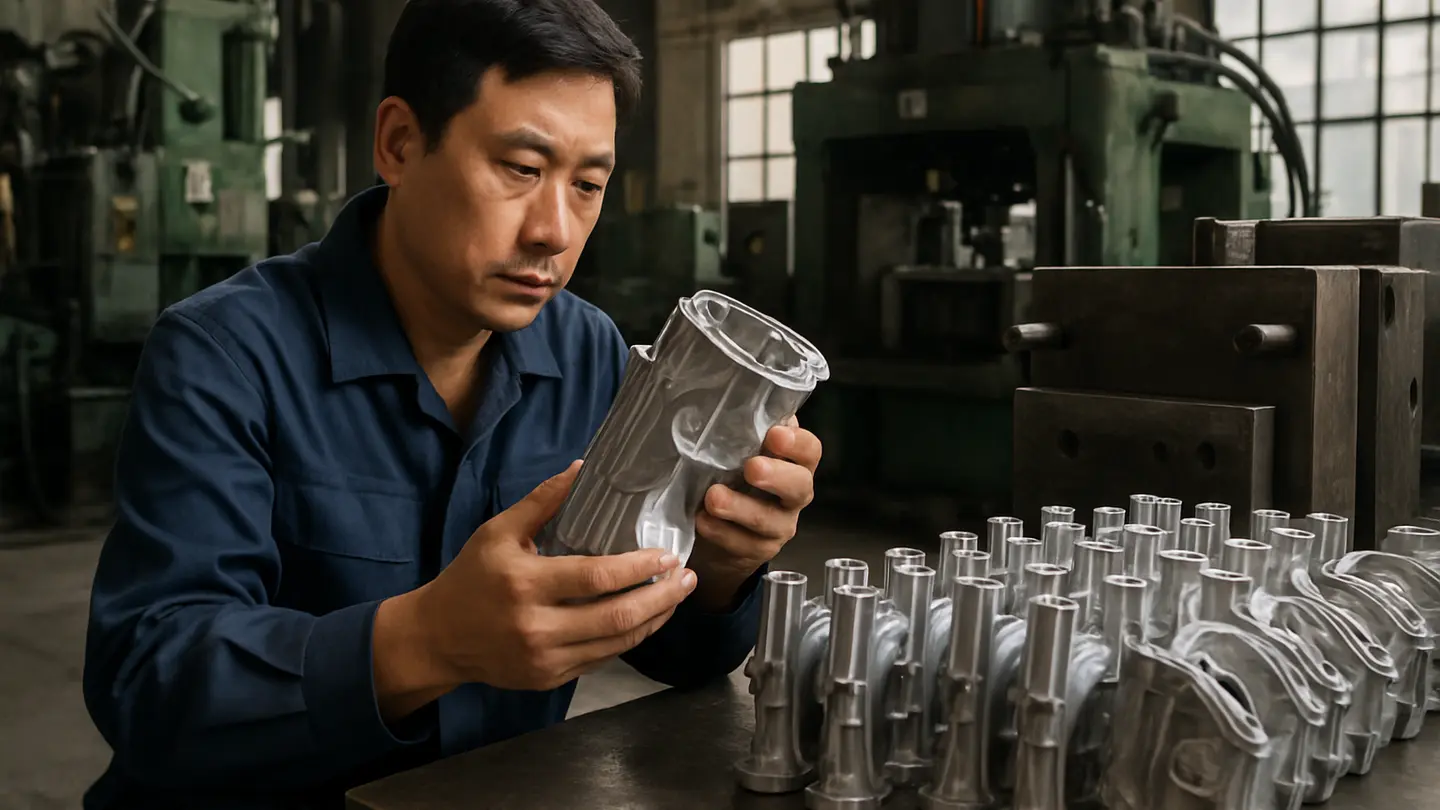
For buyers sourcing die casting in China, the lowest unit price is rarely the full story. Results depend on three decisions often made too casually: alloy choice, mold agreement, and acceptance standard. If those are vague, suppliers may deliver parts that match the quote but fail functional, cosmetic, or assembly needs.
Aluminum, zinc, and magnesium all have valid uses. Aluminum suits housings, brackets, heat-dissipation parts, and medium-to-large structural components. Zinc works well for small, detailed, decorative, and thin-wall parts. Magnesium is useful where weight reduction is critical, but it needs tighter process and corrosion planning.
A professional sourcing process starts before the RFQ. Buyers should define what the part must do, how it will be finished, which surfaces matter, what defects are acceptable, and who owns the mold once paid for. These decisions determine whether a China die-casting project becomes a stable supply program or a dispute over samples, porosity, rework, and hidden costs.
Select the Alloy Based on the Part’s Job
Material choice affects more than casting price. It influences mold design, cycle time, machining allowance, scrap rate, finishing method, corrosion risk, shipping weight, and rework. A cheap casting can become expensive after machining, polishing, plating, leak testing, or field failures are included.
Aluminum is often the practical starting point for industrial and consumer hardware because it balances strength, weight, corrosion resistance, and cost. It is common for housings, covers, heat sinks, brackets, pump components, and shower or plumbing-related metal parts where weight and corrosion exposure matter. It also supports many secondary machining and surface-treatment options, although the exact alloy must match the required finish and performance.
Zinc flows well into fine detail and can support thinner walls than aluminum in many designs. It is attractive for small handles, decorative fittings, latches, lock components, knobs, trim pieces, and compact hardware. It can reduce machining because it fills small features cleanly. The trade-off is density: zinc parts become heavy quickly as size increases.
Magnesium is selected for weight-critical products such as handheld devices, mobility-related components, and applications where mass reduction justifies extra control. It should not be treated as a simple aluminum substitute. It requires experienced suppliers, careful handling, and corrosion protection planning, especially in humidity, outdoor conditions, or contact with dissimilar metals.
Before recommending an alloy, a capable supplier should ask about:
- Mechanical load and impact requirements
- Operating temperature
- Outdoor exposure, humidity, chemicals, or salt spray
- Contact with water or cleaning agents
- Cosmetic expectations after finishing
- Machined surfaces, threads, sealing areas, or bearing points
- Assembly method and mating materials
If a factory recommends an alloy based only on the drawing and target price, slow down. The right material supports the part’s function at the lowest total cost, not just the lowest casting price.
Define What the Mold Price Actually Covers
A die-casting mold is an upfront asset with technical and commercial terms. Once built, the buyer is partly locked into the supplier, alloy, gating concept, cavity layout, and quality assumptions. The mold agreement is therefore one of the most important sourcing documents.
A proper tooling quote should state more than “mold cost.” At minimum, buyers should ask for:
| Mold term | Why it matters |
|---|---|
| Cavity count | Affects output, unit cost, consistency, and mold price |
| Tool steel or construction assumptions | Influences durability, repairability, and expected life |
| Expected mold life | Helps judge whether the tool matches forecast volume |
| Included trial shots | Clarifies how many sampling rounds are covered |
| Sample quantities | Avoids disputes over whether additional samples are chargeable |
| Mold maintenance responsibility | Defines who pays for routine upkeep |
| Repair responsibility | Important if premature wear or damage occurs |
| Mold ownership | Confirms whether the buyer can move the mold |
| Storage terms | Prevents surprise storage fees or disposal risk |
| Transfer rights | Critical if the buyer changes suppliers |
Mold ownership needs special attention. Paying for a mold does not automatically mean the buyer owns it unless the contract says so. The agreement should state who owns the mold, where it will be stored, how it will be identified, and what happens if the buyer wants to transfer it.
Buyers should also clarify where the supplier’s responsibility ends. Many projects involve casting, trimming, deburring, CNC machining, polishing, plating, powder coating, leak testing, assembly, inspection, and export packing. If these steps are split among subcontractors, accountability can blur: casting defects may be blamed on machining, plating failures on porosity, and cosmetic defects on packing.
An integrated supplier that controls casting, machining, and finishing can reduce disputes, but integration should be verified. If any operation is outsourced, the supplier should disclose it. Outsourcing is not automatically a problem; undisclosed outsourcing is.
Use China Tooling Benchmarks Without Chasing the Lowest Quote
China tooling can be cost-competitive, especially where mold design, CNC machining, die casting, finishing, and logistics are in the same manufacturing cluster. However, headline tooling savings are a starting point for investigation, not proof that one quote is better.
Illustrative market benchmarks often place simple single-cavity zinc die-casting molds in the low thousands of U.S. dollars, mid-complexity aluminum production tools from several thousand to tens of thousands, and complex multi-cavity or slide-heavy molds much higher. Large tools for long shot life, tight tolerances, or complex geometry can exceed those broad ranges. These figures are only rough sense checks.
Two mold quotes for the same drawing can differ because of:
- Number of cavities
- Slider and lifter requirements
- Mold base and steel assumptions
- Cooling design
- Runner and gating approach
- Expected shot life
- Included sampling rounds
- Mold-flow analysis or design-for-manufacture support
- Whether trimming dies, fixtures, gauges, or testing tools are included
- Polishing or texture requirements
- In-house toolmaking versus subcontracted tooling
An unusually low mold quote may hide different assumptions: fewer cavities, shorter expected life, limited sampling, weaker construction, no repair allowance, or missing trimming tools and machining fixtures.
The goal is not to find the cheapest mold. It is to buy the right mold for the forecast volume, quality level, and commercial plan. A low-cost tool may suit a short run or unstable design. It is risky for a long-term part with high demand, strict cosmetic standards, or tight sealing requirements.
Know When a Die-Casting Mold Is the Wrong Investment
Die casting rewards stable, repeatable production. Tooling cost only makes sense when it can be spread across enough parts and when the design is mature. If the part is still changing, a production mold can become an expensive constraint.
CNC machining may be better for low-volume parts, block-like components, prototypes, or designs likely to change after testing. It often has a higher unit cost, but avoids mold investment and allows faster revisions. For a buyer still validating fit, strength, or market demand, that flexibility can be worth more than a lower theoretical die-cast price.
Sheet-metal processes may suit flat brackets, plates, panels, covers, and simple enclosures made by laser cutting, punching, bending, and hardware insertion. If the geometry does not need casting’s three-dimensional complexity, a die-casting mold may add cost without value.
Process selection should be based on four questions:
- Does the geometry benefit from casting?
- Are the tolerances achievable as-cast, or will machining dominate the cost?
- Is the design stable enough for production tooling?
- Is the forecast volume high enough to amortize the mold?
If any answer is uncertain, compare die casting with CNC machining, extrusion, forging, stamping, or sheet-metal fabrication before approving tooling.
Make Suppliers Quote From the Same Specification Package
Supplier quotes are comparable only when every factory receives the same information. If one supplier quotes raw castings and another quotes machined, finished, inspected, export-packed parts, the cheaper quote may not be cheaper.
A complete RFQ package should include:
- 2D drawing with revision number
- 3D file where available
- Required alloy or acceptable alloy options
- Surface finish or coating requirement
- Annual volume and order quantity per shipment
- Target production volume breaks
- Critical dimensions and tolerances
- Cosmetic class or visible surface definition
- Internal-defect requirements, if applicable
- Leak, pressure, torque, load, or assembly tests
- Packing method
- Labeling and traceability requirements
- Incoterms or delivery terms
- Required inspection standard
- Required certificates or material reports
Ask for separate line items where appropriate: tooling, casting, trimming, machining, finishing, inspection, testing, packing, domestic freight, export handling, and international freight. This structure shows where cost differences come from.
Low quotes often exclude secondary work such as trimming, deburring, tapping, drilling, CNC machining, polishing, leak testing, plating, anodizing, powder coating, final inspection, export cartons, pallets, or domestic transport to the port. These omissions may result from vague RFQ wording, but the buyer still pays for the gap later.
Volume breaks are also useful. Ask for pricing at quantities such as 1,000, 5,000, 20,000, and 100,000 pieces, depending on the product. If price barely changes as volume rises, cost may be dominated by machining, finishing, or inspection rather than casting. If it drops significantly, the supplier may be spreading setup, cycle time, and labor over larger batches.
Agree on Defect Limits Before Sample Approval
Die casting can produce strong, accurate, repeatable parts, but it has predictable defect risks. The most common concern is porosity from trapped air, gas, or shrinkage as metal solidifies. Porosity is not automatically a failure; acceptability depends on size, location, and function.
A small internal void in a non-critical thick section may have no practical effect. The same void on a sealing face, threaded boss, pressure wall, machined surface, or polished decorative area may cause leakage, cracking, rejects, or complaints. Defect standards must be agreed before sample approval, not after mass production begins.
The buyer and supplier should define:
- Dimensional tolerances and critical-to-function dimensions
- Cosmetic criteria for visible and non-visible surfaces
- Acceptable levels of flash, flow marks, cold shuts, scratches, dents, and stains
- Porosity limits by location and size
- X-ray, sectioning, pressure, or leak-test requirements where needed
- Machining allowance and requirements after machining
- Finish adhesion, color, gloss, or corrosion-test requirements
- Sampling plan and AQL level, if used
- Remedies for failed batches, including sorting, rework, replacement, or credit
Sample approval is not blanket approval for all future production. Samples are often made under closer supervision than routine batches. The first production run should be inspected again against the drawing, approved samples, and written acceptance criteria. Watch dimensions affected by mold temperature, tool wear, machining fixtures, and finishing thickness.
For shower systems, plumbing fixtures, pumps, valves, or outdoor hardware, functional testing may matter as much as appearance. Leak paths, corrosion exposure, coating durability, thread quality, and assembly fit should be checked before shipment approval.
FAQ
Q1: How thin can a die-cast wall be?
Aluminum die-cast walls are often around 1.5 to 2.5 mm, depending on part size, geometry, alloy, and flow distance. Zinc can often support thinner walls because it flows more easily into fine sections.
Very thin walls can increase filling difficulty, distortion, cold shuts, and rejection risk. Wall thickness should be reviewed with the factory before tooling, especially with long flow paths, ribs, bosses, or cosmetic surfaces.
Q2: Can the same mold run both aluminum and zinc?
In most cases, no. Die-casting molds and processes are designed around a specific metal, including temperature, shrinkage, flow behavior, gating, venting, and machine setup. Switching from aluminum to zinc, or zinc to aluminum, usually requires new tooling.
If the alloy is not finalized, quote both options before approving mold drawings. Compare tooling, part weight, cycle time, finishing, machining, and reject risk—not only casting price.
Q3: Can I cut cost by casting features that are now machined?
Sometimes. Holes, slots, ribs, bosses, logos, and shaped features may be formed directly in the die, reducing secondary machining and unit cost.
However, tight holes, sealing faces, bearing surfaces, precision threads, and close-tolerance assembly points may still require machining. Ask the supplier which features can be cast reliably and which should remain machined to avoid rejects.
Q4: Can I start with a cheaper trial tool before a production mold?
Some factories offer simpler trial tooling for samples or a small first run. This can help when the design is not stable or when the buyer wants to test assembly, performance, or demand before committing to a production mold.
Trial-tool parts may have higher unit costs and may not fully represent production cycle time, surface quality, or long-term consistency. Even so, trial tooling can reduce losses if the design is likely to change. Confirm what the trial tool can and cannot prove before relying on it for final approval.
Conclusion: Put the Commercial and Quality Rules in Writing
Successful die casting in China depends on clear early decisions. If the specification is vague, the supplier will make assumptions about alloy, tooling, sampling, machining, finishing, inspection, and defect acceptability. Those assumptions may reduce the quote but create disputes later.
Buyers should document material choice, mold ownership, expected tool life, sampling terms, outsourced processes, inspection rules, and reject criteria before paying for tooling. Approved samples matter, but first production batches and ongoing shipments should be checked against the same written standard.
A well-managed die-casting project is not defined by the cheapest mold or lowest unit price. It is defined by a stable process, clear accountability, and parts that perform as intended after casting, machining, finishing, packing, and delivery.