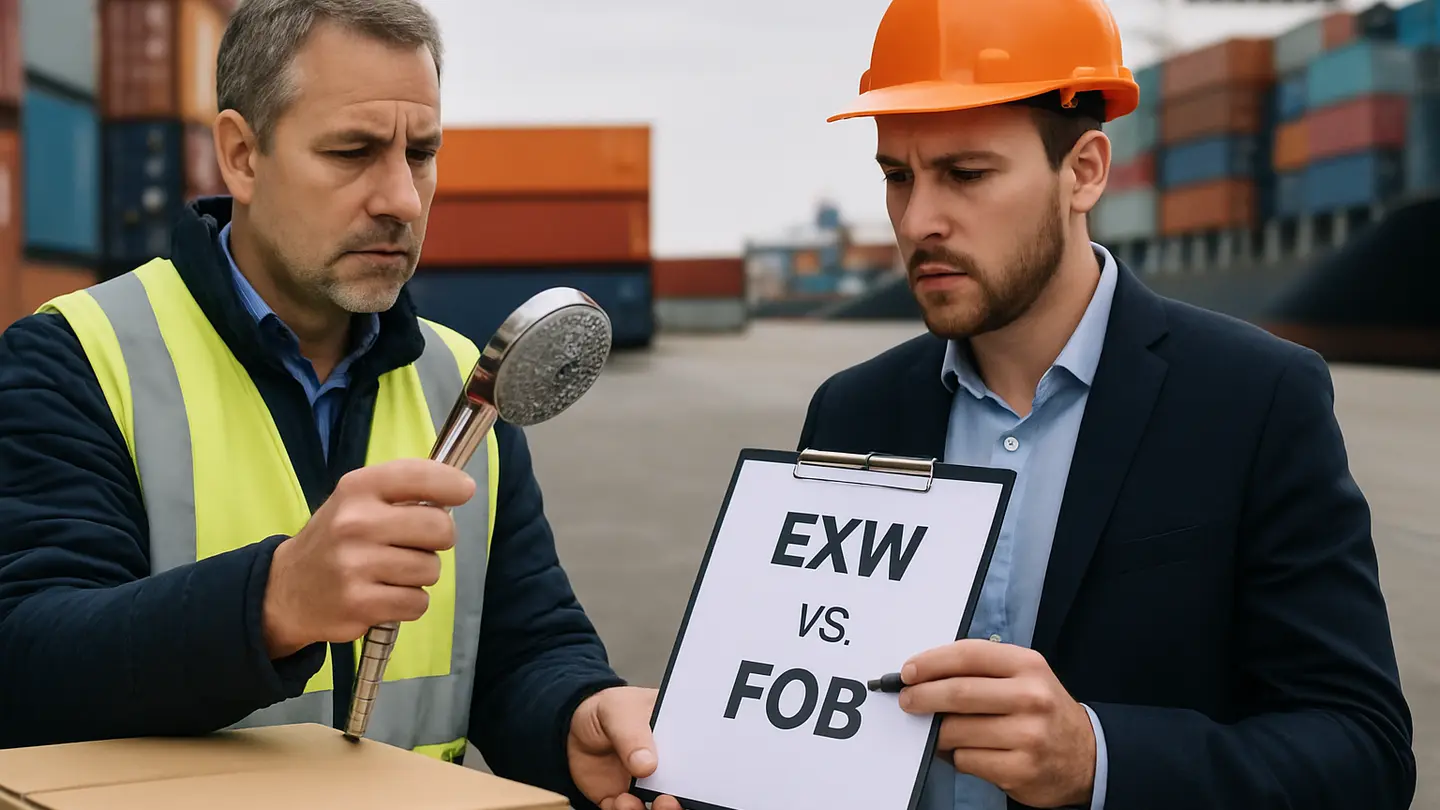
At quotation stage, FOB vs EXW can look like a simple price comparison. EXW often appears cheaper because the supplier is quoting closer to a factory-gate price: goods made, packed, and available for collection. FOB usually looks higher because the supplier is taking on more China-side export work before the goods leave the port.
That is not the whole cost story. Under EXW, the buyer must arrange and pay for pickup, inland trucking, origin handling, export documentation coordination, and delivery to the export port or terminal. Under FOB, the supplier normally handles the local China logistics needed to get the goods on board the vessel at the named port.
In both cases, the buyer still usually pays for international freight, cargo insurance if purchased, import customs clearance, duties, taxes, destination charges, and final delivery. The real question is not “Which supplier quote is lower?” but “Which Incoterm gives the lower landed cost with acceptable control and risk?”
For importers buying shower enclosures, brassware, sanitary fittings, accessories, or other China-made building products, the distinction matters. These goods may be bulky, fragile, mixed across SKUs, or shipped with strict packaging requirements. A small unit-price saving can disappear quickly if China-side logistics are underestimated.
Why EXW Leaves More Work With the Buyer
EXW, or Ex Works, places the supplier’s basic obligation at the factory, warehouse, or other agreed premises. The supplier makes the goods available for collection, and the buyer takes on the logistics chain from that point.
For a China import order, the buyer under EXW usually needs to manage:
| Cost or task | Buyer responsibility under EXW |
|---|---|
| Factory pickup | Arrange vehicle, pickup date, and collection instructions |
| Loading | Confirm who loads the goods and who bears damage risk during loading |
| Inland trucking | Move goods from factory to warehouse, consolidation point, or port |
| Origin handling | Coordinate local handling, warehouse, terminal, and documentation charges |
| Export documentation | Arrange or coordinate export declaration through a qualified China-side party |
| Main transport | Book ocean, air, rail, or courier transport |
| Destination clearance | Pay duties, taxes, broker fees, and local delivery costs |
Export declaration is often where overseas buyers underestimate complexity. A foreign buyer usually cannot simply act as the Chinese export declarant. The declaration is commonly filed by the factory, a trading company, a freight forwarder, or another registered China-side exporter. If the manufacturer does not have export rights or will not handle paperwork, another qualified party must be involved.
EXW is not wrong, but it requires a reliable local forwarder, sourcing agent, warehouse partner, or broker. Without that support, EXW can create delays before the goods reach the port.
The purchase order should also state practical details that Incoterms alone may not settle:
- Who loads goods onto the pickup truck?
- Who bears damage risk during loading?
- What pickup window is allowed after final inspection?
- Are goods packed for domestic collection or international export?
- Who provides the packing list, commercial invoice, and export data?
- Which party coordinates with the export declarant?
For bulky or breakable goods, loading responsibility is not minor. Poor container loading, weak packaging checks, or rushed third-party pickup can lead to difficult disputes. EXW gives the buyer more direct control, but also more operational burden.
What FOB Normally Includes
FOB, or Free On Board, means the supplier delivers the goods on board the vessel at the named port. In China sourcing practice, FOB usually includes the supplier’s China-side work up to loading onto the vessel.
That normally covers:
- Inland delivery from the factory to the named export port
- Export packaging coordination, if agreed in the order
- China export paperwork
- Local port handling needed before loading
- Delivery of goods on board the vessel
The buyer then pays for the main international freight, cargo insurance if needed, import clearance, duties, taxes, destination handling, and final delivery.
FOB is often easier for importers because the supplier is usually better placed to manage local trucking, port arrangements, and export declaration. A factory or trading company that exports regularly will often have existing relationships with forwarders, customs brokers, and port service providers.
FOB also lets the buyer control the international freight. The buyer can compare forwarder quotes, choose shipping schedules, decide whether to insure the cargo, and maintain visibility over the main transport leg.
The named port is essential. “FOB China” is incomplete. A proper quote should state FOB Ningbo, FOB Shenzhen, FOB Shanghai, FOB Xiamen, or another specific port. Inland trucking costs can vary substantially depending on factory location and chosen port.
The bill of lading is also important under FOB. It helps confirm that the goods were loaded, identifies the vessel and sailing details, and can support claims or disputes over shipment timing.
Which Term Is Cheaper in Real Landed Cost?
FOB can look more expensive on the supplier quotation, while EXW can look cheaper. A proper comparison must include the full landed cost.
A useful landed cost comparison should include at least:
| Cost component | Usually applies under EXW? | Usually applies under FOB? |
|---|---|---|
| Supplier product price | Yes | Yes |
| Factory pickup | Buyer | Usually supplier |
| Inland trucking to port | Buyer | Usually supplier |
| Origin handling | Buyer | Usually supplier up to FOB scope |
| Export declaration | Buyer coordinates or pays separately | Usually supplier |
| Port charges before loading | Buyer | Usually supplier, depending on quote scope |
| International freight | Buyer | Buyer |
| Cargo insurance | Buyer, if purchased | Buyer, if purchased |
| Import customs clearance | Buyer | Buyer |
| Import duty and taxes | Buyer | Buyer |
| Destination port and terminal charges | Buyer | Buyer |
| Final delivery | Buyer | Buyer |
International freight, insurance, import duty, customs broker fees, destination handling, and final delivery usually apply under both EXW and FOB. They should not be counted as “extra” only under one term.
The main difference is the China-side cost bundle. Under EXW, the buyer must add those costs separately. Under FOB, they are usually included in the supplier’s price up to the named port and vessel loading point.
Factory distance from port can change the result. A supplier near Ningbo may have low inland trucking costs. A supplier far inland may quote a higher FOB price because transport to the port is expensive. A large difference between FOB quotes may reflect geography as much as product value.
Buyers should also avoid confusing FOB vs EXW with CIF or DDP. CIF shifts arrangement of main freight and insurance to the seller up to the destination port, although the buyer still handles import clearance and destination-side costs. DDP shifts more responsibility to the seller, including import duties and delivery to the agreed destination. FOB and EXW are more commonly compared when the buyer wants visibility into freight and import costs.
A Side-by-Side Cost Check for One Order
The clearest way to compare FOB vs EXW is to ask for both prices on the same order and then add the same downstream cost assumptions.
Assume the buyer is importing one container of shower products from the same supplier, with the same SKUs, packaging, carton dimensions, palletization plan, inspection requirements, and international freight quote.
A simplified comparison might look like this:
| Cost item | EXW quote | FOB quote |
|---|---|---|
| Supplier goods price | $28,000 | $29,200 |
| Factory pickup and inland trucking | $650 | Included |
| Export declaration coordination | $180 | Included |
| Origin warehouse or handling | $220 | Included |
| Port/local charges before loading | $450 | Included |
| Ocean freight | $2,400 | $2,400 |
| Insurance | $90 | $90 |
| Import broker fee | $175 | $175 |
| Duties and taxes | Same basis, depending on customs value rules | Same basis, depending on customs value rules |
| Destination delivery | $700 | $700 |
In this example, the EXW supplier price is $1,200 lower than the FOB price. But the buyer adds $1,500 in China-side costs: trucking, export filing, handling, and port charges. Before considering management time or risk, EXW is already $300 more expensive.
The exact numbers will vary by product, city, port, season, forwarder, and container plan. The logic remains the same: EXW must be lower by more than the added origin-side costs to produce a true saving.
Use identical assumptions. If the EXW option uses loose cartons and the FOB option assumes pallets, or if one option includes export-quality packaging and the other does not, the comparison is distorted. The same international freight quote should be used for both options unless the shipping plan truly changes.
Best practice is straightforward: request both EXW and FOB pricing for the same order, then ask what is included in each price. If the supplier cannot explain the difference, be cautious about treating the lower number as a real saving.
When EXW Can Still Make Sense
EXW can be practical when the buyer wants maximum control over China-side logistics, especially when consolidating goods from several nearby suppliers.
For example, a buyer may need to collect:
- Shower enclosures from one factory
- Trays or bases from another factory
- Brass valves, hoses, or fittings from a specialist supplier
- Printed packaging from a packaging vendor
- Spare parts or installation kits from a smaller workshop
Instead of asking each supplier to deliver FOB separately, the buyer may use a China-side warehouse to receive all goods, perform checks, combine cartons, relabel items, and build a consolidated shipment. In that case, EXW can make sense because the buyer is intentionally taking control before port delivery.
This model requires a competent local partner. A forwarder, sourcing agent, or warehouse operator must coordinate pickups, inspect carton marks, verify quantities, manage storage, and prepare the shipment for export. If export filing is needed, that partner must handle it directly or coordinate with a registered exporter.
EXW can also work for buyers with a China office or long-term logistics infrastructure. If the buyer already has staff or contracted partners near the supplier base, the workload may be manageable. The buyer may save money by controlling trucking routes, consolidating loads, or avoiding supplier markups on local logistics.
However, EXW is risky without that infrastructure. A low EXW quote can lead to missed pickup appointments, unclear loading responsibility, export declaration delays, unexpected warehouse fees, port documentation problems, or disputes about damaged goods. Without strong local coordination, EXW may add risk without meaningful savings.
Match the Incoterm to the Rest of the Purchase Order
A supplier’s preferred Incoterm can reveal its export experience. A supplier that regularly quotes FOB to a named port may already understand export documentation, port delivery, customs declaration, and shipping timelines. A supplier that insists on EXW may be a smaller domestic-focused factory, a manufacturer without export rights, or simply a seller that wants to avoid logistics responsibility.
If a supplier insists on EXW, buyers should ask:
- Who will arrange pickup from the factory?
- Who loads the goods onto the truck?
- Who is responsible if goods are damaged during loading?
- Who provides the export documents?
- Who files the export declaration?
- Who pays local handling and port charges?
- Where does risk transfer in practice?
- What happens if the forwarder cannot collect on the agreed date?
For FOB quotes, the named port must be stated clearly. FOB Shenzhen and FOB Shanghai are not interchangeable. If two suppliers quote very different FOB prices, the reason may be inland distance to port, not only manufacturing cost.
The Incoterm should also be matched with the rest of the purchase order. Incoterms do not replace detailed commercial terms. Buyers should separately contract:
- Product specifications and approved samples
- Packaging standards and carton markings
- Inspection timing and inspection access
- Loading method and container plan
- Payment milestones and document requirements
- Responsibility for production updates and technical questions
- Remedies for late shipment, short shipment, or quality failures
For shower and bathroom product imports, packaging deserves special attention. Glass panels, plated surfaces, ceramic components, and precision fittings can be damaged by poor stacking, moisture, vibration, or rough handling. Whether the term is EXW or FOB, export packaging requirements should be written into the purchase order and confirmed before shipment.
FAQ
Q1: Under EXW, whose name appears on the export declaration?
Under EXW, the foreign buyer’s name usually does not appear as the Chinese export declarant. The export declaration is commonly filed by the factory, a China-side freight forwarder, a trading company, or another registered exporter.
Confirm this before accepting EXW terms. If the factory cannot or will not file the export declaration, the buyer needs to know which China-side party will do it, what documents are required, and what fees apply.
Q2: Can a trading company quote FOB, or only a factory?
A trading company can quote FOB. FOB is not limited to factories. In some cases, a trading company may handle export procedures more smoothly than a small manufacturer because it is used to documents, logistics, and customs brokers.
The trade-off is that the buyer may have less direct access to production details. Buyers should agree in writing who is responsible for technical questions, production updates, inspection coordination, corrective actions, and quality issues.
Q3: Does EXW make more sense when my factory is close to the port?
EXW may look more attractive when the factory is close to the export port because inland trucking costs are lower. Shorter distance can reduce one of the main cost disadvantages of EXW.
However, the buyer still needs to manage export filing, origin handling, pickup coordination, and port delivery. If the EXW saving is small, FOB may still be the cleaner option.
Q4: Can I move a supplier from EXW to FOB later?
Many suppliers can revise an EXW quote to FOB, but the price should normally change. Under FOB, the supplier takes on additional China-side logistics, export paperwork, and port delivery responsibilities.
If the supplier offers the same price for EXW and FOB, ask what is actually included. It may mean the original EXW quote already included some logistics, or that the FOB quote does not include all expected local charges. Where possible, ask the supplier to break out trucking, export paperwork, and port charges separately.
Conclusion: Choose the Term That Matches Cost, Control, and Risk
FOB vs EXW is not only a price decision. It is a decision about who controls China-side logistics, who carries the operational burden, and where risk moves from supplier to buyer.
EXW can be useful for buyers with strong local coordination, especially when consolidating goods from multiple nearby factories. But the lower quote must be tested against pickup, trucking, export filing, handling, port charges, and management effort.
FOB often gives a better balance for many importers. It keeps China-side export work with parties that perform it regularly, while still allowing the buyer to control international freight, compare forwarder rates, decide on insurance, and manage import clearance.
Before comparing quotes, name the FOB port. Before paying a deposit, define loading, collection, export filing, documentation, packaging, inspection timing, and cost responsibility in writing. The Incoterm is important, but it works best when the rest of the purchase order is equally clear.