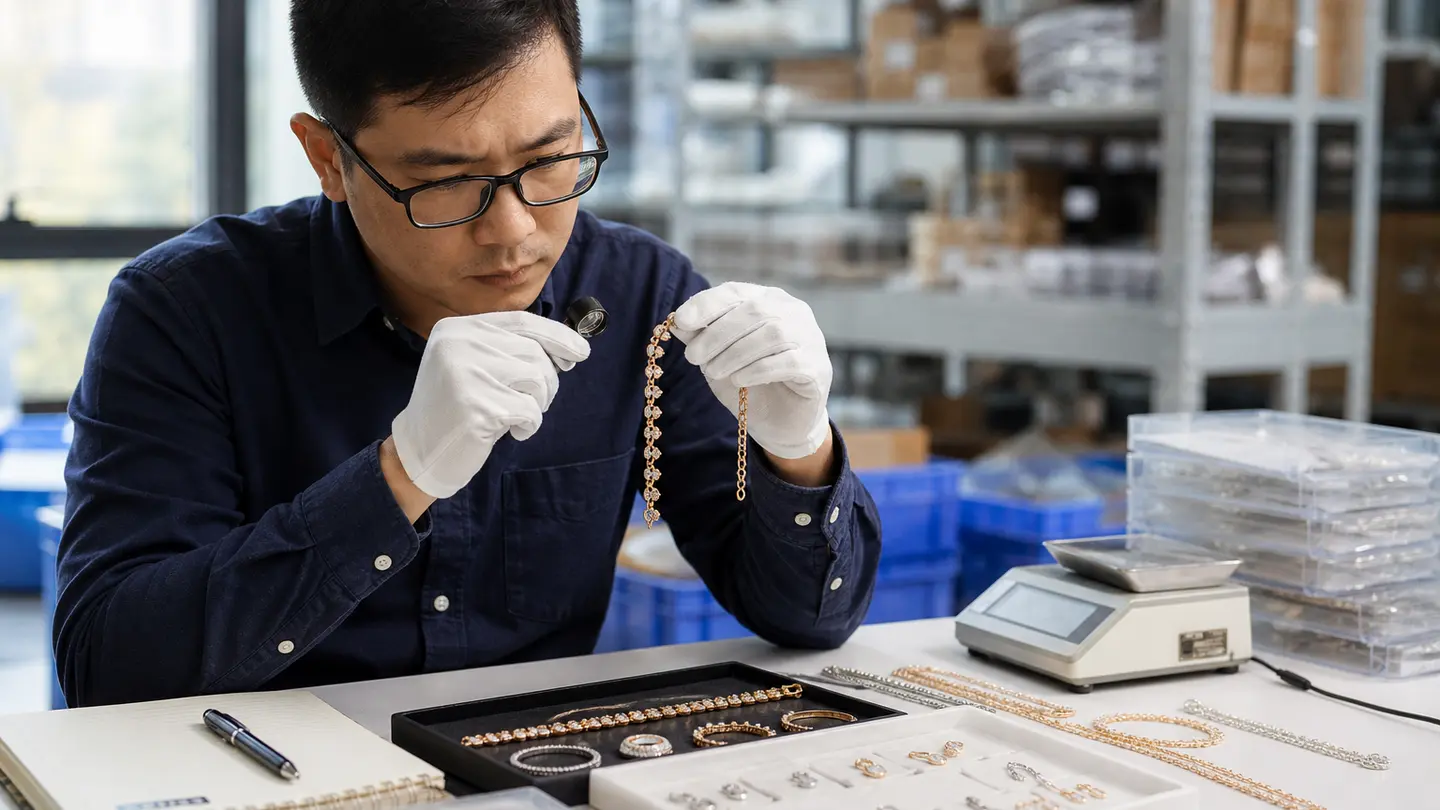
Import Jewelry from China: Metals, Testing, and MOQ
To import jewelry from China successfully, buyers need more than attractive product photographs and competitive quotations. Vague material descriptions are one of the most common causes of disagreements between buyers and suppliers. A product described as “gold jewelry,” “silver plated,” or “premium alloy” may look acceptable in a listing, but those phrases do not define the actual construction, metal content, coating thickness, or expected durability.
Before comparing prices or paying a deposit, establish exactly what is being purchased. The specification should identify the metal or alloy, gold karat where applicable, base metal, plating material, plating thickness, finish, stones, dimensions, and variant requirements. This creates a common reference point for sampling, testing, production inspection, and any later quality discussion.
Material clarity is also essential for accurate product descriptions in the destination market. Buyers should ensure that their retail claims match the actual jewelry construction and that any performance expectations are reasonable for the agreed material and finish.
Understand the Jewelry Construction You Are Buying
Jewelry categories that sound similar can represent very different product constructions. A buyer importing jewelry from China should distinguish among plated jewelry, vermeil, and solid-metal products before requesting samples.
Plated jewelry uses a base metal covered with a surface layer of another metal. Common base metals may include brass, stainless steel, zinc alloy, or other alloys. The surface plating may be gold-colored, silver-colored, rhodium-colored, or another decorative finish. The durability of a plated item depends on factors such as the base metal, plating material, coating thickness, wear conditions, surface preparation, and storage.
Vermeil jewelry generally refers to a particular construction involving precious-metal plating over sterling silver. However, buyers should not rely on the word alone. The supplier should state the silver composition, the plating metal, the stated coating thickness, and the finish. Requirements and accepted terminology may vary by market, so product claims should be reviewed against the rules that apply where the item will be sold.
Solid-metal jewelry is made primarily from the stated metal rather than being a base-metal item with a decorative surface coating. A solid-gold claim still does not define gold purity. Gold is commonly described by karat, such as 10K, 14K, or 18K. The karat should be stated in the product specification, together with any alloy information relevant to color, hardness, or sourcing requirements.
Base-metal jewelry can be commercially appropriate for fashion collections, promotional lines, or lower retail price points. The important issue is accurate disclosure. A brass bracelet with gold-colored plating can be a valid product if it is specified, tested as required, and marketed correctly. Problems arise when the buyer expects a longer-lasting precious-metal construction but receives a lower-cost plated item with an unclear base metal.
A useful material specification should connect construction to commercial expectations:
| Specification item | Why it matters |
|---|---|
| Base metal or alloy | Affects cost, weight, strength, skin-contact considerations, and corrosion behavior |
| Gold karat or silver composition | Defines precious-metal content where relevant |
| Plating material | Affects color, appearance, and product claim |
| Plating thickness | Influences expected wear resistance and must be agreed clearly |
| Surface finish | Defines whether the item is polished, matte, brushed, antique, textured, or otherwise finished |
| Stone type and setting method | Affects value, appearance, security, and inspection requirements |
The more detailed the written specification, the easier it is to compare quotations on an equivalent basis. A low quotation may reflect a thinner coating, lower-cost base metal, different stone grade, lighter unit weight, or simplified construction rather than a more efficient supplier.
Put Material and Plating Claims in Writing Before Sampling
Sampling should begin with a written specification, not only a product image or a chat message. Images can communicate overall style, but they rarely establish the critical production details needed for repeatable jewelry quality.
For each style, specify:
- Base metal and alloy description
- Plating metal or coating type
- Required plating thickness
- Surface color and finish
- Approximate finished weight or acceptable weight range
- Stone type, color, size, cut, and setting method
- Dimensions and tolerances
- Clasp, earring post, pin, chain, or other functional component requirements
- Packaging and labeling requirements
- Destination market and any relevant testing needs
The agreed plating thickness should appear in the purchase order and final production specification. It should not exist only in informal messages, because informal discussions can be difficult to match to a particular model, finish, or production batch. If the collection includes multiple finishes, such as gold-tone, silver-tone, rose-gold-tone, and black-tone, specify the plating requirement for each variant.
Buyers should also ask which production stages the supplier controls. Casting, polishing, plating, stone setting, assembly, and packaging may be performed in one facility or divided among subcontractors. Neither arrangement is automatically unsuitable, but responsibility must be clear. When a supplier uses outside processes, the buyer should know who controls material input, quality standards, production timing, and final inspection.
This is especially important for plating and stone setting. Plating consistency can be influenced by surface preparation, production conditions, and batch handling. Stone quality and security can vary depending on the selected stones, setting method, adhesive use where applicable, and inspection process. A supplier that coordinates multiple production stages should still be able to provide one clear specification and take responsibility for the finished product.
Plan Testing for the Markets Where You Will Sell
Testing requirements depend on the destination market, the intended customer, the product category, and the materials used. A buyer should define the required test scope before production rather than waiting until goods are packed for shipment.
The test scope should reflect the full construction of the item. Jewelry is often made from multiple materials, and each can affect compliance or performance. Relevant components may include:
- Base metal
- Solder or joining materials
- Surface plating
- Earring posts and backs
- Clasps, jump rings, chains, and charms
- Stones, crystals, enamel, resin, or coatings
- Separable components
- Decorative attachments and packaging where applicable
Lead and cadmium restrictions may apply to individual jewelry components, not only the main body of the item. Nickel requirements can be particularly relevant for finished surfaces intended for prolonged skin contact, as the concern may relate to nickel release rather than simply whether nickel exists somewhere within an alloy.
Children’s jewelry can face stricter requirements than adult jewelry. If products are intended for children, buyers should identify the age group, intended use, small-part considerations, and testing or certification obligations in the destination market. Do not assume that an adult jewelry report is sufficient for a children’s range.
Testing should be based on the specific model and material configuration being shipped. For example, a report for a silver-color version may not automatically support a gold-tone version if the plating process or material composition differs. Similarly, changing a clasp, stone, solder, or coating can affect the relevance of previous reports.
Laboratory testing is not a substitute for supplier controls, and supplier controls are not a substitute for required testing. A robust process combines both: documented material specifications, controlled production, approved samples, appropriate laboratory testing, and shipment inspection.
Use Sample Approval to Validate the Specification
A sample should be approved against the written specification rather than appearance alone. A product can look attractive in a photograph but still differ from the agreed weight, metal, coating, stone selection, or functional requirements.
During sample review, check the following areas:
- Weight: Confirm that the sample aligns with the expected construction. A substantially lighter piece may indicate a material or structural difference.
- Plating color: Compare the color and finish with the agreed reference. Gold-tone and rose-gold-tone finishes can vary between batches.
- Coverage: Review edges, inner surfaces, chain links, backs, posts, clasps, and recessed areas for even coating.
- Stone selection: Confirm stone type, color, clarity expectations where relevant, size, and visual consistency.
- Stone-setting quality: Check whether stones sit straight, are secure, and do not rattle, tilt, or leave visible gaps.
- Function: Test clasps, earring backs, adjustable mechanisms, and other moving parts.
- Dimensions: Measure rings, bracelets, pendants, chains, and other components against the stated requirements.
Approved samples should be retained by both buyer and supplier. Where practical, keep a sealed reference sample with an identifying model number, finish, date, and approval status. Photograph approved samples under consistent lighting and from repeatable angles. These records are useful because plating color and surface appearance can vary between production runs.
The approved sample should not become a vague visual reference. It should be tied to a version-controlled specification. If a buyer later changes the plating color, stone, clasp, or packaging, the revised version should receive a new sample approval or a clearly documented amendment.
Calculate Jewelry MOQ by Variant, Not Just by Style
Jewelry minimum order quantity is often calculated by variant rather than by the general style. A buyer may view one pendant design as a single product, while the supplier sees several separate production requirements.
MOQ may apply independently to combinations such as:
- Gold-tone, silver-tone, and rose-gold-tone finishes
- Different base metals
- Ring sizes
- Chain lengths
- Stone colors or stone types
- Different clasp designs
- Separate packaging configurations
- Custom logos, tags, or cards
For example, a buyer may select one necklace design in three plating colors and four stone colors. Although this appears to be one style, it can create twelve variant combinations. Different plating finishes may require separate production batches, while stone changes may require separate material preparation and assembly handling.
Request an MOQ breakdown before negotiating the final order. Ask the supplier to state whether the minimum applies per design, per plating finish, per size, per stone color, or per complete variant. Also clarify whether the MOQ is based on finished pieces, raw castings, plating batches, or packaging orders.
For a first order, reducing variants can lower the practical opening-order requirement. Buyers may begin with one or two commercially important finishes, a limited size range, and a smaller stone assortment. Once product demand is confirmed, additional variants can be introduced in later orders.
This approach can also simplify quality control. Fewer variants mean fewer opportunities for incorrect plating, stone mix-ups, labeling mistakes, or sizing errors during early production.
Inspect, Document, and Trace Jewelry After Production
Final inspection should take place before shipment, ideally against the approved sample and purchase-order specification. The inspection plan should include both appearance checks and functional checks.
Key inspection points include:
- Plating coverage and color consistency
- Surface scratches, pits, rough edges, and visible marks
- Stone security, alignment, and missing stones
- Clasp operation and component attachment
- Ring, bracelet, chain, or pendant dimensions
- Unit weight where specified
- Earring pair matching
- Packaging condition, barcode placement, labels, and quantity accuracy
Laboratory reports should match the shipped model and material configuration. Confirm that the report identifies the relevant product type, material arrangement, and tested components. A generic report, or one for a visibly similar but differently constructed item, may not support the product being imported.
Maintain batch traceability for every shipment. At a minimum, retain model numbers, approved specifications, sample records, production dates, inspection records, laboratory reports, supplier invoices, and batch or lot information where available. This makes it easier to investigate customer complaints, identify affected inventory, and determine whether a problem is isolated or repeated.
Re-testing may be needed when a change could affect compliance or product performance. Examples include changing the base metal, plating supplier, stone type, solder, clasp, coating process, or manufacturing location.
Tarnish should also be evaluated carefully. Some tarnish may result from storage conditions, humidity, handling, packaging materials, or long periods in inventory. However, premature discoloration can also indicate issues with plating quality, surface preparation, protective treatment, or material selection. Document the storage environment and compare affected goods with retained samples before assigning a cause.
FAQ
Q1: Should I buy from a jewelry market or direct from a factory?
Jewelry markets can be useful for small mixed purchases, rapid product comparison, and in-person evaluation of styles. They may suit buyers who need a broad assortment without developing a detailed custom specification for each item.
Direct factory relationships are generally more suitable when the buyer needs repeatable specifications, controlled materials, approved samples, and consistent reorders. A factory may be better positioned to manage production details for an established collection, although the buyer should still confirm which processes are performed in-house and which are outsourced.
For either route, request clear material information and inspect samples. A market purchase may offer convenience, but catalog items can provide less control over alloy consistency, plating thickness, or future availability.
Q2: How do I know whether I am dealing with a factory or a trader?
Ask the supplier which production stages it performs directly. Useful questions cover casting, polishing, plating, stone setting, assembly, quality control, and packaging. Request a clear explanation of where each stage takes place and who is responsible for final product quality.
A trader is not necessarily an unsuitable partner. Traders may provide access to multiple factories, broader assortments, or communication support. The important point is to understand who controls production and who can confirm material specifications, approve changes, resolve defects, and provide traceability.
Do not rely only on a supplier’s business description. Match its stated role to the information it can provide during sampling and production.
Q3: If I buy a catalog design, will competitors sell the same piece?
Possibly. Catalog designs and existing molds may be available to multiple buyers, particularly for widely offered fashion jewelry styles. Purchasing a standard design does not automatically provide exclusivity.
Buyers can differentiate a catalog design through finishes, stone choices, chain lengths, clasps, packaging, branding, or curated assortments. However, these changes may not prevent other buyers from offering a similar design.
If design ownership or exclusivity matters, address it in writing before investing in custom development or molds. A custom-mold payment by itself does not establish ownership rights unless the agreement clearly defines ownership, access, reuse restrictions, and any exclusivity terms.
Q4: How do I handle ring and bracelet sizing across markets?
Ring and bracelet sizing systems differ among US, UK, and EU markets. A size label alone may not be sufficient because conversion practices and customer expectations can vary.
The purchase order should state the intended sizing system and the exact measurements needed for verification. For rings, this may include inner diameter or circumference in addition to the stated size. For bracelets, specify internal circumference, total length, adjustable range, and clasp position where relevant.
Confirm measurements on approved samples before production. For size-sensitive products, include an agreed tolerance and require the supplier to separate, label, and pack sizes accurately.
Conclusion: Reduce Jewelry Import Risk With Written Specifications
The most effective way to reduce risk when importing jewelry from China is to replace broad marketing descriptions with a detailed written specification. Confirm the metal construction, base metal, gold karat where applicable, plating material, plating thickness, finish, stone type, dimensions, and variant requirements before paying a deposit.
Use samples to verify that the documented specification can be produced consistently. Measure or assess plating where required, test alloys and finished components for the markets where the products will be sold, and calculate MOQ at the variant level rather than assuming one minimum applies to an entire style.
Finally, retain approved samples, production records, test reports, and batch information. These documents help prevent disputes, support accurate product claims, and make it easier to manage quality across future orders.
About the Author
The author is a B2B sourcing and quality-control writer focused on supplier evaluation, product specifications, production inspection, and international purchasing risk. Their work helps buyers translate commercial requirements into practical documentation for sampling, testing, manufacturing, and shipment approval.