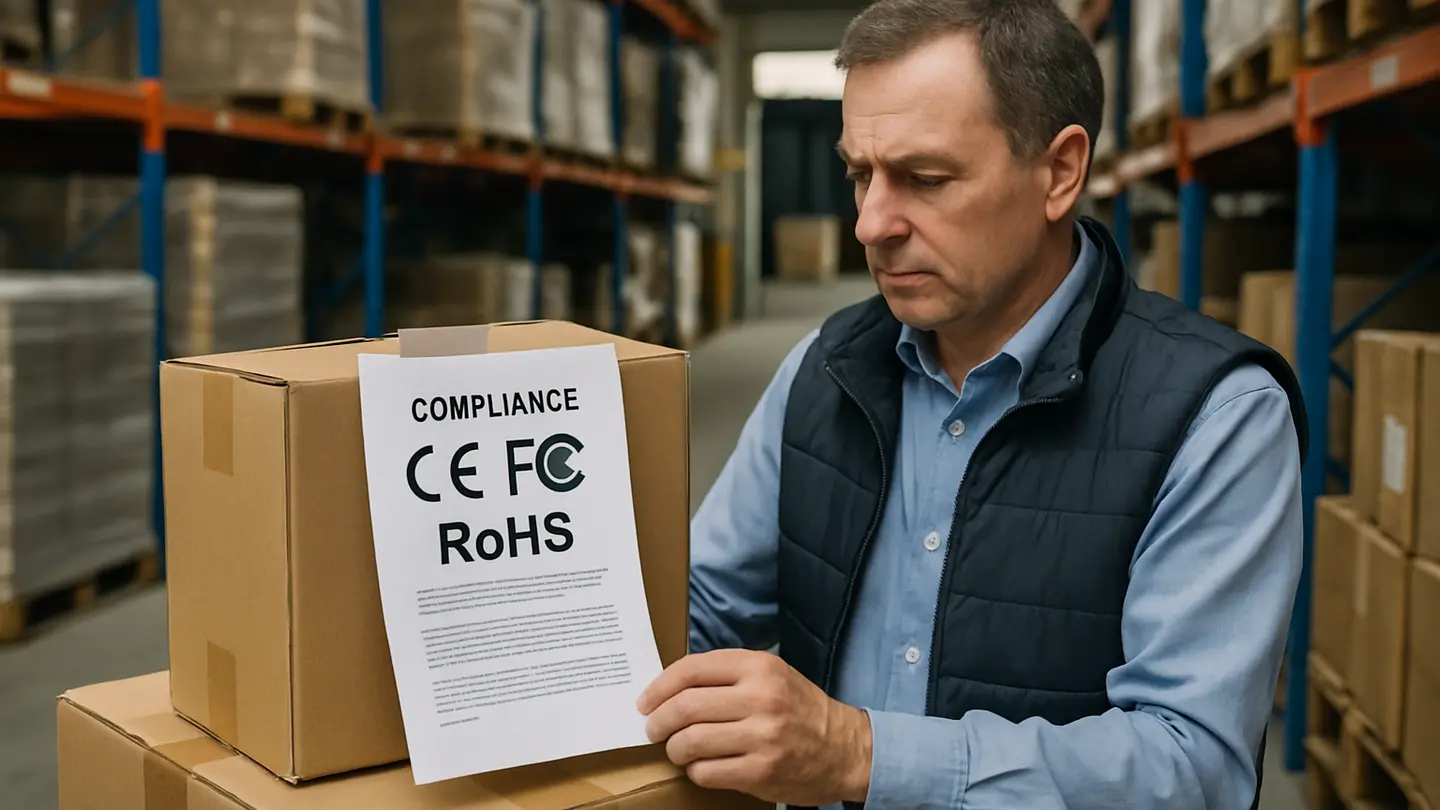
An imported product compliance failure rarely arrives as a single clean invoice. It can start with a customs hold, marketplace suspension, missing label, failed lab test, customer complaint, or regulator’s request for documents. For importers of shower products, bathroom fittings, plumbing accessories, electrical shower controls, packaged hardware, and related components, the first question is usually: who pays now?
In many cases, the importer pays first. The authority, retailer, marketplace, or customer-facing channel usually deals with the company it can reach in the destination market. Whether the overseas supplier reimburses those costs later depends on the purchase contract, evidence, payment terms, cause of the failure, and whether the supplier still has a reason to cooperate.
The practical way to view the problem is in layers: regulator and platform action determines who must respond, recall and customer costs determine the cash drain, and contract terms determine whether money can be recovered later.
Why the Importer Usually Gets the First Bill
Regulators and online platforms generally act against the importer, brand owner, seller account holder, distributor, or party placing the product on the market. If a shower hose, thermostatic valve, LED mirror, pump, drain assembly, packaged accessory, or connected bathroom device fails a market requirement, the reachable company is usually the importer or seller—not the factory overseas.
That may not feel fair when the defect was created at the factory. But market surveillance authorities and platforms are not designed to resolve buyer-supplier disputes. Their priority is stopping non-compliant goods from being sold, used, advertised, or shipped further.
It is also important to separate logistics compliance from product compliance. A freight forwarder may arrange transportation. A customs broker may prepare entry filings based on provided information. Those roles do not normally make them responsible for whether the product meets electrical safety rules, chemical restrictions, pressure-rating requirements, labeling laws, packaging rules, or platform documentation standards.
Correct customs entry is not the same as legal market compliance. A shipment can have the right tariff code, commercial invoice, packing list, and duty payment, yet still fail because a warning is missing, a test report does not cover the exact model, packaging omits importer details, or a component substitution invalidates prior testing.
The best point to manage the risk is before paying the production deposit. Before the first order, the buyer should identify destination-market rules and require evidence from the supplier. Depending on the product, this may include:
- Test reports tied to the exact model, material, voltage, finish, coating, or component set.
- Certificates or declarations that match the destination market and product scope.
- Label and packaging artwork reviewed before printing.
- Bill of materials and critical component lists.
- Sample review against specification and legal requirements.
- Factory audit or process review where change control and traceability matter.
For higher-risk shower and bathroom products—such as electrical bathroom accessories, pressure-bearing assemblies, anti-scald devices, children’s bath items, or products with coatings and elastomers—the buyer should not rely only on supplier assurances. Compliance should be part of supplier selection, quotation review, sample approval, purchase order terms, and final payment conditions.
The Real Cost Stack After a Compliance Failure
A compliance failure can create many separate costs. The official penalty, if there is one, may not be the largest item. For smaller importers, lost selling time and inventory disruption can be more damaging than a fine.
Common cost categories include:
| Cost category | What it may include | Why it matters |
|---|---|---|
| Port and logistics costs | Storage, demurrage, detention, container delays, warehouse handling | Costs can start accumulating while the buyer is still investigating the issue. |
| Verification costs | Additional lab testing, inspection, technical review, document authentication | The buyer may need evidence before goods can be released, relabeled, or sold. |
| Corrective action | Relabeling, repackaging, component replacement, software update, rework | Even a small label error can become expensive across a full shipment. |
| Disposition costs | Return freight, local re-export, scrapping, destruction, recycling | If goods cannot legally be sold, the buyer may have limited options. |
| Customer-facing costs | Refunds, replacements, support labor, retailer chargebacks | These costs grow once goods have entered distribution. |
| Recall costs | Notices, customer tracing, call center work, collection, replacement, reporting | Recall administration can exceed the value of the product itself. |
| Sales interruption | Listing suspension, retailer delisting, delayed launch, seasonal missed sales | Cash flow may be hit even if the product is eventually corrected. |
| Reputation loss | Lower platform ranking, customer complaints, retailer scrutiny | Future orders may face more checks and slower approvals. |
A shipment of shower accessories with packaging missing required importer information and warnings may look like a simple labeling problem. The real cost can include warehouse storage while labels are redesigned, labor to open and relabel cartons, inspection fees, delayed retail deliveries, and penalties under retailer vendor terms.
A supplier may also substitute a gasket, hose liner, coating, adhesive, or electrical component after sample approval. If the original test report no longer applies, the buyer may need retesting. If the goods fail, the shipment may require rework, return, or destruction. If units have already been sold, customer communication and recall planning may be needed.
This is why compliance budgeting should not focus only on “what is the fine?” A low-value product can still create a high-value failure when it blocks a shipment, disables a marketplace listing, or triggers customer returns.
When the Supplier May Have to Share the Loss
Supplier responsibility is strongest when the factory caused the compliance problem by departing from agreed requirements. Examples include unauthorized changes to materials, components, coatings, finishes, packaging, warning labels, manufacturing process, artwork, or product specification.
A supplier may also be responsible if it provides false or misleading compliance documentation. This can include test reports that do not apply to the ordered goods, certificates for a different model, altered documents, inaccurate bills of material, or production records that conceal a change. If the buyer approved one specification and the factory shipped another, the supplier is in a much weaker position.
However, not every imported product compliance failure is a factory failure. If the buyer failed to identify destination-market rules, omitted required warnings from buyer-provided artwork, asked the factory to copy a non-compliant label, or did not specify platform documentation needed for sale, responsibility may remain with the buyer.
This distinction matters because many shower and bathroom product requirements are market-specific. A product acceptable in one country may need different labeling, test evidence, packaging information, water efficiency markings, electrical documentation, chemical compliance declarations, or installation instructions in another. Unless those requirements are written into the order, the supplier may argue that it manufactured what the buyer requested.
Informal statements such as “supplier is responsible for compliance” are often too vague. Written purchase order clauses are more useful because they define what compliance means, which documents are required, what changes are prohibited, and what happens if the goods fail.
Payment leverage is also critical. If the buyer has already paid 100% before inspection, document review, and shipment release, recovery becomes harder. A staged payment structure gives the buyer practical leverage: a deposit starts production, while the balance is tied to passed inspection, correct documentation, approved labels, and no unresolved compliance deviations.
Five Contract Clauses to Set Before the First Order
The purchase order should do more than list product name, price, and delivery date. It should allocate compliance responsibility in operational terms. Five clauses are especially useful before the first order.
Applicable market rules and compliance standards
The order should identify the destination market and applicable standards, regulations, certification schemes, retailer requirements, and platform requirements. If the buyer needs specific water-contact material evidence, electrical safety reports, chemical declarations, warning statements, installation instructions, translations, or packaging marks, those requirements should be named.
A general phrase such as “goods must meet all applicable laws” is better than nothing, but it may be too broad to manage production.
No unapproved changes
The supplier should not change materials, components, sub-suppliers, coatings, adhesives, labels, packaging, tooling, manufacturing process, or specifications without written approval. This should apply even if the supplier believes the change is equivalent.
For compliance-sensitive products, an “equivalent” change may not be legally equivalent. A different plastic, plating, cartridge, hose liner, power supply, sealant, or warning can affect test results and marketability.
Required documents before shipment release
The order should list documents required before final payment or shipment release. These may include test reports, certificates, declarations, inspection records, production photos, label proofs, packaging photos, material declarations, and serial or batch traceability records.
The key timing point is “before,” not “after.” Requesting documents only after a regulator, retailer, or platform raises a problem leaves the buyer with less leverage.
Failure-cost allocation
A useful failure-cost clause should define:
- The triggers, such as failed testing, missing documents, unauthorized changes, false reports, incorrect labels, platform rejection, regulatory hold, recall, or customer safety issue.
- The costs covered, such as storage, demurrage, testing, inspection, rework, relabeling, replacement, refund, recall administration, return freight, destruction, and reasonable support costs.
- The proof required, such as invoices, inspection findings, lab reports, platform notices, customer records, and photographs.
- The notice timing, so the supplier has a chance to investigate and propose corrective action.
- The recovery method, such as credit, refund, rework at supplier cost, replacement shipment, deduction from unpaid balance, or reimbursement.
The clause should not be so vague that every problem becomes a negotiation from zero.
Final payment tied to inspection and paperwork
Final payment should depend on both product inspection and document completeness. Passing a visual inspection does not prove compliance, and complete paperwork without conforming goods is also insufficient.
A practical final-payment condition may require approved pre-shipment inspection, correct labels and packaging, complete compliance files, no unapproved deviations, and confirmation that the goods match the tested or certified sample.
Two Common Gaps: Labels and Platform Rules
Two gaps cause frequent disputes because buyers and suppliers often assume the other side is handling them: labels and platform rules.
Labeling failures can come from buyer-provided artwork, missing warnings, translation errors, incorrect importer details, wrong symbols, improper country-of-origin marking, or market-specific information missing from the packaging brief. If the buyer supplied the artwork and omitted required statements, the supplier may argue that it simply printed what was approved.
Factories may still be responsible when they print labels incorrectly, use unapproved artwork, omit approved markings, apply labels to the wrong product, or change materials in a way that makes the label or test report inaccurate. If packaging states a material, voltage, pressure rating, certification scope, or performance claim that no longer matches the goods because of a factory change, the supplier’s responsibility becomes stronger.
Platform rules are another layer. Marketplaces, retailers, and large distributors may require documentation or product attributes beyond minimum legal requirements. They may request test reports from specific lab types, images of product labels, safety data, batch traceability, category approvals, or evidence matching the exact SKU.
A product can be legally importable but still unsellable on a platform if it fails that platform’s documentation rules. A suspended listing can stop sales even when inventory is sitting in a warehouse.
Supplier responsibility for platform standards is strongest when those standards are written into the purchase order. If the order names the platform’s category requirements and lists documents needed before shipment, the buyer has a clearer basis for recovery. If the buyer mentions the platform only after listing review fails, the supplier may treat it as a new requirement rather than an order defect.
FAQ
Q1: Does buying through an agent or trading company change who I claim from?
Usually, the claim runs against the party that signed the purchase order or sales contract. If the trading company is the seller of record, the buyer’s direct contractual claim may be against that company, not the underlying factory.
The buyer should require agents and trading companies to sign the same compliance, documentation, change-control, and cost-recovery clauses expected from a factory. It is also important to confirm that the intermediary passes equivalent obligations down to the actual producer.
Q2: Should I ask for a penalty clause or a make-good clause?
A make-good clause is often more practical because it focuses on documented actual costs and corrective actions. It can require the supplier to pay for rework, replacement, relabeling, testing, credits, refunds, or other proven losses caused by the supplier’s breach.
A fixed penalty clause may look stronger, but it can create disputes if the amount does not reflect the real loss or if local law treats it differently from genuine pre-agreed damages. Enforceability depends on governing law, wording, facts, and legal drafting.
Q3: Can I make the factory carry product liability insurance?
Yes, a buyer can request that the supplier carry product liability insurance, and some export-oriented factories may already have coverage. The purchase order can require proof of coverage, minimum limits, and notice if the policy changes or is cancelled.
However, product liability insurance is not a complete answer to imported product compliance failure. Many policies focus on injury or property damage claims. They may not cover recall logistics, relabeling, platform suspension, lost sales, retailer chargebacks, storage, or commercial losses. Insurance should supplement clear compliance clauses, not replace them.
Q4: Will an escrow or trade-assurance scheme refund me for a compliance failure?
It depends on the platform, transaction terms, product category, evidence, timing, and exact nature of the failure. Some schemes are designed mainly around non-delivery, shipment discrepancies, or obvious defects at delivery. Later regulatory action, recalls, documentation rejection, or marketplace listing suspension may not be covered as expected.
Before relying on any escrow or trade-assurance arrangement, ask in writing whether post-shipment compliance failures are covered. The answer should address recalls, failed lab testing after arrival, platform documentation rejection, incorrect labels, and unauthorized production changes. If those events are outside the scheme, the buyer still needs contract clauses and payment leverage.
Another Way to Build and Check a China Supplier Shortlist
Supplier selection will not eliminate compliance risk, but it can reduce avoidable surprises. Made-in-China.com is a B2B sourcing platform that buyers can use during early supplier discovery and comparison, especially when building a China supplier shortlist.
One useful starting point is the platform’s Audited Supplier feature. According to Made-in-China.com, Audited Suppliers are subject to third-party verification and on-site audit, with Audit Reports available for buyer review. These reports can cover areas such as general supplier information, export trade, manufacturing capacity, quality control, and R&D capability. That does not replace your own compliance review, sample testing, contract terms, or factory audit where needed, but it can help screen candidates before deeper due diligence.
Buyers can also use Easy Sourcing to submit one sourcing request, receive multiple quotations from matched suppliers, compare quotes, and request samples. For compliance-sensitive products, the RFQ stage is a good time to ask which test reports, labels, declarations, and change-control procedures suppliers can support before any deposit is paid.