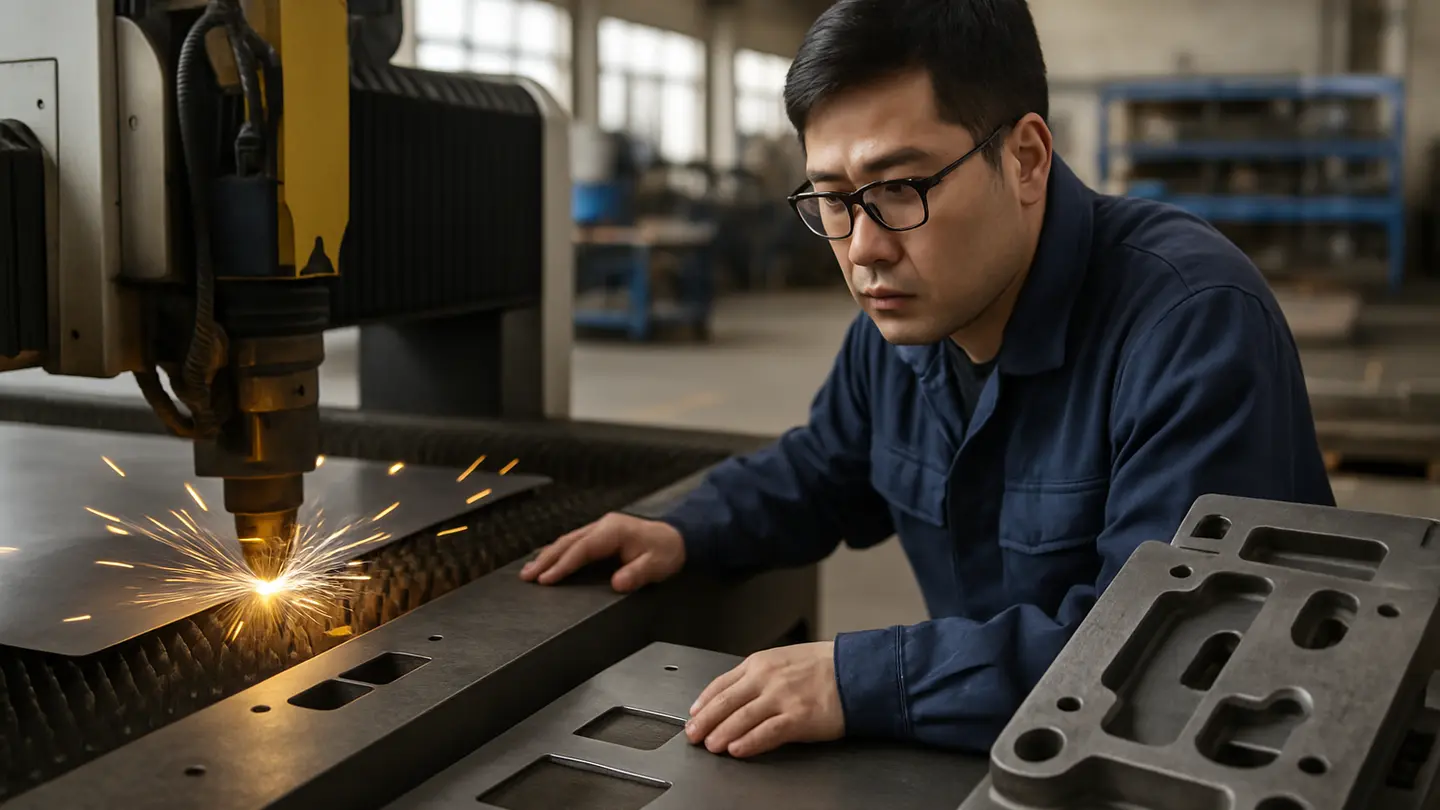
For buyers sourcing flat metal components, the choice between laser cutting and stamping is often a tooling decision disguised as a unit-price decision. A stamped part may look cheaper on repeat production, but it usually requires a dedicated die. Laser cutting starts from a digital drawing, so buyers can avoid die investment while the design is still being tested.
That matters for shower manufacturers, hardware brands, enclosure suppliers, and buyers ordering brackets, plates, trims, covers, spacers, mounting tabs, and similar sheet-metal parts. If the part is flat, annual volume is uncertain, or the drawing may change after market feedback, laser cutting services in China can help move from prototype to pilot production without locking money into tooling too early.
The right process depends on order size, design stability, part geometry, and buyer risk. Stamping is not automatically better because it is faster in mass production. Laser cutting is not automatically better because it avoids tooling. The commercial question is when the savings from stamping justify the die cost and reduced flexibility.
Laser Cutting or Stamping: Finding the Cost Break-Even Point
Stamping becomes attractive when order volume is high enough to spread the die cost across many parts. The die may be simple or complex, but it is still a dedicated investment. If the design changes, the die may need modification or replacement.
Laser cutting uses a programmed cutting path based on a CAD file. The supplier still needs to review the drawing, prepare the machine, nest parts on the sheet, and run the job, so small batches are not free of setup cost. However, changing a hole location, outline, slot size, or corner shape is usually a drawing revision rather than a new tool.
A simple break-even calculation is useful:
Break-even quantity = tooling cost ÷ per-part savings from stamping
For example, if stamping tooling costs $4,000 and stamping saves $0.40 per part compared with laser cutting, the break-even point is 10,000 parts. Below that quantity, laser cutting may be cheaper in total even if the unit price is higher. Above it, stamping may make sense if the design is stable and future orders are likely.
Buyers should ask:
- Is the first order a market test or a stable production launch?
- Could installation trials lead to a drawing change?
- Will the same part be reordered for several years?
- Is there a family of similar parts, each needing its own die?
- Would tooling approval delay the launch?
For a small first order, laser cutting often reduces financial exposure. This is especially relevant for visible fittings, enclosure accessories, or mounting components that may change after assembly testing.
Stamping becomes stronger when the part is simple, demand is predictable, and the drawing will not change. Once the die is approved, production can be fast and consistent. But if a buyer is still comparing finishes, changing hole patterns, or adjusting tolerances, laser cutting has real value.
Very small laser-cut orders may carry higher unit pricing because of programming, setup, material procurement, or packing minimums. Buyers should compare total project cost, not only the piece price.
What Laser Cutting Handles Well—and What It Cannot Replace
Laser cutting is strongest for flat sheet profiles where the main operation is cutting the outside contour and internal holes or slots.
Common metal materials for fiber laser cutting include:
- Carbon steel
- Stainless steel
- Aluminum
- Galvanized sheet
- Some copper and brass applications, depending on machine capability
For shower-related supply chains, this may include stainless-steel brackets, decorative plates, hinge shims, mounting washers, reinforcement plates, drain covers, channel spacers, and flat trim components.
However, a laser-cut part remains flat unless secondary operations are added. If the component requires bends, welded studs, threaded holes, countersinks, brushed finishing, polishing, coating, or assembly, those steps must be specified separately. Laser cutting is often only one operation in a broader sheet-metal fabrication route.
A useful distinction is the “cut blank” versus the “finished part.” The cut blank is the flat profile coming off the laser table. The finished part may require:
- Bending or forming
- Tapping or threading
- Countersinking
- Welding
- Riveting or insertion of hardware
- Deburring and edge rounding
- Surface finishing
- Plating, powder coating, passivation, or polishing
- Final inspection and packing
Complex outlines also affect cost. A rectangular plate with four holes may cut quickly. A decorative grille with many slots, tight curves, or detailed internal patterns takes longer because the machine must follow more cutting path and pierce more features. Unit price is not determined only by weight or material area.
Laser cutting cannot replace every three-dimensional process. If the part needs depth, pockets, bosses, curved surfaces, precision shoulders, or complex 3D geometry, CNC machining, casting, extrusion, forging, or stamping with forming may be more appropriate. Laser cutting can prepare the flat blank, but it does not create thick machined features by itself.
Material choice also affects supplier selection. Fiber lasers are widely used for metal sheet. Acrylic typically requires different laser equipment, so a shop that cuts stainless steel brackets may not be suitable for acrylic panels or plastic decorative parts. Confirm material, thickness, tolerance, and machine type before accepting a quotation.
Edge Quality: The Overlooked Risk in Remote Buying
Remote sourcing often focuses on dimensions, price, and delivery time, but edge quality deserves equal attention. Laser cutting can leave burrs, sharp edges, dross, heat marks, or roughness, especially on thicker materials or on the underside of the sheet. Supplier photos may show only the top surface.
For visible or hand-contact parts, this is a serious issue. A stainless-steel cover plate, handle insert, shower enclosure bracket, or exposed mounting tab may pass a dimensional check but still feel sharp to the installer or user. If the part will be handled, cleaned, or used near glass, edges should be controlled in the specification.
The drawing should state which edges require deburring, edge breaking, smoothing, or polishing. “No sharp edges” is helpful but not always enough. Better instructions identify critical areas, such as:
- Customer-facing edges to be smooth to touch
- Glass-contact areas to be burr-free
- Screw holes to be free of raised burrs
- Decorative surfaces to remain scratch-free
- Exposed corners to be rounded or softened
Buyers should also mark the cosmetic surface on the drawing. If one side will face outward after assembly, the supplier needs to know which side must be protected. Without that instruction, the shop may stack, deburr, or pack parts in a way acceptable for industrial brackets but unsuitable for visible hardware.
Inspection requirements should cover more than length and width:
| Inspection point | What to specify |
|---|---|
| Dimensions | Critical dimensions, hole locations, tolerances, and datum references |
| Edge condition | Burr limits, deburring method, smooth-touch areas, and underside quality |
| Surface finish | Scratch-free zones, grain direction if brushed, and cosmetic face |
| Flatness | Acceptable distortion after cutting, especially for thin sheets |
| Packing | Interleaving, protective film, or separated packing for visible parts |
Pre-shipment inspection is important when buying from China without visiting the factory. The plan should require photos of both sides, close-ups of edges and holes, and measurements of critical dimensions. For higher-risk orders, buyers may require sample approval before mass production and final inspection before packing or shipment.
How to Compare Quotes from Chinese Laser Cutting Suppliers
A quote for laser cutting services in China should not be judged only by the lowest unit price. Buyers need to know what is included, what is excluded, and whether the supplier has understood the finished-part requirements.
Request quotes at several quantity levels, such as:
- 10 pieces for sample validation
- 100 pieces for pilot assembly
- 1,000 pieces for initial production
- 5,000 or more pieces for reorder planning
These tiers reveal where the unit price begins to flatten. If the price falls sharply between 10 and 100 pieces but changes little after 1,000 pieces, much of the cost is setup-related. If the price remains high at larger quantities, the part may be slow to cut, material utilization may be poor, or another process may be worth quoting.
Ask suppliers to separate the quote into clear cost elements:
| Cost element | Why it matters |
|---|---|
| Material | Confirms grade, thickness, sheet standard, and material cost exposure |
| Laser cutting | Shows the cost of machine time and programming |
| Secondary work | Separates bending, tapping, welding, deburring, polishing, or coating |
| Inspection | Clarifies whether dimensional and cosmetic checks are included |
| Packing | Important for scratch-sensitive or export-packed parts |
| Tooling or fixtures | Relevant if bending, welding, or special location fixtures are required |
Material grade and thickness should be fixed in writing. “Stainless steel” is not enough. Specify grade, thickness, surface finish, and any relevant standard or equivalent. A small change in thickness can affect cost, cutting quality, bending behavior, assembly fit, and screw engagement.
Supply drawings in both editable and reference formats where possible. A DXF or DWG file may be useful for cutting, while a PDF drawing should define tolerances, material, finish, revision level, inspection points, and notes. The supplier should quote against a specific drawing revision.
Buyers should also ask whether the supplier will laser cut the part directly or outsource, punch, stamp, waterjet, or machine it. Outsourcing is not automatically a problem, but it should be disclosed if it affects quality control, lead time, or accountability.
If a part needs real depth or complex 3D geometry, a simple laser cutting quote may not be enough. Raised bosses, countersunk seats, thick precision features, and curved forms may require CNC machining, forming, stamping, or a combined process route.
Can Chinese Shops Cut Copper and Brass?
Many Chinese sheet-metal shops with modern fiber laser equipment can cut reflective metals such as copper and brass, but capability varies. Reflective materials are more demanding than carbon steel, and not every shop will accept them at all thicknesses.
Older CO2 laser machines may not be suitable for copper or brass. Fiber lasers are generally the relevant technology to discuss, but buyers should not assume every supplier has the correct machine, power level, assist gas setup, or experience.
Before accepting a quote, confirm:
- The machine type assigned to the job
- Maximum thickness the supplier can cut for that material
- Expected edge quality
- Whether a sample cut is required before production
- Whether discoloration or surface marking is acceptable
For decorative components, surface protection and handling need to be part of the quotation.
How Small Can Holes and Slots Be?
A common design rule is that laser-cut holes should be at least as wide as the material thickness. For example, in 2 mm sheet, a 2 mm hole is generally more realistic than a 1 mm hole. The same caution applies to narrow slots.
This is not an absolute limit. Some suppliers may cut smaller features depending on material, thickness, machine quality, and tolerance expectations. However, small holes and slots can be affected by heat, taper, dross, distortion, and inconsistent shape. They may also cost more because they require more piercing and slower cutting.
If the hole is functional, such as for a screw, pin, drainage path, alignment tab, or assembly fixture, confirm it through sample cutting. For precision small holes, drilling, punching, or CNC machining after blank cutting may be more reliable.
The drawing should distinguish between critical and non-critical features. Decorative perforations may allow more variation than holes used for assembly alignment. If all features have tight tolerances, the quote may become unnecessarily expensive or unrealistic.
Why Internal Corners Are Not Perfectly Sharp
A laser beam has width, often described through the kerf. Because the beam removes material along a path, internal corners will have a radius rather than a perfectly sharp 90-degree intersection. The design should allow for it.
This matters when parts fit together. If a square tab must seat into a laser-cut internal corner, the tab may interfere with the radius and prevent full assembly. This is common in brackets, folded panels, locating tabs, and interlocking sheet-metal parts.
Designers can solve this by allowing clearance, adding corner radii to the mating part, or using relief cuts. A small relief cut at the internal corner can provide space for the mating feature and avoid hand filing during assembly.
If a truly sharp internal corner is essential, discuss secondary machining or an alternative manufacturing method.
Can Part Numbers, Logos, or Fold Lines Be Marked During Cutting?
Many laser shops can etch part numbers, logos, orientation marks, or fold lines during the same setup used for cutting. This can help assembly teams, spare parts identification, quality tracking, or distinguishing left-hand and right-hand versions.
Laser marking is often less expensive than a separate printing, labeling, or engraving process because it can be programmed into the same digital workflow. For low and medium volumes, this can reduce handling.
However, laser etching creates a surface mark rather than a colored print. It may be subtle, especially on brushed or reflective stainless steel. Buyers should define visibility, location, size, and whether the mark is allowed on cosmetic surfaces.
For fold lines, the mark is a production aid, not a substitute for controlled bending. If bend position and angle are critical, the drawing should still specify bend dimensions, tolerances, inside radius, and inspection requirements.
Conclusion: Quote Both Processes Before Committing
The safest sourcing approach is to quote laser cutting and stamping at the same time, especially when the part may become a long-running production item. Laser cutting gives flexibility and avoids die investment at the beginning. Stamping may reduce the unit price later if volume becomes high enough and the design is stable.
Stamping quotes should separate die cost from part price. Without that separation, the buyer cannot calculate the crossover quantity or compare total cost fairly. Laser cutting quotes should separate material, cutting, secondary work, finishing, and packing.
For future reorders, compare forecast quantity against the break-even point. A first order of 500 pieces may favor laser cutting, while annual demand of 30,000 pieces may justify stamping. The decision can change as the product matures.
When buying remotely from China, process economics are only part of the risk. Material grade, edge quality, surface protection, dimensional inspection, and packing need to be written into the drawing, quote, and purchase order. A low unit price is not a saving if parts arrive with sharp edges, wrong material, scratched cosmetic faces, or features that do not assemble.
Laser cutting is most valuable for prototypes, pilot runs, design revisions, part families, and modest volumes where tooling would add cost and risk too early. Once demand and design are stable, stamping can be reconsidered with real numbers rather than assumptions.