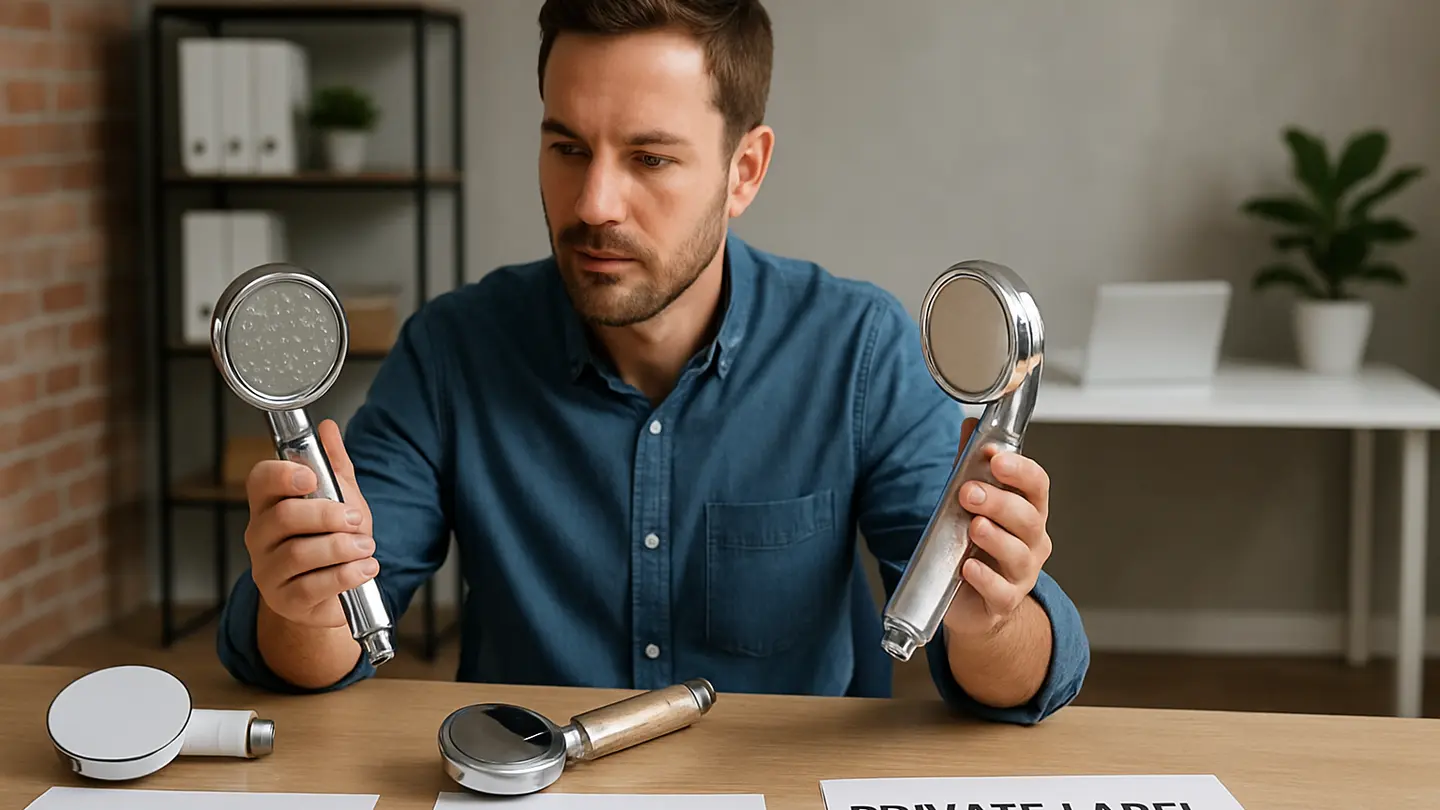
For B2B buyers, choosing a filtered shower head supplier is also a sourcing-model decision. The model affects product control, launch speed, upfront investment, and how defensible your product line may be once competitors enter the same channel.
The comparison of ODM vs OEM vs private label filtered shower head sourcing is especially important because this category combines visible design with technical performance claims. Buyers may need to evaluate filtration media, cartridge replacement systems, spray patterns, flow requirements, packaging compliance, and after-sales replacement parts.
ODM, OEM, and private label are not interchangeable. They represent different levels of ownership and customization. A startup e-commerce seller, a regional bathroom-products distributor, and an established plumbing brand may all source filtered shower heads, but the right model for each can be very different.
Defining ODM, OEM, and Private Label for Shower Head Buyers
ODM, OEM, and private label sit on a spectrum of buyer control.
ODM offers the greatest ability to shape the product around a specific concept, design target, or technical requirement. Private label allows a buyer to sell an existing product under its own brand with limited changes. OEM usually sits between the two: it adapts an existing shower head design with selected brand, functional, or packaging changes.
For filtered shower head buyers, the distinction matters because product design and filtration architecture affect cartridge compatibility, replacement frequency, flow consistency, perceived water pressure, installation fit, durability, packaging size, and certification pathways.
ODM: Custom Development Around Your Product Concept
ODM, or Original Design Manufacturing, is the most product-development-intensive model. In a filtered shower head project, ODM typically begins with a buyer’s concept, design brief, drawings, industrial design direction, or technical specifications. The manufacturer then helps turn that concept into a manufacturable product.
ODM may involve customization of the housing, handle shape, spray face, internal waterway, filter cartridge layout, sealing system, mode-switching mechanism, and material selection. Buyers may also define the filtration cartridge structure, filter media combination, cartridge replacement method, anti-clogging features, flow modes, and local plumbing compatibility.
Where a buyer needs a unique appearance or proprietary structure, custom molds may be required. Mold development increases upfront cost and extends the timeline, but it can support a more exclusive product. This is important for brands that do not want to compete directly with identical shower heads sold under many labels.
ODM is best suited to companies that need high product control, have a clear design vision, or plan to make the filtered shower head a core product line.
OEM: Semi-Custom Production Based on an Existing Design
OEM, or Original Equipment Manufacturing, is often a semi-custom approach. Many filtered shower head OEM projects begin with an existing product platform from the manufacturer. The buyer then requests changes to match brand, channel, or market requirements.
Common OEM modifications include logo placement, product color, surface finish, spray panel style, packaging design, instruction manual language, barcode labeling, and carton configuration. Some suppliers may also support limited functional adjustments, such as changing the filtration cartridge specification, modifying spray modes, adjusting hose or bracket compatibility, or altering the flow restrictor for a target market.
The main advantage of OEM is shorter development time than a fully custom ODM project. Because the core product structure already exists, the buyer can often move from sample evaluation to packaging confirmation and pilot order more quickly. Engineering risk may also be lower if the base model has already been tested and produced at scale.
OEM works well when buyers need differentiation but do not need a completely original product architecture.
Private Label: Standard Products Sold Under Your Brand
Private label is the simplest model. The filtered shower head usually remains unchanged, while the buyer applies its own brand through packaging and related materials. Branding may appear on the retail box, instruction manual, warranty card, product label, insert leaflet, or outer carton. In some cases, a logo may be added to the product if the supplier’s existing mold allows it, but product-level changes are usually minimal.
The appeal of private label is speed. Buyers can evaluate existing samples, select a model, confirm packaging artwork, and place an order without significant engineering or tooling work. This is useful for testing demand in a new market.
The trade-off is limited product uniqueness. If the same standard filtered shower head is available to many buyers, differentiation depends heavily on brand story, channel access, packaging, pricing, customer service, and marketing execution.
Private label is often the right starting point for companies that want to validate demand before committing to a more customized product strategy.
Core Differences Between ODM, OEM, and Private Label
The three models differ most clearly in customization, differentiation, investment, order quantity, and launch timeline. As customization increases, buyers usually face higher development costs, longer sampling cycles, more technical decisions, and larger minimum order quantities.
| Criteria | ODM | OEM | Private Label |
|---|---|---|---|
| Product customization | High; can involve custom design, molds, internal structure, and filtration system | Moderate; adapts an existing design or platform | Low; product usually remains standard |
| Differentiation potential | Strongest | Moderate | Mostly brand and channel based |
| Upfront investment | Highest | Medium | Lowest |
| Development timeline | Longest | Medium | Shortest |
| Buyer control | Highest | Partial | Limited |
| Typical use case | Established brand or strategic product line | Distributor, importer, or growing brand | Market testing or fast launch |
ODM generally offers the strongest path to a defensible product, especially when the buyer can justify tooling, testing, and engineering investment. OEM offers a practical compromise by allowing visible or functional customization without starting from zero. Private label is fastest and simplest but provides the least product-level differentiation.
Comparing Cost Structures and Investment Requirements
Cost is not only the quoted unit price. Buyers should consider total project investment, including sampling, tooling, packaging development, testing, certification, inspection, inventory risk, and replacement-parts planning.
ODM usually requires the highest upfront investment. Custom molds, engineering work, prototype iterations, filtration cartridge development, performance testing, and pre-production validation can all add cost before the first commercial order ships. If the project includes custom tooling, buyers should clarify payment terms, ownership, maintenance responsibility, and whether the tooling will be used exclusively for their orders.
OEM generally lowers development expense because the manufacturer starts from an existing product base. The buyer may still pay for logo tooling, color matching, packaging design, minor mold inserts, or adjusted components, but the cost is usually lower than building a product from the ground up.
Private label usually avoids major product-development costs. The buyer primarily pays for goods, packaging, branding materials, and logistics. This makes private label attractive when cash flow is limited or when the business needs to test a category before committing to tooling.
However, private label does not always mean the lowest unit cost. A standard product ordered in smaller quantities may carry a higher unit price than a high-volume ODM product after tooling costs have been amortized. The key question is whether the buyer has sufficient forecast confidence to justify customization investment.
Comparing Differentiation and Brand Positioning Potential
Filtered shower heads are easy for consumers to compare visually, especially online. If multiple sellers offer nearly identical products, competition often shifts toward price, review count, advertising spend, and delivery speed. This is where sourcing model affects brand positioning.
ODM can support the strongest differentiation. A buyer may develop a distinct silhouette, proprietary cartridge format, unique replacement mechanism, or filtration configuration tailored to a specific positioning strategy. A custom filtration cartridge may also support repeat sales through replacement filters if it is technically and commercially feasible.
OEM provides moderate differentiation. Visual changes, finish choices, packaging, manuals, and limited component adjustments may be enough for regional distributors or mid-sized brands serving specific retail or wholesale channels.
Private label relies mostly on non-product differentiation. The shower head may be standard, so the buyer’s advantage must come from branding, merchandising, listing quality, bundled accessories, customer service, price positioning, channel relationships, or localized packaging. This can still work commercially, but it is less defensible if competitors can source the same product.
How to Select the Right Manufacturing Model
The right model depends on four practical questions: How much can you invest? How fast do you need to launch? How unique must the product be? How technically defined is your concept?
If your priority is speed and market testing, private label may be the logical first step. It allows you to evaluate demand, price sensitivity, consumer feedback, and channel performance before investing in custom development.
If you already know your target customer and need a product that fits your brand more closely, OEM may be more appropriate. OEM can provide enough customization to support a branded launch while avoiding the cost and complexity of full ODM. It is also useful when buyers need adjustments for local packaging, retail requirements, or product positioning.
ODM becomes more compelling when product uniqueness is central to the business case. If you need an exclusive design, proprietary filtration structure, customized cartridge system, or specific performance profile, ODM may justify the added investment. It is also more suitable when the buyer has a long-term product roadmap rather than a single opportunistic purchase.
Design readiness is a major factor. A buyer with technical drawings, 3D files, material specifications, filtration requirements, target flow rates, and packaging dimensions is better prepared for ODM. A buyer with only a general idea may need concept refinement before engineering. For OEM or private label, the buyer can often begin with sample comparisons and supplier catalogs.
Certification requirements can also shape the development path. Requirements may vary by market, product structure, material, claims, and sales channel. Buyers should discuss applicable standards early and confirm whether the supplier has experience with the relevant testing and documentation.
Finally, commercial rights must be clarified early. For projects involving molds, custom cartridges, industrial design, or exclusive features, buyers should define mold ownership, intellectual property rights, exclusivity period, geographic restrictions, and whether the supplier may sell similar products to other customers.
Why OEM and ODM Capability Matters in a Shower Head Supplier
A supplier with both OEM and ODM capability can support a buyer across different stages of growth. Early on, the buyer may need private label or light OEM customization. As order volume grows and market feedback becomes clearer, the buyer may want to improve the product, adjust filtration claims, upgrade materials, refine ergonomics, or create a more exclusive design.
Engineering support is important because filtered shower heads must balance appearance, filtration function, water flow, sealing reliability, installation convenience, and cost. A design that looks attractive may still fail if the cartridge is difficult to replace, the spray feels weak, internal pressure loss is too high, or assembly is inconsistent.
Manufacturability also matters. A supplier experienced in OEM and ODM work can help identify whether a proposed design is practical for mass production, whether a component may increase defect risk, or whether a material choice will complicate finishing. This does not replace buyer due diligence, testing, and market validation, but it can reduce avoidable development problems.
Many buyers use a phased sourcing strategy: start with private label to test demand, move to OEM once customer preferences are clearer, and invest in ODM when the category becomes strategically important.
Example Scenarios for Filtered Shower Head Buyers
A startup e-commerce seller entering bathroom accessories may choose private label first. The business needs a fast launch, manageable minimum order quantity, and limited upfront investment. Its immediate focus is listing performance, packaging quality, customer reviews, and understanding which features customers value.
A regional distributor may prefer OEM. The distributor may already sell bathroom fittings, plumbing accessories, or home-improvement products and wants a filtered shower head that fits its local market. It may request branded packaging, specific finishes, multilingual manuals, retail-ready cartons, and minor functional adjustments.
An established brand may choose ODM. The brand may want a distinctive design, proprietary cartridge system, premium tactile feel, or a product family that includes matching replacement filters and accessories. For this buyer, differentiation and long-term control may be more important than the fastest launch.
There is no universal winner. The best sourcing model depends on business stage, budget, technical needs, channel strategy, and the level of product defensibility required.
Conclusion: Match the Model to Your Long-Term Product Strategy
ODM, OEM, and private label are strategic manufacturing options, not just sourcing terminology. Each model can be effective when matched to the right business objective.
Private label supports fast entry and lower development complexity. OEM provides a middle path, allowing branded and semi-custom products without the full burden of original development. ODM offers the highest level of product control and differentiation, but it requires stronger planning, larger investment, and a longer development horizon.
For filtered shower head buyers, the decision should balance cost, launch speed, customization, certification needs, and long-term product positioning. A company testing the market may not need custom tooling. A brand building a defensible category strategy may eventually need it.
The most resilient sourcing plans often evolve. Buyers may begin with private label, move into OEM as they learn the market, and later invest in ODM when they have the volume and strategy to support a more exclusive product line. Suppliers with OEM and ODM capabilities can be useful partners in that progression, provided commercial rights, quality expectations, and development responsibilities are clearly defined.
Tools for Finding and Evaluating China Suppliers
After deciding which sourcing model fits your filtered shower head business, the next step is building a supplier shortlist and comparing candidates with consistent criteria. Made-in-China.com is a B2B sourcing platform that can support early-stage supplier discovery.
Its Supplier Discovery tools help buyers find and narrow potential suppliers, including channels for Audited Suppliers. For buyers comparing OEM, ODM, and private label options, this can be useful when creating an initial list before direct outreach.
Made-in-China.com also provides Audited Supplier information and Audit Reports. According to the platform, Audited Suppliers are subject to third-party verification and on-site audit, with Audit Reports available for buyer review. These reports can cover areas such as general information, export trade, manufacturing capacity, quality control, and R&D capability.
For quotation work, Easy Sourcing allows buyers to submit one sourcing request, receive multiple quotations from matched suppliers, compare quotes, and request samples. This can reduce the manual effort of contacting suppliers one by one while buyers evaluate pricing, customization willingness, and sample quality.