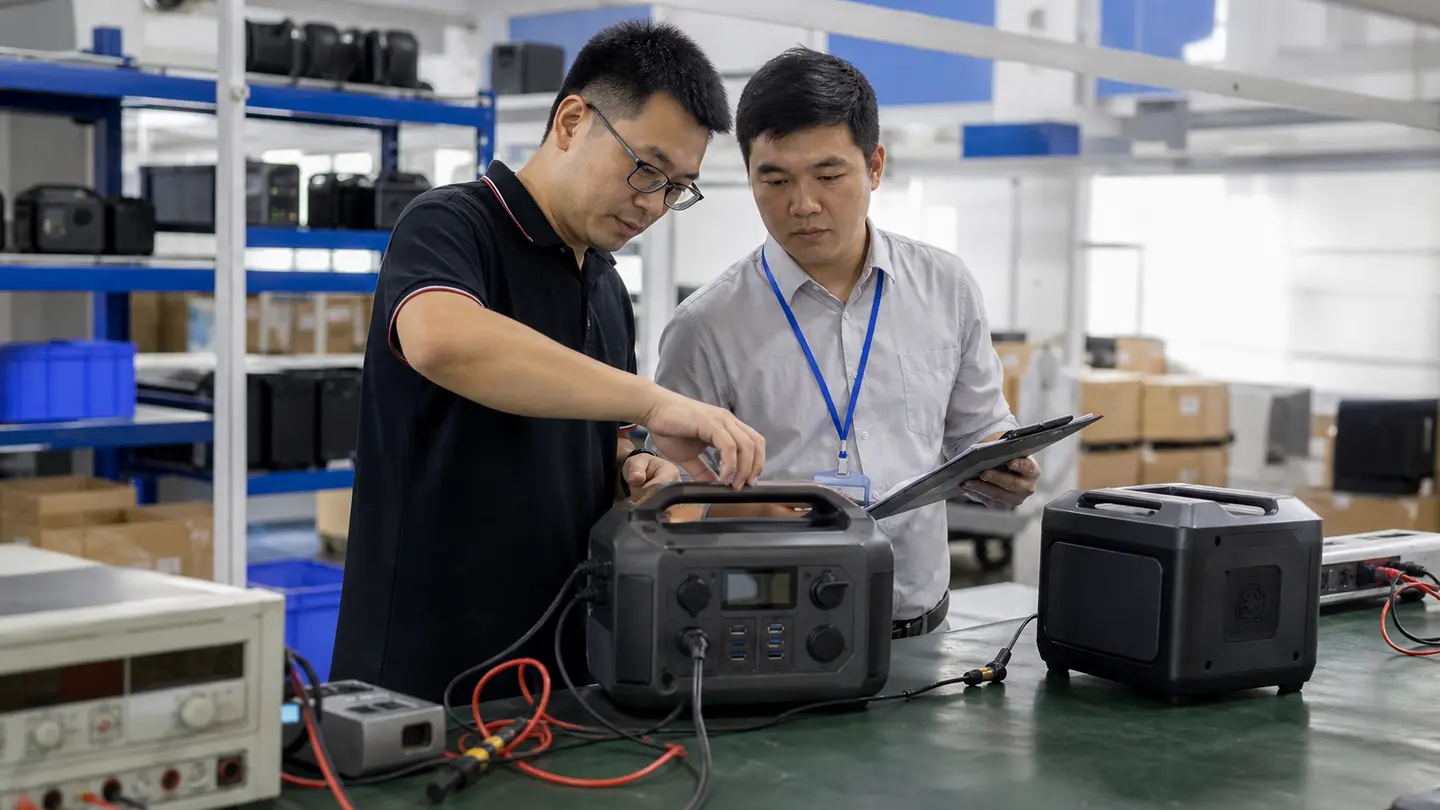
Portable Power Stations from China: Key Specifications and Supplier Checks
Sourcing portable power stations from China can give B2B buyers access to a wide range of capacities, battery chemistries, output configurations and OEM options. However, stations with similar headline specifications can perform very differently in real use. A rated watt-hour figure, for example, does not automatically show how much energy customers can use through AC outlets. Likewise, a high peak-power claim may not mean the unit can operate demanding equipment for sustained periods.
This guide concerns plug-in portable power stations designed for travel, outdoor use, mobile work, emergency backup and device charging. It does not cover fixed residential energy-storage systems that require permanent installation, grid connection or dedicated electrical design.
Before placing an order, buyers should verify usable energy, continuous output, surge performance, battery design, charging capability, safety documentation and after-sales support. Major specifications should be treated as supplier claims until they are supported by documents, sample tests and production-quality checks.
Verify Usable Capacity Instead of Relying on the Rated Figure
Capacity is commonly presented in watt-hours (Wh), but the displayed figure often refers to stored energy at the battery-cell level. The energy actually delivered to a connected device can be lower, especially when the station runs AC loads through its inverter.
Energy is lost during DC-to-AC conversion, internal power management and normal heat generation. The amount of usable energy can also change with load size, ambient temperature, battery state and the efficiency of the connected device. A unit with a 1,000 Wh rated battery may therefore deliver less than 1,000 Wh through its AC sockets.
Ask the factory to clarify exactly what its capacity statement means. Useful questions include:
- Is the published watt-hour figure based on nominal cell energy or measured output energy?
- What battery voltage and amp-hour configuration supports the stated Wh value?
- What test load was used to measure delivered energy?
- Was the test performed through AC output, DC output or both?
- At what ambient temperature, output level and battery condition was testing completed?
- Does the result include inverter losses?
A practical supplier should be able to provide a test method and explain the definition used for usable capacity. If possible, request a sample and test it under known loads that reflect the intended market. For example, a buyer targeting mobile offices may test laptops, monitors and networking equipment, while an outdoor-equipment distributor may test lighting, coolers or power tools.
Capacity validation is especially important when comparing low-cost quotations. An apparently cheaper product may have less usable energy than a higher-priced alternative, creating higher return risk and weaker customer satisfaction after launch.
Match Continuous and Surge Output to Real Device Loads
Output power should be reviewed in two parts: continuous output and surge output.
Continuous output is the power the portable station can provide over an extended period. It determines whether the unit can support a device that runs steadily, such as a fan, television, medical device, electric cooler or small appliance. Surge output, sometimes called peak output, is the higher power available for a short time when a device starts.
Motors, compressors, pumps, refrigerators and certain tools can require a substantial startup surge. A refrigerator may have a modest running load but draw much more power when its compressor begins operating. Similarly, a tool with a motor may exceed its normal running wattage during startup or under heavy use.
When comparing portable power stations from China, ask suppliers to provide:
- Rated continuous AC output in watts
- Peak or surge output in watts
- The duration allowed at surge output
- Overload protection behavior
- Output waveform type
- Inverter efficiency at relevant loads
- Performance data for demanding loads, where available
Pure sine wave output is generally preferable for sensitive electronics and motor-driven equipment. It can also be a more suitable choice for buyers whose customers will connect laptops, CPAP equipment, refrigeration products or professional tools. However, waveform type should not replace output testing. A pure sine wave claim does not by itself prove that the inverter can sustain the required load.
Build a load profile before selecting capacity and output. List the devices customers are likely to run, their normal wattage, estimated startup demand and expected operating time. This approach is more reliable than selecting a station simply because it has a larger watt-hour number or a higher advertised peak rating.
Choose Between LiFePO4 and NMC for the Intended Use
Battery chemistry affects weight, energy density, expected cycle performance, heat behavior and product positioning. Two common choices are lithium iron phosphate, usually called LiFePO4, and nickel manganese cobalt, commonly called NMC.
LiFePO4 batteries are generally selected where buyers prioritize repeat use, cycle life and heat tolerance. They are often suited to portable stations intended for frequent backup use, work applications or long-term ownership. Their trade-off is typically lower energy density, which can result in a larger or heavier unit for a comparable energy rating.
NMC batteries generally offer higher energy density and can help reduce size and weight. This can be useful for portable products where customers prioritize carrying convenience, compact dimensions or travel use. However, a chemistry label alone is not enough to predict real product life or safety performance.
Battery longevity also depends on factors such as:
- Cell quality and consistency
- Battery-management-system design
- Charge and discharge limits
- Heat control
- Storage conditions
- Depth of discharge in regular use
- Firmware settings and protection logic
Request the exact chemistry in writing rather than accepting broad descriptions such as “lithium battery.” The supplier should also state the cycle-life rating, the test conditions used for that rating and the remaining-capacity threshold associated with it. A cycle-life figure without a defined test method has limited value for product comparison.
For B2B procurement, the correct chemistry depends on the product’s intended duty cycle. A lightweight unit for occasional mobile use may justify a different battery design than a heavier backup-focused station expected to be discharged frequently.
Assess Ports, Charging Options and Backup Changeover
Port selection should match the devices used by the target customer group. A station designed for outdoor consumers may need multiple USB outputs and DC ports, while one aimed at tradespeople may require sufficient AC outlets and higher AC power capability.
Review the quantity, type and rating of every port. In particular, confirm actual USB-C Power Delivery capability rather than relying on a USB-C label. USB-C ports may vary significantly in output performance, and buyers should verify the wattage available to connected laptops, tablets and other higher-demand devices.
Important port and charging checks include:
- AC outlet type and quantity for the destination market
- AC continuous-output limit across all outlets
- USB-A and USB-C output ratings
- Regulated DC outputs and vehicle-style sockets
- Maximum combined output when multiple ports are used
- Wall-charging input and expected recharge time
- Vehicle-charging compatibility
- Solar-input voltage and current range
- Maximum solar-input power
- Connector type and required adapters
- Whether the solar input uses an appropriate controller design
Recharge-time claims also need context. A quoted fast-charge time may require a high-input source, a particular charging mode or favorable temperature conditions. Ask whether the stated result is based on charging from zero to full, a partial charge range, or a specific input power level.
Some portable stations include emergency switchover features for connected devices. Buyers should not market such a function as UPS capability unless the supplier can provide evidence supporting the claim. Verify switchover behavior, supported loads, test conditions and limitations before making any backup-power statement in product materials.
Confirm Certifications and Documentation for the Exact Model
Documentation must match the exact product being imported. A test report for a similar model, different battery capacity, alternate charger or different outlet configuration may not be sufficient for the destination market.
Request documentation early, before production begins or shipping is arranged. Depending on the market and product configuration, buyers may need to review safety reports, labels, declarations and transport paperwork. Verify that model names, electrical ratings, battery details and manufacturer information match the final ordered variant.
A useful document-review process includes:
- Compare the quoted model, sample model and final purchase-order model.
- Check whether battery capacity, charger, outlet type and enclosure are covered by the documents.
- Review the issuing laboratory and validate certification-directory records where applicable.
- Confirm that labels and instruction manuals contain the required product information.
- Check whether any private-label changes affect the documentation or marking requirements.
For EU-bound products, appropriate conformity documentation is needed in addition to product marking. Buyers should plan this work before finalizing packaging and labels, particularly when selling under a private brand.
Lithium-battery shipping also requires careful coordination. Transport paperwork, battery classification information, packaging requirements and carrier acceptance can affect freight planning. Do not assume that a factory’s general shipping statement applies to every shipment method, destination or battery size. Confirm requirements with the relevant freight provider and carrier before goods are ready to move.
Evaluate OEM Options, Software Support and Spare-Parts Readiness
Stock models are often the lower-risk route for buyers seeking fast market entry. They usually have established tooling, shorter development timelines and fewer variables in the first order. The trade-off is less control over appearance, port layout, firmware behavior and product differentiation.
OEM programs can provide more control over branding, packaging, specifications and features. However, customization may involve higher minimum order quantities, longer lead times, more approval stages and additional compliance work. Even small changes, such as a different battery pack, charger or outlet arrangement, can affect testing and documentation.
When evaluating a supplier, look beyond the product sample. Ask about:
- Firmware update procedures
- Mobile-app availability and stability, if applicable
- Language support for app and product interfaces
- Warranty claim process
- Repair guidance and diagnostic support
- Availability of spare parts such as chargers, fans, screens, connectors and battery modules
- Lead times for replacement components
- Production inspection process
- Incoming material controls and finished-product testing
A portable power station can appear satisfactory during a short sample trial but cause costly after-sales issues later if firmware is unstable, battery protections are inconsistent or replacement parts are unavailable. Supplier audits, whether performed directly or through a qualified third party, can help identify production-control and quality-management risks before larger commitments are made.
FAQ
Q1: How do I judge whether a capacity figure is honest before ordering?
Request the battery-cell configuration and check whether nominal voltage multiplied by amp-hour capacity reconciles with the claimed watt-hour figure. For example, the supplier should be able to explain the underlying battery arrangement rather than provide only a headline Wh number.
Then ask how much energy is delivered through the AC and DC outputs under stated test conditions. A supplier that cannot document the basic calculation or explain its capacity test method should be treated as a higher-risk option requiring additional sample testing.
Q2: How many units should I order for a first purchase?
A pilot order is generally a sensible way to limit exposure to unproven performance, uncertain demand and after-sales risk. It gives the buyer an opportunity to inspect production consistency, validate packaging, confirm shipping handling and gather customer feedback.
Set the first order according to realistic sales expectations and available support capacity, not only the supplier’s price-break threshold. Larger orders become less risky after the model has demonstrated acceptable field performance and return rates.
Q3: How much does the shipping weight affect what I should order?
Weight can materially affect freight and handling costs because portable power stations contain dense battery packs. Ask for packed unit weight, carton dimensions, units per carton and pallet information before comparing quotations.
A lighter station with a higher factory price may still have a lower landed cost than a cheaper, heavier alternative. Freight comparisons should also account for destination, shipment method, lithium-battery handling requirements and carton efficiency.
Q4: What quality problems show up most with cheap units?
Common concerns include overstated usable capacity, exaggerated output claims, poor thermal management and weak battery-protection systems. These issues can shorten service life, limit real-world performance and raise safety concerns.
Load testing can reveal some capacity and inverter weaknesses, but it does not fully validate protection functions. Dedicated checks are needed for overload protection, temperature response, charging behavior, short-circuit handling and battery-management performance.
Final Checklist for Lower-Risk Sourcing
Before confirming an order for portable power stations from China, make sure the supplier can provide evidence for the specifications that matter most:
- Usable-energy test method and sample-load results
- Verified continuous and surge AC output
- Exact battery chemistry and stated cycle-life conditions
- Port ratings, USB-C output and charging-input limits
- Solar voltage, current and connector compatibility
- Documentation matching the exact imported model
- Lithium-battery transport paperwork and carrier acceptance
- Sample inspection and realistic load testing
- Warranty process, firmware support and spare-parts availability
- Packed weight and dimensions for landed-cost calculations
The strongest sourcing decisions are based on verifiable performance rather than attractive headline specifications. Buyers that test samples, reconcile capacity claims, review documents carefully and assess after-sales readiness are better positioned to reduce returns, compliance problems and product-support costs.
Author Profile
The author is a B2B sourcing and product-evaluation writer focused on practical procurement considerations, specification review and import-risk management for technical consumer and commercial products.