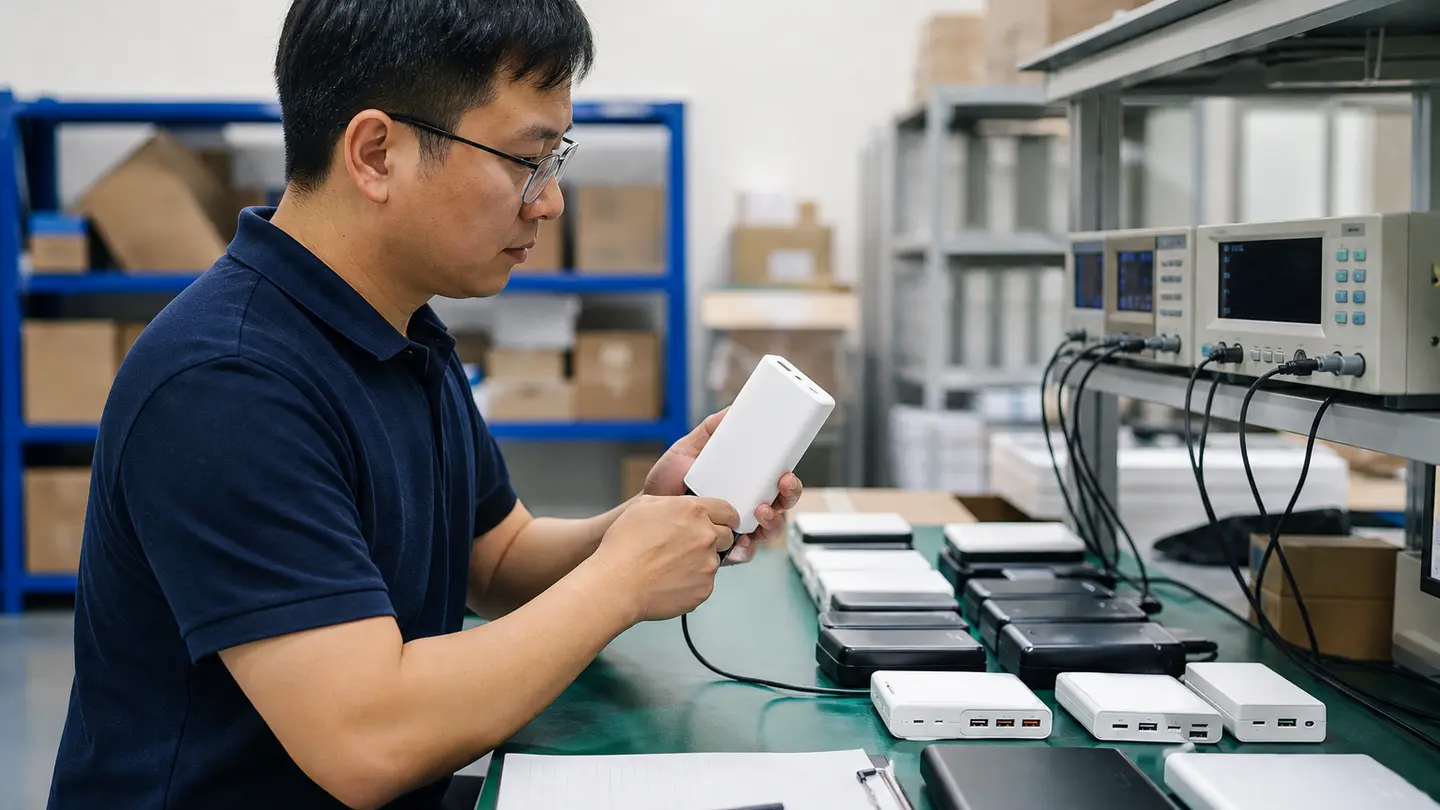
Why Printed Capacity Rarely Equals Usable Output
When sourcing power banks from China, the capacity printed on the housing is often the first specification a buyer compares. However, a power bank labeled “10,000 mAh” does not normally deliver 10,000 mAh to a connected phone, tablet, or other device.
The reason is that the printed mAh figure usually refers to the internal battery cells at their nominal voltage. The power bank must convert that stored energy to the output voltage required by USB ports, and that conversion consumes energy. Additional losses occur through the protection board, charging circuit, cable resistance, heat, and the connected device’s own charging process.
For B2B purchasing, watt-hours are generally a more useful comparison unit than mAh because watt-hours account for both capacity and voltage. Buyers should distinguish between:
- Nominal cell energy: The energy stored in the cells inside the power bank.
- Rated output energy: The energy the finished product is designed to provide at its output ports.
- Measured usable output: The actual energy delivered during controlled discharge testing.
A supplier may quote a high internal-cell capacity while providing little information about output performance. That does not automatically mean the product is defective, but it makes comparison difficult and increases the risk of overstated retail claims.
Before confirming a capacity claim, request samples and conduct practical tests on finished units. The test should measure usable output watt-hours, not only the supplier’s stated cell mAh. Testing should also reflect the intended use case, such as USB-C output, standard USB output, or wireless charging where relevant.
For private-label or marketplace sales, avoid advertising a power bank as capable of a specific number of device charges unless that statement is supported by repeatable testing. Actual charging results vary by device battery size, charging voltage, cable quality, and power-bank conversion efficiency.
Cell Quality Is the Most Important Hidden Specification
The cells inside a power bank are one of the largest drivers of its cost, usable capacity, cycle life, reliability, and safety. Yet they are also difficult for a buyer to verify after the finished product has been sealed.
Two power banks with similar housings, printed capacity, and port layouts can perform very differently if they use different cell grades or cell sources. Cell selection can affect:
- Actual stored energy and delivered output
- Capacity retention after repeated charge and discharge cycles
- Heat generation during charging and discharging
- Consistency between units and batches
- Risk of early failure
- Safety performance when combined with the protection circuit and enclosure
Buyers should not assume that a low quote means a supplier has found a more efficient manufacturing method. Lower pricing may reflect lower-grade cells, older stock, recycled cells, reduced quality control, or substitutions made after sample approval. These issues may be difficult to identify through visual inspection alone.
The protection board, soldering quality, insulation, wiring, and casing design also matter. A good cell cannot fully compensate for poor assembly, weak battery protection, or inadequate thermal design.
A purchase specification should identify the approved cell configuration as clearly as possible. Useful controls include:
| Specification control | Why it matters |
|---|---|
| Cell manufacturer | Reduces ambiguity about the intended source of cells |
| Cell model or part number | Helps distinguish approved cells from generic alternatives |
| Cell capacity and configuration | Supports capacity verification and consistency |
| Cell-lot traceability | Helps investigate field failures by batch |
| Approved substitution process | Prevents unapproved component changes |
| Written change approval | Requires buyer consent before changes to cells, boards, or key components |
If a supplier cannot provide clear documentation on the cells used, the buyer should treat the capacity and reliability claim as higher risk. Samples should be taken from production-representative material where possible, not only from an early prototype or showroom sample.
Validate Fast-Charging Claims Before Using Them in Listings
Fast charging can improve a power bank’s commercial appeal, but only when the stated charging performance is real, compatible with target devices, and clearly communicated.
A broad statement such as “fast charging” is not enough for B2B buyers. Ask the supplier to identify the specific charging protocols supported and the relevant versions where applicable. The specification should also state the maximum input and output power for each port.
Important points to confirm include:
- Maximum charging input power
- Maximum output power per port
- Supported charging protocols
- USB-C input and output capabilities
- Whether the USB-C port supports two-way charging
- Total output power when multiple ports are used at once
- How power is shared between ports during multi-device charging
- Wireless charging output and alignment performance, if included
- Temperature behavior during higher-power charging
Multiport performance is frequently misunderstood. A power bank may deliver its highest stated output only when one port is used. When two or more devices are connected, the available power may be divided between ports. This should be documented before buyers create packaging, manuals, online listings, or sales training materials.
Wireless charging claims also need separate verification. A product may include a wireless charging coil but deliver lower-than-expected performance because of alignment sensitivity, phone-case thickness, heat, or limited input power. If wireless charging is a major selling point, test it with representative devices and realistic charging conditions.
Charging features should reflect the intended market segment. A value-focused promotional power bank may not need every premium charging protocol. Conversely, a higher-priced product aimed at business travelers or technology users may require stronger USB-C performance and more detailed specifications.
Do not accept a factory default configuration simply because it is available. Decide which features customers will value, whether target devices can use them, and whether the added component cost can be recovered in the final selling price.
Confirm Compliance Documents Before You Plan to Sell
Compliance evidence should be checked before packaging is finalized, listings are prepared, or a deposit is paid. Requirements vary by destination market, product configuration, and sales channel.
A document is useful only if it applies to the actual product being purchased. Buyers should confirm that certificates, reports, and declarations match:
- The exact power-bank model
- The current product configuration
- The battery type and capacity range
- The relevant destination market requirements
- The applicable version of the required standard or rule
- The current manufacturer and production location where relevant
A report for a visually similar product may not cover the product you plan to import. The same issue can arise when a supplier changes the cell type, protection board, charging chipset, casing, or wireless charging module after documentation was issued.
It is also important to consider the credibility and validity of the laboratory or issuing organization. Buyers should review document details, confirm that reports are complete, and check whether the issuing laboratory is appropriate for the intended compliance purpose. A document that appears official may not satisfy a marketplace, customs authority, distributor, or insurer.
Marketplace requirements can be stricter than basic import requirements. Some sales channels may request battery documentation, product testing evidence, labeling information, warning statements, or additional product-safety material before allowing a listing to go live. A shipment that clears import procedures may still face delayed or blocked online listings if the seller cannot provide requested documentation.
Compliance requirements should be incorporated into the purchase agreement. The supplier should be responsible for providing agreed documents that match the final production version, while the buyer should verify that those documents meet the rules of the intended market and channel.
Plan Lithium-Battery Shipping Before Paying the Deposit
Standalone power banks are generally transported as lithium-ion batteries under UN 3480. This classification can make logistics more complex than for ordinary consumer electronics.
Air freight for lithium batteries is subject to specialized requirements that can affect carrier availability, routing, packing, state of charge, labeling, documentation, and lead time. A supplier may be able to manufacture the order on schedule but still face delays because the proposed freight method is not available for the battery configuration or destination.
Before paying a deposit, ask the supplier or freight provider to confirm:
- Whether the product can be shipped by the preferred transport method
- Whether the route supports standalone lithium-ion batteries
- Required packaging and labeling
- Documentation needed before booking
- Any limitations on battery state of charge
- Whether the planned shipment includes only power banks or mixed goods
- Expected battery-handling lead time in addition to production lead time
Request the UN 38.3 test summary early in the sourcing process. This is a key transport document for lithium-battery products and may be requested by logistics providers or downstream partners. Do not assume that a supplier’s statement that it “ships batteries regularly” is enough evidence for your specific product and destination.
Battery logistics should be considered in the total sourcing plan, not left until goods are ready. Confirming transport feasibility early can prevent missed launch dates, storage charges, last-minute route changes, and expensive changes in freight method.
Calculate Return Risk, Not Just the Unit Price
A lower unit price can be attractive, especially in competitive consumer-electronics categories. However, the true cost of power banks from China should be calculated using return risk and downstream selling consequences, not purchase price alone.
Low delivered capacity, early battery failure, unstable charging, overheating complaints, misleading charging claims, and documentation problems can all generate costs after delivery. Those costs may include:
- Customer refunds or replacements
- Return freight and warehouse handling
- Marketplace claim expenses
- Lower review scores
- Reduced listing visibility or sales performance
- Customer-service workload
- Product disposal or recall-related costs
- Lost reorder opportunities with distributors or retailers
A small saving per unit can disappear quickly if the return rate rises. This is especially relevant for marketplace sellers, where negative reviews and product-performance complaints can affect sales beyond the affected batch.
Build quality-control costs into landed-cost planning. These may include sample testing, pre-production approval, production monitoring, batch inspection, capacity testing, charging-performance checks, packaging inspection, and document review.
The goal is not to eliminate all risk, which is rarely realistic. It is to identify avoidable risks before a large shipment is released. Controlled component changes are particularly important. If the supplier changes cells, charging boards, or key electronics without approval, the performance of the finished product may change even when the exterior appearance remains the same.
Identify the Factory Responsible for Production Quality
A trading company, sourcing intermediary, or reseller may be useful in some purchasing arrangements. However, buyers should understand who actually manufactures the product and who controls production quality.
When the real production site is unclear, accountability can become weaker. A reseller may provide a sample from one source while production is handled by another. This can create inconsistency in cell sourcing, assembly methods, inspection standards, and compliance documentation.
Factory verification can help buyers assess whether the supplier has the capability to produce the required product consistently. An audit or verification process should consider areas such as:
- Production capability for the required product type
- Incoming inspection of cells and electronic components
- Traceability records for battery cells and finished batches
- Assembly and soldering controls
- In-process quality checks
- Finished-product testing methods
- Packaging and labeling controls
- Handling of rejected units
- Change-control procedures for components and materials
Purchase documents should identify the responsible legal supplier and set out the product requirements in practical terms. The agreement should cover approved components, capacity claims, charging functions, labeling, compliance evidence, traceability requirements, change approval, inspection rights, and remedies for non-conforming goods.
A buyer should also request a clear batch-identification method. Without it, a complaint involving a small number of units can become an investigation into an entire shipment.
FAQ
Q1: What decides the minimum order on a power bank?
Minimum order quantity is influenced by the cost and availability of cells, protection boards, enclosures, packaging, tooling, testing, and customization. Custom colors, printed branding, unique packaging, or non-standard charging configurations can raise the MOQ because they require dedicated materials or production setup.
An unusually low MOQ is not automatically a problem, but it can justify further questions. The supplier may be using stock products, shared components, excess inventory, or a production source that is not fully disclosed. Buyers should confirm whether the proposed order will be produced specifically for them and whether the same approved components will be used.
Q2: Is a higher price a reliable sign of better cells?
No. A higher price alone does not prove that a power bank uses better cells or has stronger quality control. Branding, packaging, sales commissions, housing design, and shipping terms can all affect quoted price.
Better evidence includes named cell components, written specifications, traceability commitments, approved-substitution controls, production-representative samples, and measured capacity testing. Buyers should compare quotations on an equivalent basis rather than assuming the most expensive offer is the safest choice.
Q3: Which charging features are worth paying for?
The right features depend on the intended customer, target devices, retail price range, and sales channel. Premium charging functions may be valuable for technology-focused users or higher-end travel products, but they may add cost that a budget segment cannot recover.
Before selecting a configuration, identify the devices customers are likely to charge, the charging standards those devices support, and the performance competitors offer in the same price range. Then verify that the chosen feature set works in finished samples before using it in marketing claims.
Q4: How do I trace a faulty unit back to its batch?
Use a date code, batch code, or serial reference on the product or inner packaging. The supplier’s production records should connect that code to the manufacturing date, production line, cell lot, protection-board batch, and inspection records.
Traceability should be agreed before production begins. If a faulty unit cannot be linked to a specific batch, the investigation may need to cover the full shipment, increasing the cost and disruption of corrective action.
Final Buyer Checklist Before Shipment
Before releasing final payment or authorizing shipment, confirm that the following items have been reviewed:
- Finished-product samples meet the agreed capacity expectation
- Usable output has been assessed in watt-hours, not only internal-cell mAh
- Cell manufacturer, model, configuration, and approved alternatives are documented
- Fast-charging protocols, input power, output power, and multiport behavior are verified
- Wireless charging performance is tested if it will be advertised
- Compliance documents match the exact final product model and destination requirements
- Marketplace documentation requirements have been checked
- The UN 38.3 test summary is available where required for transport
- Battery-shipping feasibility has been confirmed for the intended route
- Packaging, labeling, manuals, and capacity claims match the approved specifications
- Batch codes and traceability records are in place
- Any component changes have been approved in writing
- Pre-shipment inspection and agreed remedies for non-conforming goods are documented
Defensible product claims come from measured performance, controlled components, and complete documentation. For power banks, verifying these factors before shipment is usually far less costly than managing returns, blocked listings, customer complaints, or freight delays after goods have left the factory.
About the Author
This article was prepared by a B2B sourcing and product-quality writer focused on practical procurement controls for consumer products. The content is intended to help buyers assess specifications, production risks, compliance evidence, and logistics considerations before placing large-volume orders.