Printing a Logo on Products: What Lasts, What Peels, and What Buyers Should Check
For B2B buyers, the question is not simply whether a factory can print a logo on products. The real question is whether that logo will still look acceptable after shipping, handling, installation, cleaning, washing, sunlight exposure, or daily use.
A sample can look perfect in a supplier’s photo and still fail later. Ink may peel from plastic, a transfer may crack after washing, a printed mark may wear away where installers grip it, or a full-color logo may fade under UV exposure. These failures often come from choosing the wrong decoration method for the material and use conditions.
Logo durability depends on four practical factors:
- The base material, such as ABS plastic, stainless steel, aluminum, glass, fabric, rubber, or coated metal.
- The surface shape, including flat, curved, textured, recessed, or irregular areas.
- The decoration method, such as screen printing, pad printing, UV printing, heat transfer, embroidery, or laser engraving.
- The use environment, including water, detergent, abrasion, sunlight, heat, and handling.
For sourcing teams, private-label buyers, and importers, logo approval should be part of quality control, not only artwork approval. Before mass production, confirm appearance, adhesion, wear resistance, color consistency, and placement accuracy.
The safest approach is to approve a decorated sample, stress-test it under realistic conditions, and write the accepted standard into the production documents.
Six Common Logo Methods and the Products They Fit Best
Different logo methods suit different product categories. A process that works on a flat plastic panel may perform poorly on a curved metal fitting. A method that gives excellent full-color detail may not be the most durable option for heavy-contact use.
| Method | Best fit | Main strengths | Common limitations |
|---|---|---|---|
| Silk-screen printing | Flat or slightly curved surfaces, solid-color logos, higher-volume production | Cost-efficient at scale, good opacity, suitable for bold designs | Less suitable for complex curves, gradients, or very fine detail |
| Pad printing | Small, curved, recessed, or irregular parts | Good for small components and uneven shapes | Limited print area; color registration can be challenging |
| Heat transfer | Fabrics, bags, coated items, promotional goods | Supports gradients, photographic designs, and multi-color artwork | Can peel or crack if film, heat, pressure, or curing is poor |
| Embroidery | Towels, robes, caps, uniforms, fabric accessories | Textured, premium feel; durable on many textiles | Loses fine detail; small text may become unreadable |
| Laser engraving | Metal, coated metal, some plastics, wood, glass | Permanent mark on or into the base material; no ink layer to peel | Usually not full color; contrast depends on material finish |
| UV printing | Plastic, metal, glass, acrylic, coated surfaces | Sharp full-color printing, useful for complex designs | Ink sits on the surface; adhesion depends on material and pretreatment |
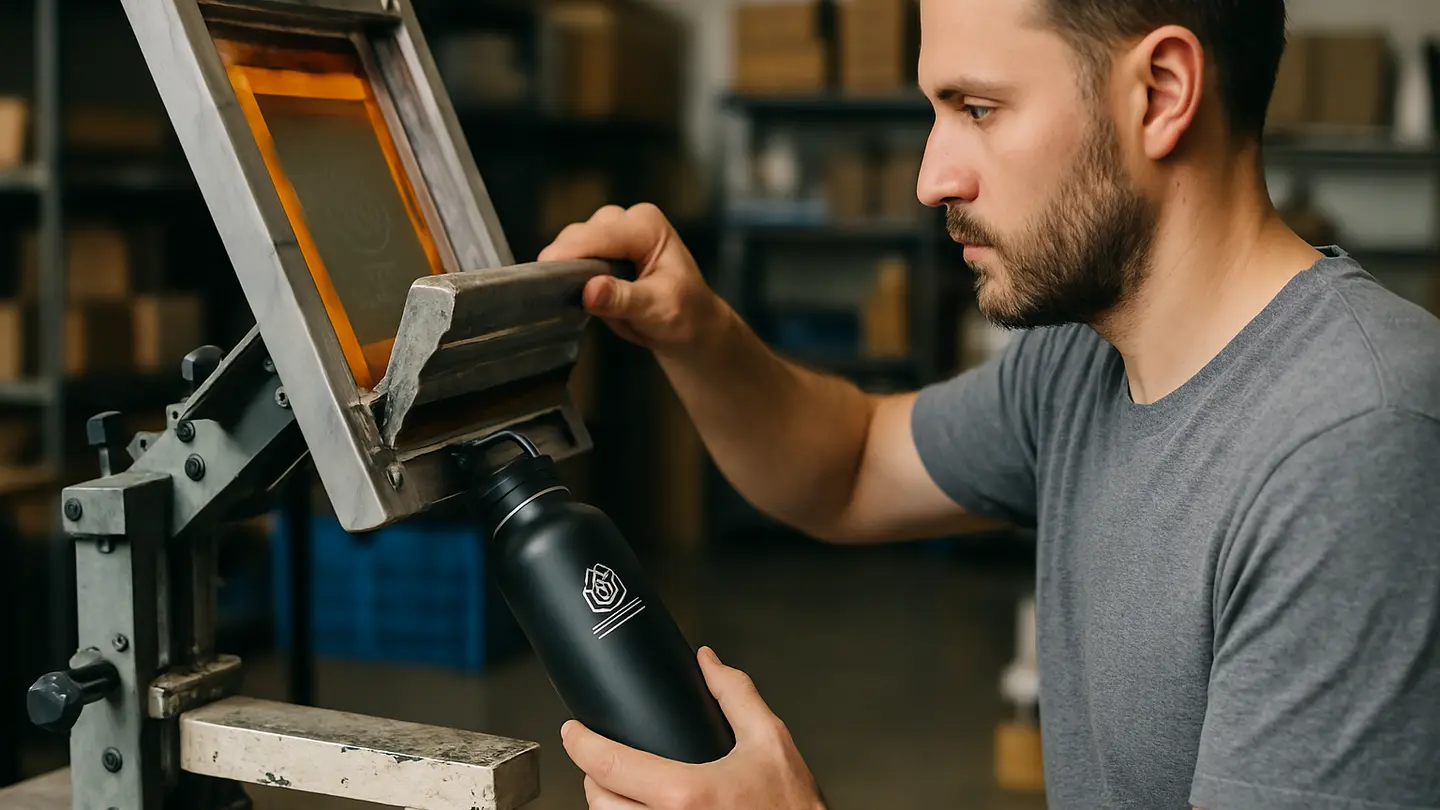
Silk-screen printing is common for simple one- or two-color logos on flat surfaces. It can be economical at volume because setup cost is spread across many units.
Pad printing is useful where screen printing cannot follow the product shape. The flexible pad transfers ink onto small, curved, or uneven parts such as control knobs, caps, switches, and small housings. Buyers should confirm whether the requested logo size and color registration are realistic.
Heat transfer is often chosen for gradients, photographic effects, or multi-color artwork on fabrics, bags, apparel, and some coated goods. Its durability depends on transfer-film quality, temperature, pressure, dwell time, and compatibility with the base material.
Embroidery gives fabric products a raised, tactile finish and can suit robes, towels, caps, uniforms, and textile accessories. Fine lines, thin lettering, tight spacing, and small icons can close up or distort when stitched, so artwork often needs simplification.
Laser engraving marks the surface itself. On stainless steel, anodized aluminum, coated metal, and selected plastics, it can create a durable mark without an ink layer. However, the result is usually single-tone, and visibility depends on the material’s finish and contrast.
UV printing applies cured ink to the surface and is valued for sharp, full-color graphics. It can be used on plastic, glass, acrylic, metal, and coated surfaces, but buyers should not assume UV ink bonds equally well to every substrate. Surface energy, coatings, primers, and curing quality all matter.
How Logo Marks Usually Fail in Real Use
Logo failure often appears only after the product has been handled, cleaned, installed, or used. A decoration method should be judged against the product’s expected environment.
Washing quickly exposes weak decoration. On textiles, poor embroidery backing can distort, and low-quality heat-transfer film may lift or crack. On washable plastic or coated products, weak ink adhesion may show after repeated water, detergent, or temperature exposure.
Sunlight creates another risk. Some inks fade under UV light, and coatings may discolor, yellow, or become chalky. Outdoor items, bathroom accessories near windows, and products used in humid or bright environments need special attention to UV resistance.
Frequent rubbing is one of the most common causes of logo wear. The first damaged areas are usually high-contact points: handles, edges, buttons, knobs, caps, and areas where installers, warehouse staff, or end users naturally grip the product.
Scratching is different from rubbing. A logo may survive casual handling but fail when it contacts tools, metal parts, packaging inserts, or other products in a carton. Buyers should consider assembly, packing, shipping, and installation, not only consumer use.
Peeling usually indicates poor adhesion between the logo layer and the base material. This can happen when the surface is oily, dusty, too smooth, chemically resistant, or incompatible with the selected ink or film. Polypropylene, polyethylene, silicone, rubber-like materials, and certain coated plastics may require flame treatment, corona treatment, plasma treatment, primer, or special ink systems.
Cracking is common when flexible materials bend, fold, compress, or expand but the logo layer cannot move with them. It can also result from low-quality heat-transfer film or incorrect application conditions.
Fraying is mainly a textile issue. Embroidered edges, woven labels, fabric patches, and stitched decorations can fray if thread density, backing, edge finishing, or washing resistance is poor.
The key sourcing lesson is simple: evaluate the logo where it is most likely to fail, not where it looks best in a product photo.
Do Not Approve Production Until the Sample Has Been Stress-Tested
A sample photo proves that the factory can apply the logo once. It does not prove that the logo will last.
Before mass production, request samples made with the actual production material, finish, coating, and decoration process. A logo printed on a substitute plastic or different metal finish may not behave the same way. Small material changes can affect ink adhesion, color appearance, laser contrast, and wear resistance.
Stress tests do not need to be complicated, but they should reflect real conditions. Depending on the product, practical tests may include:
- Repeated hand rubbing on the logo area.
- Abrasion with a cloth, sponge, or specified test pad.
- Washing or soaking in water.
- Exposure to detergent, alcohol, or common cleaning agents.
- Humidity or moisture exposure.
- Sunlight or UV exposure.
- Tape adhesion testing.
- Scratch testing with a defined tool or force.
- Bending or folding for flexible materials.
- Heat or cold exposure if the product will face temperature changes.
The important point is repeatability. “Rub hard for a while” is not a test standard. A better instruction defines the method, pressure or load, number of cycles, tool or material used, and acceptance criteria.
For example, a buyer might require the logo to remain legible after 100 rub cycles with a damp cotton cloth under a specified load, with no visible peeling or major color loss. For a textile product, the requirement may include wash cycles, water temperature, detergent type, drying method, and allowed change in appearance.
Acceptance criteria should be clear before production. Does slight gloss change count as failure? Is minor fading acceptable? Is any edge lifting unacceptable? Should the logo remain fully readable, or is partial wear acceptable for a hidden internal mark?
For higher-value or compliance-sensitive orders, third-party testing may be appropriate. For lower-risk orders, buyer-managed sample testing may be enough. In both cases, document the result with photos, sample identification, test conditions, and a written pass/fail decision.
Artwork, Color Matching, and Placement Details That Delay Orders
Many logo problems begin before production starts. Factories can only reproduce what the buyer specifies clearly.
Vector artwork is usually best because it can be scaled without losing sharpness. Common formats include AI, EPS, SVG, or production-ready PDF, depending on the supplier’s requirements. JPG or PNG files may look acceptable on screen but become blurred, jagged, or distorted when enlarged or separated for printing.
Small text, thin lines, tight spacing, and complex gradients should be checked at the final size. A logo that looks clean on a presentation slide may be impossible to reproduce on a small curved component. Ask the supplier to confirm minimum line thickness, minimum text height, and registration tolerance before approval.
Fonts should be converted to outlines or shapes before files are sent. If the supplier does not have the same font installed, the file may open incorrectly.
Color matching also needs discipline. Screenshots, phone photos, and monitor colors are unreliable. Pantone references are more useful because they provide a common production target. Even then, the same Pantone color may appear different on white plastic, brushed steel, black fabric, clear acrylic, or coated paper.
For brand-critical colors, a physical color chip or approved printed sample is better than a digital reference alone. The factory should confirm whether the selected process can achieve the requested color on the chosen material.
Placement is another frequent source of delay. A complete production file package should specify:
- Logo size.
- Exact position from fixed product reference points.
- Orientation.
- Color references.
- Print method.
- Artwork version.
- Whether the logo should be centered visually or measured mechanically.
- Tolerance for position and rotation.
- Any areas where printing is not allowed.
For curved or irregular products, a flat artwork file may not be enough. The supplier may need a placement drawing, marked sample, 3D reference, or photo showing the desired location. Without this, the logo may be technically correct but visually wrong.
Logo Printing Costs, Setup Charges, and Minimum Order Quantities
Logo decoration costs usually include setup cost and per-unit cost. These often move in opposite directions.
Screen printing and pad printing commonly require screens, plates, fixtures, ink mixing, and alignment. The initial charge may be higher, but the per-unit cost can be attractive at volume, especially for repeat orders.
Digital methods such as UV printing may reduce setup barriers for short runs, multi-color graphics, or variable designs. However, the per-unit cost can be higher, and production speed may be slower depending on equipment and artwork complexity.
Laser engraving may require fixture setup and machine programming. It can be efficient for simple marks on suitable materials, but large logos, deep engraving, difficult materials, or precise positioning can increase cycle time and cost.
Embroidery pricing often depends on stitch count, logo size, thread colors, backing, and fabric handling. A larger stitched logo takes more material and more machine time.
Minimum order quantities are not always set only by the logo method. They can depend on product holders, color changes, ink mixing, alignment, machine scheduling, curing time, packaging coordination, and the supplier’s workflow. A factory may accept a low product MOQ but require a higher quantity for a custom logo because setup time would otherwise be uneconomical.
Be cautious with “free logo printing” offers. The cost may be built into a higher unit price, limited to one color, restricted to a small print area, available only above a certain quantity, or tied to the factory’s preferred method.
When comparing quotations, ask suppliers to separate:
- Product unit price.
- Logo setup charge.
- Logo per-unit charge.
- Artwork or plate fee.
- Sample fee.
- Cost for each additional color.
- Cost difference for alternative logo methods.
- MOQ for each method.
- Lead time impact.
This makes quotations easier to compare and prevents a low headline price from hiding practical limitations.
FAQ
Q1: Which method lasts longest on plastic?
There is no single most durable method for all plastics. Plastic type, surface finish, coating, flexibility, and use conditions all affect performance.
For rigid plastic with a suitable surface, pad printing, screen printing, or UV printing may work well if the ink system and pretreatment are correct. Low-surface-energy plastics may need primer or surface treatment. If the plastic is coated, the logo may bond to the coating rather than the base material, so the coating’s durability also matters.
Shortlist methods based on color needs, logo size, surface shape, and handling intensity. Then test the most relevant options on the actual plastic used in production.
Q2: Can I print a logo on stainless steel?
Yes. Stainless steel can be branded in several ways, depending on the desired appearance and durability.
Laser marking or etching is often used when buyers want a durable, non-ink mark for stainless steel components, panels, fittings, and accessories. Final contrast depends on the grade, surface finish, and marking parameters.
UV printing may be considered when full color is required. Because the ink sits on the surface, adhesion and scratch resistance should be tested carefully. Brushed, polished, bead-blasted, coated, and mirror finishes can all affect how the mark looks and wears.
Q3: What if my logo has fine lines or small text?
Fine details should always be tested at the final production size on the actual material. Do not approve based only on enlarged artwork.
Embroidery can cause thin lines and small text to close up, especially on thick or textured fabric. Very small lettering may need to be removed, enlarged, or changed to a simpler mark.
Printed methods also have limits. Textured plastics, rough coatings, curved surfaces, and ink spread can cause fine lines to fill in or disappear. If brand rules allow it, a simplified logo may be more reliable for small products.
Q4: Should I get third-party testing or trust the factory’s report?
A factory report can be useful if it clearly states the sample source, test method, conditions, equipment, duration, and acceptance criteria. A third-party report can provide additional independence, especially for high-value orders or demanding use conditions.
However, a vague report that says “abrasion test passed” without explaining the load, cycles, method, and sample identity is weak evidence, regardless of who issued it.
The test should contain enough detail for both buyer and supplier to repeat it. If the result cannot be repeated, it is difficult to use when resolving a quality dispute.
Conclusion: Put the Approved Logo Standard in Writing
Logo durability should not depend on informal messages or sample photos. Once the buyer approves a logo method, the approved standard should be written into the purchase order, product specification, or quality agreement.
At minimum, the documents should identify the approved sample, artwork version, logo method, color reference, placement requirements, and test conditions. For large or brand-sensitive orders, payment milestones can be tied to production matching the approved sample and passing agreed checks.
Before shipment, finished batches should be inspected against the approved sample. Inspectors should check logo position, color, clarity, adhesion, scratches, rubbing damage, and consistency across units.
The best way to avoid disputes is to make the standard repeatable. If both buyer and supplier understand the same test, acceptance criteria, and approved sample, logo quality becomes easier to manage.