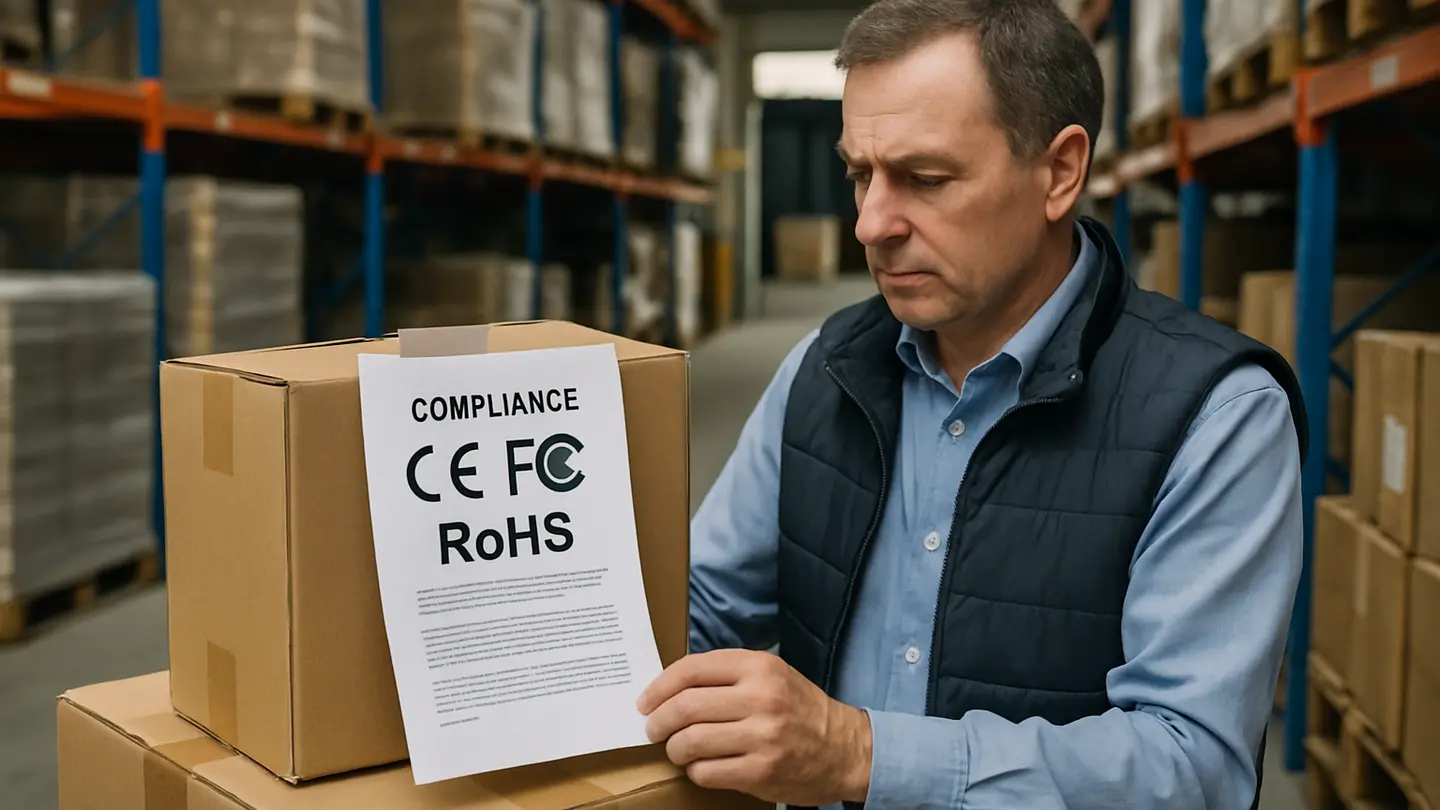
When Does a Product Change Require Retesting?
A product change requires retesting when the change could affect the evidence behind regulatory compliance, safety, performance, labeling, or market access. The difficult part for importers is that not every change looks important on a factory floor. A new coating may look identical to the approved finish. A substituted power adapter may fit the same socket. A firmware update may improve usability while also changing radio behavior, charging logic, or safety controls.
For B2B buyers, product change retesting is best treated as a decision process, not an automatic yes-or-no answer. Some changes can be handled through a document review. Others need a laboratory to assess the existing test file. Some require only targeted additional tests. A smaller group requires a full retest because the tested product and the shipped product are no longer meaningfully the same.
Common triggers include changes to:
- Raw materials, plastics, metals, glass, elastomers, or adhesives
- Surface treatments, coatings, pigments, plating, or anti-corrosion finishes
- Batteries, chargers, power supplies, wiring, motors, heating elements, or pumps
- Firmware, software, app controls, sensors, or radio modules
- Production processes, curing temperatures, welding methods, assembly settings, or tooling
- Critical component suppliers
- Product labels, warnings, instructions, age grading, performance claims, or intended use
Before asking a lab for an opinion, collect the supplier’s documentation. A vague statement such as “same quality, only supplier changed” is not enough. Importers should request the revised bill of materials, component specifications, certificates, drawings, process changes, supplier declarations, and a clear description of what changed compared with the tested build.
The destination market also matters. Some regulatory regimes or certification programs prescribe how changes must be handled. In those cases, the importer does not have much discretion: the applicable regulation, standard, certification body, or notified body process may define whether a file review, engineering assessment, partial test, or full retest is required.
Four Retesting Outcomes, from File Review to Full Retest
The first question is not “How much testing do we want to pay for?” It is “Does the applicable rule already tell us what must happen?” Certain product categories, certification marks, radio approvals, chemical restrictions, medical or children’s product requirements, and electrical safety programs may have formal change-control rules. If a rule dictates the response, follow it.
Where the rule does not prescribe the exact action, changes generally fall into four outcomes.
| Outcome | What it means | Typical use case | Buyer caution |
|---|---|---|---|
| Document or file review | Existing reports, drawings, bills of materials, and supplier declarations are compared with the proposed change. | Administrative updates, non-critical supplier name changes, or packaging changes with no safety or compliance function. | A file review is only as reliable as the documents provided. |
| Lab assessment | A qualified lab reviews the change and advises whether existing evidence remains valid. | Component, material, or construction changes where impact is uncertain. | The lab’s opinion should be retained with the compliance file. |
| Partial added testing | Only affected portions of the original test plan are repeated. | New coating, new plastic resin, changed charger, updated label, or changed user-contact material. | Added tests should match the compliance risk created by the change. |
| Full retesting | The changed product is tested as a new or substantially different build. | Major design changes, new power architecture, structural redesign, critical component sourcing change, radio change, or multiple simultaneous changes. | Full retesting may affect launch timing, payment, and shipment plans. |
Partial testing is often the most efficient outcome when the change is narrow and well documented. For example, if a shower product uses a new plated finish, a lab may focus on chemical, corrosion, coating durability, or user-contact requirements rather than repeating unrelated mechanical tests. If an electric shower accessory changes its power supply, testing may focus on electrical safety, temperature rise, EMC, or relevant charger requirements.
Full retesting becomes more likely when the change affects a core safety or compliance function. Examples include power systems, batteries, heating elements, pressure-bearing structure, load-bearing components, radios, software controlling safety functions, or materials that contact skin, food, water, or children. It is also more likely when the supplier changes a critical component source without enough traceability to show equivalence.
Laboratories can advise on testing scope, but importers remain responsible for compliance decisions. A lab can say whether a change appears to require additional testing under a standard. It cannot transfer the importer’s legal responsibility for placing compliant goods on the market.
Why a Small Substitution Can Create a Big Compliance Problem
A two-cent substitution can create a six-figure problem if it invalidates the assumptions behind the original test report. The issue is not only whether the replacement part works. The issue is whether the replacement part is the same, for compliance purposes, as the part that was tested.
Factory quality checks often focus on appearance, fit, basic function, dimensions, and packaging. Those checks may not detect compliance-related differences. Two plastics may look identical but have different flame retardants, plasticizers, restricted substances, heat resistance, or long-term durability. Two metal finishes may look similar but differ in nickel release, corrosion performance, coating thickness, or chemical composition. Two power adapters may have the same output rating printed on the label but different internal construction, certification status, insulation, or temperature behavior.
This is why “similar-looking” is not compliance evidence. A test report is tied to a specific tested build, including its materials, parts, construction, and sometimes production methods. If the factory substitutes a component, the original report may no longer support the goods being shipped.
Color changes deserve particular caution. A new pigment can introduce restricted substances or change material performance. A black plastic version and a bright red version may not be equivalent if different masterbatch, stabilizers, or recycled content are used. Coatings also create risk because they sit at the product surface where users touch the item and where wear, corrosion, or chemical migration may occur.
Supplier changes can be equally important. A factory may source a hose, seal, cartridge, battery, coating powder, or electronic module from a different vendor to reduce cost or solve a shortage. Even if the factory’s incoming inspection accepts the part, the buyer should ask whether the tested report named or implied the original component source.
Importers should compare the claimed unit-cost savings against the full cost of accepting the change. Retesting fees are only one part of the calculation. Schedule delays, air freight, relabeling, customer chargebacks, customs holds, product recalls, and unsellable inventory can quickly exceed the savings from a cheaper part.
Controlling Product Changes You Did Not Approve
Unapproved product changes are common in sourcing because factories are under pressure to manage cost, lead times, material availability, and production efficiency. A supplier may substitute a component after a vendor raises prices. It may change a coating because the previous finish caused rejects. It may shift assembly to a different line or subcontractor. It may update firmware to fix a bug. None of these changes is necessarily malicious, but each can affect compliance.
The purchase order should make change approval explicit. Buyers should require written approval before any change to materials, component source, construction, tooling, software, firmware, process settings, labeling, packaging with safety functions, or part specifications. The clause should apply even when the factory believes the change is “equal,” “better,” or “no impact.”
The tested build also needs to be defined clearly. It is not enough to say “Model A approved.” The compliance file should identify the exact bill of materials, drawings, component specifications, rated values, firmware version, process settings where relevant, artwork, labels, user instructions, and approved samples. If the product has multiple finishes, sizes, plug types, voltages, accessories, or model variants, the coverage should be explicit.
Early production inspection and during-production inspection can help identify visible deviations from approved samples. Inspectors can compare color, finish, labeling, markings, connectors, dimensions, packaging, accessories, and general construction. They can also photograph rating plates, labels, warning statements, plugs, chargers, and visible components.
However, hidden changes require deeper checks. Buyers may need to review purchase records, component invoices, incoming quality records, firmware versions, batch records, or supplier declarations. For electrical and mechanical products, opening units may be necessary to inspect internal construction. In some cases, targeted testing is the only practical way to confirm whether a hidden material or component change affects compliance.
Change control works best when it is built into the order process before production starts. If the buyer waits until final inspection to discover a changed component, the options are usually expensive: hold the shipment, negotiate rework, accept risk, or pay for urgent testing.
A Three-Question Test Before Production Continues
When a supplier announces a change, or when an inspector discovers one, the buyer should pause and apply three questions.
First, does the change affect anything measured in the original test? This includes chemical content, mechanical strength, electrical safety, EMC, water resistance, pressure resistance, durability, flammability, labeling, warnings, or performance claims. If the original test measured it, a change related to that area deserves careful review.
Second, could the change alter failure modes or user exposure? A stronger part may still change how the product fails. A new coating may improve appearance but increase chemical exposure. A different battery may fit the enclosure but change charging risk. A firmware update may improve control response but change overheating, shutoff, or radio behavior.
Third, does the change modify claims, intended users, or use conditions? Marketing and labeling changes can trigger compliance issues even when the physical product is unchanged. Claims such as “antibacterial,” “child-safe,” “commercial grade,” “water-saving,” “lead-free,” “medical,” “outdoor,” or “high temperature” may bring additional requirements or require evidence not covered by the original report.
If the answer to any question is yes, production should not continue as if nothing happened. Ask the supplier for documents and send the change package to a qualified lab or compliance advisor. The delay may be inconvenient, but it is easier to resolve before goods are packed, invoiced, and shipped.
Do Not Assume One Test Report Covers Every Version
Importers often buy product families: several sizes, finishes, power ratings, accessories, packaging versions, or private-label variants under one commercial range. A test report may cover the full family, but it may also cover only the specific model submitted to the lab.
Do not assume coverage. Read the report carefully and confirm which models, configurations, ratings, materials, colors, plug types, and accessories are explicitly named. Check whether the report includes representative models, worst-case models, or a series rationale. Also check whether the report refers to specific drawings, photos, component lists, labels, or samples.
A changed build that is not named in the report may still be acceptable if a lab confirms that it is covered by the original assessment. But that confirmation should be obtained and retained. Verbal reassurance from the factory is not enough.
This issue becomes important when suppliers offer “same series” documents. A report for one model may not cover a different voltage, material, coating, battery capacity, radio module, pressure rating, or user-contact component. Even small model code differences can matter if they identify different internal parts.
From a commercial standpoint, unresolved compliance coverage should be tied to payment control. If the changed build is not clearly covered by existing documents, buyers should consider withholding final payment or shipment release until the issue is resolved. Once goods leave the factory, leverage decreases sharply.
FAQ
Q1: Does a change I asked for myself follow the same process?
Yes. A buyer-requested change can affect the tested build just as much as a factory-initiated substitution. Adding a feature, strengthening a part, changing a finish, revising dimensions, changing packaging claims, or updating instructions may all affect compliance evidence.
Do not assume that an “improvement” is automatically low risk. Stronger materials, thicker coatings, new electronics, revised seals, or upgraded accessories may change test results or introduce new requirements. Complete the same change review before approving revised drawings, samples, or production tooling.
Q2: Does a new packaging supplier mean a retest?
Often, a packaging supplier change requires only a file review. If the carton dimensions, materials, labels, warnings, barcodes, and protective performance remain the same, the compliance impact may be limited.
Retesting may be needed if the packaging has a regulated function. Examples include child-resistant packaging, food-contact packaging, sterile or hygiene-related packaging, safety warnings, transport requirements for batteries or chemicals, or packaging that is part of the product’s protective function. Ask the factory to describe the packaging change in writing and check whether existing test reports, certifications, or required labels reference the packaging specification.
Q3: Should the retest use hand-built samples or units off the production line?
Retest samples must represent final production. A hand-built sample may be acceptable if it uses the same materials, components, construction, firmware, process settings, and workmanship expected in mass production. A production-line sample may also be acceptable if it reflects the final approved build.
The risk with hand-built samples is that they can be better controlled than normal production. The risk with early line samples is that the process may not yet be stable. In either case, obtain written factory confirmation that the submitted samples match the final production configuration. Keep photos, serial numbers, batch references, and sample submission records with the compliance file.
Q4: Does the retest have to go to the lab that issued the original report?
Not always. The original lab may be faster because it already has the test file, sample photos, construction details, and prior results. That can make the assessment more efficient, especially for partial retesting or report updates.
Another qualified lab may perform added tests if it has enough documentation to understand the original product and the change. Provide the original report, bill of materials, drawings, component specifications, labels, approved sample, and a clear change description. If certification body rules apply, check whether the original issuing body must be involved before moving the work elsewhere.
Conclusion: Resolve Change Control Before Shipment
Product changes that were not priced into the sourcing plan can create unsellable inventory, delayed shipments, and payment disputes. The lowest-risk approach is to treat change control as part of production management, not as an afterthought at final inspection.
Before shipment, buyers should collect change records, supplier explanations, revised specifications, and lab-level decisions where needed. Packed goods should be checked against the build described in the compliance documents, not only against the commercial sample or sales contract.
The key question is simple: are the goods being shipped still the goods that were tested and approved? If the answer is unclear, resolve it before final payment. Product change retesting is not only a laboratory expense; it is a sourcing control that helps importers make decisions while they still have leverage.