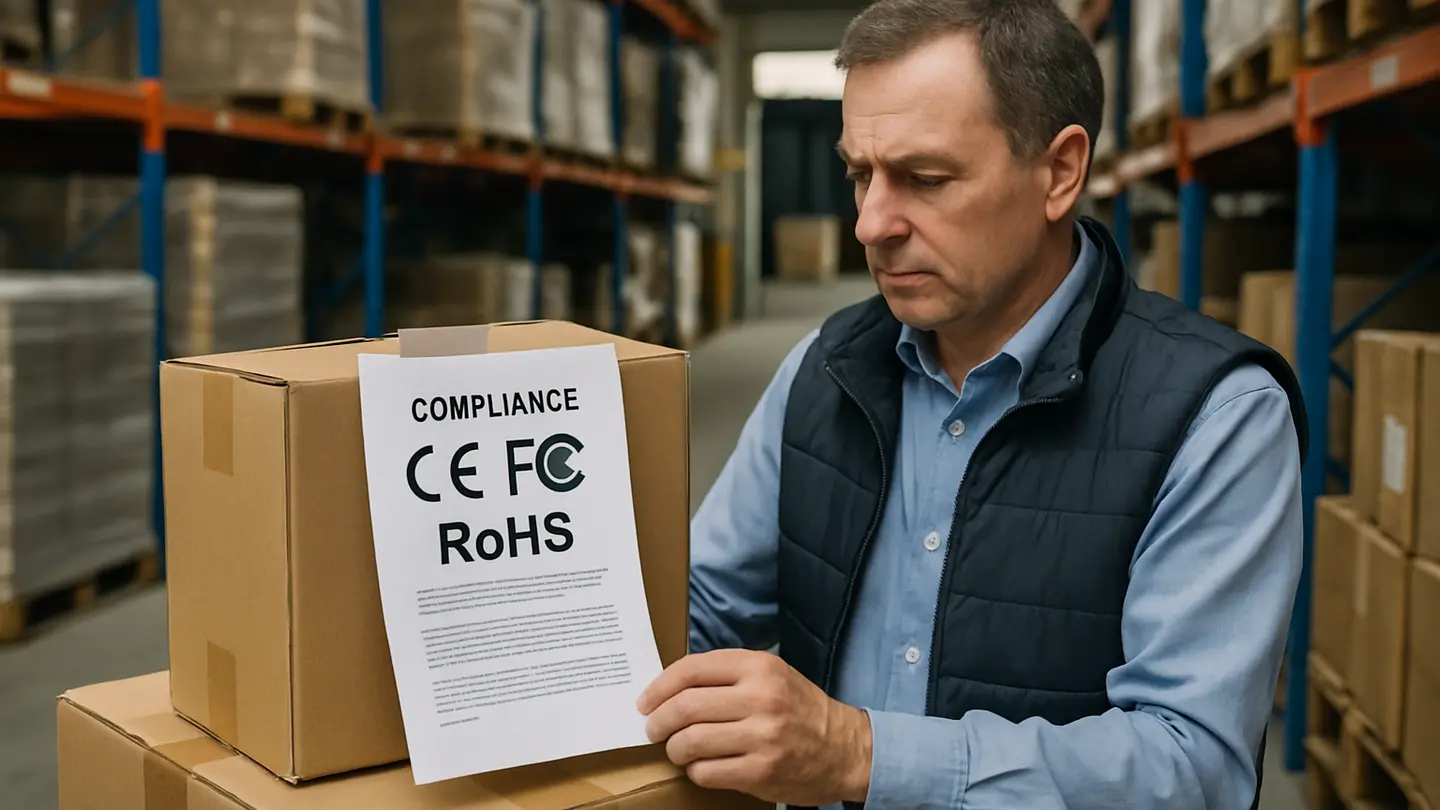
Product compliance when importing from China is often treated as a customs or post-shipment problem. That is the wrong sequence. Once goods are packed, loaded, and paid for, the buyer has far less leverage to correct missing reports, incorrect labels, unsupported marks, or production changes.
For B2B buyers sourcing bathroom, plumbing, electrical, or private-label products, compliance should be built into the payment schedule: before the deposit, sample approval, artwork approval, and balance payment.
Suppliers may help, but regulators, marketplaces, retailers, and insurers usually look first to the company placing the product on the destination market. Payment milestones are control points that prevent unresolved risk from moving from the factory to the importer.
Who the Regulator Will Contact and Who Is Allowed to Sign
The first question is not “Does the factory have a certificate?” It is “Who is legally responsible in the market where the product will be sold?”
In many markets, regulators pursue the importer, distributor, brand owner, or other responsible economic operator established there. If imported shower fittings, electrical bathroom accessories, LED mirrors, or thermostatic valves fail a safety or labeling rule, the overseas factory may be difficult to reach. The local importer is easier to identify.
In the EU and UK, importers generally must check that required conformity procedures have been carried out, ensure documentation is available, keep certain records, and make sure products carry appropriate labels, marks, addresses, and identifiers. Exact duties vary by regulation and product category, but imported goods carry obligations once placed on the market.
Private-label sourcing can increase those obligations. If goods are sold under the buyer’s brand, or if the buyer materially changes the product, packaging, instructions, or intended use, the buyer may take on manufacturer-like responsibilities, including signing declarations or maintaining technical documentation.
Signing authority depends on the setup:
- For factory-branded goods, the manufacturer may be named in technical documentation, while the importer still has destination-market duties.
- For buyer-branded goods, the brand owner may need to sign or hold documentation as the manufacturer.
- For products requiring a local authorized representative or responsible person, the appointment must be clear, documented, and accepted before shipment.
Freight forwarders and customs brokers may arrange transport or customs entries, but they generally do not assume responsibility for product safety, labeling, technical files, or market surveillance responses.
Before paying a deposit, identify who will be named on the product, who can sign declarations, who will keep records, and who will respond if a regulator asks for evidence.
Identify the Rules, Standards, and Marks Before You Commit
Compliance requirements depend on product category, destination market, and intended user. A simple-looking product may fall under several regimes.
A shower hose may raise material and labeling questions. A brass mixer or valve may involve drinking-water-contact requirements. An illuminated mirror or digital shower control may involve electrical safety, electromagnetic compatibility, radio rules, energy labeling, chemical restrictions, and waste-electrical obligations. Products for hotels, gyms, healthcare facilities, or public washrooms may also face buyer-specific procurement requirements.
Supplier certificates are useful only if they match the product and market. A factory may send a CE certificate, FCC report, UL file reference, food-contact report, or chemical test report that actually relates to:
- another model;
- an earlier product version;
- a different material or coating;
- another buyer’s branded item;
- a component rather than the finished product;
- a different destination market;
- an outdated or irrelevant standard.
Marks and schemes are not interchangeable. CE marking is a regulatory declaration for certain product categories in the European Economic Area. UKCA marking applies in the UK for many regulated goods. FCC requirements apply to certain electronic and radio-frequency products in the United States. UL and ETL marks are typically associated with third-party safety certification and may be required by retailers, contractors, insurers, or local electrical codes.
A CE mark does not satisfy FCC requirements. A generic “RoHS compliant” statement does not prove electrical safety. A material safety data sheet is not a finished-product test report. A component certificate does not always cover the assembled item.
Before issuing a purchase order, ask for a compliance map:
| Checkpoint | What to confirm before deposit |
|---|---|
| Destination market | Country or region where goods will be sold or installed |
| Product category | Applicable regulations, directives, standards, and restricted substances |
| Intended user | Consumer, professional, construction, hospitality, healthcare, or industrial use |
| Required marks | Regulatory marks, retailer-required marks, and voluntary certification marks |
| Evidence needed | Test reports, certificates, declarations, technical files, labeling, manuals |
| Cost allocation | Who pays for initial testing, retesting, artwork changes, recalls, or rework |
Testing quotes should identify standards, sample counts, model variants covered, lead times, retest fees, factory audit requirements if applicable, and recurring costs such as surveillance, annual listing fees, or periodic retesting. A low unit price can lose value if a full retest is required after production begins.
Verify That the Test Report Is Genuine and Covers Your Exact Goods
A professional-looking test report is not enough. It must be authentic, current, and applicable to the exact goods being purchased.
Common problems include reports issued for another buyer, factory, model, or product generation. Sometimes the tested product used a different power supply, plastic resin, coating, adhesive, cartridge, hose material, wireless module, or packaging configuration. In other cases, the report covers only a component, not the finished product as assembled.
Before approving samples, check:
- laboratory name and contact details;
- report number and issue date;
- applicant and manufacturer names;
- product description and photographs;
- model names and model-family coverage;
- ratings, dimensions, materials, and key specifications;
- standards and versions tested against;
- test results, limitations, and exclusions;
- amendments or superseded reports.
Where possible, verify the report number directly with the issuing laboratory or through the lab’s verification system. If the supplier resists basic verification, treat that as a warning sign.
Model-family reports can be legitimate, but only within the stated scope. A report may cover several sizes, colors, or cosmetic variants if the safety-critical construction is the same. It may not cover a different heating element, motor, radio module, transformer, coating, or material unless those differences are clearly included.
The strongest approach is buyer-controlled testing: the buyer selects the lab, agrees the test plan, sends approved samples, and ensures the report names the buyer’s product, model numbers, brand where relevant, and destination-market standards.
Tie testing to sample approval. Do not approve a golden sample for production if the compliance evidence relates to a different design. The sample, test report, bill of materials, and purchase specification should describe the same product.
Check Labels, Marks, Manuals, and Specification Changes Before Printing
Labels and manuals often cause avoidable delays because they are reviewed too late. Product labels, cartons, inserts, warranty cards, installation instructions, and online documentation should be checked before artwork is printed.
Typical label elements may include:
- country of origin;
- importer or responsible company name and address;
- manufacturer name or identifier;
- model number, batch number, serial number, or SKU;
- electrical ratings, water-pressure ratings, or other technical ratings;
- material declarations or food-contact statements where applicable;
- warnings, installation limits, and safe-use instructions;
- required marks such as CE, UKCA, FCC, recycling, WEEE, or other product-specific symbols.
Wording and placement can matter. A mark on a carton may not be enough if the rule requires it on the product. A warning in English may not be enough for a multilingual EU market. A missing importer address can trigger marketplace rejections or customs questions even when the product has passed testing.
Specification control is equally important. Many compliance failures begin as quiet substitutions. A supplier may change a plastic grade, cable, seal, valve cartridge, finish, adhesive, electronic component, packaging material, or power adapter. The product may look the same, but the earlier report may no longer apply.
Purchase order terms should require the supplier to disclose and obtain written approval for any substitution before production. The same requirement should apply to subcontracting, component changes, mold changes, firmware changes, and packaging changes. For higher-risk goods, require updated bills of materials and critical-component lists before mass production.
Origin paperwork should also be reviewed before balance payment where applicable. This may include certificates of origin, supplier declarations, invoices, packing lists, and documents needed for tariff treatment, customs entry, anti-dumping checks, or public-procurement requirements. Incorrect origin marking or inconsistent paperwork can delay clearance and create enforcement risk.
Confirm Listing Compliance Before the Product Goes Live
Compliance does not stop with the physical product. Online listings, distributor portals, retail uploads, and marketplace dashboards may require information that matches the packaging and retained documents.
In the EU, online offers for regulated products may need to show manufacturer details, a local responsible party or importer where required, product identification, and relevant warnings or safety information. Other markets and platforms may require certificates, test reports, tracking labels, safety images, declarations, energy data, chemical statements, or installation warnings.
Marketplaces can reject uploads or delist products when documents do not align with the listing. Common mismatches include:
- model numbers on the listing that differ from the test report;
- a brand name on the packaging that is not shown in the declaration;
- manufacturer details that differ across invoices, labels, and reports;
- warnings on the listing that are missing from the manual;
- images showing a different plug, power adapter, finish, or accessory;
- certificates covering a different SKU or bundle.
For B2B sellers, the same issue can arise with contractor portals, distributor catalogs, and retailer onboarding systems. A project buyer may request proof that the exact item proposed for a hotel, apartment development, or commercial washroom matches the certified or tested model.
Batch, serial, or model identification supports traceability and recalls. If a defect or compliance issue appears, the buyer should be able to identify affected shipments, customers, and production dates. Without traceability, a small issue may become a broader withdrawal because affected units cannot be separated from compliant stock.
Before a product goes live, compare the listing, packaging, product label, instructions, invoice, declaration, and test reports side by side. Consistency is the evidence chain showing that the listed goods are the same goods that were assessed.
Build the Compliance File Before Paying the Balance
The final balance payment is often the buyer’s last meaningful leverage point. Once payment is released and goods leave the factory, missing documents become much harder to obtain.
Before paying the balance, assemble a compliance file for the actual shipment. Contents vary by product and market, but may include:
- approved purchase specification and drawings;
- approved golden sample reference;
- bill of materials or critical-component list;
- test reports and certificates;
- declarations of conformity or supplier declarations;
- technical file access arrangements;
- product and packaging artwork approvals;
- manuals, warnings, and installation instructions;
- importer, manufacturer, authorized representative, or responsible-person details;
- batch, serial, model, and production-date identifiers;
- inspection reports and shipment photos;
- commercial invoice, packing list, and origin documents.
For EU-regulated products, importers generally need to keep declarations and ensure that technical documentation can be made available to authorities. In some cases, the manufacturer holds the full technical file and the importer must be able to obtain it. In private-label arrangements where the buyer is treated as the manufacturer, the buyer may need to hold the technical file directly.
Retention periods and start dates vary by regulation and market. Confirm the retention rule for each product category instead of applying a single blanket period.
The file should link documents to real goods. A declaration without model numbers is weak. A test report without photos may be difficult to match. A batch number that does not appear on the carton or invoice may not support traceability. A strong file connects each shipment to the tested design, approved labels, signed declarations, and production identifiers.
Payment terms can reinforce this process. The purchase order may state that balance payment is conditional on delivery of specified compliance documents, passing inspection, no unauthorized substitutions, and artwork matching the approved regulatory layout. The contract should also allocate the cost of failures: retesting, rework, relabeling, storage, disposal, return freight, customer claims, and regulatory penalties where enforceable.
FAQ
Q1: Can my purchase contract make the factory legally responsible instead of me?
A purchase contract can allocate costs between buyer and supplier. It can require the factory to reimburse testing costs, pay for rework, indemnify the buyer for certain losses, replace non-compliant goods, or cooperate with regulators and laboratories.
However, a contract usually cannot transfer statutory market-role duties away from the importer or responsible company in the destination market. If the law says the importer must check documents, keep records, label goods, or respond to authorities, a private contract with an overseas factory will not normally remove that duty.
Use contract terms for leverage and recovery rights, not as a substitute for performing the legal obligations attached to your role.
Q2: Does appointing an EU or UK authorized representative make my imports compliant?
Not by itself. An authorized representative may perform specific tasks for a non-market manufacturer if properly appointed in writing, such as holding certain documents, cooperating with authorities, or signing documents where the applicable law allows it.
The product still needs the right standards, testing, technical documentation, labeling, and traceability. Importer duties may still apply.
Authorized representatives are most relevant where a non-EU or non-UK manufacturer, or a private-label brand owner outside the market, needs a local compliance role. The appointment should be agreed before shipment and reflected consistently in labels, documents, and listings.
Q3: Does using a fulfilment warehouse in Europe move the compliance duty to them?
Usually not. A fulfilment warehouse generally stores, picks, packs, or dispatches goods. It does not automatically become responsible for product conformity when another EU-established operator is already the importer, manufacturer, authorized representative, or distributor.
Responsibility can depend on which company is established in Europe, who imports the goods, who is named on the product, who sells to the end customer, and which regulation applies. For marketplace and cross-border e-commerce models, these roles can become unclear unless agreed in advance.
Before shipment, decide which company will be named on the goods, which company will hold documents, and which company will answer compliance questions.
Q4: Are the duties different if I sell only to businesses rather than consumers?
Sometimes. Certain warnings, age-related requirements, consumer instructions, and general product safety duties may differ between consumer and business-only channels. A product sold only to trained installers or commercial operators may not need the same presentation as a retail consumer product.
However, B2B status does not remove many core rules. Electrical safety, electromagnetic compatibility, radio equipment, chemical restrictions, pressure-related requirements, food-contact or water-contact rules, waste-electrical obligations, and customs labeling can still apply.
Fix the sales channel before deciding the evidence required. If a product might later move from trade-only distribution to retail or online consumer sales, assess that broader use before production.
Conclusion: Treat Compliance as a Payment-Sequencing Process
Product compliance should be managed through the sourcing timeline, not repaired after shipment. The buyer has the most leverage before money changes hands and before the supplier commits to materials, tooling, labels, and packaging.
Settle the applicable rules and marks before paying the deposit. Verify reports before sample sign-off. Approve labels, manuals, and packaging before printing. Require disclosure of specification changes before production. Hold final payment until the compliance file links the shipment to the tested product, approved documents, identifiers, and origin paperwork.
This approach does not eliminate every risk, but it prevents the common problem of discovering after payment that the supplier’s evidence does not support the goods purchased. Importers keep more control when compliance is a condition of payment, not a favor requested after the container has left the factory.