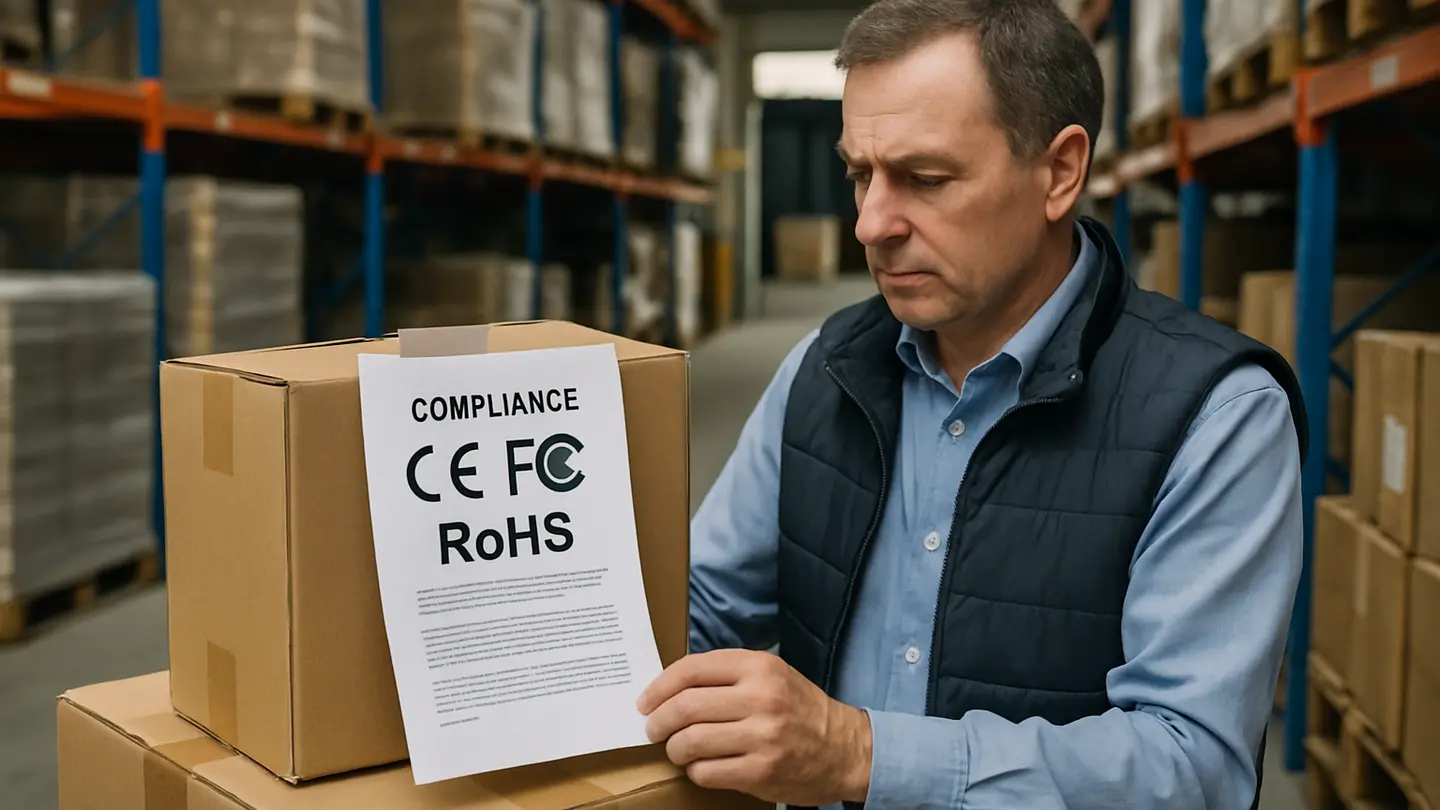
Labeling mistakes are rarely dramatic at the artwork stage. They become expensive when finished goods are packed, cartons are sealed, a vessel is booked, or inventory is sitting in a warehouse with labels that cannot legally be sold.
For importers, product labeling requirements for importers are part of market access, customs clearance, consumer safety, traceability, and commercial risk control. A label can affect whether goods are released, accepted by a retailer, kept active on a marketplace, or handled efficiently in a recall.
US and EU requirements often overlap in principle but differ in execution. The same product may need different information on the product itself, the retail box, and the export carton. Some requirements are general, such as product identity or responsible-party information. Others depend on the product category, such as electrical safety markings, chemical warnings, textile fiber content, water-efficiency claims, energy labels, children’s product tracking details, or language-specific instructions.
The practical sourcing lesson is simple: label compliance should be reviewed before packaging is printed, not after production is complete.
Why Labeling Should Be Part of the Buying Decision
Importers sometimes treat labels as a design task for the supplier’s packaging department. That is risky. In most commercial situations, the importer or brand owner is the party placing the goods on the destination market and is expected to understand the applicable rules there.
A factory’s default label may reflect its usual production habits, domestic market, or another customer’s requirements. A supplier that exports to Europe may not know the exact language, warning, address, traceability, and packaging rules for your EU member states. A supplier that has shipped similar goods to the US may have used labels approved by another importer for a different product, claim, or sales channel.
Labeling affects cost, timing, and risk. Before confirming an order, buyers should know:
- whether the product itself needs permanent marking;
- whether retail packaging must be redesigned for each market;
- whether an EU-based responsible contact or importer address is required;
- whether warnings or instructions need translation;
- whether marketing claims require test evidence;
- whether export cartons need buyer-specific shipping marks, barcodes, or warehouse references.
A well-managed purchase order should make label approval part of the control process. The buyer can require approved artwork before mass packaging production, reserve a payment milestone until print proofs are signed off, and instruct inspectors to compare finished goods against the approved label file.
This is especially important for B2B buyers sourcing bathroom fixtures, shower products, plumbing accessories, electrical bathroom items, or packaged installation components. These products may involve safety, water contact, installation instructions, warning labels, spare-part traceability, and claims about materials or performance.
Core Label Information Required in the US and EU
There is no single universal label that works for every product. Importers should start with a core checklist and then add product-specific requirements.
For many packaged consumer goods in the US, common label elements include product identity, quantity, and responsible-party information. The identity statement tells the buyer what the product is. Quantity information may need to follow rules on placement, units, and format. Responsible-party information normally identifies the business connected to the product in the US market, such as the manufacturer, packer, distributor, or importer, depending on the applicable rule.
Country-of-origin marking is another frequent US issue. US Customs and Border Protection generally requires imported articles to be marked with their country of origin in a way that informs the ultimate purchaser, unless an exception applies. The correct wording, placement, and permanence can vary. “Made in China,” “Made in Vietnam,” or another origin statement is a customs compliance matter, not just a branding choice.
The EU has a different structure. Labels may need to distinguish between the manufacturer, importer, distributor, and an EU-based responsible person or economic operator, depending on the product category and regulatory framework. For some products, placing goods on the EU market requires a contact established in the EU. For others, importer details, manufacturer details, batch information, CE marking, safety warnings, instructions, or conformity references may be required.
A simplified comparison looks like this:
| Label element | US considerations | EU considerations |
|---|---|---|
| Product identity | Often required on retail packaging for consumer goods | Usually expected for consumer clarity and product identification |
| Quantity | May require specific format and units for packaged goods | Metric units are commonly required; presentation rules may apply |
| Responsible business | US manufacturer, packer, distributor, or importer may need to be identified | Manufacturer and importer details may be needed; EU-based contact may be required for some products |
| Country of origin | Common customs marking requirement for imported goods | Origin marking rules vary; not the same as US customs marking |
| Warnings and instructions | Product-specific; may involve federal or state rules | Product-specific; often language-sensitive by member state |
| Compliance marks | Examples may include category-specific marks or claims | CE marking applies only where relevant legislation requires it |
| Claims | Must be truthful and supported | Must be supportable and consistent with applicable EU rules |
The key is not to copy labels from a competitor or supplier sample. Importers should identify the applicable product category first, then confirm what must appear on the product, packaging, instructions, and shipping units.
Product, Retail Box, and Carton Labels: What Each Layer Does
Labeling compliance becomes clearer when buyers separate the three main packaging layers.
The first layer is the product marking. This is information placed directly on the product, nameplate, tag, molded surface, adhesive label, rating plate, or permanent marking area. Product markings matter because retail packaging may be discarded after purchase. If a warning, serial number, model number, traceability code, electrical rating, or compliance mark must remain available during use, placing it only on the box may be insufficient.
The second layer is retail packaging: the consumer-facing box, blister card, bag, sleeve, or display package. It communicates product identity, quantity, brand, instructions, claims, warnings, barcodes, and responsible-party information to the buyer, retailer, and market surveillance authorities.
The third layer is the export or shipping carton. This layer is read mainly by logistics teams, customs brokers, warehouses, distributors, and receiving departments. Carton marks may include purchase order number, SKU, item description, carton quantity, gross and net weight, carton dimensions, country of origin, handling symbols, batch number, destination, and barcodes.
Problems arise when required information is placed on the wrong layer. For example:
- A required product warning printed only on the outer shipping carton may never reach the consumer.
- A traceability code printed only on the retail box may be lost if the product is separated from the packaging.
- A marketplace barcode placed only on the product may not satisfy warehouse carton-receiving rules.
- An origin mark hidden under a removable sleeve may not meet customs expectations.
- A compliance mark placed on packaging may not be acceptable if the product itself requires marking.
For durable goods, installed products, or items with safety instructions, buyers should ask what information must remain with the product after the box is thrown away. That often determines whether a product label, instruction manual, hangtag, or molded marking is needed.
How to Use Print Proofs Before Production
A print proof is the buyer’s last low-cost opportunity to prevent a packaging error from becoming a shipment problem. It should be reviewed before cartons, retail boxes, manuals, insert cards, labels, or stickers are mass printed.
A useful print-proof review covers every layer of labeling:
- product label or nameplate;
- retail box or retail bag;
- instruction sheet or manual;
- warning insert or hangtag;
- barcode label;
- export carton artwork;
- pallet or warehouse labels, if required.
Each item should be checked against a defined compliance list, not just reviewed for appearance. The buyer should verify exact wording, company names, addresses, model numbers, country-of-origin statements, SKU codes, batch codes, units of measure, icons, warning symbols, and claim language.
Translation deserves special attention. Machine translation or a supplier’s informal translation may not be adequate for safety instructions or legally significant warnings. Someone competent in the destination-market language should review the final text, especially for EU sales where language expectations differ between member states.
Buyers should also check artwork version control. A common failure occurs when a supplier prints an older PDF, uses a pre-approval draft, or updates the box but not the manual. File names, revision dates, and approval signatures help reduce this risk.
Final inspection should not be limited to product appearance. Inspectors should compare finished goods and packaging against the approved print proof, including location, readability, print quality, permanence, barcode scannability, and consistency between the product, inner box, master carton, and packing list.
How to Handle Supplier Labeling Assurances
Suppliers often say, “We export this product all the time,” or “This label is accepted in your market.” That may be true, but it is not enough. The supplier may be referring to a different customer, sales channel, product version, or country. Even small changes can affect labeling: a different material claim, plug, accessory, warning, private-label brand, or EU destination country.
Importers should independently verify supplier assurances. Experienced suppliers can provide useful examples, templates, and category knowledge. But the buyer should treat supplier statements as inputs to be checked, not as final legal approval.
Responsibility should be assigned early. Before artwork begins, decide who will provide:
- final legal company name and address;
- US importer, distributor, or responsible-party wording;
- EU manufacturer, importer, or responsible contact details;
- warning text;
- instruction text;
- translations;
- country-of-origin wording;
- model and batch code format;
- claim substantiation;
- barcode files and carton marks.
Formal documents should reflect the approved label requirements. Purchase orders, product specifications, quality agreements, or production agreements should reference the final artwork files and revision numbers. If the buyer wants the supplier to print labels exactly as approved, that instruction should be explicit.
Late changes are expensive. If an error is discovered after printing, the choices are usually unattractive: apply stickers, reprint packaging, unpack and repack goods, delay shipment, split inventory by market, or negotiate who pays. Stickers may solve some commercial problems, but they are not always acceptable for required markings, durable warnings, or high-quality retail presentation.
Related Requirements That Are Not the Same as Legal Label Compliance
Legal label compliance is only one part of getting goods accepted into the supply chain. Importers must also separate it from marketplace, retailer, and warehouse preparation rules.
A retail package can be legally compliant and still fail a platform’s barcode requirements. A carton can include all required legal markings and still be rejected by a fulfillment center because the label size, placement, carton weight, shipment ID, or scannable code does not meet the platform’s routing guide. Large retailers may also have their own packaging, carton, pallet, and advance-shipping-notice requirements.
These operational rules should be managed alongside legal compliance, but they should not be confused with it. A marketplace barcode does not replace a legally required warning. A warehouse carton label does not replace country-of-origin marking where that marking must reach the ultimate purchaser. A retailer’s private-label template does not automatically satisfy EU safety or traceability rules.
Marketing claims are another related risk. Labels often include statements such as “lead free,” “eco-friendly,” “water saving,” “antibacterial,” “recyclable,” “BPA free,” “complies with,” “certified,” or “meets standard X.” These claims should be backed by valid test reports, certifications, technical files, or supplier declarations appropriate to the market.
Before approving a claim or compliance mark, importers should ask:
- Which regulation or standard does the claim refer to?
- Is the test report for the exact product, material, and model?
- Is the laboratory accepted for the intended purpose?
- Is the report current and complete?
- Does the supplier have authorization to use the mark?
- Does the claim mean the same thing in the US and the EU?
Labels create evidence. If a claim is printed on the package, regulators, competitors, customers, and plaintiffs can ask the importer to prove it.
FAQ
Q1: Can I use one label for both the US and the EU?
Yes, a combined US-EU label may be possible if all required information fits clearly and does not confuse the buyer. This is more realistic for simple products with enough label space and limited warning text.
Feasibility depends on units, addresses, language needs, responsible-party details, country-of-origin wording, and product-category rules. Some importers use shared product markings but separate retail packaging for the US and EU.
Q2: Does the label need to be in the local language everywhere in the EU?
Often, warnings, safety information, and instructions must be provided in a language accepted by the destination member state. The EU is not a single-language market, and language expectations can differ between countries.
A multilingual insert may work for some products and markets, but it is not a universal solution. Importers should confirm the language requirements for the specific product category and each EU country where the goods will be sold.
Q3: Can a brand name replace the legal company name on the label?
A brand name alone is usually not enough if authorities cannot identify and contact the responsible business. Labels must allow the relevant party to be traced.
A trade name or trademark may be acceptable in some situations when paired with sufficient contact details, but importers should not assume that a logo satisfies legal identification requirements. The safest approach is to include the required legal entity and contact information in the format expected for the product and market.
Q4: Does selling through a distributor change who goes on the EU label?
Not automatically. A reseller or distributor does not become the EU responsible contact simply because it sells the product. Depending on the product and supply chain, EU labels may still need manufacturer details, importer details, and an EU-based responsible contact where required.
The importer, brand owner, supplier, and distributor should define compliance roles in contracts before artwork approval. If the distributor is expected to act as an importer or responsible contact, that role should be agreed in writing and reflected correctly on the label.
Another Way to Build a China Supplier Shortlist
Labeling compliance depends on product category, destination market, and the importer’s review process. It also depends on choosing suppliers that can communicate clearly, maintain version control, and follow approved specifications. For buyers sourcing from China, Made-in-China.com can be used as one channel for building an initial supplier shortlist alongside independent compliance checks.
Supplier Discovery provides ways to find and narrow supplier options, including Audited Suppliers and regional supplier channels. For early-stage evaluation, Audited Suppliers are subject to third-party verification and on-site audit, with Audit Reports available for buyer review. These reports can include structured information such as supplier details, export trade, manufacturing capacity, quality control, and R&D capability.
These tools do not replace product testing, legal review, label approval, or importer due diligence. They can help buyers organize supplier screening before requesting samples, negotiating specifications, or asking for packaging artwork and compliance documents.