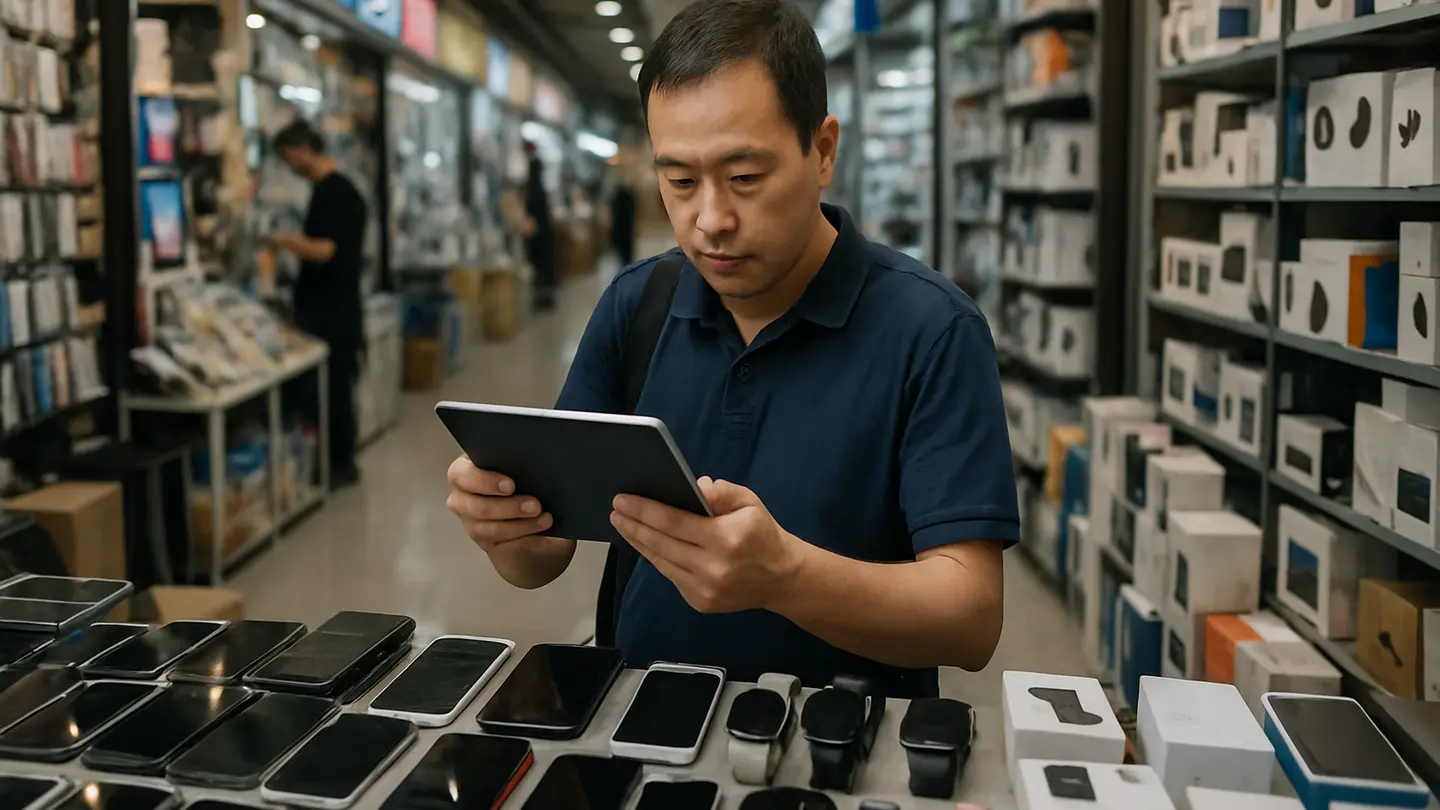
Shenzhen is one of the world’s most concentrated electronics sourcing destinations. Its wholesale markets offer components, cable assemblies, repair parts, mobile accessories, development boards, used devices, and finished consumer products—often within a short walk.
That breadth also creates risk. Similar-looking products can use different chips, displays, battery cells, firmware, materials, or compliance documentation. A stall may represent a manufacturer, distributor, trader, or reseller. The lowest price may reflect old inventory, a different specification, or goods that cannot be legally imported into the target market.
For B2B buyers, the productive approach is to select the right market buildings, arrive with a clear specification, compare equivalent offers, and verify products and suppliers before placing a meaningful order.
Why Shenzhen Electronics Markets Are Not All the Same
“Huaqiangbei” is often used as shorthand for Shenzhen’s electronics markets, but it is a district rather than one marketplace. It contains many commercial buildings with different product mixes, supplier types, price points, and quality levels.
One building may specialize in ICs, connectors, LEDs, and components; another may focus on phones, repair parts, or accessories. Some stalls represent established distributors with traceable stock, while others are traders sourcing from multiple factories.
Before visiting, review building directories, map likely suppliers, and prioritize specialist markets when the category is defined. In-person visits are especially useful when refining a product brief because side-by-side comparison reveals differences in enclosure quality, connector fit, labels, packaging, screen brightness, charging, and accessory completeness.
Ask suppliers directly:
- Are you the manufacturer, factory sales office, authorized distributor, or trader?
- Do you hold stock locally or source after an order?
- Can you support custom packaging, firmware, branding, or modifications?
- Who handles quality control and export documentation?
- Can you provide business registration and factory details?
A trader is not automatically unsuitable. Traders can help with mixed-SKU buying, small orders, samples, and consolidation. The important point is understanding the seller’s supply-chain role and price structure.
Which Shenzhen Electronics Market Fits Your Product Category?
The most efficient Shenzhen wholesale electronics markets depend on the intended product. Market names, tenants, and floor allocations can change, so confirm current directories and supplier locations before travel.
| Market or area | Typical sourcing focus | Best suited to | Key consideration |
|---|---|---|---|
| Huaqiang Electronics World | Components, modules, connectors, cable assemblies, LEDs | Buyers sourcing parts or building electronic assemblies | Verify part authenticity, date codes, packaging, and traceability |
| SEG Plaza | Computer parts, development boards, testing tools, prototype-related products | Engineers, prototype buyers, and computer hardware purchasers | Compare technical specifications rather than appearance alone |
| Yuanwang Digital Mall | Phones, tablets, digital devices, repair-related inventory | Buyers of finished mobile and digital products | Check IMEI/serial status, software configuration, and brand/IP rights |
| Longsheng Accessories City | Mobile accessories, wearables, packaging, low-cost electronics | Retailers and importers buying broad accessory assortments | Product quality can vary widely across similar designs |
| Feiyang Times | Used and refurbished devices | Buyers experienced in secondary-device sourcing | Define grading, battery condition, lock status, and return terms |
| Bao’an Electron Digital City | Finished electronic goods and consumer devices | Buyers seeking finished products beyond central Huaqiangbei | Allow additional travel time and verify supplier capabilities |
Huaqiang Electronics World is a logical starting point for components and supporting hardware, including modules, switches, cables, sensors, displays, and power supplies. For components, availability is not enough: confirm whether parts are new, authentic, correctly stored, and traceable.
SEG Plaza is often relevant for computer hardware, maker products, development boards, prototype tools, and test equipment. Verify processor versions, memory configurations, firmware, operating-system support, and included accessories.
Yuanwang Digital Mall is associated with phones, tablets, repair inventory, and finished digital products. Branded goods require extra caution: verify supply authorization, origin, activation status, intellectual-property exposure, and import rules.
Longsheng Accessories City can be useful for cases, charging products, cables, screen protectors, earbuds, wearables, and retail packaging. Clear specifications matter because a cable may use thinner conductors or a power bank may use different cell grades than claimed.
Feiyang Times is relevant for used and refurbished devices. Define condition grades in writing and inspect battery health, screens, housing, account locks, network compatibility, and serial-number status.
Bao’an Electron Digital City may broaden options for finished-goods buyers willing to source beyond central Huaqiangbei. Plan around a focused supplier list rather than treating it as general browsing.
Arrive With a Product Specification, Not Just a Product Idea
A vague request such as “I need a good Bluetooth speaker” produces vague quotations. A written specification lets suppliers quote against the same requirement and makes comparisons meaningful.
For each product, prepare a one-page brief covering:
- Product name, use case, and target customer
- Reference photos or physical samples
- Critical dimensions, materials, colors, and finishes
- Required functions and technical parameters
- Battery, charging, chips, connectors, screen, memory, or wireless requirements
- Packaging, labeling, manuals, inserts, and barcode requirements
- Branding, logo, firmware, or private-label requirements
- Target markets, certifications, estimated volume, and delivery date
Use one test checklist across all supplier visits. For USB-C chargers, for example, record output profiles, plug material, cable gauge, temperature under load, package contents, markings, and prices at several quantities. This prevents comparison of a fully specified product with a lower-grade alternative.
Request quotations at multiple quantity tiers, such as sample price, 100, 500, 1,000, and 5,000 units where relevant. Ask whether each price is based on stock, standard production, or customized production. Stock may be immediate but unsuitable for custom packaging or stable long-term supply; production may involve minimums, deposits, and lead times.
Test Electronics Before You Leave the Market
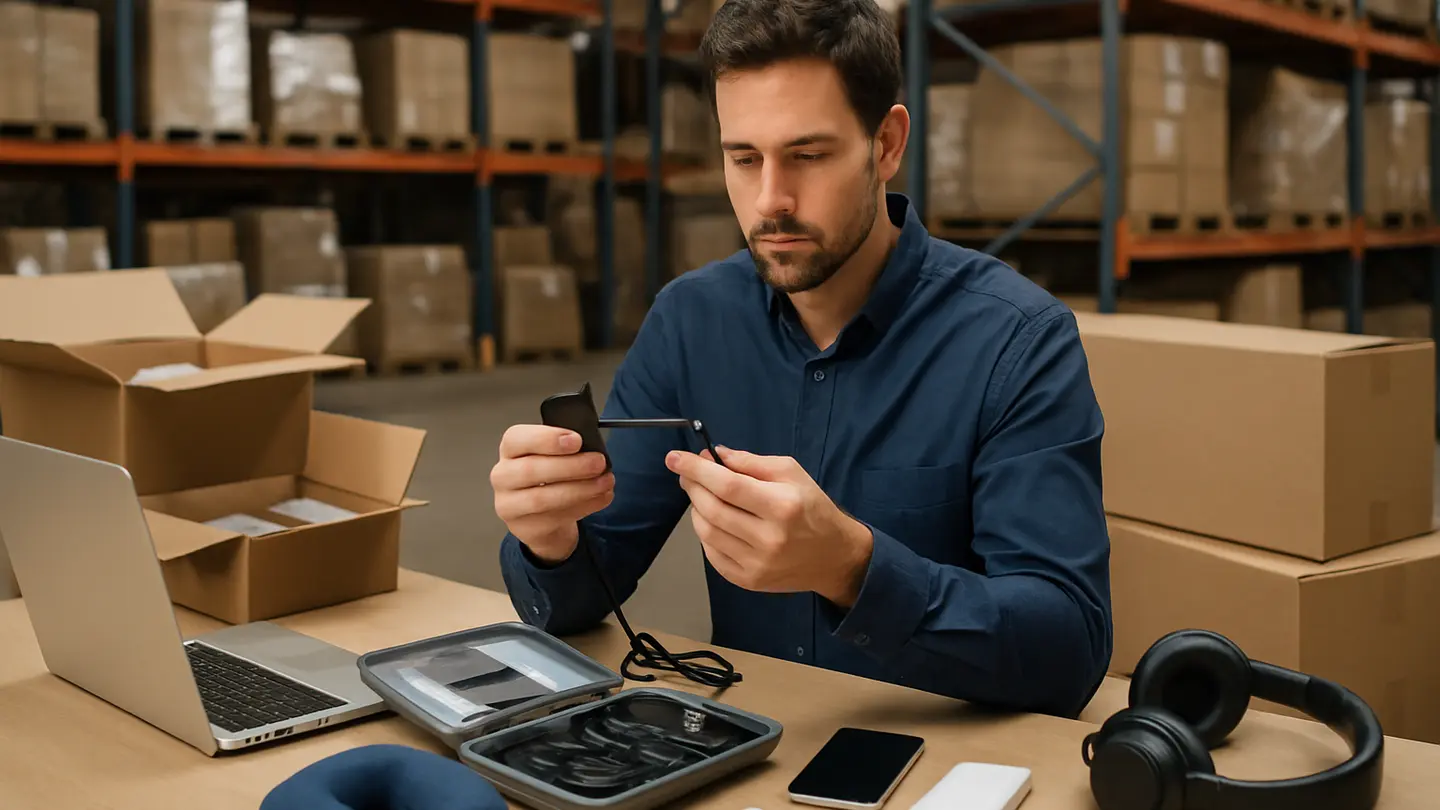
Visual inspection is necessary but insufficient. Similar-looking products can contain different cells, chips, screens, memory, drivers, antennas, and circuit-board layouts.
Test functions that matter for the intended application:
- Power-on behavior and restart stability
- Charging speed and heat generation
- Battery runtime and charging performance
- Port fit and data transfer
- Wireless pairing, range, and connection stability
- Screen brightness, touch response, dead pixels, and viewing angle
- Audio, microphone, camera, storage, or processor performance
- Serial numbers, IMEI status, firmware version, accessories, labels, and packaging
For technical products, bring known-good cables, adapters, a power meter, and a laptop or phone with relevant apps. If a supplier cannot support practical testing, apply additional caution.
Also verify the seller’s role. A manufacturer should be able to explain production capability, quality-control points, material sourcing, lead times, and customization limits. A distributor should show traceability; a trader should clearly identify product origin and supply consistency.
For repeat orders, request:
- Business license and registered company name
- Factory address or production evidence where factory status is claimed
- Model-specific test reports and certificates
- Sample approval and production inspection standards
- Warranty, defect allowance, and replacement arrangements
A certificate is not sufficient unless it applies to the exact model, configuration, and destination market.
How Pricing and Negotiation Differ by Electronics Product Type
Negotiation in Shenzhen is product-specific. Generic accessories such as cases, simple cables, packaging, and unbranded products often offer more room for price movement than branded devices, scarce components, or specialized modules.
For accessories, price can depend on materials, packaging, color mix, logo treatment, order volume, and ready stock. Combining related product lines with one supplier may improve terms and reduce consolidation complexity.
For branded products and standardized components, margins may be narrower. Price can be affected by availability, date code, currency exposure, packaging format, payment terms, and delivery timing. A lower quote may indicate excess stock, nonstandard packaging, or an alternative-grade component.
Market pricing may include trader margins and inventory costs. That can be worthwhile for small orders, urgent replenishment, or mixed buying. Once volumes are stable and specifications finalized, direct factory sourcing may improve control over product changes, packaging, quality standards, and scheduling, though it can involve higher minimums.
Negotiate commercial terms, not only unit price:
- Quantity breaks and sample-cost treatment
- Deposit and balance-payment terms
- Production lead time and packaging inclusions
- Defect rate, replacement policy, and inspection rights
- Spare parts, shipping handover point, and repeat-order price validity
A substantially lower quote needs a clear explanation. The specification—not the headline price—determines whether an offer is competitive.
Confirm Compliance Before You Commit to a Purchase
Compliance depends on the product and destination market. A product acceptable for domestic sale in China may not be eligible for import or retail sale elsewhere.
For applicable wireless and electronic products entering the United States, FCC authorization requirements may apply. Products for the European Economic Area may require CE documentation and compliance with relevant directives, while RoHS restrictions can apply to electrical and electronic equipment. Other markets may impose safety, radio, labeling, energy-efficiency, recycling, or registration rules.
Lithium-battery products require separate attention. Transport rules can differ for batteries contained in equipment, packed with equipment, or shipped alone, and may affect packaging, labeling, documentation, testing evidence, and carrier acceptance.
Before committing, confirm:
- Which regulations apply to the exact product and destination.
- Whether supplier documentation is current and model-specific.
- Whether the tested sample matches the production model.
- Whether labels, manuals, plug types, and warnings meet local requirements.
- Whether shipping documents match the actual goods and battery configuration.
Do not rely on statements such as “CE available” or “FCC certified.” Review the documentation, check the model number, and compare report details with the final configuration. Where risk is material, consult a qualified compliance professional or testing laboratory before shipment.
Can You Source Shenzhen Electronics Without Visiting in Person?
Yes, particularly for established products, repeat orders, or suppliers that have already passed verification. Remote sourcing works best when specifications are stable and approval procedures are clear.
A remote workflow may include sample collection, video calls, supplier-document review, third-party inspection, photo and video reporting, shipment consolidation, and export coordination. It can be effective when buying from several suppliers and using a local agent, inspection company, or freight forwarder to confirm goods before export.
However, an in-person visit remains valuable for new-product discovery and side-by-side supplier comparison. It is easier to assess construction, substitution risk, and a seller’s operating model in person than through catalog images.
Whether sourcing remotely or in person, the controls are the same: verify suppliers, approve samples, document specifications, use controlled payment terms, arrange inspection, and plan shipping before release.
FAQ
Q1: How many days does a first trip need?
A focused first visit for one product category can often be completed in two to three working days. This allows time to identify relevant buildings, meet suppliers, collect samples, and revisit shortlisted sellers after comparing quotations.
Allow more time for multiple categories, factory visits, customization, or meetings with freight forwarders and inspection providers.
Q2: How do people pay on the floor?
Mobile payment apps are widely used by market sellers. Cash may be accepted for small purchases, while larger production orders are commonly handled by bank transfer.
International buyers should confirm the receiving entity before paying. Verify the company name, bank details, invoice, product description, and agreed terms. Avoid significant payments to unrelated personal accounts unless independently verified and acceptable under internal controls.
Q3: Can I buy a single unit to evaluate?
Many sellers can provide one unit or a small quantity for evaluation. Sample pricing is often higher than bulk pricing because the seller must break packaging or fulfill a low-volume order.
Test the sample against the written specification, inspect packaging, verify identifiers, and retain it as an approved reference sample if production proceeds.
Q4: Do component stalls sell loose pieces or only full reels?
Many component sellers offer loose pieces as well as reels, trays, tubes, or other standard packaging. Loose quantities suit prototypes and repairs, but per-unit cost is usually higher and traceability may be weaker.
When comparing quotations, use the same packaging unit and quantity basis. Check reels for manufacturer labels, part numbers, date codes, sealing condition, and stated quantity.
Final Checklist for Sourcing in Shenzhen Electronics Markets
Preparation is the strongest protection against costly sourcing mistakes in Shenzhen wholesale electronics markets. Before placing an order, ensure the decision is based on the actual product and supplier—not a photo, low opening price, or informal promise.
Use this final checklist:
- Select market buildings according to product category.
- Bring a written, measurable product specification.
- Request comparable quotations at several quantity levels.
- Test samples using the same checklist across suppliers.
- Confirm whether each seller is a manufacturer, distributor, or trader.
- Review business information and production evidence where relevant.
- Verify model-specific compliance documents for the destination market.
- Check lithium-battery transport requirements before shipment.
- Approve packaging, labeling, accessories, and manuals.
- Agree payment, inspection, defect, and delivery terms in writing.
- Arrange consolidation and shipping only after goods are verified.
A successful buying trip is measured by validated samples, comparable supplier data, clear compliance information, and a sourcing path that can be repeated reliably.
About the Author
The author is a B2B sourcing and supply-chain researcher covering procurement practices, supplier verification, import documentation, and international trade risks. Their work focuses on practical decision-making for buyers managing product quality, compliance, and logistics across cross-border supply chains.