For residential developments, hospitality properties, wellness facilities, and retail buyers, shower-water quality has become a practical product-selection issue rather than a niche concern. Municipal water is generally treated for safety, but it can still contain chlorine or chloramines, trace metals, fine sediment, volatile organic compounds, and particles released from aging plumbing. In private wells or older buildings, the mixture can be even more variable.
The main appeal of a shower filter is not that it turns shower water into drinking-quality water. It is that it treats water at the point of use, just before it contacts the skin, scalp, hair, and respiratory zone. For users who complain about chlorine odor, dry-feeling skin, dull-looking hair, or visible particles in the shower stream, the shower head filter benefits can be noticeable when the product is matched to the actual water problem.
Buyers should also be cautious. A filter marketed as “15-stage” or “20-stage” is not automatically better than a simpler cartridge. Filtration performance depends on media type, media quantity, contact time, flow rate, cartridge design, and credible testing. In most cases, proven media and substantiated claims matter more than inflated stage counts.
What a Shower Head Filter Is and Where It Fits
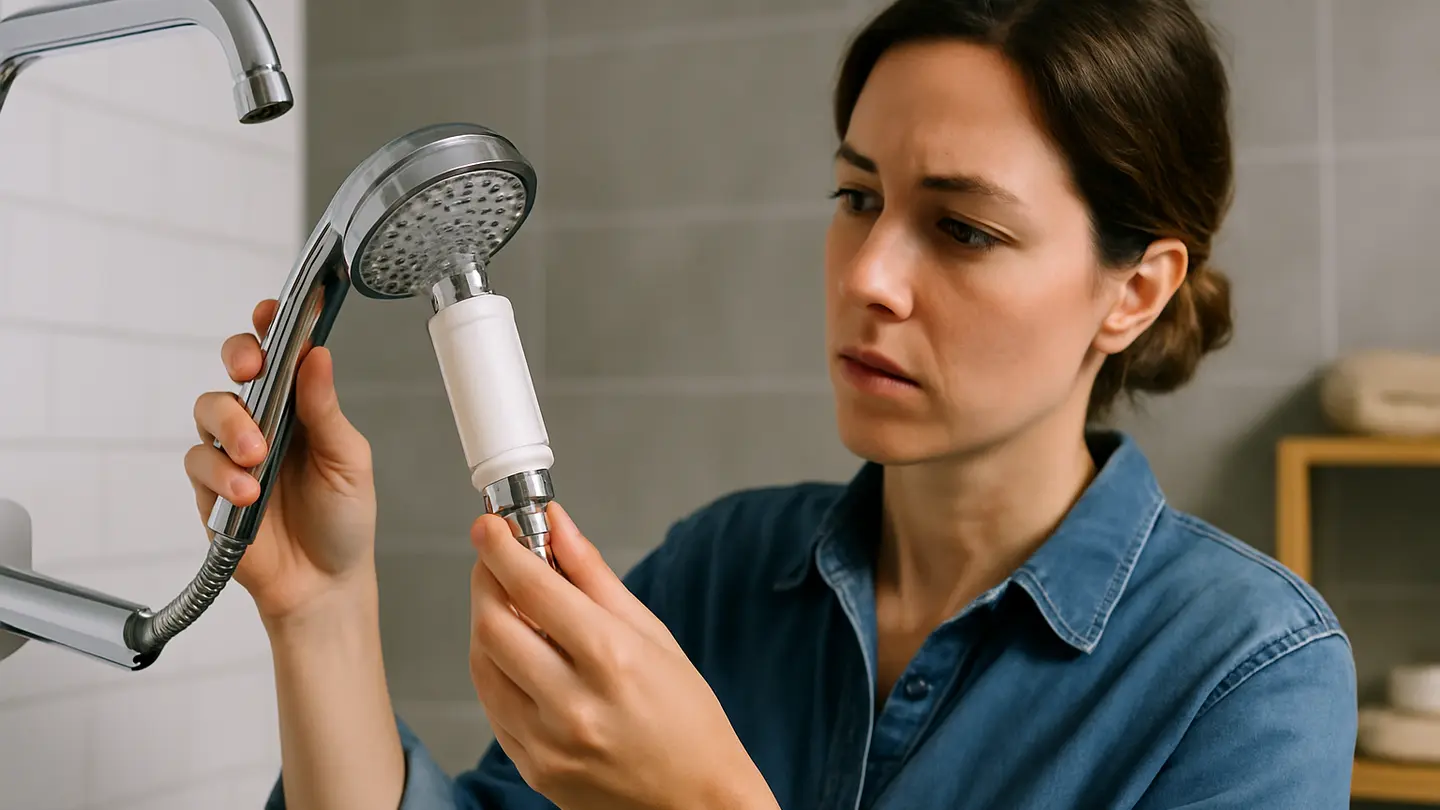
A shower head filter is a point-of-use water-treatment device installed at the shower outlet. It may be a compact inline cartridge attached between the shower arm and the showerhead, or it may be integrated into the showerhead body itself. Some handheld shower systems also include replaceable filter cartridges in the handle or hose connection.
Its role is narrow but useful: it treats water immediately before the user is exposed to it. Unlike a whole-house system, it does not protect plumbing, water heaters, laundry appliances, or taps elsewhere in the building. Unlike a drinking-water filter, it is not primarily designed for ingestion standards. It is intended to improve the water used for bathing.
Common target issues include:
- Chlorine used as a municipal disinfectant
- Chloramines in water systems that use combined chlorine
- Fine sediment from pipes, tanks, or plumbing work
- Certain metals that may be present in trace amounts
- Some volatile organic compounds, depending on media
- Odor, discoloration, or residue that affects user perception
Sediment is worth noting for B2B buyers managing hotels, apartments, gyms, or older buildings. Even when the municipal supply is acceptable, internal plumbing can contribute fine particles. A shower filter with appropriate mechanical filtration can help reduce visible or fine debris at the fixture, although severe sediment problems should be addressed upstream.
Key Benefits Users May Notice from a Shower Filter
The most commonly reported benefit is a reduction in chlorine odor and the “stripped” feeling some users associate with heavily treated water. Chlorine is an effective disinfectant, but in the shower it can interact with skin oils and hair. Reducing chlorine at the outlet may help users feel that their skin retains moisture better after bathing.
Hair-related benefits are also a major purchasing driver. Filtered shower water may help reduce the dry, brittle, frizzy, or rough feeling that some users experience after repeated washing in chlorinated water. For salons, spas, serviced apartments, and premium hospitality projects, this can support a better user experience even when the underlying water supply meets normal municipal standards.
Another potential benefit is reduced exposure to chlorine vapor in the shower environment. Warm water and spray can release disinfectant odor into the air. People with respiratory sensitivities may find lower chlorine odor more comfortable, although a shower filter should not be presented as a medical device or treatment for respiratory conditions.
For users with sensitive skin, reducing certain irritants may also help reduce discomfort associated with dryness, itching, or rash triggers. The effect varies by person and by water chemistry. A filter cannot diagnose or cure skin conditions, but it can reduce some exposure factors that contribute to user complaints.
Shower filters may also reduce some residue or discoloration associated with sediment or oxidized metals. However, this is different from softening water. Most shower filters do not remove dissolved calcium and magnesium, which are the main causes of hard water. They may improve the feel or smell of water without solving scale formation.
Common Shower Filter Media and What Each One Does
The media inside the cartridge largely determines what a shower filter can and cannot do. A multi-layer cartridge may use several materials, but more layers do not automatically mean better performance. A small amount of weakly relevant media is less useful than enough of the right media with proper water contact time.
For B2B purchasing, the key question is not “How many stages does it have?” but “Which contaminants are being targeted, by which media, and with what evidence?”
Activated Carbon
Activated carbon is a porous filtration material that captures certain contaminants through adsorption. Its internal surface area allows organic compounds and some disinfectants to attach to the carbon surface as water passes through.
Common source materials include coconut shell, coal, and wood. Coconut-shell carbon is widely used because of its hardness and high surface area, but performance still depends on grade, particle size, cartridge design, and contact time.
In shower filters, activated carbon is commonly used to reduce chlorine and some volatile organic compounds. It can improve odor and water feel when chlorine is the main concern. However, carbon is not a practical solution for removing hardness minerals such as dissolved calcium and magnesium. Buyers should not interpret carbon filtration as water softening.
KDF Copper-Zinc Media
KDF is a granular copper-zinc alloy used in water-filtration cartridges. It works through oxidation-reduction, or redox, reactions that convert certain contaminants into less problematic forms or help remove them from the water stream.
In shower applications, KDF media is often used to target chlorine and some metals. It is also valued because it can perform in warm or hot water conditions where some media may be less effective. KDF is frequently paired with activated carbon or other media to broaden filtration performance.
Its limitation is hard water. KDF does not meaningfully remove dissolved calcium and magnesium, so it should not be sold as a true softener. It may improve water quality in specific ways, but scale control requires a different approach.
Vitamin C Media
Vitamin C filtration uses ascorbic acid chemistry. Ascorbic acid reacts with chlorine and chloramines, neutralizing disinfectants that contribute to odor and the harsh feel some users notice in shower water.
This media type is mainly relevant when disinfectant reduction is the primary goal. It is commonly found in compact shower filters, spa-style showerheads, and products aimed at users sensitive to chlorine odor.
Vitamin C media is not designed to remove hardness minerals, heavy metals, or sediment. For buyers, it is best considered a targeted disinfectant-reduction option rather than a broad filtration solution.
Calcium Sulphite
Calcium sulphite is another media used to reduce chlorine in shower water. It reacts with chlorine and converts it into less problematic compounds, helping reduce odor and potential irritation associated with disinfectant exposure.
One reason calcium sulphite appears in shower-filter designs is that it can function in both hot and cold water. That makes it relevant for shower conditions, where elevated temperature and high flow rates can challenge some media.
Its scope is still limited. Calcium sulphite does not remove hardness minerals or heavy metals. If a supplier presents it as a complete solution for hard water, scale, and metals, buyers should ask for test data and clarify the mechanism.
Antibacterial Filter Balls
Antibacterial filter media is designed to inhibit microbial growth inside the filter cartridge itself. This is important because shower filters operate in warm, wet environments, and cartridges can remain damp between uses.
Some versions use inorganic antibacterial compounds supported on porous mineral carriers. The claimed mechanism often involves damaging bacterial cell walls or interfering with microbial activity on the media surface.
Performance varies significantly by formulation and material quality. Buyers should distinguish between media that helps control microbial growth inside the cartridge and products that claim to disinfect shower water. Those are different claims and require different evidence.
Anti-Scale Media
Anti-scale media is intended to interfere with the formation or deposition of scale crystals. Instead of removing hardness minerals from water, it may alter how minerals behave so that scale is less likely to adhere strongly to surfaces.
Some anti-scale products use slow-release granules that dose small amounts of scale-control agents into the water. Others use media designed to influence crystal structure. The practical result may be reduced scale appearance on showerheads or glass, depending on water chemistry and usage conditions.
This should not be confused with softening. Calcium and magnesium usually remain in the water. Dosage, flow rate, water temperature, and service life all depend on product design, so B2B buyers should review replacement intervals carefully.
Zeolite
Zeolite is a porous aluminosilicate mineral used in various filtration applications. Its structure allows it to capture some contaminants through ion exchange and adsorption.
Depending on the type and treatment of the zeolite, it may target ammonia and certain metals. In some cartridges, it is included as a supporting media for broader contaminant reduction.
However, zeolite is not usually the primary choice for chlorine reduction or hard-water control in shower filters. If chlorine odor is the main complaint, buyers should prioritize media such as activated carbon, KDF, calcium sulphite, or vitamin C, depending on the water chemistry and product testing.
Tourmaline
Tourmaline is a crystalline boron silicate mineral. It appears in some shower filters and mineral-ball cartridges, often accompanied by claims related to pH adjustment, ionization, negative ions, or water softening.
For professional buyers, tourmaline should be treated with caution. Evidence for meaningful shower-water benefits from tourmaline media is limited compared with established chlorine-reduction media. It may be included as a supplemental mineral material, but it should not be viewed as proven primary filtration media.
If a product relies heavily on tourmaline-related claims, request clear test results tied to specific contaminants rather than general wellness language.
Maifan Stone
Maifan stone is a mineral-rich stone used in some shower-filter products, especially those marketed around mineralization or “natural” water improvement. It may release trace minerals into water and may adsorb some contaminants under certain conditions.
Its role is usually supplementary. It is not a primary solution for chlorine reduction, heavy-metal removal, or hard-water control. In a multi-media cartridge, Maifan stone may contribute to the product story, but it should not be the basis for critical performance claims.
B2B buyers should ask whether Maifan stone is included for measurable filtration performance or mainly for mineral-content positioning.
FIR Ceramic Balls
FIR ceramic balls are mineral-based ceramic media. Manufacturers may claim far-infrared effects on water quality, water structure, or user comfort.
The evidence for changing water structure through FIR media in a way that produces practical shower-water benefits is limited. These balls may add trace minerals or serve as part of a decorative multi-media cartridge, but they are doubtful as standalone shower filters.
For procurement decisions, FIR ceramic balls should be treated as secondary media unless a supplier provides credible contaminant-reduction data.
The Hard-Water Limitation Buyers Should Understand
Hard water is mainly caused by dissolved calcium and magnesium. These minerals form scale on fixtures, glass, tiles, and heating surfaces. They can also make soap less efficient and leave a mineral feel on the skin or hair.
Most shower head filters do not truly remove hardness minerals. They may reduce chlorine, odor, sediment, or certain metals, which can change the way water feels. That improved feel is sometimes mistaken for softening, but the mineral content usually remains largely unchanged.
True softening generally requires ion exchange, where calcium and magnesium are exchanged for sodium or potassium ions. This is normally done through a dedicated water softener installed upstream. Other scale-control systems may condition minerals to reduce deposition, but they are still different from actual mineral removal.
For buildings with persistent scale problems, clogged showerheads, white deposits, or rapid fixture staining, a basic shower filter is unlikely to be enough. Buyers should consider whole-building softening, point-of-entry treatment, or dedicated anti-scale systems based on water testing and maintenance goals.
How to Choose a Shower Head Filter: A Five-Step Buying Checklist
Start with the main concern. A hotel operator dealing with chlorine odor has a different problem from an apartment manager dealing with sediment after pipe repairs. A salon concerned about hair feel may prioritize chlorine reduction and flow consistency. A facility with visible scale needs to evaluate hardness rather than assume a shower cartridge will solve it.
Use this checklist before purchase:
| Buying step | What to check | Why it matters |
|---|---|---|
| 1. Identify the problem | Chlorine odor, dry-feeling skin, hair dryness, sediment, staining, or scale | The right filter depends on the actual issue |
| 2. Match media to the target | Carbon, KDF, vitamin C, calcium sulphite, sediment screens, or anti-scale media | Media determines performance more than stage count |
| 3. Check flow and pressure | Rated flow rate, pressure range, and showerhead compatibility | Poor matching can reduce user satisfaction |
| 4. Calculate replacement cost | Cartridge life, replacement price, and ease of maintenance | Low upfront cost can become expensive over time |
| 5. Look for credible evidence | Third-party certification or test data for key claims | Substantiates chlorine-reduction or contaminant claims |
Where chlorine reduction is a key claim, third-party certifications can improve buying confidence. For shower filtration, buyers may see references to standards such as NSF/ANSI 177, which is associated with shower filtration systems and aesthetic chlorine reduction. If certification is not available, request laboratory test data, test conditions, and expected cartridge life.
Also review installation details. Inline filters are often easy to retrofit, but they add length between the shower arm and showerhead. This may affect clearance in compact shower stalls. Integrated filtered showerheads can be cleaner visually but may limit design flexibility. For hospitality and multi-unit projects, replacement access and cartridge standardization are important operational factors.
Finally, confirm whether the cartridge is replaceable or whether the entire unit must be discarded. Replaceable cartridges usually support lower long-term waste and easier maintenance planning, while sealed disposable units may simplify inventory but increase recurring cost.
Final Verdict: When a Shower Head Filter Is Worth Buying
A quality shower head filter is worth considering when the primary goal is point-of-use reduction of chlorine odor, certain irritants, fine particles, or specific contaminants supported by the filter media. Users may notice softer-feeling skin, healthier-feeling hair, less chlorine smell, and a more comfortable shower experience.
The key is realistic expectation-setting. A shower filter can improve water feel without truly softening hard water. If scale is the main problem, buyers should evaluate softening or dedicated scale-control systems rather than relying on a basic shower cartridge.
For professional purchasing, prioritize proven media, credible performance claims, suitable flow rate, reasonable cartridge life, and third-party certification where possible. The best shower filter is not the one with the longest stage-count label; it is the one that matches the actual water-quality problem and performs consistently in real shower conditions.