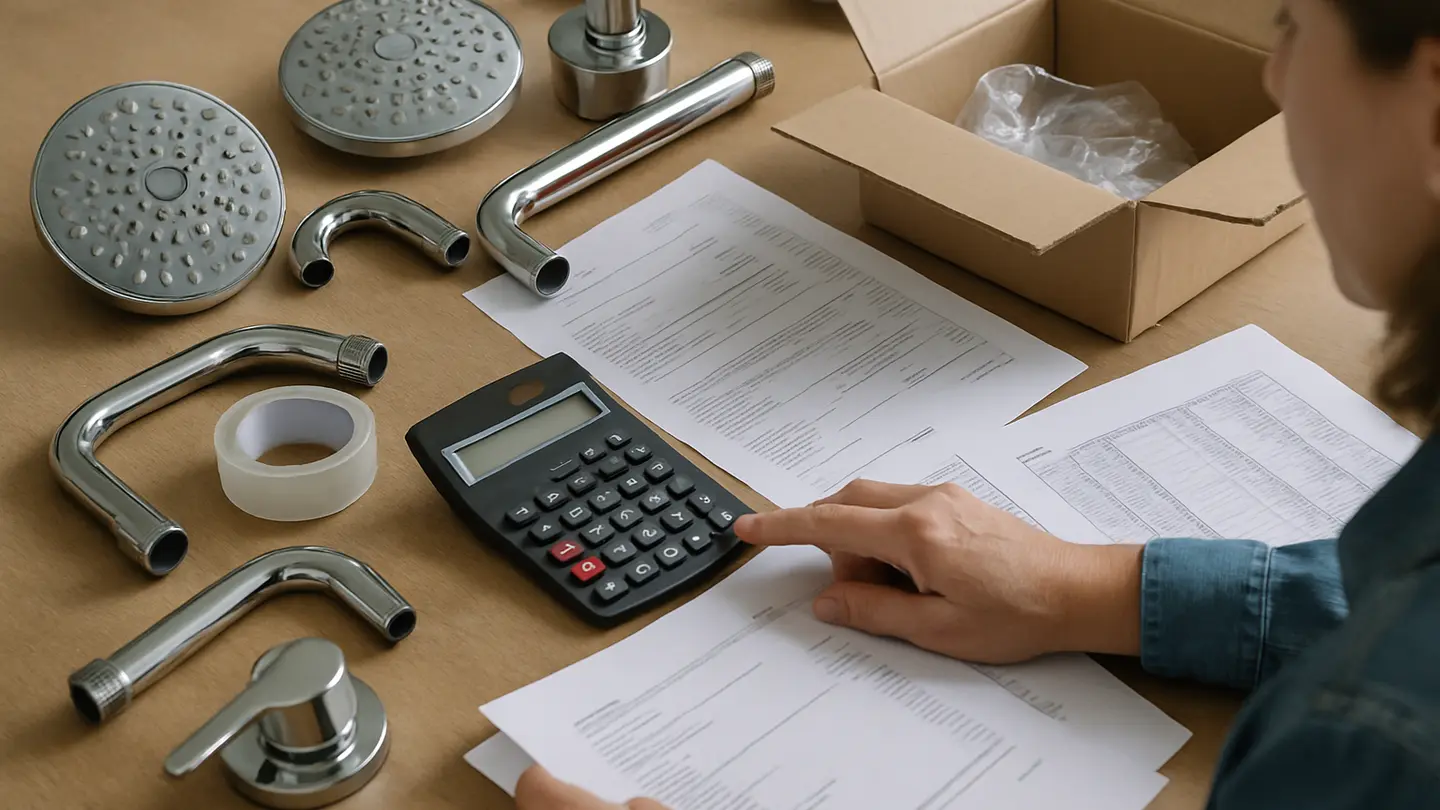
An attractive EXW or FOB quote from a shower manufacturer can look profitable until freight, destination handling, inspections, compliance files, duties, and warehouse prep are added. For shower heads, shower systems, faucets, glass enclosures, trays, hoses, valves, and hardware kits, the factory price is only one part of the commercial picture.
Effective shower manufacturer sourcing should start with total landed cost: the expected per-unit cost at the final warehouse, distributor, or fulfillment center.
Why Low Shower Factory Quotes Can Still Damage Margins
Low supplier quotes often create false savings. The problem usually appears after the buyer has accepted the quotation, paid a deposit, confirmed the finish, or locked packaging. At that point, correcting cost assumptions may mean changing the order, delaying production, or absorbing extra expense.
Shower products carry sourcing risks that make hidden costs more likely. Trays and glass enclosures are heavy and bulky, so freight can rise quickly when carton dimensions or pallet layouts are inaccurate. Glass panels need stronger packaging. Plated finishes may require approval samples and checks for color consistency, corrosion resistance, or surface defects. Shower heads, mixers, valves, and systems must meet expectations for pressure, leakage, fit, and installation.
Accessory packaging is another cost leak. Screws, washers, hoses, brackets, manuals, and labels must be complete and organized. If missing hardware creates returns or installation complaints, a cheaper factory quote can become expensive.
The goal is not simply the lowest unit price. It is the supplier and shipment plan that protect profit after all costs are included.
1. Factory Unit Price vs. True Landed Cost for Shower Products
The factory unit price is not the full import cost. It may represent the product at the supplier’s premises, at the port, or at another delivery point depending on Incoterms. A buyer comparing two shower manufacturers only by unit price may choose the quote that lands at a higher final cost.
Total landed cost includes the factory price plus all costs required to move the product into saleable inventory, such as:
- International freight
- Origin charges
- Export clearance costs
- Cargo insurance
- Import duties and taxes
- Customs broker fees
- Destination terminal handling
- Drayage or local trucking
- Inspection fees
- Lab testing or compliance checks
- Storage and warehouse handling
- Packaging upgrades
- Documentation and administration costs
Incoterms matter because they allocate responsibility. Under EXW, the buyer usually carries more responsibility for pickup, origin handling, export coordination, and onward transport. Under FOB, the seller generally handles delivery to the port and loading arrangements according to the agreed terms, while the buyer manages international freight and import clearance. DDP may include delivery to the buyer’s door with duties and import processes included, but buyers should confirm exactly what is covered.
Commonly missed costs include sample rounds, tooling changes, finish approvals, upgraded cartons, foam inserts, manuals, barcode labels, wire transfer charges, and buyer-side administration. Compare shower manufacturers by final per-unit landed cost, not by the initial supplier invoice.
2. Freight Quotes That Exclude Port, Terminal, and Storage Fees
A low ocean or air freight quote can be misleading if it excludes destination-side charges. Shower products often ship in heavy cartons or large packages, so logistics assumptions should be checked before the purchase order is issued.
A complete freight estimate may include terminal handling, ISF filing where applicable, deconsolidation for LCL cargo, customs broker fees, drayage, chassis rental, delivery appointment charges, and final warehouse delivery. If the quote only shows port-to-port ocean freight, it does not represent actual delivered cost.
Bulky shower enclosures and trays can increase dimensional weight and handling costs. Glass packaging may require stronger cartons, wood crates, pallets, or extra protective materials. These reduce damage risk but may increase CBM, pallet count, and local handling charges.
Demurrage, detention, and storage are especially important. Demurrage may arise when cargo stays at the port beyond the free-time window. Detention may apply when containers or equipment are not returned on time. Storage fees may apply to LCL cargo or warehouse-held goods.
Buyers should request line-item freight quotes. Confirm destination free days, customs-exam scenarios, and whether final delivery is included. A DDP quote can be useful as a delivered-cost ceiling for comparison, even if the buyer chooses FOB.
3. Duties, Taxes, and Marketplace Prep Costs That Change Shower Unit Profit
Import duties, tariffs, customs broker fees, VAT or sales-tax exposure, and channel prep costs can materially change shower unit profit. These expenses may not appear in the manufacturer’s quotation, but they still affect gross margin.
HS classification is a key risk area. Shower heads, mixer valves, shower columns, glass enclosures, trays, hoses, and hardware kits may not share the same classification. A complete shower system may require different analysis from a standalone replacement part. Incorrect classification can increase duty exposure, delay clearance, or require corrections.
Buyers should involve a customs broker or qualified trade professional when classification is unclear. Supplier-provided HS codes may be useful as a starting point, but they should not be accepted blindly. The importer is usually responsible for accurate customs declarations in the destination market.
Sales channels add another layer of cost. Marketplace, distributor, retail, and fulfillment-center requirements may include carton labels, pallet specifications, suffocation warnings, barcode placement, packaging durability rules, routing guides, and prep fees. A shower enclosure can pass customs but fail warehouse intake if packaging is weak or labels are wrong.
Before shipment, check compliance and packaging requirements for the intended market and channel. Model a conservative tariff and prep-cost scenario before issuing the purchase order.
4. Quality Control Costs: Pay Before Shipment or Pay Through Returns
Skipping inspection does not eliminate quality cost. It often moves that cost into returns, replacements, chargebacks, rework, negative reviews, and lost customer trust. For shower products, defects may not appear until installation or use.
A good QC plan starts before production. Buyers should define a golden sample, approved finish, packaging standard, and functional requirements. For shower heads, faucets, mixers, and systems, checks may include leak testing, pressure testing, flow performance, thread compatibility, hose fitting, surface inspection, and accessory completeness. For glass enclosures, inspection should cover glass condition, edge quality, hardware fit, hole alignment, and packaging protection. Shower trays may require checks for dimensions, surface defects, drainage fit, and structural integrity.
Packaging tests also matter. Carton drop tests, master carton strength, foam inserts, corner guards, and internal organization can reduce breakage and fulfillment problems.
Third-party inspections are commonly priced by man-day, so include them in landed cost rather than treating them as optional overhead. If one rejected container or high-return shipment would cost more than inspection and corrective action, QC is financially justified.
Set AQL limits, defect definitions, functional test requirements, and packaging standards before production starts. Once goods are packed and ready to ship, the buyer has much less leverage.
5. Agent Commissions, Supplier Markups, and Payment Friction
Sourcing agents can help with supplier screening, negotiation, sample follow-up, inspection coordination, and shipment communication. However, the fee structure must be transparent. Agents may charge a commission, flat project fee, monthly retainer, inspection coordination fee, or supplier-funded rebate.
Bundled pricing can hide the difference between the actual shower factory invoice and the buyer-facing invoice. This does not automatically mean the service is poor, but it makes landed-cost analysis harder. Buyers should request factory price disclosure where possible and separate accounting for service fees, QC coordination, logistics support, and dispute handling.
Commission calculations should be clear. Is the commission based on factory price, FOB value, total invoice value, or landed cost? A percentage applied to freight, duties, or taxes can become larger than expected.
Payment friction also matters. Wire transfer fees, currency conversion spreads, sample payments, split deposits, consolidation charges, and bank deductions can affect final cost. If the supplier receives less than expected because of intermediary bank fees, shipment release or production timing may be affected.
A transparent agent can add value, but the cost model should show exactly where the money goes.
6. Customs Holds, Missing Compliance Files, and Delay Charges
Customs delays can turn a profitable order into a costly one. Holds may be triggered by invoice errors, HS-code inconsistencies, undervaluation concerns, carton-label problems, missing certificates, or packing lists that do not match the shipment.
Extra costs may include customs exam fees, broker handling, trucking re-routing, warehouse storage, demurrage, and detention. If the buyer has launch deadlines, retail delivery windows, or contractor project schedules, the commercial damage can extend beyond direct logistics charges.
Shower products can involve compliance requirements related to water-contact materials, plumbing standards, glass safety, lead-content limits, labeling rules, and market-specific certifications. Requirements vary by country, product type, and sales channel, so buyers should confirm what applies before production and shipment.
A pre-clearance document pack should be required before goods leave the origin port. At minimum, it should include the commercial invoice, packing list, bill of lading details, HS codes, certificates, test reports where required, product photos, and carton marks. The invoice and packing list should match the actual goods, carton counts, weights, and descriptions.
Buyers can reduce risk by tying final payment or shipment release to verified paperwork and compliance readiness.
How to Build a Landed-Cost Model for Shower Manufacturer Quotes
A landed-cost spreadsheet helps buyers audit shower manufacturer quotes before production and shipment. The model should compare costs from the factory gate to the final warehouse, distributor, or fulfillment center.
The purpose is not to create a complicated accounting system. It is to expose costs missing from supplier invoices and freight summaries. When each cost is converted into a per-unit number, buyers can see whether the order still meets target margin.
Step 1: Create the Cost Fields Buyers Usually Forget
Start with the basic product and shipment fields:
| Field Type | Examples |
|---|---|
| Product details | SKU, product name, finish, specification version |
| Order details | Quantity, MOQ, unit cost, payment terms |
| Carton data | Carton quantity, carton dimensions, gross weight, net weight |
| Shipping setup | Incoterms, origin port, destination port, shipping mode |
| Logistics costs | Origin charges, freight, insurance, destination handling, drayage |
| Import costs | Duties, taxes, brokerage, customs exams if applicable |
| Channel costs | Prep fees, labeling, palletization, storage |
| Hidden costs | Samples, tooling, finish approvals, inspections, testing, wire fees |
| Risk buffer | Contingency for delays, repacking, storage, or cost variance |
Small transaction and handling costs can distort landed-cost accuracy, especially for lower-volume orders. A wire fee, sample revision, or carton upgrade may be minor on a container order but meaningful on a small trial shipment.
Step 2: Normalize Every Quote Before Comparing Factories
Before comparing shower manufacturers, collect all quote inputs: specification sheets, finish options, packaging details, lead time, MOQ, payment terms, and Incoterms. If one supplier quotes EXW and another quotes FOB, the cheaper quote may only be cheaper because it excludes more services.
Normalize every quote to the same delivery point. For example, compare all suppliers at final warehouse arrival or at the same destination port plus known local charges. This prevents an incomplete quote from appearing more competitive than a complete one.
Use official tariff resources or customs broker input to estimate duties and taxes. Add sourcing, administration, quality control, inspection, compliance, and logistics costs. Then calculate final per-unit landed cost and compare it against the target wholesale price, retail price, expected margin, and break-even volume.
This process may show that a higher factory price is safer because the supplier offers better packaging, clearer documents, more reliable quality, or lower defect risk.
Step 3: Audit the Freight, Packaging, and Compliance Assumptions
Freight and packaging assumptions should be audited before mass production. Port demurrage, storage, and detention are common unexpected shipment costs, but they are often linked to preventable planning gaps.
Require forwarder quotes to show destination deconsolidation, terminal handling, delivery, documentation, and customs-related charges. For LCL shipments, confirm how deconsolidation and warehouse fees are calculated. For FCL shipments, confirm free days, container pickup timing, chassis or equipment costs, and final delivery requirements.
Packaging must also be fixed before production. Master carton dimensions, carton weight, pallet configuration, and protective materials affect freight cost and warehouse acceptance. If a shower enclosure carton is too weak, it may create breakage. If a shower system carton does not meet fulfillment rules, it may require repacking or relabeling.
Compliance assumptions should be checked at the same time. Confirm required labels, product markings, manuals, certifications, and test reports before shipment. This quote-audit sequence acts as an early warning system for hidden sourcing costs.
Final Step: Use the Model to Protect Shower Product Margins
The landed-cost spreadsheet should track every cost from the first factory quote to final warehouse arrival. Update it when samples change, packaging is upgraded, freight quotes expire, duties are confirmed, or inspection costs are added.
Quote audits reveal cost leaks before shower orders ship. They also make supplier negotiations more practical. Instead of asking for a vague discount, buyers can negotiate specific items: carton optimization, accessory packaging, FOB inclusions, inspection cooperation, or documentation accuracy.
If sourcing numbers, logistics assumptions, or compliance documents remain unclear, pause final commitments. Do not approve molds, deposits, packaging runs, or shipment bookings until the landed-cost model supports the required margin.
FAQ
1. What is the landed cost calculation formula?
Landed cost equals the factory price plus all costs required to bring the product into saleable inventory. A practical formula is:
Landed cost = factory price + freight + insurance + customs clearance + duties + taxes + destination handling + inspection + compliance + hidden sourcing costs.
For shower products, hidden costs may include wire fees, tooling adjustments, sample rounds, finish approvals, upgraded cartons, foam inserts, installation manuals, barcode labels, and product testing.
2. Which hidden fees do beginners miss most often?
Beginners often miss destination port fees, terminal handling, customs broker charges, currency conversion markups, warehouse storage, and final delivery fees. They may also underestimate demurrage and detention, which can accumulate when containers are not collected or returned within the allowed free-time window.
On the product side, common missed costs include sample iterations, mold revisions, finish-matching changes, packaging upgrades, replacement hardware, and lab testing. Shower products with glass, plated finishes, valves, or complex installation kits usually need more careful budgeting than simple commodity items.
Marketplace, distributor, and wholesale channels may also create hidden costs through labeling, pallet, carton, and packaging requirements.
3. Does EXW vs FOB vs DDP materially change landed cost?
Yes. EXW, FOB, and DDP allocate logistics and import responsibilities differently, which can materially change per-unit landed cost.
Under EXW, the buyer usually takes responsibility from the supplier’s premises. This may include local pickup, origin handling, export coordination, international freight, import clearance, and final delivery.
Under FOB, the seller generally handles delivery to the named port and loading obligations according to the agreed terms. The buyer usually controls international freight, import clearance, destination handling, and final delivery.
Under DDP, the seller usually takes responsibility for door delivery, duties, and customs processes. However, buyers should verify exactly what is included, because exclusions or unclear terms can still create disputes.
For heavy, bulky, or fragile shower products, changing Incoterms can significantly affect freight, handling, risk, and administrative cost.
4. Are sourcing agent fees cheaper than going direct?
Sometimes, but not always. A transparent sourcing agent may reduce total cost by improving supplier screening, negotiation, sample follow-up, documentation, inspection coordination, and defect prevention. If the agent prevents one failed batch or major shipment delay, the service may be worthwhile.
Going direct can appear cheaper because there is no visible agent fee. However, buyers may still face hidden supplier markups, communication problems, quality drift, weak documentation, or logistics mistakes. The lowest direct quote is not automatically the lowest landed cost.
The best approach is to separate the agent’s service fee from the actual factory price, then evaluate the agent’s value against markup risk, quality-control support, shipment coordination, and compliance management.