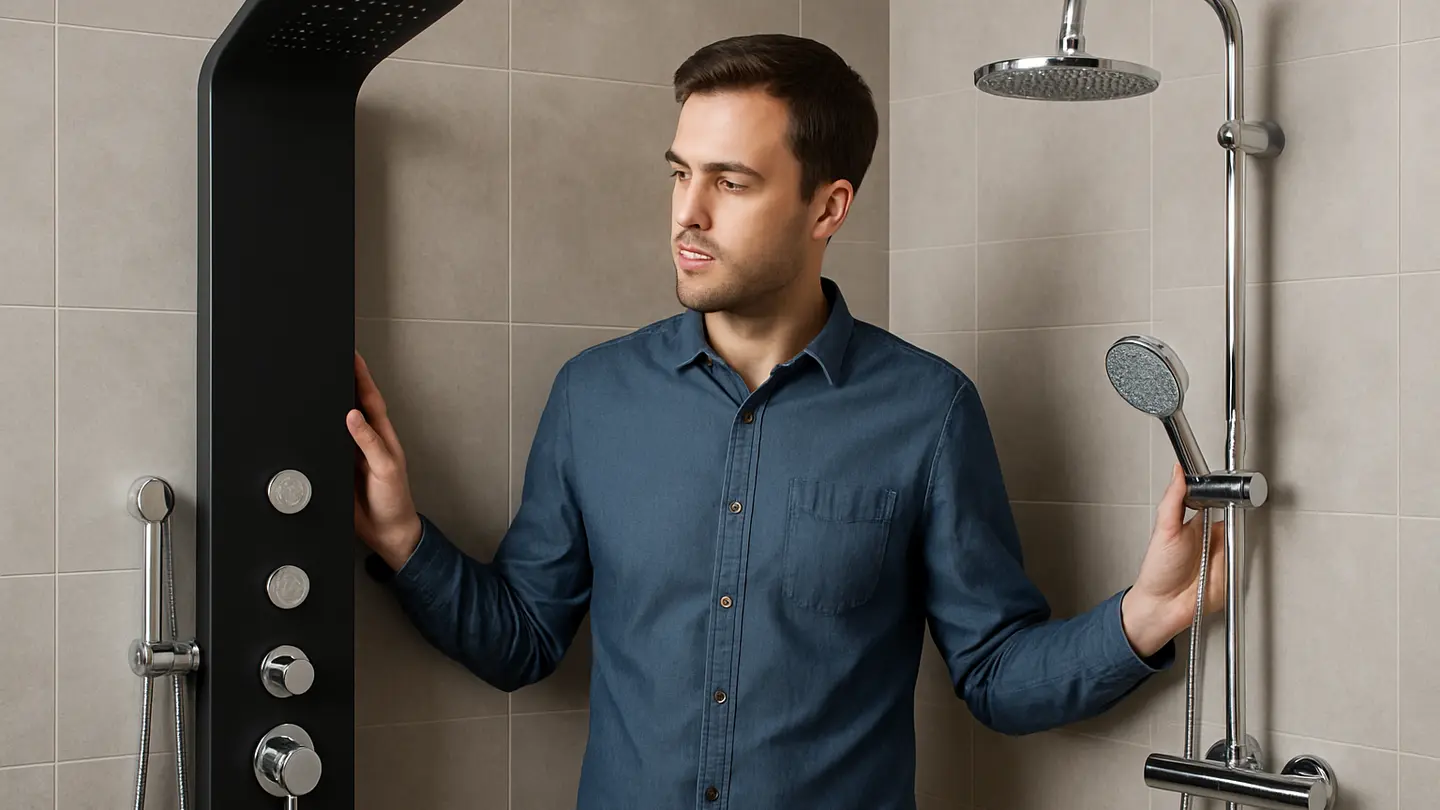
Choosing between a shower panel and a shower system is not only a style decision. It affects plumbing work, installation time, fixture placement, maintenance access, water demand, and the overall budget of a bathroom project.
A shower panel is typically an integrated vertical unit that brings several functions into one surface-mounted fixture. A shower system is usually a collection of separate components—such as showerheads, hand showers, valves, controls, and body sprays—planned around the shower layout.
For homeowners, contractors, developers, hospitality buyers, and bathroom product purchasers, the right answer depends on the renovation scope. A quick bathroom refresh may favor a panel. A full remodel or new-build bathroom may justify a more flexible system. This guide compares shower panel vs shower system options across the practical factors that matter most.
How Shower Panels and Shower Systems Work
Both shower panels and shower systems can upgrade a basic shower setup. Each can add more spray options, improve the visual finish, and create a more comfortable showering experience than a single fixed showerhead.
The difference is how the functions are delivered.
A shower panel concentrates multiple functions into one prefabricated housing. The buyer selects a finished product with built-in outlets and controls. A shower system separates those decisions. The buyer or designer chooses individual components and positions them according to the bathroom plan.
That distinction affects nearly every downstream decision: installation complexity, flexibility, cost, serviceability, and long-term suitability.
What Is a Shower Panel?
A shower panel is a single wall-mounted shower tower. It is usually installed vertically on the shower wall and connected to existing hot and cold water supplies.
Common built-in functions may include:
- An overhead shower or rainfall-style outlet
- A handheld shower with hose
- Body jets or massage sprays
- An integrated mixer or diverter control
- Sometimes a tub spout, shelf, or thermostatic control, depending on the model
The defining feature is integration. Multiple functions are housed in one vertical unit, so the buyer does not need to specify separate body sprays, diverters, brackets, and shower arms individually.
This makes shower panels attractive for projects where speed, visual impact, and simplified product selection are priorities. They are often considered for apartment upgrades, rental property improvements, compact bathrooms, and budget-conscious remodels where opening the wall is not desirable.
However, because the functions are built into the panel, the layout is largely fixed. The height and spacing of body jets, the position of the handheld bracket, and the location of the controls are determined by the product design.
What Is a Shower System?
A shower system is an assembly of separate shower fixture components. Instead of buying one integrated tower, the buyer selects and combines individual parts.
A typical shower system may include:
- A fixed showerhead or rain showerhead
- A handheld shower and slide bar or wall bracket
- Body sprays or side jets
- A thermostatic or pressure-balancing valve
- Diverter controls
- Volume controls
- Shower arms, elbows, trims, and wall outlets
- Digital controls in more advanced specifications
The main advantage is design freedom. Components can be placed around the user, the shower enclosure, and the desired aesthetic. For example, a rain head can be ceiling-mounted, body sprays can be positioned at different heights, and controls can be placed near the entrance so the user can start the water before stepping in.
This approach is more common in full bathroom renovations, new construction, luxury residential projects, hotels, and projects where concealed plumbing is already being planned.
Side-by-Side Comparison: Shower Panel vs Shower System
The table below summarizes the main decision points.
| Criteria | Shower Panel | Shower System |
|---|---|---|
| Basic structure | One integrated vertical unit | Separate components assembled into a complete layout |
| Installation style | Usually surface-mounted | Often requires concealed or semi-concealed plumbing |
| Customization | Limited to available panel models | High; components and positions can be selected individually |
| Body jet placement | Usually fixed within the panel | Can be positioned at custom heights and locations |
| Visual impact | Modern, visible tower-style feature | Can be minimalist, concealed, or highly customized |
| Space impact | Adds visible fixture depth on the wall | Concealed systems can reduce visible bulk |
| Installation disruption | Often lower, especially when using existing supply points | Higher if walls or tile must be opened |
| Budget fit | Often suitable for tighter budgets or faster upgrades | Better suited to larger budgets and full renovations |
| Maintenance access | Many components are accessible from the panel face | Concealed repairs may require more disruption |
| Best project fit | Quick updates, small bathrooms, rental units, partial remodels | New builds, major remodels, premium bathrooms, custom layouts |
For a simple replacement project, a shower panel may reduce labor and simplify purchasing. For a bathroom being rebuilt from the studs, a shower system can deliver a cleaner and more tailored result.
The important point is that neither format is automatically better. The better option is the one that matches the construction conditions and performance expectations.
Feature and Functionality Differences
Shower panels and shower systems can both offer multiple water outlets, but they do so in different ways.
A shower panel uses a prebuilt vertical housing. The overhead outlet, handheld shower, body jets, and controls are arranged by the manufacturer. This can be convenient because the buyer sees the complete configuration before purchase. It also reduces the number of separate parts that need to be coordinated.
The trade-off is limited adjustment. If the body jets are too high, too low, or too close together for a specific user profile, there may be little that can be changed. The panel must also fit the shower wall visually and physically.
A shower system is modular. The designer or installer can specify:
- A wall-mounted, ceiling-mounted, or rain-style showerhead
- One or more handheld shower positions
- Body sprays at selected heights
- Separate volume controls for different outlets
- A thermostatic valve for more stable temperature control
- A diverter to switch between outlets
- Digital controls where compatible and specified
This modularity is especially useful in commercial or premium residential projects where fixture placement must serve a defined user experience. For example, a hotel may want consistent control placement across rooms, while a high-end residential project may require a ceiling rain head, handheld shower, and body sprays arranged around a bench.
Controls are another major difference. Shower panels often include integrated controls suitable for the functions built into the unit. Shower systems can support more advanced control strategies when specified correctly. That may include thermostatic valves, separate volume controls, or digital interfaces, depending on the product line and plumbing design.
The more outlets a shower system has, the more important it becomes to plan the valve capacity, water pressure, pipe sizing, and hot water supply. A panel may appear feature-rich, but a custom system can often be engineered more precisely for performance.
Plumbing, Water Use, Space, and Maintenance Factors
Plumbing is one of the most important differences in the shower panel vs shower system decision.
A shower panel is commonly used as a surface-mounted upgrade. In many projects, it connects to existing hot and cold water lines and covers the connection area with the panel body. This can reduce demolition and tile work. It may also make the project more predictable when the goal is to refresh an existing bathroom without rebuilding the wall.
A shower system is more dependent on internal plumbing. Separate outlets need separate water paths, valves, diverters, and wall penetrations. If the system is concealed, the installer may need to open walls, cut tile, adjust pipework, and waterproof the area carefully after installation.
Water demand also deserves attention. Multi-outlet systems can require more flow than a simple single-head shower, especially when large rain heads or multiple body sprays are used. The project team should evaluate:
- Available water pressure
- Pipe size and plumbing layout
- Valve flow capacity
- Whether multiple outlets will operate at the same time
- Water heater capacity
- Local code and water-efficiency requirements
A large rain head combined with body sprays can place significant demand on the hot water system. If the water heater cannot keep up, the finished shower may disappoint even if the fixtures look premium. This is especially important for hotels, multi-family projects, and larger homes with simultaneous water use.
Space is another consideration. A panel adds a visible vertical fixture to the shower wall. In a small enclosure, the added depth may be noticeable, though the all-in-one format can still be practical because it avoids multiple visible fittings. A concealed shower system can look cleaner and may reduce visible bulk, but it requires more planning behind the wall.
Maintenance differs as well. Both panels and systems need regular cleaning and descaling, especially in hard-water areas. Spray nozzles, handheld showers, and body jets can accumulate mineral deposits over time.
Repair access can favor panels in some cases because many working parts are located within or behind the panel housing. Removing or servicing the panel may be easier than opening a tiled wall. However, this depends on the product design and availability of replacement parts.
For concealed shower systems, repairs can be more disruptive if a valve, pipe connection, or in-wall component fails. High-quality installation, accessible shutoffs where possible, and compatible service parts are important for reducing long-term risk.
Pros, Cons, and How to Choose the Right Option
A shower panel is often the practical choice when the buyer wants a faster upgrade with less disruption. It can deliver an immediate visual change and multiple shower functions without requiring a fully redesigned plumbing layout.
Key advantages of shower panels include:
- Easier product selection because functions are bundled
- Often faster installation than a multi-component system
- Less wall disruption in many retrofit projects
- Modern appearance at a relatively accessible price point
- Good suitability for small bathrooms, rental units, and partial renovations
Key limitations of shower panels include:
- Less freedom to choose individual components
- Fixed body jet placement
- Limited ability to tailor the layout to different users
- Visible wall-mounted tower may not suit every design
- Replacement may require matching the panel footprint or connection points
A shower system is usually the better fit when the bathroom layout is being redesigned and the project budget allows for professional plumbing work. It gives the buyer more control over the final experience and visual result.
Key advantages of shower systems include:
- Bespoke fixture layout
- Wide choice of showerheads, handhelds, body sprays, and controls
- Ability to conceal plumbing and reduce visible clutter
- Better fit for premium design schemes
- More control over temperature, volume, and outlet selection when properly specified
Key limitations of shower systems include:
- Higher upfront component cost
- More complex installation
- Greater need for skilled plumbing and waterproofing work
- More planning required before tile and wall finishes are completed
- Concealed repairs can be more disruptive
For a compact bathroom where the wall is already finished and the budget is controlled, a shower panel may be the most efficient upgrade. For a new bathroom, luxury remodel, or hospitality project where layout and finish quality are central, a shower system may provide stronger long-term value.
A useful decision framework is to ask four questions:
- Is the wall already finished? If yes, a panel may avoid demolition. If no, a system may be easier to plan.
- How much layout control is required? If fixed jet positions are acceptable, a panel may work. If fixture placement matters, consider a system.
- What is the water supply capacity? Multi-outlet systems should be checked carefully for flow and hot water demand.
- What level of maintenance access is preferred? Panels may be easier to access, while concealed systems require better planning and installation quality.
The best choice is not the one with the longest feature list. It is the one that fits the bathroom size, renovation scope, user expectations, and service requirements.
Another Way to Build a China Supplier Shortlist
For B2B buyers comparing shower panels, shower systems, or related bathroom fixtures from China, supplier screening is as important as product selection. Made-in-China.com is a B2B sourcing platform that can help buyers build an initial shortlist rather than contacting suppliers one by one without structure.
Supplier Discovery can be used to find and narrow potential suppliers, including channels for Audited Suppliers. For early-stage evaluation, Audited Supplier information and Audit Reports can support a more organized review process. According to the platform’s official information, Audited Suppliers are subject to third-party verification and on-site audit, and Audit Reports may include structured details such as general information, export trade, manufacturing capacity, quality control, and R&D capability.
Buyers who want to compare responses more efficiently can also use Easy Sourcing. This option allows a buyer to submit one sourcing request, receive multiple quotations from matched suppliers, compare quotes, and request samples. It does not replace technical due diligence, sample testing, or contract review, but it can make the first sourcing round more manageable.
FAQ
What are the main differences between them?
A shower panel is an integrated vertical unit with multiple functions built into one wall-mounted product. A shower system is assembled from separate components such as showerheads, handheld showers, body sprays, valves, and controls. Shower systems generally provide more control over fixture selection and placement.
How does installation compare?
Shower panels usually mount to the wall with basic hardware and connect to existing water supplies, depending on the bathroom conditions. Shower systems often require more complex plumbing work. Concealed systems may involve cutting tile, opening walls, installing valves, and routing pipes to separate outlets.
Can I customize a shower panel?
Customization is usually limited. The features, control layout, and jet positions are generally fixed by the panel design. If the project requires personalized fixture selection, custom body spray height, ceiling-mounted outlets, or separate controls, a shower system is usually the better option.
Which is more cost-effective?
Shower panels usually cost less upfront and are often cheaper to install, especially in retrofit projects. Shower systems typically require higher spending on separate components and professional labor. The more cost-effective choice depends on the project scope: panels often suit quick upgrades, while systems may justify their cost in full renovations or premium bathrooms.