Why first Amazon sourcing orders usually break down in the process
First import orders for Amazon sellers rarely fail for one isolated reason. The product idea may be reasonable, the market research acceptable, and the supplier technically capable. The breakdown usually happens between those points: vague specifications, unverified supplier claims, weak sample control, missing compliance documents, poor packaging, late freight planning, or no clear owner for production follow-up.
Sourcing from China for Amazon should therefore be managed as a sequence, not as a single purchase order. A low factory quote is only the starting point. The product must still survive Amazon fees, arrive in sellable condition, meet category requirements, be accepted by FBA, and leave enough margin after advertising, returns, and reorders.
This guide focuses on the checks that matter before the buyer loses leverage. What seems optional before deposit often becomes expensive after balance payment, shipment, or warehouse rejection.
Step 1: Choose a product that can still profit after Amazon costs
The factory unit price is only one part of the commercial calculation. A product that looks profitable at quotation stage may become weak once landed and selling costs are included.
Before approving a first order, calculate margin after:
- Amazon referral fees;
- FBA fulfillment or third-party fulfillment costs;
- estimated launch advertising;
- import duty and customs-related charges;
- international freight;
- inspection, labeling, bundling, or prep costs;
- storage fees;
- expected returns and replacements;
- product photography, listing content, and launch support.
Size and weight deserve special attention. A slightly higher factory price may be acceptable if the product packs smaller, ships efficiently, and stays in a lower FBA fulfillment tier. A bulky low-cost item can lose margin through freight, storage, oversized cartons, and slow sell-through.
Stress-test the numbers before committing. Model a lower launch price, higher ad spend, delayed sell-through, and returns above target. If the product only works under perfect conditions, it may not be suitable for a first sourcing order.
Step 2: Identify the supplier behind the quotation
A supplier name on a quotation does not always show who controls production. The seller may be a factory, trading company, sales office, or intermediary that passes the order to another workshop after receiving the deposit.
Not every trader should be avoided. A capable trading company can consolidate products, communicate clearly, and handle smaller orders that factories may not want. The risk is hidden dependency. If defects, delays, material changes, or packaging problems appear, the buyer needs to know who has authority to fix them.
Basic verification should include:
- business license details;
- registered and operating addresses;
- export experience;
- product category experience;
- ownership of the bank account receiving payment;
- consistency between the contracting party, invoice, and payment beneficiary;
- references, prior export documents, or production evidence where appropriate.
Send every supplier the same written specification: dimensions, materials, finish, tolerances, accessories, packaging, labels, carton requirements, barcode placement, and compliance expectations. If each quote reflects a different interpretation, the cheapest price may simply exclude important requirements.
Step 3: Approve a physical sample instead of relying on photos
Photos and videos help with screening, but they cannot fully prove a product. They may hide color variation, weak finish, sharp edges, odor, poor hand feel, unstable assembly, thin materials, or awkward use. These details often decide whether customers leave positive reviews or return the item.
A physical sample should become the production benchmark. Once approved, document what has been accepted, including:
- dimensions and tolerances;
- material grade or composition;
- color reference;
- surface finish;
- weight range;
- assembly method;
- accessories and spare parts;
- packaging structure;
- inserts and instructions;
- warning labels;
- barcode and FNSKU requirements;
- carton markings.
Keep one sealed reference sample for inspection comparison. If the factory keeps another approved sample, both sides have a practical reference during production.
Do not approve a “close enough” sample and assume mass production will improve. If the sample has defects, confirm whether they are sample-only issues or normal production standards. Corrections should be written into the purchase order before production begins.
Step 4: Confirm compliance before the factory receives full leverage
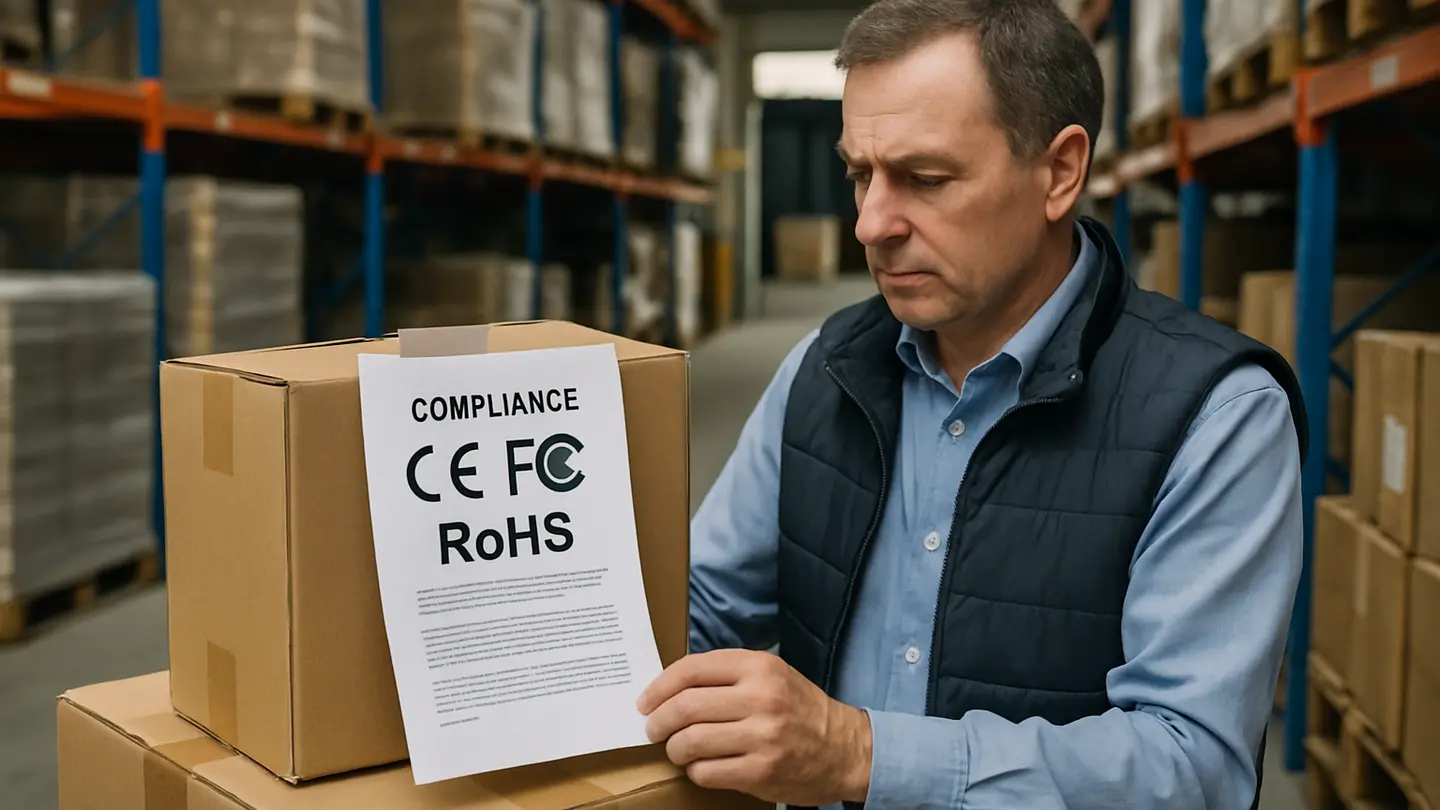
Amazon compliance is product-specific. A certificate, test report, or declaration is useful only if it matches the exact product being listed and imported. Documents for a similar model, older design, different material, or another brand may not solve the buyer’s problem.
Before deposit where possible, and certainly before balance payment or shipment, check that the product, packaging, labels, and documents align. Important details include:
- model number;
- brand name;
- manufacturer or importer details;
- age grading where relevant;
- warnings and usage instructions;
- packaging claims;
- listing claims;
- applicable test reports;
- battery, electrical, chemical, food-contact, textile, or cosmetic requirements where relevant.
The risk is not limited to regulators. Amazon may request documentation, suppress a listing, reject inventory, or require proof that the item meets category rules. A supplier may say “we have certificates,” but the buyer must confirm what those certificates cover.
Timing matters. Before deposit, the buyer can still choose another supplier or change the product. Before balance payment, the buyer can still request corrections. After shipment, options may involve storage charges, relabeling, disposal, return freight, or unsellable inventory.
Step 5: Understand what the Amazon category changes
Category selection affects more than search placement. It changes the sourcing risk because each category carries different compliance, operational, and customer-service burdens.
Beauty and healthcare products are often compact and consumable, but formulas, ingredient lists, label wording, expiration dates, and product claims require care. Claims about treatment, medical benefit, skin improvement, or safety can create regulatory or Amazon policy exposure.
Electronics bring risks around batteries, chargers, radio functions, plugs, manuals, technical files, and return behavior. Customers notice malfunction quickly, and reviews mentioning charging failure, overheating, connectivity issues, or unclear instructions can damage a listing.
Household goods may look simpler, but size, breakage, carton strength, storage fees, and slow-moving inventory can hurt profitability. A durable product may still fail if packaging cannot survive export and warehouse handling.
The right category is not only the one with demand. It is the one where the buyer can manage sourcing, compliance, packaging, and return risks within the first-order budget.
Step 6: Monitor the production run you are paying for
Factories make the order. They do not protect the buyer’s Amazon margin, review rating, or launch calendar. Those interests must be managed by the buyer or by someone assigned to act for the buyer.
Early production checks help because problems found at the beginning can often be corrected before the full batch is affected. These checks may cover color, printing, stitching, joints, material thickness, assembly fit, finish, accessories, and workmanship. They are especially useful for custom packaging, private-label branding, new tooling, or modified stock items.
Mid-production inspection can be worthwhile for larger, unfamiliar, or higher-risk orders. It confirms whether the factory is following the approved sample and written specification before the order is complete.
Final inspection before balance payment is the buyer’s last major leverage point before shipment. It should compare finished goods against the approved sample, purchase order, packaging requirements, carton markings, labeling rules, and agreed defect limits. Once the balance is paid and goods leave the factory, practical control drops sharply.
Step 7: Design packaging for Amazon receiving, not only retail display
Packaging for Amazon must present the product well to the customer and pass through receiving, storage, picking, packing, and delivery without operational problems.
For FBA, warehouse acceptance depends on scannable labels, correct placement, compliant packaging, and carton preparation. Common first-order failures include:
- FNSKU or barcode labels that do not scan;
- labels placed over seams, curves, or reflective surfaces;
- missing suffocation warnings on poly bags;
- bags that are too thin or not sealed properly;
- retail packaging that opens during handling;
- weak export or warehouse cartons;
- cartons exceeding weight or dimension limits;
- mixed SKUs without clear carton identification;
- missing “Made in China” marking where required;
- incorrect shipment labels or carton counts.
Confirm the packaging plan before the factory begins packing. Repacking at origin is inconvenient; relabeling or repacking after arrival is usually more expensive and can delay launch.
A practical review should include unit packaging, inner cartons, master cartons, pallet requirements if used, barcode files, label placement photos, carton strength, and special handling needs for fragile, liquid, sharp, heavy, or bundled products.
Step 8: Select freight around both margin and reorder timing
Freight decisions should consider both the first launch and the second order. The cheapest route may be too slow, while the fastest route may destroy margin.
Sea freight usually protects margin on heavier or bulkier goods, but it requires longer forecasting. The buyer must account for production time, inspection, factory release, export handling, ocean transit, customs clearance, delivery appointment, and Amazon receiving. Peak seasons or port disruption can stretch the calendar further.
Air freight can support a launch, rescue a stockout, or test a small quantity quickly. It is less suitable for bulky or low-margin goods because freight may exceed the profit.
Split shipments can be a useful compromise. A smaller portion travels by air to start sales or maintain ranking, while the larger quantity moves by sea to protect margin. This only works if labeling, cartons, customs documents, and Amazon shipment creation are planned carefully.
Reorder timing should begin before the first batch sells out. Build a timeline that includes supplier lead time, change approval, production, inspection, freight, customs clearance, and Amazon check-in delays. Promising listings often lose momentum because the buyer waits for sales proof before starting the next order.
Step 9: Use the first month of sales to improve the next order
The first month of sales is also a product audit. Return reasons, customer messages, reviews, and support questions can show what sourcing missed.
Useful signals include:
- repeated complaints about missing parts;
- unclear instructions;
- sizing or fit misunderstandings;
- packaging damage;
- odor, color, or finish complaints;
- product failure after limited use;
- customers using the item differently than expected;
- mismatch between listing photos and received product.
Do not place the second order as a blind repeat. Recurring complaints should become specific supplier instructions. “Improve packaging” is vague. Better instructions might be: increase carton thickness, add corner protection, change the insert tray, include a parts checklist, revise the English manual, or tighten tolerance on a loose component.
The first order proves whether the sourcing chain can deliver a product that Amazon customers accept. The second order should reduce known problems, improve packaging, correct listing misunderstandings, and lock in specification changes before volume increases.
Step 10: Assign ownership for every sourcing task
Every step in the sourcing chain needs a named owner. If no one is responsible, it is easy to assume the supplier, freight forwarder, inspector, or Amazon prep provider has handled it.
Ownership should be assigned for:
- supplier verification;
- specification writing;
- sample review;
- compliance document review;
- purchase order terms;
- production follow-up;
- inspection booking;
- packaging approval;
- barcode and label files;
- carton marks;
- freight coordination;
- customs documentation;
- FBA shipment creation;
- receiving follow-up;
- return analysis.
Managing China sourcing independently also requires time-zone availability and detailed communication. If a factory needs approval on a packaging change, material substitution, or label file, delayed responses can affect production timing.
Local sourcing support may be justified when order value or product risk exceeds the cost of help. It does not remove the buyer’s responsibility for commercial decisions, but it can improve visibility, factory communication, document collection, inspection coordination, and escalation before goods leave China.
FAQ
Q1: Do I need my own brand registered before the first order?
Not always. Some sellers begin testing before brand registration is complete, depending on the product, marketplace rules, and listing strategy. However, trademark ownership can affect long-term control over the listing, brand assets, and protection against copycats or listing conflicts.
Because trademark registration may take months, it is often sensible to begin the process while sampling and supplier evaluation are underway. Avoid investing heavily in packaging, molds, content, and inventory under a brand name that cannot be protected or may conflict with another owner’s rights.
Q2: Should I start with one product or several?
Most first-time sellers should test one product through the full cycle: sourcing, sampling, compliance review, production, inspection, shipping, launch, returns, and reorder planning. One product creates enough work for a first import order.
Launching several products at once multiplies supplier communication, packaging files, compliance checks, cash exposure, and inventory risk. It also makes lessons harder to read. A single-product test provides clearer feedback before adding more SKUs.
Q3: The factory’s MOQ is far higher than the quantity I want to test. What now?
MOQ may reflect raw material minimums, setup costs, packaging print minimums, machine time, color runs, or the factory’s production economics. Ask what specific cost or constraint the MOQ protects.
Possible solutions include using a stock color, reducing customization, joining a shared production run, buying through a trader, accepting plain packaging for the test, or paying a higher unit price for a smaller quantity. A higher test price can be rational if it prevents overbuying unproven inventory.
The goal of the first order is not always the lowest unit cost. It is to test the product with controlled downside.
Q4: The factory now sells my exact product to other Amazon sellers. Can I stop that?
If the buyer purchased an existing supplier product with ordinary customization, exclusivity is usually limited unless negotiated in writing. Factories may sell the same or similar product to other buyers, including Amazon sellers.
Control improves when the buyer owns meaningful design changes, custom tooling, protected intellectual property, distinctive packaging, or a registered brand. Exclusivity, tooling ownership, mold access, confidentiality, and IP rights should be addressed before production begins.
Even then, enforcement depends on the agreement, jurisdiction, evidence, and practical leverage. Treat product differentiation as part of the sourcing plan from the beginning.
Conclusion: reduce first-order risk by managing sourcing as a sequence
First-order risk falls when sourcing is managed as connected decisions rather than a single factory purchase. The product must make sense after Amazon costs. The supplier must be understood. The sample must become a benchmark. Compliance must match the exact listing. Production must be monitored. Packaging must work for FBA. Freight must protect timing and margin. Customer feedback must inform the next order.
Many failures happen because optional-looking checks are skipped at the wrong moment. A document review before deposit is easier than a listing suspension after arrival. Packaging approval before production is cheaper than relabeling at a prep center. Final inspection before balance payment is stronger than a complaint after goods are already in the warehouse.
For buyers sourcing from China for Amazon, the first order should not be treated only as inventory. It should teach the buyer how to build a more controlled second order.