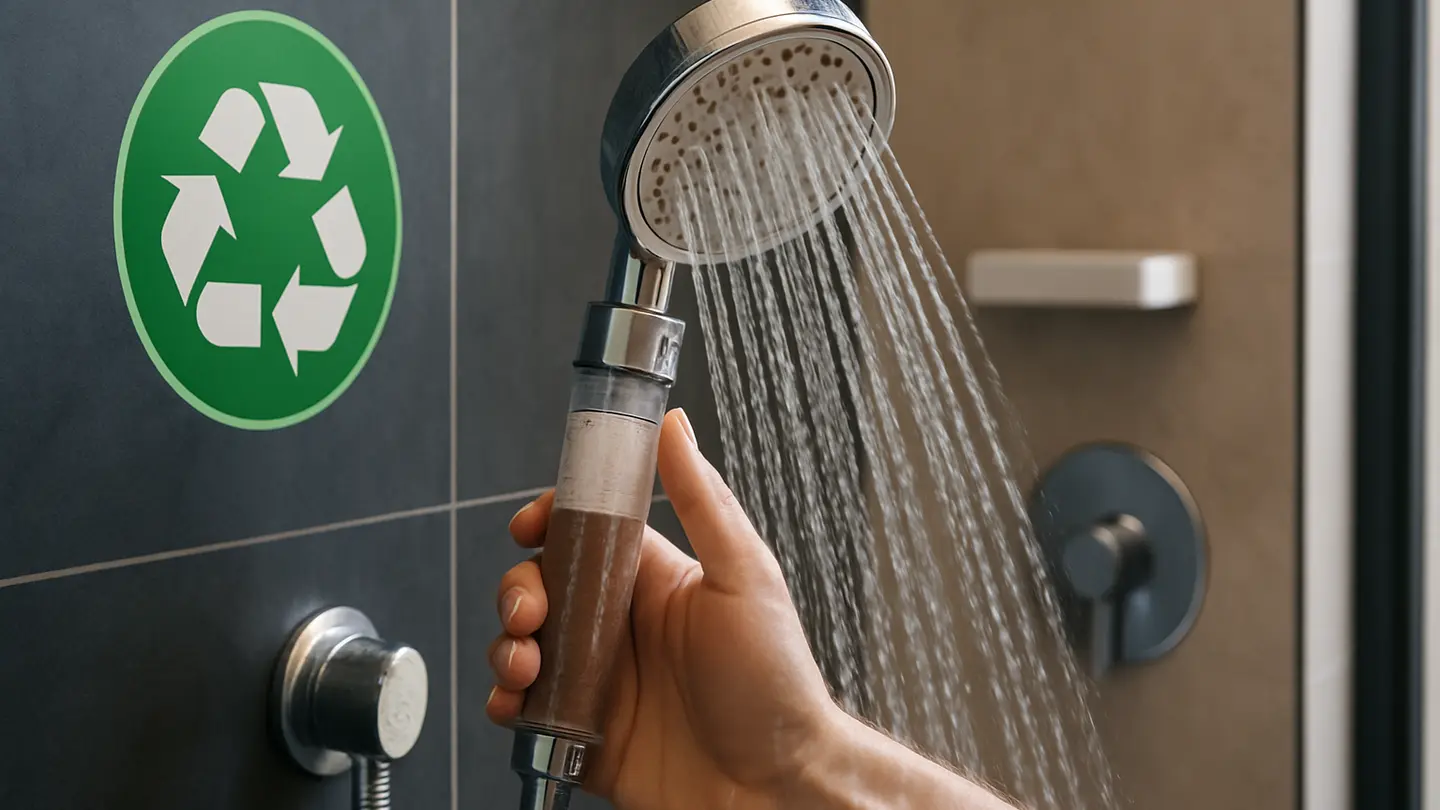
Sustainable shower design is no longer only a question of lowering gallons per minute. For many B2B buyers, the purchase decision now sits at the intersection of water efficiency, hot-water energy demand, filtration performance, user comfort, maintenance, and product life span.
That shift is especially visible in filtered showerheads. A filtered model that saves water but delivers a weak spray may disappoint users and invite returns. A filter that improves perceived water quality but requires frequent cartridge changes may create cost, waste, and service complaints. A high-flow product that feels luxurious may conflict with conservation targets or regional efficiency expectations.
For manufacturers, importers, hospitality buyers, property developers, and retail category managers, the buying question is becoming more integrated: can one shower product reduce water use, support comfortable rinsing, address water-quality concerns, and remain practical to maintain over time?
Why Water Quality and Water Savings Are Now Linked
Showerheads influence two everyday resource streams: the volume of water passing through the fixture and the energy used to heat that water. A lower-flow showerhead can reduce both, but only if the product maintains acceptable spray coverage and rinsing performance. Otherwise, users may stay in the shower longer, select higher-flow modes, or replace the product.
Filtration adds another layer. Once a showerhead includes a filter, buyers also need to evaluate cartridge materials, replacement intervals, service access, and claims about contaminant reduction. These factors have sustainability implications of their own. A product that reduces hot-water use during every shower may still create avoidable waste if the complete head is replaced when only the filter media is exhausted.
The strongest approach is to treat efficiency and filtration as one product system. In that system, flow control, media capacity, internal waterways, spray plate design, pressure behavior, and replacement components all affect the final outcome.
Shower Use Has Real Water and Energy Consequences
Showers are a meaningful contributor to indoor residential water use. In hotels, multifamily housing, gyms, student accommodation, senior living, and other high-use environments, the effect can be even more concentrated because fixtures are used repeatedly and maintenance teams must manage performance at scale.
Lower-flow showerheads can reduce consumption directly. For every minute of use, a 1.8 GPM model uses less water than a 2.5 GPM model. Because shower water is usually heated, lower water volume can also reduce the energy required for hot-water production. That matters for utility costs, emissions reporting, and building performance targets.
However, the savings are not automatic in every installation. Real-world results depend on:
- nominal flow rate;
- available water pressure;
- shower duration;
- user habits;
- spray mode selection;
- hot-water system efficiency;
- whether the product maintains adequate rinsing comfort.
This is why performance-based efficiency programs matter. WaterSense-labeled showerheads, for example, must meet flow and performance requirements rather than simply restrict water. For B2B buyers, that distinction is important: a very restrictive product can look efficient in a specification sheet but fail in guest rooms, apartments, or retail reviews if users perceive the spray as weak.
Filtration Adds a Water-Quality Role to the Showerhead
Filtered showerheads are designed to address water-quality concerns at the point of use. Depending on the product architecture, filtration media may be placed in the handle, inside the showerhead body, or in a separate inline housing between the shower arm and the head.
Common media include:
- Activated carbon, often used for chlorine taste and odor applications in water treatment, though its effectiveness in hot, fast-flow shower conditions depends heavily on design.
- Calcium sulfite, frequently used in shower filters because it can perform in warmer water conditions.
- KDF media, a copper-zinc formulation often marketed for chlorine reduction and scale-related effects, depending on water chemistry and design.
- Ceramic materials, sometimes used as a physical filtration element or as part of multi-media cartridges.
Buyers should be cautious with “multi-stage” claims. More stages do not automatically mean better filtration. A compact cartridge with many small media layers may have less contact time than a larger, simpler cartridge with a more suitable media bed. Performance depends on media quality, flow rate, cartridge size, water temperature, contact time, and the conditions under which the product was tested.
For shower filtration systems, NSF/ANSI 177 is a recognized standard associated with reduction of free available chlorine. If a supplier claims filtration performance, buyers should ask whether the claim is supported by testing to a relevant standard, what the test conditions were, and how long the performance lasts over the rated service life of the cartridge.
The Two Functions Need to Be Designed as One System
Filtration and water conservation can work against each other if they are treated as separate add-ons. Filter media creates resistance. If the water pathway is narrow or poorly arranged, the filter can restrict flow, reduce spray force, and create uneven output. Users may then remove the filter, switch to a higher-flow model, or complain about performance.
The opposite problem is also possible. A product may use oversized passages to preserve a strong flow feel, but if the flow rate remains high, the water-saving value is weakened. A large flow path can also reduce contact time with filter media, limiting filtration effectiveness.
A sustainable shower design should balance several variables at once:
- filter capacity and service life;
- contact time through the media;
- nozzle count, diameter, and spacing;
- pressure compensation;
- spray coverage and droplet size;
- resistance to clogging;
- cartridge sealing;
- housing durability;
- ease of cleaning and maintenance.
Micro-hole nozzles can improve perceived spray strength by increasing water velocity through smaller openings, although they must be designed to resist clogging. Air mixing can create a fuller spray feel at a lower flow rate by blending air into the water stream. Multiple spray modes can also help because not every user wants the same experience: rinsing, massage, rainfall, and mist functions serve different preferences.
For B2B buyers, the key is not to assume that “filtered” and “low-flow” are independently good. The product needs to perform as an integrated hydraulic and filtration system.
How Buyers Can Assess a Sustainable Filtered Showerhead
A practical evaluation framework should cover four areas: water use, filtration performance, maintenance burden, and product lifespan. Each area can either support or undermine sustainability.
For example, a showerhead may offer excellent water savings but use a disposable integrated filter that requires replacing the entire head. Another may use replaceable cartridges but lack clear data on filter capacity or chlorine reduction. A third may provide good filtration data but operate at a higher flow rate than the project or market requires.
The buying process should therefore compare both in-use savings and replacement impacts. That includes the main body, filter cartridge, packaging, installation accessories, and the likelihood that users will keep the product in service rather than replace it early.
Check Flow Rate Alongside Spray Comfort
Flow rate remains one of the most direct ways to compare shower water use. A 1.8 GPM showerhead uses 28% less water per minute than a 2.5 GPM model. In a ten-minute shower, the difference is straightforward:
| Flow rate | Water used in 10 minutes | Difference versus 2.5 GPM |
|---|---|---|
| 1.8 GPM | 18 gallons | 7 gallons less |
| 2.5 GPM | 25 gallons | Baseline |
Across many rooms, apartments, or retail customers, that difference can become material. But buyers should not evaluate flow rate in isolation. A product that saves water on paper must still offer adequate spray comfort at typical field pressure.
Important checks include:
- Flow rate at relevant pressures. Ask for test data at the pressure ranges expected in the target market, not only a single ideal condition.
- Flow rate across spray modes. Some products meet a target in one mode but exceed it in another, depending on the diverter and nozzle layout.
- Pressure compensation. A pressure-compensating design can help maintain consistent flow across variable building conditions.
- Nozzle layout. Spray plate geometry affects coverage, droplet size, and the perception of force.
- Filter condition. Flow should be evaluated with a new cartridge and, where possible, near the end of rated cartridge life.
- Housing durability. A water-saving product that cracks, leaks, or loses finish quality prematurely may not be sustainable in practice.
Actual savings vary with shower duration, pressure, spray mode, and user behavior. For hospitality or multifamily projects, buyers may also want to test a sample in real rooms before committing to a large order. User feedback can reveal whether the selected flow rate feels acceptable under actual plumbing conditions.
Evaluate the Filter as a Replaceable Component System
A filtered showerhead should be assessed as a component system, not a single disposable item. Replaceable cartridges can extend the useful life of the main showerhead body, provided the cartridge is easy to access, affordable to supply, and clearly specified.
Simple cartridge removal matters. If replacement requires tools, awkward disassembly, or unclear instructions, users may skip maintenance or replace the entire product. In commercial settings, maintenance teams need a predictable process that can be repeated across many units without damaging the housing or seals.
Buyers should request documentation on:
- filter media composition;
- rated service capacity;
- recommended replacement interval;
- flow rate during filtration testing;
- inlet water conditions used in testing;
- chlorine-reduction data, if claimed;
- maximum operating temperature;
- pressure limits;
- storage and shelf-life guidance for replacement cartridges;
- packaging format for spare cartridges.
Temperature is especially important. Shower water is warm or hot, and not every filtration media performs the same way at elevated temperatures. A supplier’s test data should reflect conditions that are relevant to shower use rather than only cold-water applications.
Buyers should also avoid treating compact shower filters as true water softeners unless the supplier provides credible evidence for that claim. Many shower filters are marketed around scale, skin feel, or hair feel, but true softening typically requires ion exchange or another defined hardness-reduction process. A small cartridge inside a showerhead may influence certain water characteristics, but it should not be assumed to remove hardness like a whole-home softener.
For sustainability claims, cartridge design is part of the evidence. A durable head with a small replaceable cartridge may reduce waste compared with replacing the full product. But if cartridges require very frequent replacement or use excessive packaging, the advantage may narrow.
Look Beyond Use-Phase Savings to the Full Product Life Cycle
Water savings during use are important, but they are only one part of the product life cycle. B2B buyers should also consider how long the product remains in service, how easily it can be maintained, and how much waste is generated by replacement parts.
Durable bodies reduce premature replacement. Material selection will vary by market position, price point, and installation environment, but the product should be engineered for the expected operating temperature, pressure, and cleaning conditions. Corrosion-resistant finishes are especially important in humid bathrooms and high-turnover facilities where fixtures are cleaned frequently.
Cleanable nozzles also support product life. Mineral buildup can distort spray patterns, reduce user satisfaction, and create the impression that the showerhead has failed. Flexible silicone nozzles or other cleanable spray surfaces can help maintenance teams restore spray performance without replacing the fixture.
Universal connections are another practical sustainability feature. Standard threaded connections simplify retrofits and reduce the need to replace arms, hoses, brackets, or adapters. For large projects, this can reduce installation complexity and avoid unnecessary component waste.
Packaging should match the sales channel and sustainability expectations. Retail products may require protective, display-ready packaging with clear replacement cartridge information. Project or OEM shipments may be better suited to bulk packaging that reduces individual plastic or printed material. Either way, packaging should protect finishes and threaded parts during transport; damaged products are waste before they are ever installed.
A useful procurement checklist includes:
| Evaluation area | What to verify | Why it matters |
|---|---|---|
| Water efficiency | Rated GPM, pressure conditions, spray-mode flow | Determines likely water and hot-water savings |
| Spray performance | Coverage, force, user comfort, clog resistance | Helps prevent dissatisfaction and early replacement |
| Filtration | Media type, test data, NSF/ANSI 177 relevance, service capacity | Supports credible water-quality claims |
| Maintenance | Cartridge access, replacement interval, spare-part availability | Affects long-term usability and waste |
| Durability | Body material, finish quality, seals, temperature and pressure limits | Reduces premature failures |
| Retrofit fit | Universal connections, accessory compatibility | Simplifies installation and avoids extra replacement |
| Packaging | Protection, recyclability, channel fit | Balances damage prevention and waste reduction |
Sustainable shower design is strongest when these factors are specified together. A filtered showerhead should not be bought only as a wellness feature, and a low-flow showerhead should not be bought only as a utility-saving device. The more relevant question is whether the product can deliver measurable efficiency, credible filtration performance, and a maintainable service model over its expected life.
Another Way to Build and Verify a China Supplier Shortlist
For buyers comparing showerhead manufacturers and component suppliers in China, Made-in-China.com can be used as a B2B sourcing platform to identify and compare potential suppliers before direct negotiation.
Supplier Discovery can help buyers build and narrow an initial shortlist, including by locating Audited Suppliers and regional supplier channels. For early-stage due diligence, Audited Suppliers are subject to third-party verification and on-site audit, with Audit Reports available for buyer review. These reports can provide structured information in areas such as general company information, export trade, manufacturing capacity, quality control, and R&D capability.
Easy Sourcing is another practical option when buyers want to reduce manual outreach. A buyer can submit one sourcing request, receive multiple quotations from matched suppliers, compare quotes, and request samples. For sustainable filtered showerheads, that request should still include detailed requirements: target flow rate, filtration claims, cartridge specifications, test documentation, packaging expectations, and sample evaluation criteria. Made-in-China.com can support supplier discovery, but technical verification and product testing remain essential buyer responsibilities.