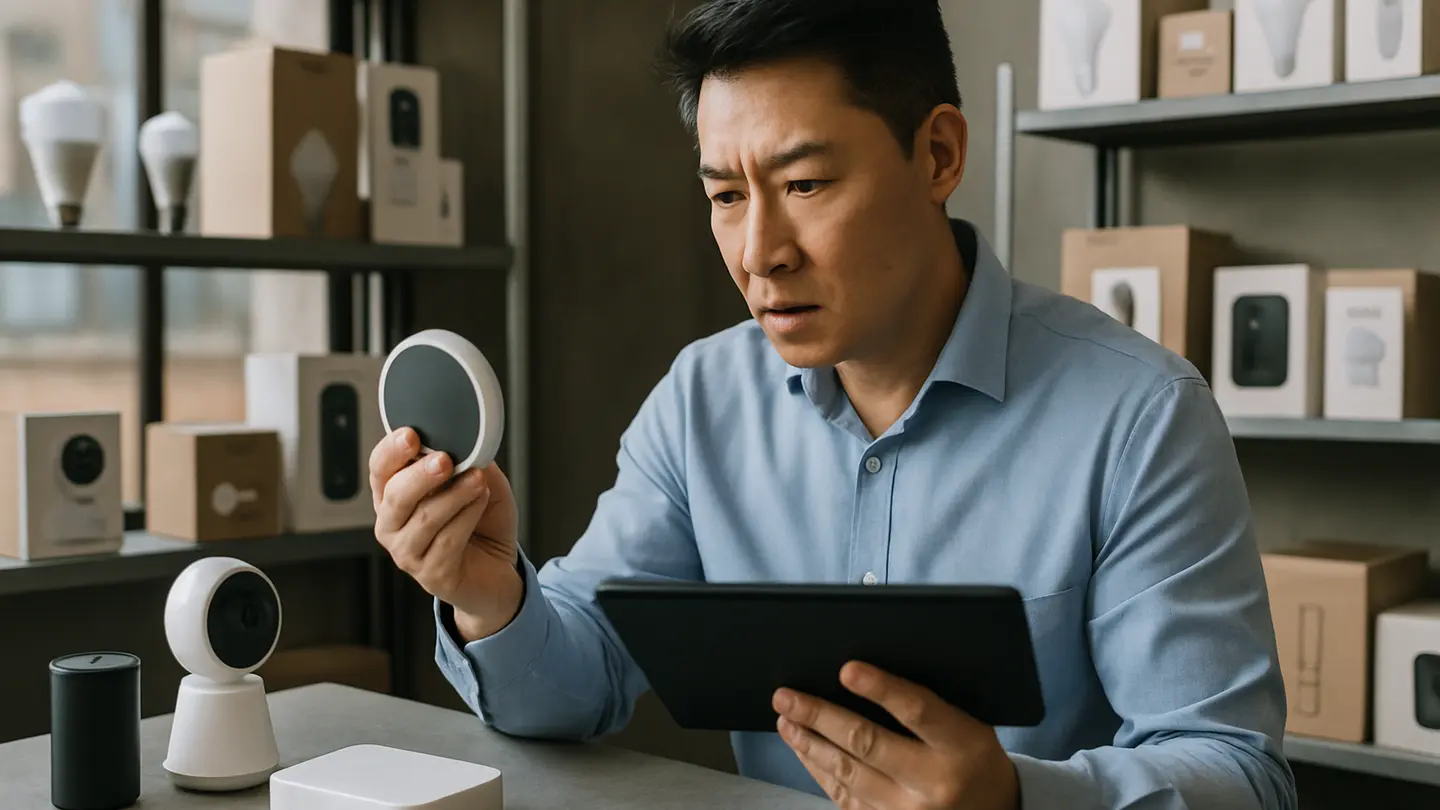
Confirm That Category Demand Is Still Growing
The most promising trending electronics from China solve recurring problems: home security, charging, remote work, health monitoring, travel, and driving convenience. For B2B buyers, durable demand matters more than trade-show novelty.
Before contacting factories, determine whether demand is growing, flattening, or becoming a price-driven commodity market. Review several signals together:
- Search-interest direction: Favor sustained interest over a single spike.
- Leading listing performance: Check review velocity, stock availability, ranking movement, and updated product versions.
- New-listing volume: More sellers may indicate opportunity or overcrowding.
- Price movement: Stable pricing can support margins; falling prices may indicate cost-led competition.
- Return and complaint patterns: Reviews can reveal defects, confusing setup, battery issues, compatibility failures, and overstated specifications.
Initial order quantities should reflect uncertainty. Categories with limited differentiation warrant controlled launches, while connected cameras and battery power stations usually need smaller runs after samples, compliance review, and freight planning.
The goal is not to find a viral item. It is to deliver a reliably specified product at a viable landed cost.
Smart Home Devices
Smart home products address familiar needs such as lighting control, monitoring, access management, and energy awareness. Common options include smart plugs, sensors, indoor cameras, video doorbells, and keypad locks.
Product similarity can hide major usability differences. Confirm whether a device supports a dedicated app, third-party platform, gateway, cloud subscription, or specific ecosystem. Compatibility claims should be specific.
Network requirements are important. Many lower-cost devices support only 2.4 GHz Wi-Fi, while consumers may use dual-band routers or mesh networks. Test setup, reconnection after power loss, firmware updates, and account recovery on real networks.
For cameras and microphone-equipped devices, ask:
- Where video, audio, and account data are routed;
- Whether recordings are stored locally, in the cloud, or both;
- Who can access stored footage;
- Whether the buyer controls the application and privacy documentation;
- What happens if app support ends.
For keypad locks, test mechanical overrides, battery warnings, unlock records, weather resistance, and operation during network loss. Poor instructions, unclear door compatibility, or weak emergency-access procedures can create expensive after-sales issues.
Wireless Audio Products
Earbuds, headphones, portable speakers, clip-on microphones, and translation audio products are visible consumer categories but difficult to assess from photographs or short demonstrations.
Suppliers may make broad claims about battery life, noise reduction, sound quality, low latency, waterproofing, and voice features. Buyers should use a consistent sample test routine.
For earbuds and headphones, measure runtime at normal listening levels with expected features enabled. If active noise cancellation, transparency mode, multipoint pairing, or voice use reduces runtime, reflect that in final specifications and marketing.
Useful checks include:
- Pairing and reconnection reliability;
- Microphone quality in quiet and noisy settings;
- Video latency and left-right synchronization;
- Charging-case durability;
- Fit, controls, and pressure points;
- Firmware-update process and post-launch support.
Firmware support matters because products may improve—or develop problems—after sale. A supplier with a defined update method and stable application support is more valuable than one offering an impressive sample without a maintenance plan.
For translation earbuds and voice devices, test actual target language pairs, accents, background noise, conversational speed, and offline versus cloud-dependent functions. A controlled demonstration may not reflect real customer use.
Health Monitors Require the Strongest Due Diligence
Home health electronics can command higher prices but carry greater accuracy, safety, and compliance risk. Blood-pressure monitors, pulse oximeters, thermometers, body-composition scales, sleep trackers, and wearables should not be sourced based on appearance or broad claims.
The key requirement is evidence for the exact model ordered. Reports and certificates for similar-looking units, earlier versions, or related products are insufficient. Model numbers, photographs, electrical ratings, and report scope should match the purchase order.
For blood-pressure monitors, buyers may need clinical-validation evidence under a recognized protocol, depending on claims and destination market. “Medical grade” and “high accuracy” are not substitutes for documented validation. The same caution applies to disease-detection, blood-oxygen, or continuous-monitoring claims.
Health-monitor sourcing should include:
- Accuracy evidence for the claimed function;
- Applicable labeling and market-access requirements;
- Instructions, warnings, and contraindications;
- Traceability for critical sensors and components;
- Complaint investigation and batch identification;
- Evidence that production performance can remain consistent.
If the commercial model depends on medical or diagnostic claims, obtain specialized regulatory advice before finalizing packaging or advertising.
Fast Charging, Cables, and Power Accessories
Charging products benefit from device ownership, travel, hybrid work, and the shift to USB-C. Relevant items include wall and car chargers, wireless pads, power banks, USB-C cables, travel adapters, and charging stations.
Headline wattage does not always equal sustained output. Test chargers under load for a meaningful period. Check temperature rise, output stability, reconnection behavior, and output reduction when several ports are used.
For multiport chargers, request a port-allocation table. A charger marketed as 100 W may provide that power through only one USB-C port. Product listings should explain realistic charging combinations.
USB-C cables require more than visual inspection. Depending on current and data requirements, a cable may need an E-marker chip. Test charging and data performance when claiming high-wattage charging, video output, or high-speed data transfer.
| Product type | Practical checks before bulk order |
|---|---|
| Wall charger | Sustained output, heat, plug fit, port allocation, safety documentation |
| Multiport charger | Total power budget, output reduction by port combination, cable compatibility |
| USB-C cable | Current capability, E-marker where required, data speed, connector durability |
| Power bank | Cell consistency, actual capacity, charging cycles, transport documentation |
| Wireless charger | Alignment tolerance, heat, case compatibility, charging interruptions |
Cells, controller chips, cable gauge, and connectors can materially affect performance. Identify critical components in the approved specification rather than leaving them to factory discretion.
Work-From-Home Equipment
Hybrid work supports demand for webcams, USB microphones, ring lights, laptop stands, monitor arms, conference speakers, and USB hubs. These products may be less regulated than health devices or connected security products, but accurate specifications remain essential.
Webcam claims deserve scrutiny. “4K” may mean interpolated output rather than native sensor resolution, while stated frame rates may apply only at lower resolutions. Test samples in daylight, ordinary indoor light, and low light. Evaluate autofocus, exposure, microphone pickup, field of view, and compatibility with relevant operating systems and video platforms.
USB hubs and docking products should be checked for functions customers need:
- Measured power delivery to the laptop;
- Video resolution and refresh rate;
- Reliability with drives and peripherals;
- Ethernet performance where included;
- Heat during simultaneous use;
- Operating-system compatibility limits.
For stands, lights, and mounts, test hinges, clamps, threaded fittings, cable strain relief, and packaging. A functional product can still generate returns if it arrives damaged or fails after repeated adjustment.
Automotive Accessories and Portable Power
Automotive electronics include dash cameras, tire-pressure monitors, car chargers, reversing cameras, diagnostic tools, air compressors, and jump starters. Portable power also serves campers, travelers, field workers, emergency-preparedness buyers, and households needing backup capability.
Test dash cameras under complaint-generating conditions: low light, glare, vibration, heat, and extended recording. Verify parking mode, event triggering, file overwrite behavior, storage-card compatibility, and parked-vehicle power consumption.
Portable power requires early logistics planning. Large lithium batteries can affect freight routing, packaging, carrier acceptance, warehouse procedures, and delivery timing. Confirm that the battery configuration can move through the intended transport method before promising delivery dates.
For power banks, jump starters, and power stations, examine:
- Battery cell type and supplier;
- Actual usable capacity and output behavior;
- Battery-management-system functions;
- Over-temperature and short-circuit protection;
- Cycle-life assumptions;
- Required transport documentation;
- Hazardous-goods packaging where applicable.
Freight constraints can change the economics of an otherwise attractive product. Heavier battery products may require specialized shipping and a different sales model.
Where Electronics Products Are Manufactured in China
Consumer-electronics sourcing is heavily concentrated around Shenzhen and Dongguan, where supplier networks can shorten development cycles. Buyers can often find nearby specialists for circuit boards, batteries, molding, cables, packaging, tooling, assembly, applications, and testing.
This concentration can speed sample revisions and support many configurations. However, flexibility creates risk if factories change internal components without documenting revisions.
Not every product is best sourced in the same region. Medical devices, automotive components, specialized sensors, and higher-control manufacturing may be concentrated elsewhere in China. The supplier’s proven capability with the specific product matters more than location.
When feasible, factory visits, third-party audits, or in-process inspections reduce quotation-stage uncertainty. They can reveal whether the supplier performs real assembly and testing, controls incoming components, uses test equipment consistently, and handles defective units properly.
Pre-Bulk-Order Checks for Electronics Buyers
Treat the approved sample as the beginning of validation, not the end. A single sample may use different parts or receive more attention than normal production.
A practical pre-order process includes:
- Evaluate multiple samples. Test more than one supplier and more than one unit from the preferred supplier where possible.
- Create a written specification. Define key components, performance requirements, firmware version, packaging, accessories, labeling, and tolerances.
- Match documents to the ordered model. Confirm reports, declarations, battery documents, and wireless approvals apply to the exact configuration.
- Confirm production capacity. Review order load, component lead times, tooling, quality-control steps, and realistic dates.
- Approve a production reference sample. Retain a sealed, dated unit identifying the required configuration.
- Inspect before shipment. Check workmanship, performance, packaging, labeling, accessories, and unit consistency.
- Review commercial viability. Calculate landed cost alongside returns, warranty replacements, marketplace charges, fulfillment, distributor margins, and support costs.
A low ex-factory price is not enough. The viable product can be sold, supported, shipped, and replaced without eroding margin.
FAQ
Q1: Do I have to be early into a category to make money in it?
No. Early entry can help, but later sellers can succeed with better-tested products, accurate specifications, dependable packaging, useful documentation, and stronger post-sale support.
Risk rises in mature categories with no differentiation beyond a lower price. Focus on execution quality and a defined customer need rather than trying to be first.
Q2: Does a lower factory price usually mean different parts inside?
It can. Lower pricing may result from substitutions in battery cells, integrated circuits, camera modules, speakers, charging controllers, memory, plastics, or other internal parts.
Ask suppliers to identify critical components in quotations and specifications. Where performance depends on particular parts, include approved component details and change-control requirements in the purchase agreement. Proposed substitutions should require written approval and, where necessary, retesting.
Q3: Does a factory building for a known brand make it a safer choice for me?
It may indicate relevant capability, but it does not guarantee the same components, production line, quality attention, or delivery priority for a smaller account. Major brands may use their own tooling, approved suppliers, and inspection controls.
Assess the proposed execution for your order: production arrangement, components, sample consistency, documentation, communication, and inspection capability.
Q4: Does adding wireless change the approval work on a product?
Often, yes. Wireless functions can trigger radio, electromagnetic compatibility, safety, labeling, and other market-access requirements that vary by destination. Bluetooth, Wi-Fi, cellular, and proprietary radio technologies may create different obligations.
An approved wireless module can reduce some work only if final integration follows its approved conditions. Changes to antennas, enclosures, power settings, firmware, or the module may require reassessment.
Conclusion: Source Electronics With Evidence, Not Assumptions
Consumer electronics are easy to source badly because products can look convincing in photographs yet fail in daily use. Hidden differences in cells, firmware, Wi-Fi compatibility, charging controllers, sensors, and internal modules can create costly returns.
Strong buying decisions combine market evidence with product evidence. Confirm meaningful demand, test the performance customers notice, verify model-specific documentation, and inspect production before shipment.
For buyers evaluating trending electronics from China, the best opportunity is rarely the product with the longest feature list. It is the product whose performance, compatibility, shipping requirements, and support obligations have been validated before bulk ordering.
About the Author
The Shower Manufacturer editorial team covers B2B procurement, supplier evaluation, product quality control, and import operations. Its sourcing guides help professional buyers assess product viability, technical risk, compliance requirements, and supply-chain execution.