For facility managers, procurement teams, and specifiers, soap dispensers vary by operation method, mounting style, refill system, compatible soap format, and maintenance profile.
A unit that works in a private office washroom may not suit a school restroom, hotel shower area, commercial kitchen, gym locker room, or healthcare-adjacent handwashing station. B2B buyers should balance hygiene expectations, installation space, traffic, refill labor, durability, appearance, and total operating cost.
Core Soap Dispenser Types by Operation
Soap dispensers are often categorized by how they release soap. Operation style affects hygiene, power needs, maintenance, and compatible soap formats.
| Operation type | Best suited for | Key consideration |
|---|---|---|
| Manual | Offices, kitchens, standard restrooms, lower-complexity sites | Simple and power-free, but users touch the unit |
| Automatic | High-use restrooms, hospitality, hygiene-sensitive spaces | Touchless operation, but requires batteries or wiring |
| Foaming | Cost-conscious high-use facilities, public washrooms | Uses compatible foaming soap and may reduce soap consumption |
| Liquid | General handwashing, kitchens, bathrooms, shower areas | Broad soap compatibility, depending on viscosity and dispenser design |
Manual Soap Dispensers
Manual soap dispensers release soap when the user presses a pump, lever, or button. They are widely used because they are simple to specify, easy to understand, and generally require no batteries or electrical connection.
For B2B procurement, that simplicity reduces dependency on battery replacement, electrical planning, sensor calibration, and electronic maintenance. Manual dispensers are practical for standard restrooms, breakrooms, staff kitchens, hospitality bathrooms, and smaller shared facilities.
They are available in plastic, stainless steel, ceramic, and decorative materials. Plastic units are lightweight and cost-effective for volume purchasing. Stainless steel offers a more durable, professional appearance in commercial restrooms, kitchens, locker rooms, and public facilities.
Manual dispensers may be disposable or refillable. Disposable units are typically pre-filled and replaced when empty. Refillable versions are opened and replenished with the approved soap format. Buyers should check refill frequency, opening method, and pump compatibility with the intended soap viscosity.
Automatic Soap Dispensers
Automatic soap dispensers use sensors to detect a hand and dispense soap without direct contact. This touchless operation is the main reason they are chosen for shared, high-use, or hygiene-sensitive spaces.
They are often specified in public restrooms, airports, hotels, schools, office buildings, and food-service-adjacent handwashing areas where hygiene perception matters.
The trade-off is power. Most automatic dispensers require batteries, while some are hardwired. Battery-operated units are easier to install but need a replacement schedule. Hardwired models can reduce battery maintenance but may add electrical planning and installation cost.
When evaluating automatic units, buyers should check sensor reliability, dispense volume settings, soap compatibility, refill access, battery compartment placement, and suitability for wet or humid environments.
Foaming Soap Dispensers
Foaming soap dispensers mix soap with air to create a light lather. They require compatible foaming soap or, in some cases, properly diluted liquid soap that meets the manufacturer’s specifications.
Foam spreads quickly across the hands and often rinses away easily. In high-use restrooms, foaming systems may use less soap per dispense than standard liquid systems, helping reduce refill frequency and consumable use.
Buyers should not assume any liquid soap can be used in a foam dispenser. Incompatible formulas may clog the pump, produce poor foam quality, or shorten dispenser life. For multi-site procurement, standardize the dispenser and refill combination so cleaning teams are not managing too many soap formats.
Liquid Soap Dispensers
Liquid soap dispensers release soap in liquid form rather than converting it into foam. They suit buyers who prefer standard hand soap, gel soap, cream-style soap, or specialty liquid formulas.
Liquid dispensers can be manual or automatic, wall-mounted or countertop, refillable or cartridge-based. Their flexibility makes them common in restrooms, kitchens, shower areas, hospitality bathrooms, offices, and staff handwashing stations.
The main specification issue is viscosity. Some dispensers are designed for thinner liquid soaps, while others can handle thicker gels or creams. Before ordering soap in bulk, confirm the recommended viscosity range, especially for moisturizing soaps, antibacterial hand soaps, shower gels, or multi-purpose wash formulas.
Mounting and Installation Choices
Installation style affects space use, appearance, user access, cleaning workflow, and how permanent the dispenser will be. The main options are wall-mounted, deck-mounted, countertop, and sink-mounted dispensers.
Wall-Mounted Soap Dispensers
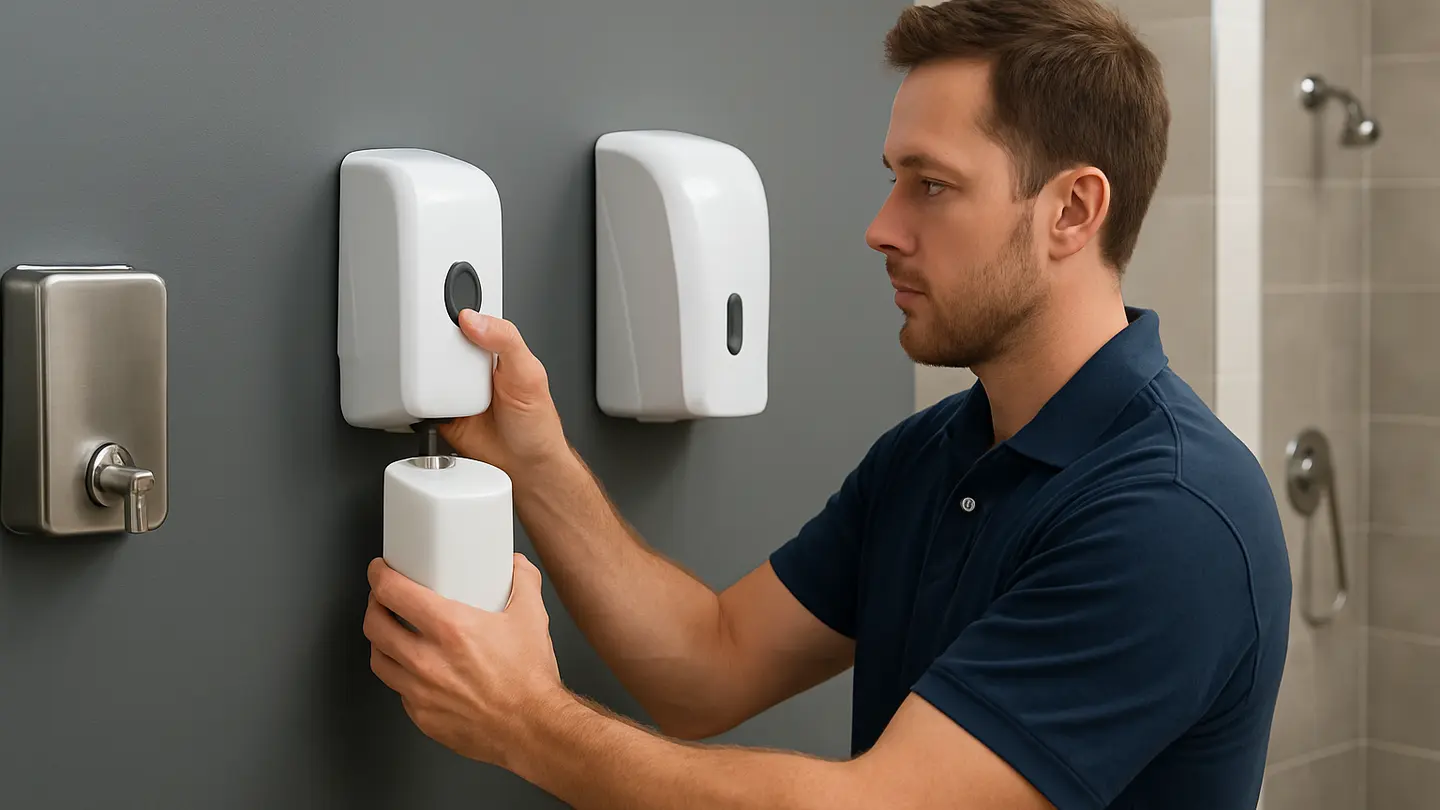
Wall-mounted soap dispensers are fixed to a wall, keeping counters, sink decks, and vanity surfaces clear. They are common in commercial restrooms, staff kitchens, locker rooms, shower facilities, public wash areas, and high-traffic buildings.
Their biggest advantage is consistency. Users know where to find the dispenser, cleaning staff can service units in predictable locations, and facility managers can standardize placement across rooms or sites.
Installation quality matters. Mounting into wall studs provides stronger support when available, especially for larger dispensers or high-use areas. Where studs are not available, suitable wall anchors may be used depending on wall material, dispenser weight, and expected usage. Tile, drywall, concrete, and partition walls require different mounting considerations.
For shower facilities and locker rooms, buyers should also consider moisture exposure, corrosion resistance, and whether the dispenser can handle shampoo, body wash, or liquid soap formulas if used beyond handwashing.
Deck-Mounted Soap Dispensers
Deck-mounted soap dispensers are installed on counters, vanity tops, or sink decks. They create a built-in appearance near faucets and other fixtures, which can improve the look of wash stations in hospitality, office, and commercial environments.
These dispensers are often selected when buyers want a cleaner counter layout than a freestanding bottle but do not want a wall-mounted unit. Finishes can be chosen to coordinate with faucets and other hardware, such as chrome, brushed nickel, matte black, or stainless steel.
Before specifying deck-mounted units, check refill access. Some models refill from the top, while others require access below the counter. In busy facilities, top-fill designs may reduce service time.
Countertop Soap Dispensers
Countertop soap dispensers are free-standing units that sit on a counter, sink ledge, shelf, or vanity surface. They require no permanent installation, making them useful for quick deployment, temporary facilities, leased spaces, small offices, and locations where drilling is not allowed.
They are easy to move, replace, or reposition as layouts change. This flexibility is valuable for seasonal hospitality operations, shared office kitchens, temporary handwashing stations, and low-traffic restrooms.
Countertop dispensers come in many materials and capacities, from compact plastic pumps to decorative ceramic units and stainless steel models. The main limitations are stability, theft risk, clutter, and cleaning. In high-use public areas, wall-mounted or fixed units are usually better.
Sink-Mounted Soap Dispensers
Sink-mounted soap dispensers install through a pre-drilled sink or countertop hole. The visible pump sits above the surface, while the soap reservoir is usually concealed below the sink or counter.
This creates an integrated, uncluttered look around the sink area. It is common in kitchens, hospitality bathrooms, office washrooms, and commercial vanity installations.
Before specifying sink-mounted units, confirm hole size, countertop thickness, clearance below the sink, and refill method. Some reservoirs are small and require frequent refilling, while larger under-counter bottles reduce service frequency but need more space. Buyers should also check whether the pump can be removed from above for refilling or maintenance.
Dispensing Mechanisms and Compatible Soap Formats
The dispensing mechanism affects ease of use, portion control, maintenance, and soap compatibility. Procurement teams should match the mechanism to traffic, hygiene expectations, refill format, and maintenance capacity.
Pump Soap Dispensers
Pump soap dispensers move soap through a tube when downward pressure is applied to the pump head. They are familiar, intuitive, and widely used in kitchens, bathrooms, staff areas, hospitality rooms, and low-to-medium traffic commercial spaces.
Pump units commonly work with liquid, gel, and cream soap formulas, although compatibility depends on pump design and soap viscosity. They usually require no batteries or electrical power, which keeps installation and service simple.
Refillable pump dispensers are generally straightforward to maintain. For B2B buyers, key considerations include pump durability, clog resistance, refill opening size, reservoir capacity, and availability of replacement pump parts.
Push-Button Soap Dispensers
Push-button soap dispensers release soap when the user presses a button, panel, or lever. They are common in commercial restrooms, kitchens, schools, industrial facilities, and shared wash areas.
Many manual push-button units operate without batteries, which makes them reliable in busy facilities. They can also be more robust than decorative pump bottles, especially when designed for wall-mounted commercial use.
Their straightforward mechanisms can make maintenance easier. However, because users touch the button or panel, these dispensers do not offer the same contact-reduction benefits as sensor models.
For high-traffic facilities, buyers should look for durable construction, tamper-resistant housings, easy refill access, and controlled dispense volume to limit overuse.
Sensor and Touchless Dispensers
Sensor and touchless dispensers detect a hand and automatically release soap. Users do not press a pump, button, or lever, which can improve hygiene perception and reduce contact with shared surfaces.
Many touchless models run on batteries, although some are wired. They may be wall-mounted for commercial restrooms or placed on countertops for smaller facilities, hospitality settings, and office kitchens.
When comparing sensor dispensers, consider response time, false triggering, battery life, dispense adjustment, drip control, and compatibility with the selected soap. A unit that dispenses too much soap can increase consumable cost, while one that dispenses too little may frustrate users.
Touchless units are especially useful in high-use washrooms, premium hospitality spaces, food-service-adjacent areas, and facilities where reducing contact points is a priority.
Soap Refills, Cartridges, and Refill Systems
Refill format affects operating cost, hygiene, packaging waste, storage needs, procurement planning, and cleaning staff workflow. A dispenser should not be selected only by appearance or unit price; the refill system often determines long-term value.
Common refill options include cartridges, bag-in-box refills, disposable units, and refillable reservoirs. Buyers should confirm compatibility between the dispenser model, soap formula, refill container, and expected usage volume before committing to a system.
Soap Cartridges
Soap cartridges are sealed, pre-filled containers designed for compatible dispensers. When the cartridge is empty, staff remove it and insert a new one instead of pouring soap into a reservoir.
This can simplify maintenance, reduce mess, and reduce exposure to contamination during refilling. Cartridges can also support consistent portion control, especially when paired with dispensers that deliver a fixed amount per activation.
The trade-off is cost and supplier dependency. Cartridge systems may involve higher upfront or per-refill costs, and buyers may be limited to compatible refill formats. Before selecting one, confirm refill availability, lead times, minimum order quantities, storage requirements, and whether alternative soap formulas are supported.
Bag-in-Box Refills
Bag-in-box systems use flexible soap bags placed inside compatible dispensers. The dispenser pump draws soap directly from the bag, and the bag collapses as product is used.
This format limits air exposure inside the refill as soap is dispensed, which can support hygiene and product stability. Bag-in-box refills may also reduce packaging waste compared with some rigid cartridge systems, depending on materials and disposal process.
For facilities with many dispensers, bag-in-box systems can offer a practical balance between sealed refill convenience and storage efficiency. Buyers should check bag size, dispenser compatibility, pump connection design, and whether staff can replace the bag quickly without spills.
Disposable vs. Refillable Soap Dispensers
Disposable soap dispensers are pre-filled and discarded when empty. They can reduce direct refilling and cleaning tasks, which may help in temporary facilities, event spaces, or locations where labor simplicity is the main priority.
However, disposable units generate more product waste and may cost more over time, especially in high-use environments. They also provide less flexibility if the facility wants to change soap formulas, fragrances, or suppliers.
Refillable soap dispensers are reusable units replenished with new soap from bulk containers, cartridges, or bags. They may reduce long-term costs and plastic waste when paired with efficient refill programs. The trade-off is that staff must manage refilling, cleaning, and occasional pump maintenance.
For most B2B buyers, the decision comes down to labor cost, hygiene requirements, sustainability goals, traffic volume, and the ability to standardize refills across locations.
Another Way to Build a China Supplier Shortlist
Once dispenser type, mounting style, soap format, and refill system are defined, buyers can compare potential suppliers. Made-in-China.com is a B2B sourcing platform that can support early supplier discovery.
Supplier Discovery helps buyers find and narrow potential suppliers, including regional supplier channels and Audited Suppliers. For buyers sourcing soap dispensers, shower accessories, restroom hardware, or related facility products, this can structure the first round of research.
Audited Suppliers are subject to third-party verification and on-site audit, with Audit Reports available for buyer review. These reports can include company details, export trade, manufacturing capacity, quality control, and R&D capability. They are not a substitute for your own due diligence, but they can support early-stage screening.
Easy Sourcing is another option for quotation gathering. Buyers can submit one sourcing request, receive multiple quotations from matched suppliers, compare quotes, and request samples, reducing the need to contact suppliers one by one at the start.
FAQ
What are the different mechanisms soap dispensers can have?
Common mechanisms include manual pumps, automatic sensors, and foaming systems. Manual pumps release soap through a push-down action. Automatic dispensers detect a hand and dispense soap without touch. Foaming mechanisms mix air with compatible soap to create lather.
The mechanism affects hygiene, usability, maintenance, portion control, and compatible soap format.
Can you recommend some soap dispensers suitable for small bathrooms?
For small bathrooms, wall-mounted dispensers are often a good choice because they save counter space. Sink-mounted dispensers can also work if the sink or countertop has an available hole and enough space below for the reservoir.
Compact manual pump dispensers are suitable for simple, low-footprint setups. Prioritize accessibility, refill access, traffic level, and whether the dispenser will stay stable in daily use.
What’s the difference between manual and automatic soap dispensers?
Manual dispensers require users to press a pump, button, or lever to release soap. Automatic dispensers use sensors to detect a hand and dispense soap without direct contact.
Automatic models reduce contact with dispenser surfaces and are often preferred in shared or hygiene-sensitive spaces. Manual models are usually simpler, often lower cost, and do not typically require batteries or electrical power.
How do I choose the right size of soap dispenser for my kitchen?
Choose dispenser size based on how often the kitchen is used. A small private kitchen may only need a compact dispenser, while a staff kitchen, shared pantry, commercial prep area, or larger household may benefit from a higher-capacity unit.
Higher capacity can reduce refill frequency, but the dispenser still needs to fit the sink or counter area. For many typical kitchens, a 12–16 ounce dispenser is a practical starting range.
More Recent Buying Guide Topics
For related procurement planning, buyers may also compare restroom fixture materials, shower accessory finishes, commercial faucet types, drain styles, towel dispensers, grab bars, and other washroom hardware. Define the use environment first, then compare installation requirements, maintenance needs, consumable compatibility, durability, and supplier support.