How to Assess Sunglasses Manufacturers in China
Finding suitable sunglasses manufacturers in China involves more than comparing unit prices or reviewing a product catalog. A supplier may offer an attractive frame design and low quoted cost while lacking clear documentation for the lenses, materials, or target-market requirements relevant to your order.
The first step is to define the intended product program. A fashion sunglasses collection, sports-oriented polarized range, retail private-label line, and low-cost promotional giveaway each require different manufacturing capabilities. The factory’s location, production model, component supply chain, and quality-control process should fit the program—not simply the initial design.
Chinese eyewear manufacturing is concentrated in several regional clusters. Some areas are better known for fashion-frame production, while others have stronger links to lens suppliers, injection molding, or wholesale optical distribution. Matching the supplier’s strengths to the product reduces avoidable development delays and quality risks.
Before requesting quotes, prepare a basic supplier-verification plan covering:
- The legal supplier and the actual production site
- Frame and lens sourcing arrangements
- OEM, ODM, or white-label production model
- Product specifications and approved materials
- Test documentation needed for the destination market
- Sample approval and production inspection requirements
- Packaging, carton markings, and shipment controls
A supplier can be suitable for one type of sunglasses but unsuitable for another. Verification should therefore focus on the specific product you intend to buy, rather than general claims about experience or capacity.
China’s Main Sunglasses Manufacturing Hubs
China’s eyewear industry includes several important manufacturing and sourcing centers. Each has different strengths, and buyers should not assume that every supplier in an eyewear region manufactures all components in-house.
Xiamen is often associated with performance-oriented sunglasses, including polarized and impact-resistant lens programs. Buyers sourcing outdoor, fishing, driving, cycling, or sports styles may find suppliers with experience in lens coatings, polarization options, and durable frame constructions. However, individual suppliers still need verification of the actual lens source and applicable testing documentation.
Wenzhou is a major base for fashion-frame OEM and ODM production. Factories in and around the region commonly support plastic and metal fashion sunglasses, branded collections, seasonal styles, and customized logo programs. It can be a practical sourcing area for buyers that need a broad choice of frame silhouettes, colors, decorative details, and packaging options.
Taizhou is often relevant for high-volume, injection-molded sunglasses, especially lower-cost promotional styles and fast-moving retail products. Injection molding can support consistent production at scale, but material selection, mold quality, finishing, and lens specification still affect both appearance and durability. Low-cost molded products should not be assumed to meet the same performance expectations as a more highly specified retail frame.
Danyang is primarily known as an optical-lens and eyewear wholesale center. It can be useful for buyers seeking lens-related supply options, optical products, or component sourcing, but it should not automatically be treated as a dedicated fashion-frame manufacturing base. A trading company in Danyang may coordinate products from several different factories.
For any location, confirm the actual production site responsible for your order. A sales office, showroom, or exporter may not be the factory that molds the frame, produces the lenses, assembles the sunglasses, or packs the final cartons. Factory audits, video walkthroughs, production records, and transparent component information can help establish who is doing the work.
Choosing Between OEM, ODM, and White-Label Sunglasses
The production model determines how much control a buyer has over design, materials, intellectual property, and product differentiation.
OEM production generally means the supplier manufactures sunglasses according to the buyer’s drawings, measurements, specifications, branding, and material requirements. This model is appropriate when the buyer has an original frame design or detailed technical requirements. OEM projects may involve new molds, longer development periods, and higher initial costs, but they give the buyer more control over the finished product.
ODM production starts with an existing supplier design that is modified for the buyer. Changes may include colors, lens tint, logo placement, hardware, packaging, or selected frame details. ODM can shorten development time compared with a fully original design, although the underlying design may remain part of the supplier’s catalog.
White-label sunglasses are usually standard catalog products supplied with the buyer’s logo, label, or packaging. This is often the fastest route to market and may require lower development investment. The trade-off is limited product uniqueness. The same base model may be available to other buyers, sometimes in similar colors or configurations.
Buyers should not assume that adding a logo creates design exclusivity. If a catalog frame is important to a brand strategy, discuss exclusivity before placing an order. The agreement should clarify:
- Who owns any new molds
- Whether mold costs include exclusive use
- Who owns modified or buyer-created design files
- Whether the factory may sell the design to other customers
- Geographic or channel-based exclusivity, if applicable
- What happens to molds if the supplier relationship ends
Written terms are more reliable than verbal assurances. This is particularly important for custom acetate-look frames, metal details, temple decorations, or molded shapes that require dedicated tooling.
Why a UV400 Claim Is Not Proof of Compliance
“UV400” is a commonly used lens claim, but it is not a standalone certificate. It generally describes a lens intended to filter ultraviolet radiation through 400 nanometers. The claim may be useful in a product specification, but buyers still need supporting evidence that the actual lens supplied meets the requirements for the intended market.
For the United States, sunglasses are subject to FDA requirements relating to impact-resistant lenses. A supplier’s UV400 statement does not by itself demonstrate impact-resistance compliance. Buyers should request documentation appropriate to the exact lens and finished product configuration being ordered, rather than relying on a generic report for a different model or material.
For the European Union, sunglasses require relevant testing, technical documentation, conformity obligations, and appropriate product marking. Lens filter categories are also important for consumer information. The category identifies the degree of visible-light transmission and intended use. Category 4 lenses provide very strong sun-glare reduction, but they are not suitable for driving. Product labels and instructions should be checked against the applicable market requirements before sale.
In Australia, compliance duties can fall on importers or retailers as well as suppliers. This means a buyer cannot simply transfer responsibility to a factory by requesting a “compliant” product. The importing business should understand the applicable product obligations, labeling expectations, and evidence required for its sales channel.
A practical verification approach is to request:
- Test reports for the precise lens material, tint, coating, and polarization configuration.
- Confirmation that the report applies to the lens used in the buyer’s order.
- Product labels, warnings, and user information proposed for the target market.
- Clear identification of the responsible economic operator where required.
- A process for controlling lens substitutions during production.
Documentation should be reviewed before production approval, not after goods have been shipped.
The Product Specification Behind the Supplier Quote
A sunglasses quote is only meaningful when the product specification is sufficiently detailed. Two frames that appear similar in a catalog can vary substantially in materials, coating performance, fit, durability, and packaging cost.
The frame specification should identify the material type and grade. For example, buyers may need to distinguish between different plastic materials, metal constructions, or mixed-material frames. The specification should also identify frame dimensions, finish, color reference, logo method, temple construction, and hardware details.
The lens specification should cover more than lens color. Include:
- Lens material
- Lens thickness or required construction where relevant
- Tint and color reference
- Lens filter category
- Polarization requirement
- UV-filtering requirement
- Mirror, anti-scratch, or other coating requirements
- Lens logo or marking details
Hinges and fittings can materially affect perceived quality. Define whether the product requires standard hinges, reinforced hinges, spring hinges, screws of a specified finish, or other hardware. Small details such as alignment, opening resistance, screw retention, and temple symmetry can affect retail returns.
Accessories also influence the total landed cost and customer experience. Cases, pouches, cleaning cloths, inserts, barcode labels, hangtags, inner boxes, and master cartons should be included in the quote request. A high-quality hard case or custom printed box may have a separate minimum order quantity from the sunglasses themselves.
Tooling, packaging, and order quantities need separate review. A low unit price may exclude mold costs, color setup charges, custom packaging minimums, or special lens-coating requirements. Ask suppliers to separate one-time costs from recurring product costs so that comparisons are accurate.
Approving Samples and Controlling Production Consistency
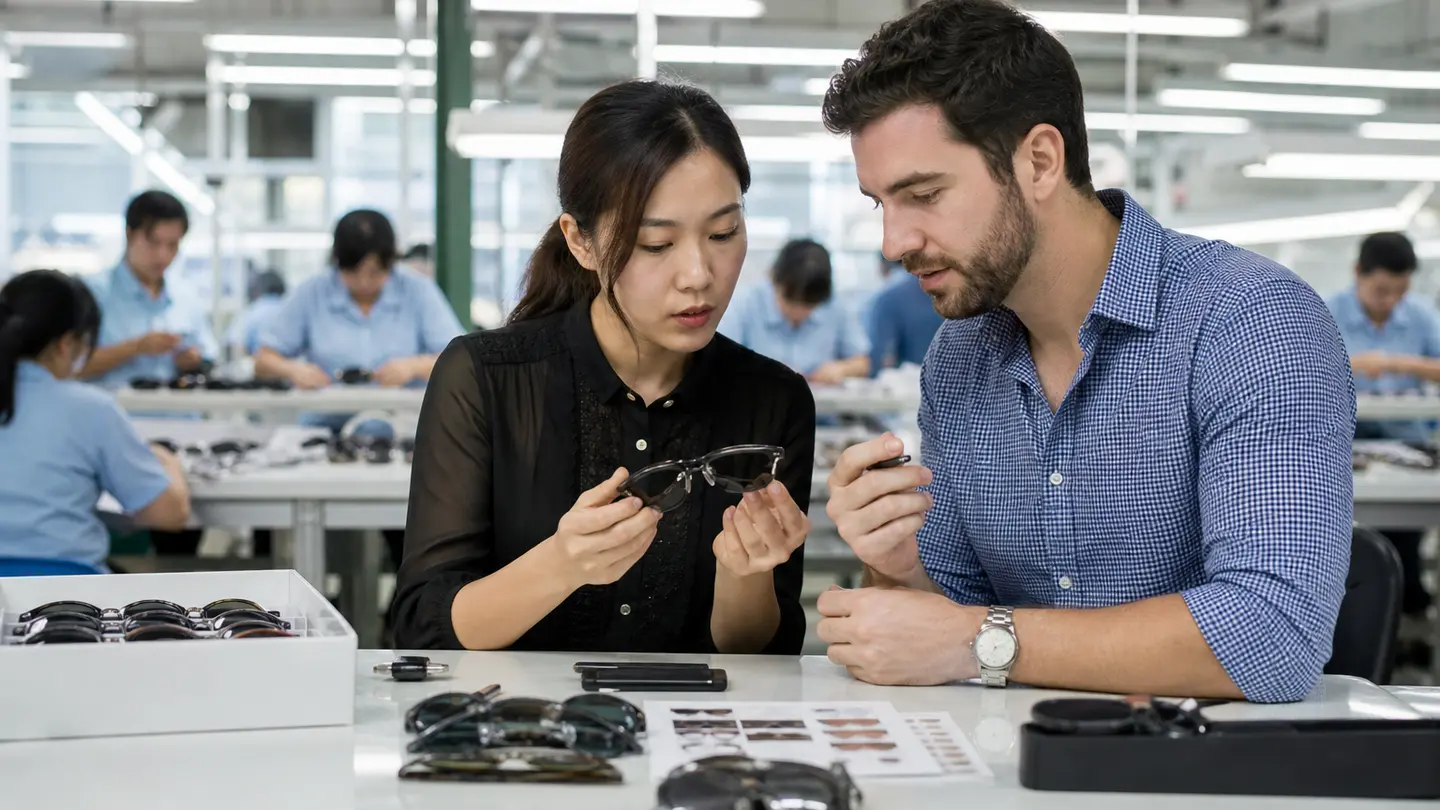
Development samples are necessary, but they are not always representative of mass production. Early sunglasses samples may be handmade or assembled using methods that differ from the final production line. A visually acceptable sample does not automatically prove that the factory can maintain the same finish over a large run.
The approved sample should define measurable and inspectable requirements. These may include:
- Hinge opening and closing performance
- Temple alignment and frame symmetry
- Surface polishing and absence of visible scratches
- Tint consistency between left and right lenses
- Tint consistency across production batches
- Lens seating and edge finishing
- Coating appearance and durability expectations
- Logo position, size, color, and adhesion
- Packaging presentation and accessory inclusion
After approval, retain a sealed and signed reference sample. Both the buyer and factory should keep one. This reference is useful when resolving disagreements about color, polish level, logo placement, or other appearance criteria during production and final inspection.
Your inspection instructions should also cover carton marks, barcode labels, packing quantities, inner-box configuration, assortment ratios, and shipping marks. These details are often overlooked during sample approval but can create warehouse and retail problems after delivery.
Third-party inspectors can compare finished goods against approved samples, written specifications, cartons, and supplier documentation. They can identify visible defects, packing discrepancies, or quantity issues. However, inspectors generally do not repeat laboratory testing during a standard pre-shipment inspection. If laboratory verification is required, it should be planned separately with appropriate samples and timing.
FAQ
Do Sunglasses Factories Usually Make Both Frames and Lenses?
Not necessarily. Many sunglasses factories specialize in frame molding, metalwork, assembly, branding, or packaging while sourcing lenses from separate lens producers. This is common in the eyewear supply chain and is not automatically a problem.
The key issue is traceability. Buyers should identify the actual lens manufacturer, understand whether the lens is produced specifically for the order, and confirm that any test report applies to the exact lens material, tint, coating, and construction used in production. A valid report for one lens should not be assumed to cover all lens options offered by the frame factory.
Does Polarization Also Mean the Lens Has UV Protection?
No. Polarization and ultraviolet filtering are separate lens characteristics.
A polarized lens is designed to reduce reflected glare from surfaces such as roads, water, snow, or vehicle hoods. UV protection concerns the lens’s ability to filter ultraviolet radiation. A lens may be polarized, UV protective, both, or neither, depending on its material and treatment.
If both properties are required, state both in the specification and request supporting test evidence for the actual lens configuration.
Should Buyers Rely on a Factory’s Brand-Client Claims?
Claims that a factory supplies established brands can be a useful initial screening signal, but they are not proof that the supplier is suitable for your order. Customer relationships may be confidential, reported product details may be incomplete, and a supplier’s work for one brand may involve a different frame type, lens source, quality level, or production process.
Evaluate the supplier based on your own product requirements. Review samples, confirm the production site, identify component sources, assess documentation, and test the buyer’s specified frame and lens configuration where necessary.
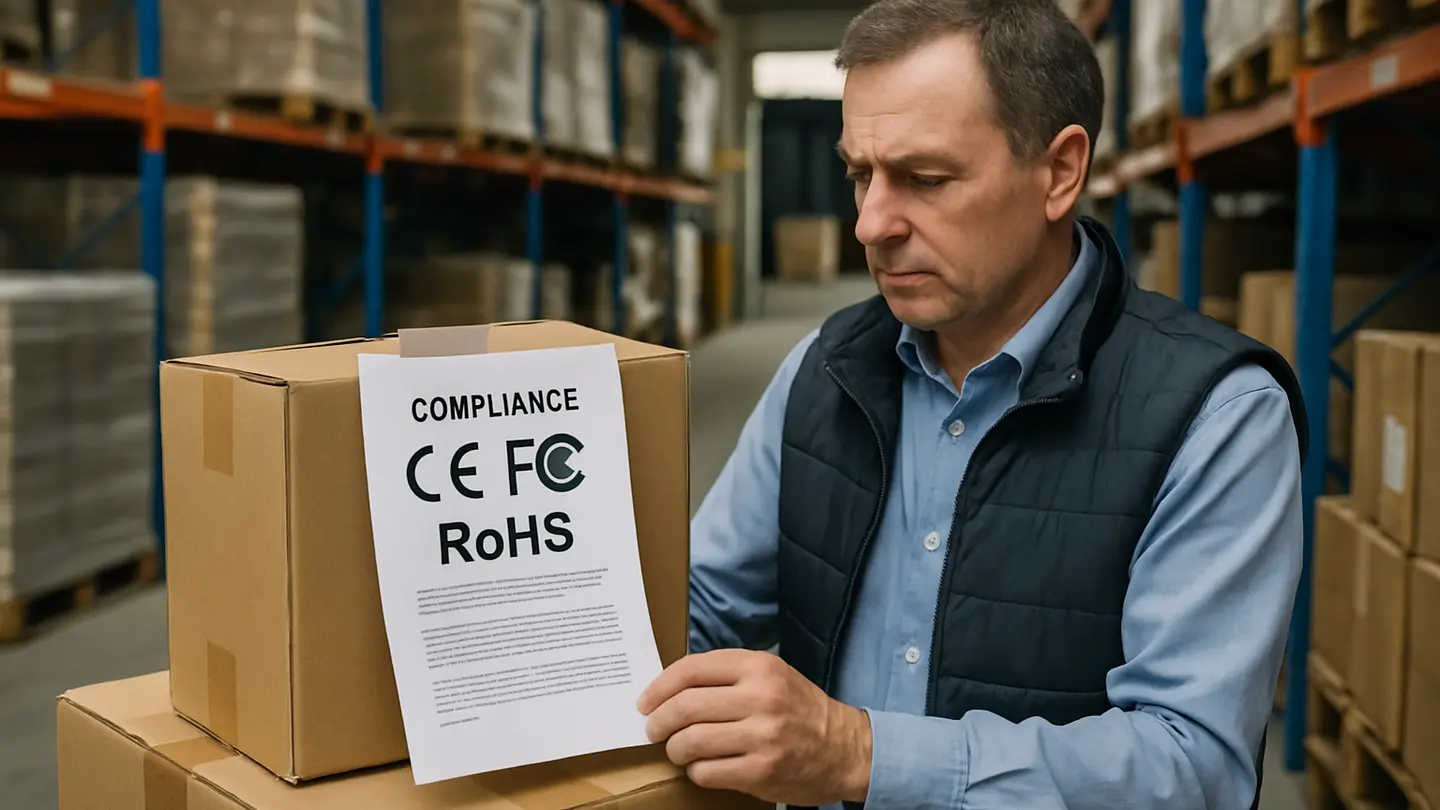
Who Is Responsible for CE Marking on Sunglasses?
Responsibility in the European Union depends on the economic operator arrangement and how the product is branded and placed on the market. A business selling sunglasses under its own name or trademark may be treated as the manufacturer for regulatory purposes, even when a separate factory physically produces the goods.
The responsible manufacturer must manage the relevant conformity documentation and product marking obligations. Buyers should clarify responsibilities with their supplier, importer, and regulatory advisers before sale rather than assuming the factory’s paperwork transfers all legal responsibility.
Final Checks Before Placing a Sunglasses Order
Frame design influences consumer appeal, comfort, and brand identity. Lens documentation and product compliance evidence support market access. Both need attention before a purchase order is issued.
Laboratory testing can support a product claim, but it does not by itself prove that every production shipment contains the same tested lens or material. Production controls, supplier transparency, reference samples, and pre-shipment checks are necessary to reduce substitution and consistency risks.
Before final payment or shipment release, compare finished sunglasses and cartons against the approved specification and signed reference sample. Check appearance, lens tint, polarization claims where relevant, logo placement, packaging components, carton marks, and packing quantities. Confirm that the documentation supplied corresponds to the product actually being shipped.
A structured verification process helps buyers select sunglasses manufacturers in China based on product fit, evidence, and repeatable quality controls—not on price alone.
Author Information
The author writes B2B sourcing and supplier-verification content for buyers managing private-label, OEM, and import procurement projects. The focus is on practical specification development, documentation review, production quality control, and supplier-risk reduction.