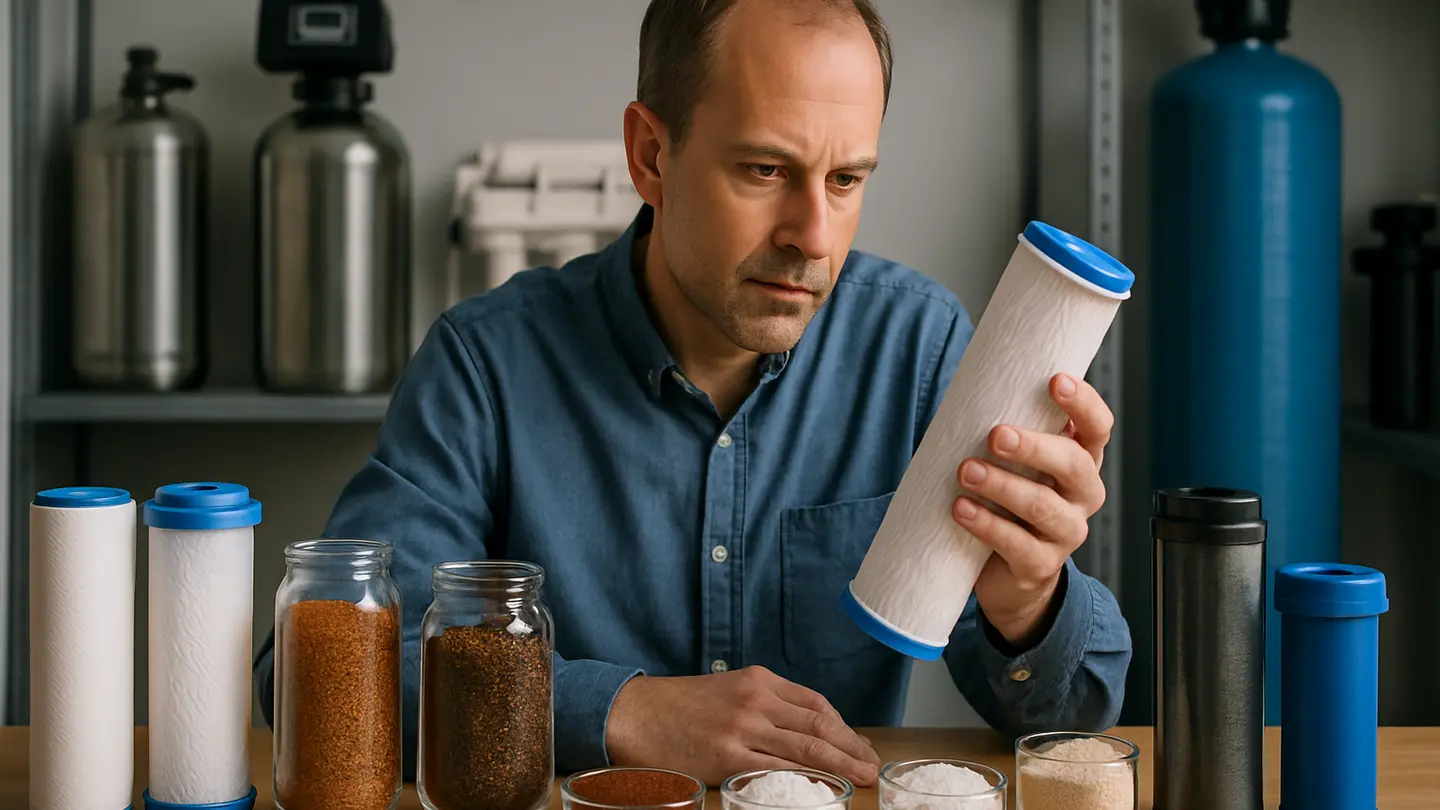
Water filter media are the working materials inside cartridges, inline housings, shower filters, pitchers, and treatment systems. Most products combine several media because no single material performs every function equally well. A shower filter may pair chlorine-reduction media with anti-scale strips and antibacterial ceramic balls, while a countertop cartridge may combine activated carbon with mineral media or specialty adsorbents.
For B2B buyers, the key is to match the media stack to the product promise. Some materials target residual chlorine, some adsorb odor-related compounds, some add minerals or adjust pH, and others support scale control or microbial-growth inhibition inside the cartridge. This guide reviews 22 common water filter materials from a procurement and product-development perspective.
Quick Reference: 22 Common Water Filter Media
| # | Filter material | Typical appearance / size | Main intended function |
|---|---|---|---|
| 1 | KDF copper-zinc media | Golden irregular granules | Chlorine and certain heavy-metal reduction; redox activity |
| 2 | Calcium sulfite balls | Small white spheres | Fast residual chlorine reduction, often in shower filters |
| 3 | Chloroba residual-chlorine media | Small white strips | Residual chlorine reduction; odor and taste improvement claims |
| 4 | ZMC composite balls | Gray spherical media | Chlorine reduction and claimed dissolved heavy-metal ion reduction |
| 5 | Coconut shell activated carbon | Black granules or pellets | Adsorption of organic chemicals and odor-causing compounds |
| 6 | Red mineralized balls | Red 3–5 mm spheres | Impurity adsorption and claimed mineral release |
| 7 | White mineralized balls | White 3–5 mm spheres | Impurity adsorption and skin-care-oriented mineral claims |
| 8 | Far-infrared mineralized spheres | Red 3–5 mm spheres | Adsorption plus far-infrared “water energizing” claims |
| 9 | Vitamin C balls | Beige 3–5 mm spheres | Gradual Vitamin C release; shower enhancement positioning |
| 10 | Vitamin E balls | Beige 3–5 mm spheres | Intended Vitamin E release for skin-friendly positioning |
| 11 | Alkaline spheres | Mineral spheres | pH increase, typically positioned around pH 8.0–9.5 water |
| 12 | Medical stone balls | Mineral spheres | Trace mineral release; mild pH increase claims |
| 13 | Selenium-enriched balls | Spherical mineral media | Targeted selenium enrichment |
| 14 | Anion spheres | Tourmaline-based spheres | Negative ion claims; possible mineral and dissolved oxygen increase |
| 15 | Magnetic energy balls | Spheres with magnetic material | Magnetic-field exposure and “smaller water cluster” claims |
| 16 | Blue antibacterial balls | Blue 3–4 mm spheres | Microorganism inhibition inside filter products |
| 17 | Black antibacterial balls | Black 3–5 mm spheres | Microbe and bacteria inhibition claims |
| 18 | Silver ion antibacterial spheres | Ceramic spheres with silver particles | Antimicrobial support through silver ion activity |
| 19 | Anti-scale strips | White 1–4 mm strips | Slowing limescale formation |
| 20 | Polyphosphate crystals | Semi-transparent 1.5–6 mm granules | Scale inhibition through calcium/magnesium sequestration |
| 21 | Fluoride remover balls | Spherical adsorptive media | Targeted fluoride ion adsorption |
| 22 | Hair-care or hair-growth filter balls | Specialized spheres | Scalp-care positioning and chlorine-related hair damage claims |
Use this table as a screening tool, not a substitute for specification review. Before ordering at scale, confirm media composition, particle size distribution, flow-rate compatibility, packing method, leaching data, service life, and test reports supporting the intended claims.
Media for Chlorine and Heavy Metal Reduction
Residual chlorine is a frequent user-experience concern in municipal water, especially in shower products where odor, skin feel, and hair-care positioning matter. Heavy-metal reduction is more safety-sensitive and should be supported by defined influent levels, test standards, and performance data.
KDF Copper-Zinc Media
KDF media is a copper-zinc alloy supplied as golden, irregular granules. It works through oxidation-reduction reactions, or redox activity, in which electrons are transferred between the media surface and substances in water.
Specifications commonly associate KDF with reduction of chlorine, iron, lead, and certain heavy metals. It may also help limit microbial growth within filter systems. Buyers should confirm alloy grade, granule size, flow resistance, and performance at the expected temperature and pressure.
Calcium Sulfite Balls
Calcium sulfite balls are small white spheres used for rapid residual chlorine reduction. They are especially relevant in shower cartridges because flow rates can be high and contact time limited.
Buyers often evaluate calcium sulfite for claimed suitability in both hot and cold water. Ask suppliers for chlorine-reduction curves at realistic flow rates rather than relying only on static laboratory claims.
Chloroba Residual-Chlorine Media
Chloroba is presented as a residual-chlorine reduction medium, usually in small white strip form. The format may increase contact surface area compared with larger compact pieces.
The intended benefit is improved taste and odor, although shower applications may focus more on odor and skin feel. Buyers should clarify composition, whether the material is for drinking-water contact or shower-only use, and how it performs after prolonged wet storage.
ZMC Composite Balls
ZMC balls are gray spherical composite media used for chlorine reduction and claimed reduction of dissolved heavy-metal ions. They are often positioned for tap-water products that want broader filtration language than chlorine reduction alone.
Because ZMC is composite, documentation matters. Ask what active ingredients are present, whether any components dissolve into water, and which heavy metals were tested. Convert broad “heavy-metal removal” language into specific claims for target ions such as lead, copper, cadmium, or mercury.
Adsorption and General Impurity Removal Media
Adsorption-based filtration relies on impurities attaching to media surfaces. Porous materials can hold odor-related compounds, organic chemicals, color bodies, and some suspended or dissolved impurities depending on pore structure and chemistry.
Coconut Shell Activated Carbon
Coconut shell activated carbon is one of the most widely used water filter materials. Activation creates a porous structure with high internal surface area, allowing adsorption of many organic chemicals, chlorine-related compounds, and odor-causing substances.
In drinking-water and beverage applications, it is strongly associated with taste and smell improvement. In shower products, buyers should check suitability for hot water, target flow rate, and microbial control. Common formats include granules, pellets, blocks, and blended cartridge layers.
Red Mineralized Balls
Red mineralized balls are typically 3–5 mm spherical media with a microporous structure. They are used for general impurity adsorption and are also claimed to release beneficial minerals.
Some suppliers position them as increasing dissolved oxygen. Treat such claims as positioning unless supported by repeatable tests. In sourcing, check color stability, dust generation, hardness, and whether the pigment or mineral composition meets destination-market safety requirements.
White Mineralized Balls
White mineralized balls are commonly supplied as 3–5 mm spheres. Like red mineralized balls, they are described as microporous media for adsorbing impurities, but their positioning often emphasizes beauty, skin care, or shower-water enhancement.
Suppliers may claim mineral release during showering. Buyers should avoid medical or therapeutic wording unless legally supportable, and should verify mineral release rate, durability, and compatibility with other cartridge layers.
Far-Infrared Mineralized Spheres
Far-infrared mineralized spheres are red 3–5 mm media that combine impurity adsorption claims with far-infrared emission claims. Suppliers may describe them as “energizing” water or improving water characteristics.
These claims need caution. Buyers should ask not only whether the media can be manufactured consistently, but whether consumer-facing language can be substantiated. For regulated markets, request test methods, emission data, and legal review before using wellness-oriented claims.
Water Enrichment and Enhancement Media
Some media are designed less for contaminant removal and more for changing perceived water characteristics. They may add minerals, vitamins, ions, alkalinity, or other enhancement features. These media can differentiate shower filters and wellness cartridges, but they require claim discipline and material-safety documentation.
Vitamin C Balls
Vitamin C balls are beige 3–5 mm spheres infused with Vitamin C. As water flows over the media, the Vitamin C is intended to release gradually.
In shower products, Vitamin C media is often positioned around antioxidant-related benefits and chlorine reduction support. Buyers should verify active content, dissolution rate, shelf life, and hot-water performance. Packaging should distinguish ingredient presence from proven user outcomes.
Vitamin E Balls
Vitamin E balls are beige 3–5 mm spheres infused with Vitamin E. Their intended function is to release Vitamin E into water for skin-friendly shower positioning.
Because Vitamin E is oil-soluble, buyers should ask how it is incorporated and how release is measured. Also check whether the balls leave residue, affect cartridge odor, or change during humid storage.
Alkaline Spheres
Alkaline spheres use mineral blends that release alkaline compounds when in contact with water. They are marketed as producing weakly alkaline water, often around pH 8.0 to 9.5.
Performance depends on local source water. The same media may produce different results depending on alkalinity, hardness, flow rate, and contact time. Buyers should confirm whether the alkaline effect remains stable throughout the claimed cartridge life.
Medical Stone Balls
Medical stone balls are associated with Maifan stone, a mineral material used in water-enhancement products. They are claimed to release trace elements and minerals such as calcium, iron, zinc, and selenium.
They may also gently increase pH. Key sourcing checks include mineral composition, batch consistency, heavy-metal leaching data, and whether the term “medical” is appropriate in the sales market. “Maifan stone mineral balls” may be safer wording.
Selenium-Enriched Balls
Selenium-enriched balls are designed to add selenium to water. Selenium is an essential trace mineral, and suppliers often connect it with antioxidant functions.
This is targeted enrichment rather than general filtration. Buyers should verify selenium release levels and ensure they remain within applicable safety limits. Nutrition or health-related marketing language needs careful review, especially for drinking-water products.
Anion Spheres
Anion spheres are typically described as tourmaline-based mineral media. Suppliers claim they release negative ions into water and may slightly increase mineral content and dissolved oxygen.
Some descriptions also refer to smaller water clusters. Treat this as a claim requiring verification. In a B2B specification, it is more practical to document composition, particle size, water-contact safety, and measurable changes in pH, conductivity, or dissolved oxygen.
Magnetic Energy Balls
Magnetic energy balls contain permanent magnetic materials that expose flowing water to a magnetic field. Supplier claims may include smaller water molecule clusters, improved solvency, or cellular absorption support.
Do not accept these claims at face value for consumer marketing. More concrete procurement points include magnetic strength, corrosion resistance, coating integrity, and cartridge compatibility. If magnetic effects are part of the selling proposition, request evidence under final-product flow conditions.
Antibacterial and Disinfection-Support Media
Antibacterial media help manage microbial growth within filtration systems. They should not be described as making water sterile unless supported by appropriate testing and regulatory clearance. In shower cartridges and multi-stage filters, they can support internal hygiene during use.
Blue Antibacterial Balls
Blue antibacterial balls are usually 3–4 mm spherical media intended to inhibit microorganisms and suppress bacterial growth inside the filter product.
Their role is supportive, not a complete disinfection system. Buyers should ask which microorganisms were tested, under what conditions, and whether the antibacterial component can leach into water.
Black Antibacterial Balls
Black antibacterial balls are typically 3–5 mm spheres designed to inhibit microbes and bacteria. Their function is similar to blue antibacterial balls: supporting hygienic operation of the filtration system.
Color alone is not a performance indicator. The active ingredient, carrier material, release behavior, and test data matter most. Buyers comparing blue and black versions should request equivalent documentation.
Silver Ion Antibacterial Spheres
Silver ion antibacterial spheres are ceramic media containing silver particles or silver-based active components. Silver ions are widely used in antimicrobial applications and are claimed to disrupt bacterial cellular processes.
Suppliers may describe silver ion media as long-lasting. Buyers should verify performance over the claimed service life, including after repeated water exposure. Also confirm silver release levels, destination-market limits, and whether claims trigger antimicrobial regulatory requirements.
Scale-Prevention and Water-Softening Media
Hard water contains calcium and magnesium minerals that can form limescale. In shower products, scale can affect spray nozzles, cartridges, fixtures, and user perception. Scale-prevention media usually reduce precipitation or crystallization rather than remove hardness completely.
Anti-Scale Strips
Anti-scale strips are white, strip-shaped media commonly described in the 1–4 mm size range. They are designed to slow limescale formation by targeting calcium and magnesium carbonate crystallization.
In shower filters, these strips may help protect showerheads, pipes, and appliances from visible scale. Buyers should clarify whether the mechanism is chemical release, surface interaction, or something else. Service life should be tested under representative hardness and temperature conditions.
Polyphosphate Crystals
Polyphosphate crystals are semi-transparent granules, often supplied in the 1.5–6 mm range. They inhibit scale through sequestration, binding calcium and magnesium ions so they are less likely to form hard deposits.
Polyphosphate is widely used for scale control, but dosage matters. Too little may not work; too much may create compliance or taste concerns in drinking-water uses. For shower applications, confirm dissolution rate, temperature stability, and compatibility with other media.
Specialty Media for Targeted Filtration Needs
Specialty media address narrower requirements, such as fluoride reduction or hair-care-oriented enhancement. They can support a defined target market, but should not be added casually. The more specific the claim, the more important validation becomes.
Fluoride Remover Balls
Fluoride remover balls are designed to adsorb fluoride ions. Activated alumina is one possible composition used for fluoride adsorption, although actual formulas vary by supplier.
This medium is relevant where fluoride levels are a specific concern. Buyers should request influent and effluent test data, capacity information, pH sensitivity, and replacement guidance. Fluoride reduction should be treated as a targeted filtration claim, not a general wellness statement.
Hair-Care or Hair-Growth Filter Balls
Hair-care or hair-growth filter balls are specialized media. Suppliers may claim they release scalp-benefiting substances, support scalp nourishment, or reduce chlorine-associated hair damage.
Review these claims before using them on packaging, listings, or distributor materials. A safer B2B approach is to define the measurable function: chlorine reduction, mineral release, or ingredient delivery. If “hair growth” language is used, obtain strong substantiation and check market-specific advertising rules.
Another Way to Build a China Supplier Shortlist
After defining the media mix, cartridge structure, flow rate, and allowable claims, buyers need suppliers that can manufacture consistently. Made-in-China.com is one B2B sourcing platform for early-stage supplier search.
Supplier Discovery can help buyers find and narrow potential suppliers, including through Audited Supplier and regional supplier channels. Audited Suppliers are subject to third-party verification and on-site audit, with Audit Reports available for review. These reports can include company details, export trade, manufacturing capacity, quality control, and R&D capability.
For buyers comparing filter media suppliers, Easy Sourcing can reduce manual outreach. A buyer can submit one sourcing request, receive multiple quotations from matched suppliers, compare quotes, and request samples. That process does not replace technical due diligence, but it can help procurement teams move from a media specification to a practical supplier shortlist more efficiently.